Editorial notice: Reviewed for underwriting accuracy by the RJI Institutional Review Team | Published: June 2026 | Last reviewed: June 2026
—————————————————————————————————————————
Executive Summary
If you operate a roofing business or work as an independent contractor, you already know the pain: your insurance premiums are likely one of your largest operational expenses. You find yourself asking: “Why is roofing insurance so expensive compared to other construction trades? I have a great crew, we use harnesses, and we haven’t had an incident in years.”
To the person on the roof, it feels like an unfair penalty. But if you want to understand why is roofing insurance so expensive, you have to recognize that insurers aren’t looking at your day-to-day successes, they are pricing your policy based on a highly specific, mathematical model of worst-case scenarios. If you want to understand the overarching mechanics of how carriers view your industry, you have to understand how insurers model catastrophic roofing exposure, long-term disability severity, and operational risk stacking.
Roofing does not exist in an underwriting vacuum. Insurers compare roofing exposure against dozens of other construction occupations when determining classification tiers, pricing, eligibility, and carrier appetite. For a broader explanation of how insurance companies evaluate the construction workforce as a whole, see Construction Workers Insurance.
When Occupational Classification and Insurance Classification Diverge
Before an underwriter ever runs a mathematical risk model, the insurance system must translate a real-world roofing operation into standardized underwriting and occupational classification categories. This is often the stage where underwriting eligibility, pricing tier, and carrier appetite begin to materially change.
To the system, a “roofer” isn’t just someone who installs shingles. Carriers rely heavily on standardized classification systems, such as the 2018 Standard Occupational Classification (SOC) or Workers’ Compensation class codes, to cross-verify that the business activities match the risk profile being submitted. If the operational reality doesn’t align perfectly with the code, the system flags the file, or worse, defaults to the highest possible risk tier.
The distinction becomes important because occupational classifications and underwriting classifications are not always identical. For example, the 2018 Standard Occupational Classification (SOC) system groups residential roofers, industrial roofers, hot-tar roofers, metal roofers, and several other roofing specializations under occupation code 47-2181 (Roofers). Insurers, however, frequently apply additional underwriting distinctions based on working height, roofing material, project type, payroll allocation, and catastrophic loss exposure. A worker may fit neatly into one occupational category while simultaneously triggering a much higher underwriting tier.
This disconnect between occupational identity and insurance classification sits at the center of many pricing disputes, coverage restrictions, and underwriting decisions. Occupational Class Ratings explains how insurers assign risk tiers to hazardous occupations and why similar jobs can receive very different insurance treatment.
       [ Real-World Activity ]
       e.g., 90% Residential Shingles, 10% Low-Slope Commercial Repairs
                                  ↓
      [ The Classification Filter ]
      System checks NCCI Codes (5551 vs. 5552) / 2018 SOC (47-2181.00)
                                  ↓
     -----------------------------------------------------
     |                                                   |
     ↓                                                   ↓
[Clean Validation]                                [The Code Trap]
Activity matches code. Moves                      Mismatched or unverified data.
to standard underwriting.                         Defaults to the highest risk rate.
The Three Critical Verification Gates for Roofers
When verifying eligibility, automated carrier triage systems and underwriters look at three specific compliance gates:
-
The Height Threshold: The structural dividing line in roofing underwriting is often 3 stories or greater. If a business is classified under standard residential roofing, but a single historical project or equipment listing reveals work at 4 stories, the classification fails validation.
-
The Commercial vs. Residential Split: Underwriting software cross-references payroll data against standard occupational classifications. Commercial roofing (flat/low-slope hot tar or TPO) requires entirely different risk coding than residential steep-slope shingle work. A blended payroll that isn’t clearly separated will cause the carrier to classify 100% of the payroll at the higher-rated commercial exposure. This becomes especially important during Workers’ Compensation payroll audits, where blended or improperly separated payroll classifications frequently trigger retroactive premium increases.
Repeated classification mismatches and severe claim history can also negatively affect future Experience Modification Rate (E-Mod) calculations, increasing long-term Workers’ Compensation costs across multiple policy periods. NCCI Occupational Classification and EMR Systems explains how payroll classifications, audit outcomes, and claim experience influence long-term Workers’ Compensation pricing. -
The Subcontractor Loophole: If a roofing contractor relies on 1099 independent contractors, the system validates whether those subs carry their own general liability insurance with equal limits. If they lack verified certificates of insurance (COIs), the system automatically reclassifies those independent workers as direct employees, instantly triggering a massive premium audit bill.
The System Trap: A roofer might accurately describe their business as “90% single-family residential.” However, if underwriting review or a post-loss investigation discovers project photos showing four-story commercial roofing exposure, the carrier may flag a material classification mismatch and re-evaluate the account under higher-risk surplus-lines standards.
Roofing Contractor Insurance Underwriting explains how carriers use classification validation, height thresholds, payroll separation, subcontractor verification, and carrier appetite rules to determine whether a roofing account qualifies for standard-market coverage or must be placed in specialty markets.
Why Insurers Model Roofing Risk as Severe Exposure
When an actuary sets roofing rates, they use a core principle: As working height increases, the risk profile shifts from Frequency to Severity.
To see how actuaries map this baseline hazard across all elevated trades, see Height Exposure Underwriting: How Insurers Evaluate Elevated Workers.
          [ OTHER TRADES ]                  [ ROOFING TRADES ]
      High Frequency / Low Severity     Low Frequency / High Severity
   ┌───────────────────────────────┐   ┌───────────────────────────────┐
   │ Minor claims (cuts, scrapes)  │   │ Rare incidents, but a single  │
   │ are predictable and cheap.    │   │ fall can exceed $1,000,000+.  │
   └───────────────────────────────┘   └───────────────────────────────┘
Insurers don’t worry about small injuries; they worry about catastrophic loss potential. A warehouse worker might experience minor strains frequently. A roofer, however, may go years without a single incident, but when an accident does occur, the probability of permanent disability, traumatic brain injury (TBI), or spinal paralysis is extraordinarily high.
Data from the Bureau of Labor Statistics (BLS) consistently shows that roofing has one of the highest fatal injury rates among all construction occupations. Because a single multi-year disability claim can easily top $1M in payouts, underwriters price your premium primarily on that massive financial exposure. This underlying calculation is broken down further in Catastrophic Fall Risk in Occupational Insurance.
What Multiplies or Lowers Your Premium
Your premium isn’t a fixed penalty; it moves dynamically based on how your daily job site operations stack up in an underwriter’s risk profile. When tracking exactly why is roofing insurance so expensive, you’ll find that your baseline premium changes based on specific occupational hazards. It answers the fundamental question facing every contractor: Why Elevated Workers Pay More for Insurance.
The Premium Multipliers (Exposure Stacking)
-
The Pitch and the Height: Risk doesn’t scale evenly. Moving from a single-story residential build to a steep-slope residential or multi-story commercial structure moves your business into a fundamentally harsher classification tier. Material type also changes underwriting severity. Torch-down roofing introduces open-flame fire exposure, while metal and brittle roofing systems increase slip and fall-through risk during wet or unstable conditions.
-
The Subcontractor Trap: If you hire independent subcontractors and fail to collect valid Certificates of Insurance (COIs) with explicit Waiver of Subrogation clauses, your carrier’s annual audit will treat those subs as your employees, instantly driving up your premium.
-
Delayed Rescue Accessibility: Operating on remote industrial sites or high-rise structures far from trauma centers increases underwriting scrutiny. Delayed emergency response means injuries take longer to stabilize, which expands claim severity. This operational bottleneck is heavily evaluated in Rescue Difficulty in High-Elevation Underwriting.
The Premium Reducers (Loss Control)
-
The Experience Modification Rate (E-Mod): Your E-Mod is your safety report card. Maintain a clean loss history, and your Mod can drop to 0.85, earning you an automatic 15% discount on Workers’ Comp. Let safety slide, and a 1.5 Mod will hit you with a 50% penalty.
-
Deploying Tech Tiers: Carriers are actively looking for “Preferred” risks. Utilizing drones for aerial roof measurements (which minimizes human foot traffic on slopes) or safety training software can unlock discretionary underwriting credits.
Where Claims and Eligibility Break
Many contractors don’t realize their coverage is broken until they try to file a claim. Underwriters build specific “breakpoints” into policies where your eligibility can suddenly collapse.
- The Latent Water Damage Trap: Roofs protect everything beneath them. A minor structural defect or poorly sealed seam can allow slow water ingress that goes unnoticed for months. When the interior ceiling finally collapses, destroying commercial inventory or causing toxic mold, the trailing general liability claim can be financially staggering.
Many of the most expensive roofing losses involve completed-operations liability, water intrusion disputes, and third-party property damage allegations. General Liability Roofing Insurance explains how insurers evaluate these exposures and where coverage limitations commonly appear. -
The Misclassification Denial: If your application states you handle 100% residential asphalt roofing, but a worker falls while installing a commercial TPO flat-roof system, the carrier will launch an immediate misclassification investigation. This can lead to delayed payouts, structural claim disputes, or total policy rescission (cancellation) for material misrepresentation. After catastrophic roofing accidents, carriers often conduct post-loss underwriting investigations, reviewing payroll records, subcontract agreements, disclosed working heights, OSHA history, and project classifications to determine whether actual operations matched the original application.
Once a severe roofing accident occurs, carriers often move beyond the initial loss report and begin a formal underwriting and claim investigation process. Commercial Roofing Insurance Claims Process explains how insurers review classifications, payroll records, subcontractor relationships, OSHA history, and coverage disclosures after a major loss. -
The Height Restriction Clause: Look closely at the exclusions page of your General Liability or Disability policy. Many standard-market policies include a hard cap (e.g., “No coverage for work performed above 3 stories”). Crossing that threshold completely voids your insurance safety net, as explained in Height Restrictions in Occupational Insurance Policies.
-
The Repeated OSHA Paper Trail: Underwriters regularly check the public enforcement database managed by the Occupational Safety and Health Administration (OSHA). A history of repeated citations for harness noncompliance or faulty ladder access signals a broken safety culture, marking your business as “ununderwritable” for standard carriers. You can track this direct relationship in OSHA Fall Violations and Insurance Costs.
How Different Policies Evaluate Roofers
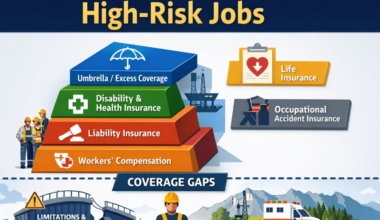
Roofing risk doesn’t just impact one line of coverage. Multiple insurance systems evaluate your daily work through completely different lenses.
| Insurance Line | What the System Evaluates | The Critical Underwriting Fine Print |
| Workers’ Compensation | Fall exposure, overall injury frequency, employer safety history, OSHA violations, and severity trends. | Roofing payroll classifications naturally receive elevated base rates due to high baseline exposure. |
| Disability Insurance | Whether an injured worker can realistically return to physically demanding elevated physical labor after serious injuries. | “Own-Occupation” vs. “Any-Occupation”: An “Own-Occ” policy pays out if you can no longer roof. An “Any-Occ” policy can deny benefits if you can work a desk job. This dynamic is mapped in Fall Severity Modeling in Disability Insurance. |
| Occupational Accident Insurance | Used primarily by independent contractors and subcontract roofers instead of traditional Workers’ Comp. | These policies regularly include much stricter exclusions, lower maximum benefit limits, and strict height restrictions. |
| Life Insurance | Absolute fatality risk metrics based on historical occupational death rates. | Insurers frequently apply occupational “flat extras” (additional fees per $1,000 of coverage), higher premiums, or reduced eligibility. |
| Accidental Death & Dismemberment (AD&D) | Sudden loss of life, severe amputation risks, and catastrophic fall probability. | Roofing routinely triggers structural coverage limitations and underwriting restrictions depending on the average job site height. |
| Employer Liability Insurance | The business owner’s direct exposure to employee safety lawsuits that fall outside standard Workers’ Comp statutory protections. | Premiums spike based on historical worker injury claims, third-party injuries, property damage claims, and safety litigation. |
| General Liability | Third-party bodily injury and property damage (e.g., roof leaks during an open storm or open-flame torch hazards). | Often contains strict exclusions regarding water damage limits and subcontracted exposure limits. |
Why Carriers Restrict Roofing
Because the roofing severity model is so volatile, standard insurance carriers have a very low appetite for this trade. A single bad year of catastrophic falls can erase millions in carrier profit, which heavily influences why is roofing insurance so expensive across the country. If an injury permanently removes a skilled tradesperson from the labor market, insurers face lifetime indemnity payments, which is why actuaries focus heavily on Permanent Disability Risk from Elevated Work.
Compounding the baseline physical risk, the insurance industry is currently reacting to macroeconomic and environmental pressures:
-
The Climate & Catastrophe Squeeze: An unprecedented uptick in regional severe weather events, like severe hailstorms, historic windstorms, and hurricanes, means property insurance carriers are shelling out massive, record-breaking payouts. To protect their balance sheets, insurers are increasing baseline premium costs across the board for construction trades.
-
Severe Material and Labor Inflation: Rampant global inflation has drastically driven up the costs of commercial building materials (like single-ply membranes and metal coping) along with specialized roofing labor. Because it costs carriers significantly more money to repair or replace a botched installation today than it did just a few years ago, underwriting standards have tightened drastically.
-
Admitted vs. Surplus Lines: Many standard (admitted) carriers refuse to write roofing entirely. This forces contractors into the Surplus Lines or Specialty Risk markets, where policies are non-negotiable, premiums are significantly higher, and coverages are heavily restricted.
-
Reduced Benefit Periods: Disability carriers writing policies for roofers frequently cap the payout window (e.g., maximum 2 or 5 years of benefits) rather than paying out until retirement age, specifically to limit their long-term financial exposure to severe spinal injuries.
Practical Eligibility Improvements
Roofing contractors cannot eliminate underwriting concern, but they can improve how carriers classify and price their operations.
The biggest underwriting improvements include:
- maintaining a low OSHA violation history,
- improving Experience Modification Rate (E-Mod) performance,
- documenting fall-protection systems,
- collecting valid Certificates of Insurance (COIs) from subcontractors,
- and reducing elevated exposure during inspections through drone-assisted workflows.
For a detailed breakdown of the regulatory controls that insurers often evaluate during roofing underwriting reviews, see OSHA Fall Protection Standards for High-Risk Work.
Insurers also respond more favorably to contractors who accurately disclose:
- working height,
- commercial vs. residential exposure,
- subcontractor usage,
- and industrial roofing operations.
These operational controls directly influence how carriers evaluate catastrophic fall exposure, occupational classification severity, and long-term claim probability.
The underwriting goal is not to make roofing “safe.” It is to move a contractor out of the highest catastrophic-severity tier and into a more controllable risk classification.
Many of these underwriting controls directly connect to broader occupational classification and claim-denial systems, as explained in Occupational Hazard Classification in Insurance and Common Reasons Claims Are Denied for Risk Jobs.
Frequently Asked Questions
Why do I pay a “flat extra” or higher premium for life or disability insurance?
Insurers price roofing occupations based largely on severity risk rather than simple claim frequency. Because a single roofing fall can result in catastrophic injuries, permanent disability, or long-term income replacement claims, insurers often apply higher premiums or occupational “flat extra” charges compared to lower-risk construction trades.
Does my working height really change my insurance eligibility?
Yes. Many insurers apply internal “Height Check” underwriting thresholds when evaluating roofing occupations. Working above certain elevations, such as multi-story residential roofs, steep-slope projects, or high-rise commercial structures, can move a worker from a standard classification into a substandard or declined underwriting tier because catastrophic fall severity increases significantly with height.
How do past OSHA violations affect my current premiums?
Insurers often interpret repeated OSHA fall-protection violations as indicators of elevated future claim probability. A poor safety history may result in higher premiums, stricter underwriting reviews, occupational class downgrades, coverage restrictions, or reduced carrier availability for roofing businesses and workers.
What happens if I’m injured while doing commercial work, but my policy only covers residential roofing?
This may be treated as occupational misclassification during the claim investigation process. If insurers determine that commercial roofing exposure was undisclosed during underwriting, it can trigger claim disputes, benefit reductions, policy rescission reviews, or denial investigations, depending on policy terms and underwriting disclosures.
Key Takeaways
- Roofers face strict underwriting because roofing combines elevated work, severe injury potential, rescue difficulty, and disability exposure.
- Roofing combines multiple underwriting systems simultaneously, increasing overall claim severity.
- As working height increases, underwriting concern shifts toward catastrophic injury exposure.
- Severe roofing falls can generate long-term disability and income replacement claims.
- Roofing workers often pay higher premiums because insurers price based on potential claim severity.
- Disability insurers closely evaluate whether injured roofers can realistically return to elevated physical work.
- OSHA violations and poor safety history increase underwriting concern significantly.
- Roofing claims often receive heavy investigation because catastrophic losses create major insurer exposure.
- Accurate occupational disclosure is critical for reducing claim disputes and underwriting problems.
—————————————————————————————————————————
Institutional & Underwriting References
Bureau of Labor Statistics (BLS)
National Census of Fatal Occupational Injuries (CFOI) — Used to evaluate occupational fatality trends, elevated-work injury severity patterns, and roofing-related fatal incident frequency across construction classifications.
https://www.bls.gov/iif/
Occupational Safety and Health Administration (OSHA)
Construction Industry Fall Protection Standards (29 CFR 1926 Subpart M) — Referenced for regulatory fall-protection requirements, ladder-access standards, harness compliance systems, and elevated-work safety enforcement trends impacting roofing underwriting.
https://www.osha.gov/fall-protection
National Institute for Occupational Safety and Health (NIOSH)
Fall Prevention Campaigns & Construction Fall Research — Used to evaluate catastrophic fall exposure, rescue-delay implications, elevated-work injury mechanisms, and long-term disability severity associated with roofing occupations.
https://www.cdc.gov/niosh/topics/falls/
National Council on Compensation Insurance (NCCI)
Workers’ Compensation Classification Inspection & Class Code System — Referenced for roofing payroll classification structures, commercial vs. residential roofing exposure separation, subcontractor audit treatment, Experience Modification Rate (E-Mod) calculations, and Workers’ Compensation pricing logic for elevated-risk construction operations.
https://www.ncci.com/
U.S. Bureau of Labor Statistics — Standard Occupational Classification (SOC) System
2018 Standard Occupational Classification (SOC) System — Referenced for occupational classification validation, roofing trade categorization, underwriting exposure verification, payroll classification alignment, and occupational risk identification used during carrier underwriting review and audit analysis.
https://www.bls.gov/soc/2018/
Reviewed for Underwriting Accuracy
This article was reviewed for underwriting accuracy involving:
- Roofing occupational classification severity
- Elevated-work exposure analysis
- Catastrophic fall severity modeling
- Workers’ compensation pricing structures
- Experience Modification Rate (E-Mod) interpretation
- Rescue-complexity underwriting factors
- Roofing liability exposure systems
- Occupational misclassification failure paths
- Disability claim-duration modeling
- Specialty-market and surplus-lines underwriting behavior