Editorial Notice: Reviewed for underwriting accuracy by the RJI Institutional Review Team | Published: March, 2026 | Updated: June, 2026.
————————————————————————————————————–
Executive Summary
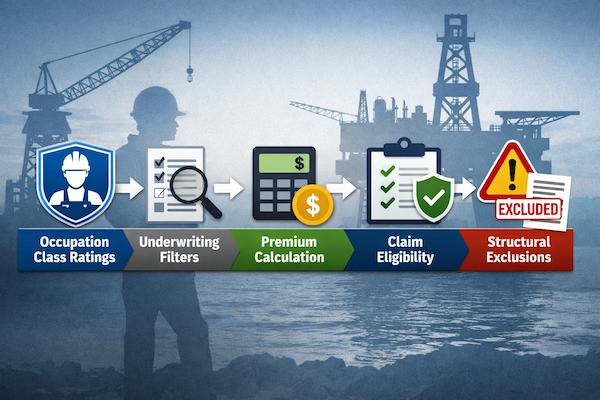
Occupational class ratings serve as the primary underwriting mechanism used by private insurance carriers to translate physical real-world hazards into mathematically standardized risk tiers. These alphanumeric designations dictate policy approval probabilities, premium multipliers, and contractual boundaries before an individual application ever undergoes standard medical or financial review.
While public safety regulatory agencies evaluate industrial workplaces broadly, private insurance underwriting requires a hyper-granular conversion of an applicant’s daily task profile into rigid actuarial bands. This document analyzes the structural classification logic, database crosswalks, mathematical multipliers, and operational controls that govern private occupational risk evaluation within high-hazard trades.
What Are Occupational Class Ratings?
An Occupation Class Rating is an alphanumeric or numerical actuarial designation used by insurers to represent the statistical loss volatility and long-duration claim probability of a specific occupation. Carriers often use systems such as 5A, 4A, 3A, A, or B, while others use numerical classes or proprietary rating structures. The relative ordering of these classes varies by insurer. Unlike generic industry labels, this rating functions as a specialized data filter embedded inside disability, life, and supplemental commercial coverage underwriting frameworks to establish the baseline pricing load and risk-acceptability parameters of an insured risk.
Occupation class ratings operate within the broader framework of Risk Job Insurance Explained and function as one of the primary underwriting filters described in How Insurance Underwriting Works for High-Risk Jobs, where occupational exposure is evaluated alongside medical, financial, and environmental risk factors.
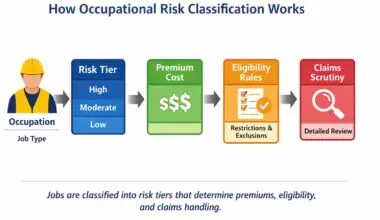
How Insurers Classify Occupational Risk
Insurance classification logic is entirely exposure-based, not job-title-based, aligning directly with SOC Classification Principle #2, which mandates that occupations be categorized based on the actual physical work performed. Underwriters rely on the 2018 Standard Occupational Classification (SOC) four-tiered hierarchical taxonomy to strip away arbitrary corporate designations and isolate specific operational exposures:
| Occupation Type | Typical Carrier Class | Primary Exposure | Typical Outcome |
|---|---|---|---|
| Administrative Engineer | 5A/4A | Minimal field exposure | Lowest premiums |
| Construction Supervisor | 3A/2A | Limited site work | Moderate pricing |
| Structural Steel Worker | A/1B | Height and machinery | Higher premiums and exclusions |
| Commercial Diver | B/Specialty | Marine and confined spaces | Restricted markets |
[Major Group: 47-0000]──►[Minor Group: 47-2000]──►[Broad Group: 47-2220]──►[Detailed Code: 47-2221]
(Construction/Extraction) (Construction Trades)  (Structural Metal Workers) (Structural Iron/Steel)
If an applicant’s official title is “Senior Project Lead,” but their daily routine involves hands-on rigging or active welding, the underwriting process may place greater weight on actual duties than corporate designations. The file is typically assigned a Detailed Occupation code based on the most hazardous task performed. Small changes in occupational wording can materially alter classification outcomes, a concept explored further in Why Your Job Title Matters in Insurance Underwriting.
Furthermore, if an employee splits time between two roles, insurers often apply a strict multi-job rule rather than averaging the risk profile. Even if a worker spends 80% of their shift performing administrative duties (Class 3A) and only 20% on the floor performing active welding or crane rigging (Class 1B), underwriters may classify and restrict the entire policy based on the most hazardous exposure.
Why Insurers Use Occupational Class Ratings
Insurers enforce strict occupational classification systems to maintain insurer capital adequacy and protect corporate liquidity reserves from the extreme financial volatility of high-hazard trades. Without precise actuarial segmentation, carriers would fall victim to adverse selection, a market failure where high-risk applicants are undercharged, ultimately destabilizing the insurer’s statutory capital reserves under risk-based capital models.
To prevent this, carriers match private applications against workplace injury surveillance datasets collected by public authorities, including:
-
OSHA Fatality Inspection Data: Used to track macro mortality spikes across heavy sectors.
-
NIOSH Occupational Injury and Illness Surveillance: Used to measure chronic, long-term impairment risk across physical labor groups.
-
U.S. Bureau of Labor Statistics Census of Fatal Occupational Injuries (CFOI): Used to feed raw statistical data into predictive loss modeling engines.
How Insurers Model Occupational Risk Severity
In high-risk underwriting, carriers differentiate between Frequency Risk (minor, highly predictable claims) and Severity Risk (rare but catastrophic, long-duration claims). Heavy manual trades trigger an immediate shift to severity modeling because their primary exposure drivers involve high-consequence failure loops:
[Height Exposure Exceeding 30ft] ──► [Catastrophic Fall Potential] ──► [Shift to Severity Modeling]Height-related exposures remain one of the most heavily modeled severity variables in occupational underwriting because falls continue to generate a disproportionate share of catastrophic injury claims. These exposure patterns closely align with the operational hazards discussed in OSHA Fall Protection Standards for High-Risk Work, where fall-prevention requirements are designed to reduce severe injury frequency and long-duration disability risk.
Underwriters analyze these exposures through specialized actuarial parameters to calculate Loss Ratio Forecasting (projected claims paid divided by premiums collected). Heavy trades are heavily penalized in severity models because a single physical failure (e.g., a structural scaffolding collapse or a marine platform incident) routinely results in permanent total disability or multi-worker fatalities, creating a severe financial tail that can run into millions of dollars per claim.
These severity differentials help explain why insurers apply stricter underwriting standards to hazardous occupations. As expected claim severity rises, carriers face greater reserve requirements, narrower profit margins, and higher long-duration claim exposure—factors explored further in Why High-Risk Jobs Face Stricter Insurance Approval.
Pricing Consequences
The direct pricing consequence of severity modeling is the application of occupational risk adjustments to baseline premium structures. Insurers frequently apply class-based pricing differentials to reflect expected claim frequency, injury severity, and long-duration disability exposure.
[Base Premium Rate] × [Occupational Risk Adjustment] = [Risk-Adjusted Premium]Many insurers use alphanumeric occupational classes that generally reflect increasing exposure severity, although class definitions, naming conventions, and pricing structures vary by carrier.
Class 5A / 4A (Lower Hazard): Typically associated with lower premiums due to limited physical exposure.
Class 3A / 2A (Moderate Hazard): May receive moderate premium adjustments based on field exposure and occupational duties.
Class A / 1B (Higher Hazard): Often carries significant pricing loads because of elevated injury severity and claim duration risk. Roofing contractors provide a practical example of how occupational classification influences pricing outcomes. Because roofing combines height exposure, fall severity potential, and elevated workers’ compensation loss costs, it is frequently treated as a higher-hazard trade within occupational classification systems, as examined in Roofing Contractor Insurance Underwriting.
Class B / Specialty (Critical Exposure): May be subject to substantial premium increases, exclusions, or restricted market availability due to severe exposure characteristics.
For workers, movement across occupational classes affects more than premium cost. It may alter carrier availability, benefit definitions, exclusion riders, and long-term claim outcomes.
Eligibility Consequences
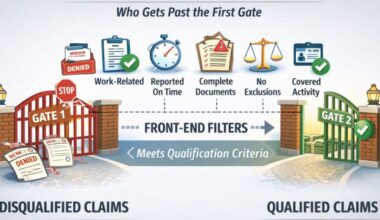
Once an underwriting rules engine locks in a low alphanumeric class band, the application moves through strict eligibility checkpoints. Occupational class assignment often serves as the first gate within the broader eligibility framework used by insurers, where approval decisions are shaped by exposure severity, insurability, and carrier risk appetite.
In high-hazard tiers, certain carriers impose underwriting decision breakpoints. If the baseline hazard exposure cannot be cleanly isolated or priced within standard risk pools, the application may be routed into specialized or surplus-lines markets depending on carrier appetite and reinsurance constraints. For extreme classifications, standard carriers may decline the risk due to reinsurance limitations that restrict their willingness to assume high-severity exposures.
These occupational filters operate alongside the broader approval standards discussed in Eligibility Requirements for Risk Job Insurance, where insurers evaluate how occupational hazards interact with financial, medical, and underwriting criteria before issuing coverage.
Claims Consequences
Occupation class ratings directly dictate contractual claim mechanics and sustainability. In lower class bands (Class A and B), insurers protect their long-tail exposure by inserting restrictive policy language:
-
Own-Occupation Scope Compressions: High-hazard policies frequently feature modified “Own-Occupation” language that limits the definition of your job to a specific duration (typically 24 months).
-
Field-Duty Materiality Tests: If a claimant suffers an injury but is deemed capable of performing localized supervisory or administrative tasks, full disability benefits can be terminated or reduced under modified own-occupation riders.
-
Partial Disability and Earnings Caps: Manual labor classifications routinely face lower proportional replacement thresholds and reduced earnings differential caps compared to Class 5A professionals.
What Underwriters Actually Check
To verify that an application accurately reflects a worker’s daily physical exposure, underwriters execute a structured sequence of data cross-checks behind the scenes. Occupational class ratings are rarely evaluated in isolation and instead form part of the broader risk-scoring frameworks used by insurers to evaluate claim probability, severity exposure, and eligibility outcomes.
       [Insurance Application Data]
                    │
                    ▼
   ┌─────────────────────────────────┐
   │   Automated Cross-Check Engine  │
   └────────────────┬────────────────┘
                    ├────────────────► [NCCI Scopes Database] (Class Code Mismatch?)
                    ├────────────────► [OSHA Enforcement Logs] (Site Citation History?)
                    └────────────────► [Payroll Records / W-2] (Wage-to-Risk Discrepancy?)
Underwriters validate task composition by pulling an employer’s National Council on Compensation Insurance (NCCI) data and comparing corporate workers’ compensation class codes with the individual’s stated duties. They may also require W-2s, 1099s, and tax returns to perform multi-year income averaging, ensuring that manual labor earnings are stable and not artificially inflated by temporary hazard pay spikes.
These occupational verification systems operate alongside the broader risk-scoring methodologies discussed in Risk Assessment Tools Used by Insurers, where carriers combine occupational, financial, environmental, and behavioral data to assess overall insurability.
Common Failure Paths in Occupational Classification
The primary failure path in occupational indexing stems from inaccurate application disclosure, where real-world task composition diverges from the assigned underwriting code.
-
The Residual Code Trap: If an application features a vague job description, underwriters invoke SOC Coding Guideline #4, dumping the file into a residual “All Other” category (e.g., SOC 47-5099: Extraction Workers, All Other). Lacking a distinct hazard definition, the software defaults to a worst-case scenario rating, triggering an unnecessary premium surge.
-
The Over-50% Tools Rule Infraction: If an audit reveals that an applicant claiming a “Supervisor” title spends more than 50% of their shift on physical tools, the carrier may trigger downward reclassification into a higher-risk occupational class.
-
Consequences of Misrepresentation: If a material mismatch is discovered during a claim investigation or renewal audit, the carrier maintains the legal right to execute retroactive re-rating, issue back-billed premium invoices, apply policy rescissions within the contestability window, or completely deny coverage based on material misrepresentation.
Operational Controls That Improve Insurability
Carriers embed continuous occupational verification controls directly into their compliance frameworks to preserve adverse selection prevention over the policy lifecycle. Ratings are systematically audited at three distinct operational friction points: at the initial policy issue, at renewal cycles, and immediately upon the filing of a catastrophic claim.
Some surplus-lines carriers may incorporate publicly available OSHA inspection records and enforcement data into broader occupational risk assessments. A pattern of safety citations at an insured’s primary worksite overrides standard classification assumptions, signaling a broken corporate risk culture and triggering immediate mandatory premium corrections or structural policy non-renewals.
Real-World Examples
Scenario 1: The Title vs. Exposure Crosswalk
-
The Applicant: An employee with the corporate job title of “Site Logistics Lead.”
-
The Reality: A field audit reveals the worker spends 30% of their time operating a heavy crane rigging apparatus at an industrial refinery.
-
The Underwriting Action: The title is discarded. The application is crosswalked directly to SOC 47-2221 (Structural Iron and Steel Workers), moving the policy from a favorable Class 3A rating down to a heavily loaded Class A rating.
Scenario 2: Sibling Silo Isolation
-
The Comparison: A Commercial Diver working on subsea valves vs. an Industrial Welder working on low-rise commercial skeletons.
-
The Underwriting Action: Though both utilize welding tools, the Commercial Diver is routed strictly to SOC 47-5011, triggering an automatic Class B designation with absolute over-water and marine exclusions. The welder remains in a standard Class A trade silo. The carrier treats the two occupations as distinct risk pools because marine exposure creates materially different loss characteristics and claim severity profiles.
Key Takeaways
-
Mechanics Trump Titles: Private insurance classification is driven entirely by daily exposure metrics and specific physical tasks, completely ignoring corporate job titles.
-
Multipliers Compound Costs: Dropping down a single alphanumeric class tier applies a permanent compound load to the policy, increasing baseline premiums by 25% to 75%.
-
The Multi-Job Rule Controls the File: Splitting duties across multiple risk tiers forces the carrier to price and restrict the entire insurance contract based on the most hazardous task performed.
-
Data Transparency Prevents Denial: Precise alignment with the 2018 SOC taxonomy and accurate disclosure of height, crane, and marine exposure is the only reliable pathway to guarantee claim sustainability and prevent retroactive policy rescission.
Workers who accurately document job duties, exposure levels, and operational changes are more likely to preserve coverage integrity throughout the policy lifecycle.
—————————————————————————————————————————
Institutional Reference Data
Bureau of Labor Statistics (BLS) Standard Occupational Classification System
https://www.bls.gov/soc/
Referenced for occupational definition matching, major-to-detailed group hierarchies, and exposure-based classification frameworks used in underwriting.
National Council on Compensation Insurance (NCCI)
https://www.ncci.com/
Referenced for workers’ compensation class codes, occupational risk segmentation, and actuarial loss-cost methodologies.
Occupational Safety and Health Administration (OSHA) Data & Statistics
https://www.osha.gov/data
Referenced for workplace fatality reporting, construction hazard surveillance, and occupational exposure datasets used in risk evaluation.
National Institute for Occupational Safety and Health (NIOSH)
https://www.cdc.gov/niosh/
Referenced for occupational injury surveillance, impairment research, and long-duration disability risk analysis.
Reviewed for Underwriting Accuracy
This article was reviewed for underwriting consistency involving:
- Occupational class rating methodology
- Exposure-based classification systems
- SOC occupational mapping and crosswalk logic
- Occupational risk segmentation frameworks
- Severity and frequency modeling principles
- Premium multiplier and risk-loading structures
- Eligibility and carrier appetite analysis
- Occupational verification and audit procedures
- Misclassification and claim breakpoint analysis
- Occupational exclusion and endorsement frameworks
Research & Underwriting Methodology
This article applies occupational underwriting analysis using:
- Exposure-based occupational classification frameworks
- SOC occupational coding standards
- Severity and frequency risk modeling
- Occupational risk segmentation methodologies
- Premium load and eligibility analysis
- Workers’ compensation classification principles
- Occupational verification and audit procedures
- Claim sustainability and exclusion evaluation
The analysis evaluates how insurers translate occupational exposure into classification decisions, pricing outcomes, eligibility thresholds, and long-term claim administration.