Reviewed for underwriting accuracy by the RJI Underwriting Research Team | Published: July, 2026 | Last reviewed: July, 2026.
————————————————————————————————————–
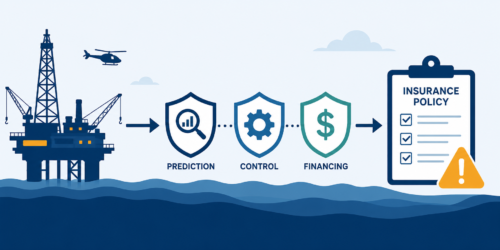
Offshore workers are frequently told that their coverage comes with more restrictions than almost any other occupational category, more medical questions, narrower eligibility, higher premiums, and exclusions that rarely apply onshore. It is easy to read this as a judgment on how dangerous the job is. That reading misses what is actually happening underneath. Offshore workers insurance restrictions are not a verdict on courage or competence. They are the visible output of an underwriting process that is trying, and often struggling, to answer a narrower question: can the financial consequences of a catastrophic loss on this exposure be predicted, controlled, and paid for with confidence?
This article sits within RJI’s broader Offshore Risk Underwriting: How Insurers Evaluate Marine & Remote Workers cluster, and it isolates one mechanism from that wider picture: how remoteness, catastrophic severity, evacuation capability, medical access, jurisdictional complexity, operational uncertainty, and market capacity combine to produce the restrictions that offshore workers and their employers actually encounter at binding and renewal.
Executive Summary
At a Glance
Why do offshore workers face insurance restrictions? Because insurers evaluate the combined effect of remoteness, injury severity, rescue capability, jurisdiction, and operational uncertainty, not the job title in isolation.
What kinds of restrictions are common? Occupational questionnaires, medical review, waiting periods, premium loading, coverage limitations, territorial exclusions, and in some cases coverage declination.
Why do insurers impose them? Restrictions are a pricing and eligibility response to reduced confidence in predicting, controlling, or financing catastrophic loss, not a punishment for hazardous work.
Can restrictions be reduced? Yes. Operational maturity, documented rescue capability, and contractor oversight are the underwriting evidence that moves an exposure back toward standard terms.
Underwriting insight: Restrictions track confidence, not danger alone, and confidence is something employers can actively build.
Before tracing how this mechanism plays out in practice, it helps to fix the vocabulary insurers actually use, since much of the frustration offshore workers report traces back to these terms being used loosely.
What Are Offshore Workers Insurance Restrictions?
Before the mechanism can be explained, the vocabulary needs to be fixed. Offshore insurance terminology is often used loosely, and workers who receive a denial or a loaded premium are rarely told which of several distinct concepts actually applies to their situation.
Offshore workers insurance restrictions: the general category of underwriting conditions, narrower eligibility, added scrutiny, exclusions, or pricing adjustments, applied to a policy because the insured’s work occurs in an offshore or marine environment.
Underwriting restrictions: conditions an insurer attaches to a policy to accept an exposure it would otherwise decline or price conservatively. Restrictions are how an insurer says yes to a risk it is not fully comfortable with.
Eligibility restrictions: conditions that determine whether a worker or employer can enter a program at all, independent of price. This is where Coverage Eligibility Gating, the practice of filtering applicants before pricing is even calculated, does its work.
Insurer appetite: a carrier’s current willingness to write a class of business, shaped by capital position, reinsurance terms, and recent loss experience rather than by the applicant’s individual file.
Coverage limitations: narrowed scope within an otherwise active policy, such as reduced benefit periods or capped indemnity for specific mechanisms of injury.
Premium loading: a surcharge applied to base rate because an underwriter judges the exposure to carry more variance than the standard rate assumes.
Occupational exclusions: specific activities, locations, or mechanisms of loss carved out of coverage entirely, while the rest of the policy remains active.
Restriction, Limitation, Exclusion, and Declination Are Not the Same Thing
These four words describe a spectrum of underwriting response, not synonyms. A restriction adds a condition to keep coverage available. A limitation narrows what an active policy actually pays for. An exclusion removes a specific activity or peril from scope while leaving the rest of the policy intact. A declination is a refusal to offer terms at all. Confusing these terms is one of the most common sources of frustration for offshore workers, since a denial letter that uses one term loosely can be read as far more final than the underwriting decision actually was.
| Term | What It Does | Typical Trigger |
| Restriction | Adds a condition to keep the policy active | Elevated but manageable uncertainty |
| Limitation | Narrows benefit scope within an active policy | Specific loss mechanism carries higher variance |
| Exclusion | Removes one activity or peril, policy remains active | A single exposure cannot be priced reliably |
| Declination | No terms offered | Confidence in predicting or financing loss has broken down entirely |
Figure 1. The restriction spectrum, from conditional acceptance to outright declination.
What all four have in common is that they typically reflect underwriting uncertainty rather than a simple judgment that offshore work is dangerous. Plenty of hazardous occupations are written at standard terms because insurers can predict, price, and finance the losses with confidence. Offshore restrictions exist because that confidence is harder to establish, not because the work is uniquely reckless.
With the vocabulary fixed, the next question is what an insurer is actually protecting against each time it reaches for one of these tools.
Why Do Insurers Restrict Offshore Workers? The Underwriting Confidence Model
Every underwriting decision, whether it produces standard terms, a loaded premium, or a decline, is really a judgment about underwriting confidence. That confidence is not a single number. It rests on three distinct pillars, and offshore work puts pressure on all three at once: confidence in predicting how a loss will unfold, confidence in controlling a loss once it starts, and confidence in financing a loss once the bill comes due. Restrictions accumulate wherever any one of the three weakens, and the strongest offshore files are the ones that give an underwriter reasons to trust all three simultaneously.
Confidence in Prediction
Prediction confidence asks whether an insurer can rely on historical data to forecast how often a loss will occur and roughly how large it will be. Onshore occupational claims cluster around a fairly stable distribution of injury types and costs, which is what lets standard actuarial pricing work well. Offshore claims sit on a longer, fatter tail: a single platform or vessel incident can involve multiple workers and injury patterns- burns, drowning, hypothermia- that carry disproportionate cost relative to their frequency. Remote operations compound this by removing the nearby emergency response that quietly caps severity onshore.
Confidence in Control
Control confidence asks whether an insured can stop a loss from escalating once it begins, and whether an underwriter can trust that practices reviewed at binding are the practices actually in force day to day. Offshore work strains this in two ways. Operational uncertainty is structurally higher, since shifting contractor relationships and rotating crews make it harder to verify that stated safety practice matches lived practice. And control confidence extends into the aftermath of an incident, where recoverability and survivability risk describe a worker’s likely path back to function and their likely chance of surviving the event at all. Delayed medical access extends the window in which a survivable injury becomes fatal. An employer that can demonstrate fast, verified loss control, contained incidents, rapid rescue, and credible medical response is directly rebuilding this leg of confidence.
Confidence in Financing
Financing confidence asks whether the insurer can absorb the loss without destabilizing its own balance sheet. A class of business that produces occasional, very large, hard-to-predict claims forces an insurer to hold more capital in reserve than a class with frequent, small, predictable claims, even at a similar average cost, because reserving follows the shape of the loss distribution, not just its mean. Offshore claims often take years to settle once multi-jurisdictional litigation is involved, so the capital held against a single open file can stay tied up, and uncertain in amount, far longer than an onshore claim would require. This is why insurer appetite for offshore exposure depends as much on how a loss could develop over time as on how large it looks on day one. Occupational injury and fatality statistics published by the U.S. Bureau of Labor Statistics help underwriters benchmark offshore severity, though such data informs prediction more directly than it resolves financing, which depends on the insurer’s own capital position and reinsurance terms.
Restrictions appear wherever confidence declines along any of these three legs. The table below maps that decline onto typical policy terms; every mechanism introduced later in this article answers the same underlying question in a different guise: does this weaken prediction, control, or financing confidence?
| Underwriting Confidence | Typical Underwriting Response |
| High | Standard terms |
| Moderate | Additional underwriting questions |
| Reduced | Premium loading |
| Low | Coverage limitations |
| Very Low | Occupational exclusions |
| Minimal | Coverage declination |
Figure 2. Underwriting confidence and its typical response. Confidence rarely collapses in one step; it moves down this scale as prediction, control, or financing concerns accumulate.
Underwriting confidence does not decline in the abstract. It declines in response to specific, observable exposures, and offshore work concentrates several of them at once.
How Offshore Risks Combine to Increase Insurance Restrictions
Underwriters do not evaluate offshore risk as a single variable. They build a picture from several interacting exposures, each of which independently reduces confidence, and each of which is the subject of a dedicated RJI mechanism article. This section keeps each exposure to its underwriting essentials and hands off detailed treatment to those articles.
Why Remote Offshore Operations Increase Insurance Restrictions
Fixed platforms, floating production storage and offloading vessels (FPSOs), drillships, offshore wind installations, and the support vessels that service them all share a defining underwriting feature: they are physically isolated from the emergency infrastructure that shapes onshore claims outcomes. There is no nearby trauma center, no immediate ambulance response, and no walk-in urgent care. Remote operations are treated by underwriters as a severity multiplier layered on top of whatever base occupational hazard already exists, since the same injury produces a worse outcome offshore purely because of distance from care. Operational safety benchmarking published by the International Association of Oil & Gas Producers is one of the reference points underwriters use when assessing whether a given operator’s remote-site practices align with industry norms. Full treatment of medical access timelines and their coverage implications sits in Remote Medical Access and Occupational Coverage.
Why Rescue Capability Matters to Underwriters
Offshore rescue depends on a chain of specific, weather-sensitive assets, helicopters, standby rescue vessels, and coordinated response protocols that either function or do not, with limited middle ground. Helicopter dependency and offshore evacuation capability are underwritten as a distinct exposure because they govern how long an injured worker waits before receiving definitive care, and weather delays can extend that wait far beyond what onshore emergency response would ever tolerate. These are governed in RJI by Offshore Evacuation Risk and Insurance, Helicopter Transport Risk in Offshore Insurance, and Remote Rescue Delays in Offshore Claims, which together explain why rescue infrastructure quality is one of the clearest levers an employer has over its own eligibility.
Why Catastrophic Injuries Change Insurance Decisions
The mechanisms of injury most associated with offshore work- burns, explosions, drowning, crush injuries, falls from height, and hypothermia- share a common underwriting trait: they tend to produce either full recovery or catastrophic outcome, with less of the moderate-injury middle ground that stabilizes onshore claims experience. This bimodal severity pattern is a major reason offshore claims reserves carry more uncertainty than their frequency alone would suggest, and it is treated in depth in Marine Fatality Exposure in Insurance Underwriting. Where these mechanisms of injury are also occupational safety concerns tracked by the National Institute for Occupational Safety and Health, underwriters treat that research as corroborating evidence rather than as a substitute for claims-specific loss data.
Why Jurisdiction Creates Offshore Insurance Problems
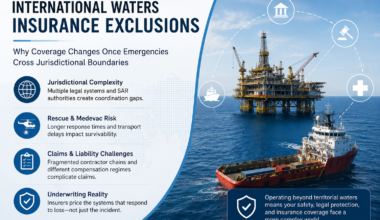
Offshore operations routinely cross between territorial waters, exclusive economic zones, and international waters, and the legal authority governing a rescue, an investigation, or a claim can change depending on exactly where an incident occurs. This creates what RJI terms Jurisdictional Coverage Conflict, where two or more legal systems each have a plausible claim to authority over the same loss, and neither resolves quickly. Because this article’s flagship treatment of the mechanism already exists in International Waters Insurance Exclusions, the discussion here is intentionally brief: jurisdictional uncertainty raises the cost and unpredictability of claims handling, and underwriters respond to that unpredictability with territorial restrictions rather than attempting to price the ambiguity directly. The International Maritime Organization sets much of the framework governing which flag state and coastal state rules apply at sea, and that framework is often the starting point underwriters use to trace which jurisdiction will ultimately govern a given claim.
Why Fatigue Increases Underwriting Risk
Offshore rotation schedules, extended hitches followed by concentrated time off, produce measurable cognitive degradation and operational exhaustion toward the end of a rotation, which underwriters treat as a human reliability exposure rather than a lifestyle detail. Fatigue does not cause incidents on its own so much as it reduces the margin available to catch and correct other hazards before they become losses. The full underwriting treatment of rotation-linked disability exposure is covered in Offshore Rotation Work and Disability Insurance.
Why Interacting Risks Receive More Underwriting Scrutiny
The individual exposures above are each manageable in isolation. The underwriting problem is that they rarely occur in isolation. Exposure Interaction describes what happens when several exposures compound rather than merely add: a worker at height, in the final days of a rotation, during a period of poor flying weather that would delay any evacuation, is not simply four independent risks summed together. This differs from simple Exposure Stacking, which describes multiple hazards accumulating within a single risk without necessarily changing each other’s likelihood or severity, the way a policy might separately price a height exposure and a weather exposure and add the two loadings together. Interaction describes hazards that actively worsen one another, so the combined loading behaves more like a multiplier applied across the exposures than a sum of independent parts.
Consider a worker maintaining a wind turbine nacelle or platform derrick at height. Fatigue late in a rotation narrows the margin for catching a mistake before it becomes a fall. Poor flying weather extends how long an injured worker waits for care if that fall occurs. Marine motion underneath the work adds a further layer of instability neither fatigue nor weather alone would introduce. None of these factors alone would justify treating the file as an outlier, but their interaction narrows the underwriter’s margin for error the same way it narrows the worker’s.
This is also why exposure interaction pressures all three legs of underwriting confidence at once: it widens the range of outcomes an underwriter must predict, strains an employer’s ability to control the incident once one factor goes wrong, and lengthens the tail of claims cost the insurer must be prepared to finance. Recognizing interaction as its own variable, distinct from stacking, is one of the clearest reasons offshore files receive more scrutiny than a simple hazard checklist would justify.
Even after a policy is issued, the same operational uncertainty that produces restrictions also changes how claims are investigated and resolved.
How Offshore Insurance Restrictions Affect Claims
Restrictions are not only about preventing losses from occurring. They are also a response to how difficult offshore losses are to resolve once they happen. Investigations into offshore incidents routinely involve multiple contractor chains, since a single platform may host direct employees, drilling contractors, catering crews, and specialist technicians under separate employment and insurance arrangements, each potentially responsible for a different slice of the same incident.
Jurisdiction disputes compound this further, since determining which legal system’s evidentiary standards and liability rules apply can delay the investigation before it even begins. Delayed reporting is common where an incident occurs mid-rotation and formal documentation waits until crew changeover, weakening the evidentiary record right when it is most needed. Evidence preservation offshore is genuinely harder than onshore: there is no static crime scene to seal off, weather and operational necessity often require a scene to be cleared quickly, and offshore documentation practices vary widely between operators.
Together, these factors mean offshore claims frequently fail what RJI calls Claims Qualification Criteria, the evidentiary thresholds an insurer needs cleared before a claim can be adjudicated cleanly, not because the underlying loss is illegitimate, but because the surrounding documentation and jurisdictional clarity were never built to support a fast, low-friction claims process.
Where claims friction cannot be eliminated, insurers price around it instead, which is why pricing and eligibility are best understood as two settings on the same dial rather than separate decisions.
How Offshore Insurance Restrictions Influence Premiums
It is easy to think of restrictions and pricing as separate levers; restrictions decide who gets coverage, pricing decides what it costs. In practice, they are the same lever used at different intensities. Premium increases, higher deductibles, and larger self-insured retentions are all ways an insurer transfers part of the uncertainty it cannot fully underwrite back onto the policyholder, which is functionally a restriction even when it is presented purely as a rate.
Offshore premiums run higher than comparable onshore occupational coverage largely because of the severity and jurisdictional factors already described, not primarily because offshore incident frequency is dramatically higher across the board. Reserve requirements follow the same logic: an insurer holding capital against a book with fat-tailed severity potential must reserve more conservatively per policy than one insuring a book with tightly clustered, predictable losses, and that reserving cost is ultimately reflected in price.
Employers who treat pricing purely as a cost to be negotiated down, rather than as a signal about where underwriting confidence is weakest, tend to miss the more useful lever: addressing the operational uncertainty driving the price is usually more durable than negotiating the number itself.
That same dial governs whether a worker or employer can access coverage at all, and it rarely moves in a single step.
How Offshore Workers Insurance Restrictions Affect Eligibility
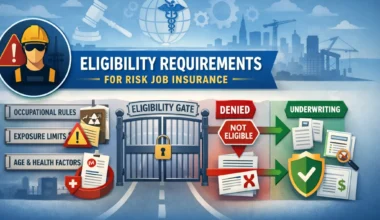
Eligibility restrictions are the most visible consequence for individual workers, since they determine whether an application proceeds at all. Common forms include detailed occupational questionnaires that go well beyond a simple job title, medical requirements calibrated to remote-access risk rather than general fitness, waiting periods before certain benefits activate, territorial limitations that exclude specific waters or regions, and contractor requirements that condition coverage on documented safety oversight of subcontracted crews.
What is easy to miss is that these restrictions rarely appear all at once. They accumulate along a predictable path as an underwriter’s confidence in an exposure declines step by step. RJI refers to this as the Restriction Escalation Framework.
Higher Exposure
↓
Additional Underwriting Questions
↓
Medical Review
↓
Premium Loading
↓
Coverage Limitations
↓
Occupational Exclusions
↓
Coverage Declination
Figure 3. The Restriction Escalation Framework. Restrictions typically develop progressively as underwriting confidence declines, rather than appearing as a single event.
This progression matters because it means a worker or employer who receives an initial round of extra questions is not automatically facing exclusion or decline. It reflects Coverage Activation Thresholds being tested, the specific conditions that must be satisfied before a given layer of coverage switches on, and Coverage Eligibility Gating working through its early stages rather than its final ones. The further along this path an exposure travels, the more the resulting policy resembles Policy Narrowing, a gradual reduction in what is actually covered even where a policy nominally remains active, and the greater the risk that a worker ends up carrying Underinsurance Risk, a gap between the coverage a worker believes they hold and the coverage that would actually respond to a given loss.
Each of the exposures and consequences described so far traces back to a small number of recurring patterns that an underwriter can usually identify from an applicant’s file well before any claim occurs.
What Triggers Offshore Workers Insurance Restrictions?
Restrictions rarely originate from a single dramatic event. Each pattern below follows the same reasoning cycle: what happens operationally, what standard it is measured against, how an underwriter reads it, who feels the effect first, and what changes in the policy as a result.
Poor Operational Maturity
Operational Reality: an employer relies on informal safety practice rather than a repeatable, auditable process.
Institutional Basis: file review standards expect evidence of a functioning safety management system, not a verbal assurance of one.
Underwriting Interpretation: without an auditable process, the underwriter cannot verify that stated practice matches daily practice.
Employer Impact: the account is priced as unproven rather than credited for practices it may genuinely follow.
Insurance Consequence: standard terms are withheld until documentation exists to support them.
Inadequate Rescue Capability
Operational Reality: evacuation and rescue arrangements are ad hoc rather than contracted and drilled.
Institutional Basis: offshore evacuation standards elsewhere in this cluster expect a named provider and a tested response time.
Underwriting Interpretation: an underwriter cannot rely on a response time that has never been verified under real conditions.
Worker Impact: an untested rescue chain is often the difference between a recoverable injury and a fatality.
Insurance Consequence: pricing is built around worst-case rescue delay rather than best-case capability.
Weak Documentation Practices
Operational Reality: incident records, training logs, or maintenance histories are incomplete.
Institutional Basis: for U.S. Outer Continental Shelf operators, documentation aligned with Bureau of Safety and Environmental Enforcement reporting gives underwriters a baseline to check applicant records against.
Underwriting Interpretation: incomplete filings read as a discipline flag, not an administrative gap.
Employer Impact: the underwriter substitutes conservative defaults for the evidence that was not provided.
Insurance Consequence: heavier reliance on default assumptions across the whole file.
Poor Contractor Oversight
Operational Reality: a worksite involves multiple contractors without clear oversight of their safety standards.
Institutional Basis: multi-employer worksite liability principles hold that responsibility cannot simply default to whichever insurer responds first.
Underwriting Interpretation: the exposure is underwritten at the level of the least mature contractor on site.
Employer Impact: a well-managed primary operator still absorbs the consequences of a poorly managed subcontractor.
Insurance Consequence: coverage is conditioned on documented oversight of every contractor on site.
Jurisdictional Uncertainty
Operational Reality: operations cross territorial and international waters with no clear framework for which legal system applies.
Institutional Basis: flag state and coastal state rules, set within the framework the International Maritime Organization maintains, can each claim authority over the same incident.
Underwriting Interpretation: this ambiguity cannot be resolved through pricing alone, since resolving it is itself uncertain.
Worker Impact: a worker’s path to compensation depends on which jurisdiction ends up applying.
Insurance Consequence: territorial exclusion rather than broad geographic acceptance.
Unmanaged Exposure Interaction
Operational Reality: Several elevated hazards are present with no documented controls showing how their combined effect is managed.
Institutional Basis: Underwriters evaluate interacting hazards differently from independent hazards because compounding exposures can materially change both loss severity and claim variability.
Underwriting Interpretation: Without evidence that interacting hazards are actively managed, the exposure cannot be evaluated as a collection of independent risks.
RJI Interpretation: The RJI Exposure Interaction framework describes this as a distinct underwriting variable rather than a simple accumulation of individual risks.
Worker Impact: The worker experiences the combined effect of interacting hazards directly, increasing the likelihood that one event escalates into a catastrophic outcome.
Insurance Consequence: Because unmanaged exposure interaction weakens prediction, control, and financing confidence simultaneously, insurers respond with additional pricing, coverage limitations, or other underwriting restrictions rather than assessing each hazard in isolation.
Claims Qualification Problems
Operational Reality: prior claims history shows repeated difficulty meeting evidentiary or reporting standards.
Institutional Basis: Claims Qualification Criteria set the evidentiary threshold a claim must clear before adjudication.
Underwriting Interpretation: past qualification failures read as a forward-looking indicator, not a historical footnote.
Employer Impact: future terms are shaped by claims-handling history as much as safety history.
Insurance Consequence: tighter documentation and reporting requirements are written into future terms.
Every failure path above has a mirror image: a specific, documentable control that rebuilds the confidence the failure eroded.
How Employers Can Reduce Offshore Workers Insurance Restrictions
The throughline across all of them is that underwriters are not looking for generic safety commitment. They are looking for specific, auditable evidence that can substitute for uncertainty in their pricing model.
Demonstrate a Verified Rescue Plan
Contracted evacuation providers, published response-time commitments, and named backup arrangements for weather delay.
Control Fatigue Through Rotation Management
Documented rotation limits, rest requirements, and monitoring rather than informal scheduling.
Match Medical Capability to Operational Remoteness
On-site medical staffing and telemedicine arrangements matched to the actual remoteness of the operation.
Use Regular Emergency Drills as Underwriting Evidence
logged, regular drills rather than a policy document that has never been exercised.
For drilling operations specifically, alignment with practices recommended by the International Association of Drilling Contractors gives underwriters a recognized standard for well-control and rig-safety documentation, much as IOGP benchmarking supports evaluation of broader remote-site operations. Neither substitutes for an insurer’s own file review, but both narrow the uncertainty an underwriter must price around.
Document Contractor Oversight
A documented process for vetting and monitoring subcontractor safety standards on shared worksites.
Maintain Complete Operational Records
Complete, timely incident and maintenance records that let an underwriter verify practice rather than infer it.
Build Audit-Ready Safety Documentation
The ability to produce evidence on request, which itself signals operational maturity independent of the evidence’s content.
None of these is safety advice in the general sense. Each is a specific underwriting credit mechanism, evidence that, once documented, gives an underwriter a concrete basis to move an exposure back toward standard terms rather than treating it as an unknown. It is worth noting that OSHA jurisdiction offshore is narrower than it is onshore, since much of the U.S. Outer Continental Shelf falls primarily under BSEE authority, which is itself a reason underwriters lean on operator-specific documentation rather than assuming a single regulator’s oversight covers the full offshore exposure.
Confidence built at the individual file level still operates inside a market with its own constraints, and those constraints can override an otherwise clean underwriting file.
Why Offshore Workers Insurance Restrictions Change Over Time
Individual underwriting decisions sit inside a larger market context, and restrictions on any single policy are shaped as much by that broader environment as by the specific file in front of an underwriter.
Carrier Appetite
Offshore risk is largely written through a limited number of specialist markets rather than the general insurance market, and their collective capacity rises and falls with pricing cycles. When specialist capacity contracts, even well-managed employers can face tighter terms simply because fewer carriers are actively competing for the business.
Portfolio Concentration
Portfolio Concentration Underwriting describes an insurer’s need to manage how much of its total offshore exposure sits in one region, operator type, or peril. An excellently managed employer can still face restrictions if an insurer has simply accumulated too much offshore concentration already, since the constraint is the insurer’s aggregate exposure, not the individual applicant’s risk profile.
How Reinsurance Shapes Offshore Insurance Restrictions
Primary insurers offload much of their catastrophic offshore exposure to reinsurers, and reinsurance terms shape what primary carriers can afford to write. Catastrophe aggregation limits imposed by reinsurers, along with the broader capital allocation reinsurers make available to offshore portfolios, filter down into the restrictions and pricing that individual employers see at renewal.
This matters more for offshore business than for most onshore classes because of the financing leg of underwriting confidence described earlier. Offshore claims often take years to move from first notice to final settlement, particularly where multi-jurisdictional litigation or long-term disability prognosis is involved, and until a claim settles the insurer carries an estimate that can move materially as the claim develops. A book carrying this much uncertainty about final claims cost ties up capital longer, and less predictably, than a book of fast-closing claims would, and reinsurers price their own capital accordingly.
That reinsurance cost becomes a capital allocation decision at the primary carrier level: offshore business only clears the bar against every other line an insurer could write instead when the reinsurance-adjusted return justifies tying up capital for the length of an offshore claim’s tail. When reinsurance costs rise, or claims development on recent offshore losses runs worse than expected, primary carriers often pull back capital allocation to the class entirely rather than simply raising price, which is why restrictions can tighten across an entire portfolio even where an individual employer’s own claims history has not changed at all.
Why Offshore Insurance Restrictions Change Over Time
Restrictions are not fixed. They move with catastrophe losses elsewhere in the market, cyclical hardening and softening of pricing, regulatory changes from bodies with authority over offshore operations, individual high-profile offshore incidents, and shifts in reinsurance cost. Part of what drives this movement is Risk Model Lag, the delay between a real-world change in offshore operating conditions and that change being fully reflected in underwriting models. An employer’s own risk profile can improve while market-wide restrictions still lag, or conversely, restrictions can tighten industry-wide even where an individual employer’s practices have not changed at all.
The mechanisms described so far are easiest to see in motion, so the scenarios below trace five offshore roles through the same underwriting logic.
Real-World Examples of Offshore Workers Insurance Restrictions
The following scenarios illustrate how the mechanisms above translate into an actual underwriting decision. Each follows the same path from operational situation to underwriting interpretation to insurance restriction.
Offshore Driller
Operational Situation: Works rotating hitches on a drillship operating across multiple jurisdictional boundaries, with exposure to well-control incidents.
↓
Underwriting Interpretation: High catastrophic severity combined with jurisdictional complexity and rotation-linked fatigue reduces confidence in both loss control and claims resolution timelines.
↓
Insurance Restriction: Premium loading, mandatory rescue-capability documentation, and territorial conditions tied to the vessel’s operating region.
Offshore Electrician
Operational Situation: Performs live and de-energized electrical work in confined spaces on a fixed platform with helicopter-only access.
↓
Underwriting Interpretation: Combined burn and shock severity potential with rescue dependency on helicopter availability raises both survivability and recoverability concerns.
↓
Insurance Restriction: Occupational questionnaire targeting confined-space and live-work frequency, plus a waiting period on certain disability benefits.
ROV Technician
Operational Situation: Operates remotely operated vehicles from a support vessel, with periodic deck work during launch and recovery in variable sea states.
↓
Underwriting Interpretation: Lower direct catastrophic exposure than drilling roles, but launch and recovery operations introduce crush and overboard risk during adverse weather.
↓
Insurance Restriction: Narrower coverage limitation tied specifically to deck operations during launch and recovery, rather than a broad occupational exclusion.
Offshore Crane Operator
Operational Situation: Operates a pedestal crane handling heavy lifts between vessel and platform in open water, where a dropped load or crane failure affects multiple workers simultaneously.
↓
Underwriting Interpretation: Single-point failure potential affecting multiple workers at once creates an exposure-stacking concern independent of the operator’s individual skill.
↓
Insurance Restriction: Coverage conditioned on documented lift planning and inspection records, with premium loading if contractor oversight of rigging crews cannot be demonstrated.
Offshore Welder
Operational Situation: Performs hot work in proximity to hydrocarbon processing equipment on a production platform.
↓
Underwriting Interpretation: Explosion and burn severity potential combined with the operational maturity of the platform’s hot-work permitting process directly affects underwriting confidence.
↓
Insurance Restriction: Coverage eligibility gated on evidence of a formal permit-to-work system, with occupational exclusion risk if that system cannot be documented.
Pulled together, the reasoning above resolves into a small number of durable principles.
Key Takeaways
- Offshore workers insurance restrictions reflect underwriting confidence in predicting, controlling, and financing catastrophic loss, not simply a rating of how dangerous the job title sounds.
- Restrictions usually result from interacting risks, remoteness, rescue capability, severity, jurisdiction, and fatigue, compounding one another rather than from any single hazard.
- Insurer appetite, portfolio concentration, and reinsurance capacity mean two equally well-managed employers can face different terms depending on market conditions outside their control.
- Operational maturity, documented rescue capability, and contractor oversight are the concrete evidence that moves underwriting confidence, and therefore restrictions, in the employer’s favor.
- Restrictions develop progressively along the Restriction Escalation Framework, which means early underwriting questions are an opportunity to respond with evidence, not a signal that decline is inevitable.
Operational Reality
↓
Underwriting Confidence
(Prediction • Control • Financing)
↓
Insurance Restriction
↓
Pricing / Eligibility / Coverage
↓
Market Consequence
Figure 4. Operational realities influence underwriting confidence, which in turn drives restrictions, pricing, coverage terms, and broader market behavior.
Conclusion
Offshore workers insurance restrictions are ultimately an expression of underwriting confidence. Every questionnaire, exclusion, waiting period, territorial condition, premium adjustment, and eligibility decision represents an insurer’s attempt to narrow uncertainty before committing capital. Employers that systematically reduce operational uncertainty do more than improve safety; they improve insurability itself. In offshore underwriting, confidence is not assumed. It is demonstrated.
—————————————————————————————————————————
Sources & Underwriting References
- U.S. Bureau of Labor Statistics (BLS) — Occupational injury and fatality statistics used to benchmark occupational risk severity and support actuarial assessment of high-risk industries.
- National Institute for Occupational Safety and Health (NIOSH) — Research on occupational injury mechanisms, fatality patterns, and workplace hazards used to understand catastrophic injury exposures.
- International Association of Oil & Gas Producers (IOGP) — Industry guidance and operational safety benchmarking for offshore oil and gas operations, including remote-site risk management and incident prevention.
- International Association of Drilling Contractors (IADC) — Offshore drilling operational standards, well-control guidance, and safety management practices referenced when evaluating drilling contractor operational maturity.
- International Maritime Organization (IMO) — International maritime conventions governing vessel operations, flag-state responsibilities, and jurisdictional frameworks that influence offshore insurance claims and coverage.
- U.S. Bureau of Safety and Environmental Enforcement (BSEE) — Regulatory authority for offshore energy operations on the U.S. Outer Continental Shelf, providing reporting requirements and operational safety oversight relevant to underwriting documentation.
- Occupational Safety and Health Administration (OSHA) — U.S. workplace safety regulations and guidance. Although offshore jurisdiction is limited in many offshore environments, OSHA standards remain an important benchmark for occupational risk management and contractor safety systems.
Research & Underwriting Methodology
This article was developed using Risk Job Insurance’s RJI Underwriting Translation Framework (RUTF). The analysis synthesizes publicly available regulatory guidance, occupational safety research, offshore operational standards, and established insurance underwriting principles to explain how insurers evaluate offshore exposure, why coverage restrictions develop, and how operational evidence influences underwriting confidence. The article is educational in nature and does not represent underwriting guidelines from any individual insurer.