Editorial notice: Reviewed for underwriting accuracy by the RJI Underwriting Research Team | Published: June, 2026 | Last reviewed: July, 2026.
————————————————————————————————————–
Executive Summary
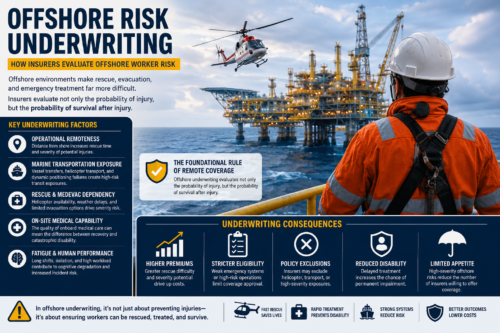
Offshore risk underwriting dictates how insurers evaluate workers operating in hazardous marine and remote environments. Because offshore environments make rescue, evacuation, and emergency treatment much harder, injuries at sea often become far more severe than similar injuries onshore. When determining pricing and eligibility, insurers evaluate how likely workers are to receive fast rescue, emergency treatment, and successful evacuation after a serious offshore incident. Ultimately, the reliability of offshore insurance depends heavily on whether emergency systems can realistically prevent severity escalation after an incident occurs. This makes offshore insurance heavily dependent on the quality of operational infrastructure rather than on worker classification alone.
What Is Offshore Risk Underwriting?
In the specialized world of occupational coverage, a distinct line separates corporate asset protection from worker-level evaluation. Corporate offshore insurance underwriting focuses on macro-level exposures, evaluating physical platforms, marine infrastructure, offshore energy systems, and multi-million-dollar offshore liability exposure. Corporate offshore insurance often relies on specialized insurance markets designed to handle extremely large and complex risks, such as those monitored globally by Lloyd’s Offshore & Energy Insurance Markets.
Conversely, offshore occupational underwriting zeros in on the individual human element within the marine worker classification. It evaluates worker survivability, evacuation feasibility, rescue timing, medevac capability, disability severity, and the likelihood that workers can be rescued and stabilized before injuries become catastrophic.
When an underwriter reviews an application for a remote-worker insurance system, they are not performing a standard actuarial review. This underwriting framework sits within the broader offshore workers insurance system, where coverage reliability often depends on rescue capability, transport infrastructure, evacuation planning, and operational risk severity. For a broader explanation of how offshore coverage works, where policies fail, and why offshore workers face unique insurance challenges, see Offshore Workers Insurance: How Coverage Actually Works and Where It Breaks Down.
They are evaluating how difficult it would be to rescue, stabilize, and transport a worker after a serious offshore incident. Because of operational isolation and the presence of floating-infrastructure hazards, offshore underwriting focuses less on whether an injury happens and more on whether the worker can recover before delayed medical access makes the situation worse. The central question is not just “Will a worker get hurt?” but “Can we get them to a trauma bay before a treatable injury becomes a fatality?”
Why Insurers Evaluate Offshore Workers Differently
Onshore workers typically operate within minutes of advanced trauma centers. For offshore workers, working far from shore reduces the amount of time available to stabilize a serious injury before it becomes life-threatening. Insurers treat offshore environments differently because a routine medical event onshore can transform into a catastrophic emergency claim due to delayed trauma stabilization and medevac dependency. Bad weather, delayed helicopters, and unstable evacuation conditions can quickly turn a manageable injury into a catastrophic disability case.
The foundational rule of remote coverage states that offshore underwriting evaluates not only the probability of injury, but the probability of survival after injury. Many of these operational restrictions stem from the same severity concerns that explain why offshore workers face insurance restrictions across the global maritime markets. To assess this survival probability, insurers evaluate the emergency systems supporting offshore survival against international safety benchmarks established by the International Maritime Organization (IMO):
-
On-site medical stabilization capability and advanced telemetry.
-
Dedicated helicopter medevac systems and flight radius limitations.
-
Weather-response reliability and seasonal operational risks.
-
Backup emergency systems and lifeboat capacity.
-
The platform’s ability to stop a small incident from turning into a major disaster.
-
Offshore evacuation feasibility under extreme sea states.
When these systems are deemed weak or overly dependent on outside help, the underwriting consequences trickle directly down to the worker and contractor. This manifests as sharp premium increases, strict eligibility restrictions, total policy exclusions, reduced disability reliability, and a severely limited insurer appetite for the risk.
Core Variables in Offshore Risk Underwriting
Underwriters categorize and evaluate risk based on several interlocking operational variables rather than reviewing workers in isolation.
1. Operational Remoteness
The farther a vessel or platform moves from shore, the less insurers worry about minor injuries and the more they focus on catastrophic outcomes after major incidents. Insurers analyze the precise distance from established medical infrastructure. As nautical miles increase, rescue becomes slower, and the window available to save or stabilize a worker shrinks significantly. Underwriting guidelines establish that remote medical access and occupational coverage function as intertwined metrics; when medical access becomes delayed, coverage restrictions usually tighten.
2. Marine Transportation Exposure
A worker’s risk profile begins long before they set foot on an offshore installation. Underwriters heavily scrutinize marine transport operations, specifically looking at vessel-to-platform transfer exposure and swing-rope or basket transfer systems. Furthermore, floating-platform movement and dynamic positioning instability increase the risk of crushing injuries during transport phases. Insurers evaluate the transport-phase fatality severity and water-survival exposure of the transit route. Because aviation transits represent a massive concentration of multi-worker risk, helicopter transport risk in offshore insurance is modeled as a primary peril, focusing closely on helicopter transfer systems, pilot certifications, and hull safety records derived from data by the International Association of Oil & Gas Producers (IOGP).
3. Rescue & Medevac Dependency
If a worker suffers a major trauma, their survival may depend entirely on how quickly rescue teams, helicopters, and emergency crews can respond. Underwriters look at helicopter medevac availability and the contractual guarantees of third-party rescue providers. They calculate the likelihood that bad weather, heavy swells, thick fog, or high winds could prevent helicopters from reaching the platform during an emergency. When these extraction windows are compromised, insurers enforce specific clauses regarding remote rescue delays in offshore claims that restrict the insurer’s total financial liability and increase out-of-pocket employer costs.
4. Multi-Fatality Accumulation Exposure
From an underwriting perspective, one of the most troubling aspects of marine occupational insurance is accumulation risk. Offshore explosions, catastrophic fires, structural failures, evacuation breakdowns, and helicopter crashes do not just harm one individual; they threaten the entire crew simultaneously. Insurers evaluate the risk of multiple workers being injured or killed in a single offshore disaster. If an agency insures thirty workers on a single drillship, a single marine disaster can wipe out the entire risk pool. Managing marine fatality exposure in insurance underwriting requires insurers to restrict the absolute number of insured workers permitted on a single asset or transit vessel, tracking workforce deployment records kept by the Offshore Energies UK (OEUK).
5. Environmental & Weather Severity
The physical geography of the work site modifies the risk profile. Insurers assess historical data for storms, wave instability, and sudden visibility deterioration that cause severe weather shutdowns and evacuation disruption. Constant movement during heavy seas increases fatigue, balance-related injuries, slips, trips, and long-term physical strain on offshore workers. Underwriters document that offshore evacuation risk and insurance availability fluctuates wildly based on these localized marine weather patterns.
6. Worker Rotation, Fatigue & Cognitive Degradation
Offshore occupational underwriting actively accounts for human factors. Long shift patterns (such as 28-day rotations) create documented offshore fatigue accumulation and cognitive degradation. Isolation stress, combined with long-shift impairment and chronic sleep disruption, leads directly to decision-quality deterioration. When evaluating offshore rotation work and disability insurance, insurers price policies based on the length of the rotation, the rest-to-work ratios, and the mental health support systems available to remote crews, utilizing field studies from the National Institute for Occupational Safety and Health (NIOSH).
7. Offshore Medical Fitness & Survival Modeling
Because remote environments punish physical vulnerability, medical screening offshore is much stricter because a delayed rescue makes health emergencies more dangerous. Standard onshore medical disclosures are insufficient for marine occupational insurance. Insurers demand rigorous offshore medical screening to filter out pre-existing vulnerabilities that could trigger a remote crisis. Insurers pay particular attention to cardiovascular risk, seizure history, diabetes management, and obesity-related evacuation concerns. If a worker suffers a cardiovascular event or an acute metabolic crisis in an environment marked by delayed access to emergency treatment, a manageable medical emergency can quickly become life-threatening.
How Insurers Classify Offshore Workers
Inshore and offshore tasks are not credentialed or rated equally under marine operational systems. Underwriters categorize workers based on their precise operational environment, platform type, transport dependency, and rescue complexity, using compliance metrics enforced under OSHA Maritime Standards:
-
Oil rig workers and roughnecks are heavily exposed to high-pressure systems, heavy machinery, and catastrophic industrial incidents, especially on floating drilling structures where evacuation may be delayed.
-
Offshore crane operators face elevated underwriting severity because suspended loads, high winds, blind lifts, and unstable marine movement increase the likelihood of severe injuries and difficult rescue conditions.
-
Offshore welders and fabricators often work around enclosed spaces, volatile gases, structural movement, and height exposure. These conditions create higher risks of explosions, burns, crush injuries, and evacuation complications during emergencies.
-
Commercial divers fall into one of the highest-risk offshore insurance categories because underwater work combines decompression danger, hyperbaric pressure exposure, and complete rescue isolation during emergencies.
-
Maritime crew workers and supply-vessel personnel face a different risk profile tied to vessel movement, line handling, deck instability, transport injuries, and water-survival exposure during offshore transit operations.
As operational complexity increases, moving from fixed platform maintenance to deep-water exploratory drilling or underwater hyperbaric exposure, the underwriting severity escalates exponentially.
Why Offshore Claims Become More Severe
In offshore underwriting, the concept of severity outweighs frequency. Carriers evaluate specific physical realities that dramatically increase the severity and cost of a claim:
-
Floating Infrastructure vs. Fixed Jackets: Fixed platforms anchored to the seabed offer a stable operating environment, resulting in lower underwriting severity due to predictable evacuation systems. In contrast, floating production systems, drillships, semi-submersibles, and Floating Production Storage and Offloading (FPSO) units introduce constant platform movement during rough offshore conditions. Weather-linked structural movement and operational instability mean that workers on floating infrastructure face significantly higher premium ratings and tighter disability underwriting limits.
-
Dynamic Positioning Instability: Insurers heavily evaluate dynamically positioned (DP) vessels that rely on computer-controlled thrusters to maintain position. A loss of position (“drift-off” or “drive-off”) caused by sensor fouling or thruster desynchronization can sever subsea connections, personnel transfer bridges, or crush transport vessels against the platform hull. These severe offshore movement hazards share similarities with catastrophic fall risk in occupational insurance, where a sudden loss of stability rapidly escalates injury severity and disability exposure.
-
Helicopter Transit Volatility: Because aviation transits represent a massive concentration of multi-worker risk, helicopter transport is modeled as a primary peril. Underwriters evaluate helicopter transfer systems, pilot certifications, engine redundancies, and heli-port automation. If a contractor utilizes non-redundant, single-engine aircraft or lacks automated weather-monitoring infrastructure, underwriters implement immediate capacity caps to restrict the number of insured personnel permitted on any single flight leg.
-
Industrial Containment Capability: When assessing marine worker risk on offshore energy operations, underwriters closely inspect the engineering redundancies protecting the workforce. They look at safety structures audited by the Bureau of Safety and Environmental Enforcement (BSEE), specifically evaluating Blowout-Prevention Systems (BOPs) reliability ratings and testing intervals, automated fire-suppression deluge coverage in high-risk living quarters, and the speed and segmentation capability of automated isolation valves within Emergency Shutdown Systems (ESD). Underwriting evaluates whether these safety networks can realistically prevent a minor localized fire or pressure spike from escalating into an insurvivable platform-wide disaster.
Why Offshore Claims Become More Complex
The organizational structure of offshore projects introduces a unique layer of friction known as liability fragmentation. A single offshore asset rarely houses employees from just one company; instead, it is an intricate ecosystem of offshore contractor chains, including drilling contractors, marine logistics vendors, transport subcontractors, and third-party rescue providers.
       [Operator / Energy Oil Co.]
                  │
        ┌─────────┴─────────┐
        ▼                   ▼
[Drilling Contractor]   [Logistics Vendor] ──> [Transport Subcontractor]
When an incident occurs, such as a drilling hand being injured during a rough-sea basket transfer from a crew boat to a semi-submersible, the claim shatters along multiple distinct liability vectors:
-
The Logistics Vendor’s Protection & Indemnity (P&I) Club evaluates the vessel’s positioning fault.
-
The Drilling Contractor’s Worker Underwriting System reviews whether the worker violated shift-rotation fatigue limits.
-
The Operator’s Energy Market Framework analyzes whether the infrastructure itself failed to provide safe access.
Because multiple corporate entities and their respective insurers actively attempt to shift blame, offshore losses frequently trigger intense offshore jurisdiction risk and insurance coverage disputes over state laws, federal maritime acts (such as the Jones Act), or international maritime law.
Why Offshore Claims Become More Complex:
-
Maritime Jurisdiction Disputes: Determining whether a claim falls under local state laws, federal maritime acts (such as the Jones Act), or international maritime law.
-
Delayed Incident Reporting: Operational isolation and communication blackouts on remote vessels often delay the transmission of formal incident reports to onshore underwriters.
-
Medevac Documentation Issues: Logistical chaos during an emergency extraction frequently results in fragmented medical charts and poor tracking of initial treatment times.
-
Transport Verification Problems: Underwriters require strict proof of exactly when and where an injury occurred (e.g., whether the worker was on the platform, on the gangway, or in transit via a helicopter transfer system).
-
Offshore Medical Verification Difficulties: Remote telemedicine diagnoses often conflict with subsequent onshore evaluations by specialized trauma physicians, leading to intense insurer scrutiny.
Why Offshore Workers Pay More for Insurance
Underwriters translate physical hazards into economic realities every day. Workers face significantly higher premiums and narrower disability terms because offshore environments can delay emergency treatment long enough for survivable injuries to become fatal or permanently disabling. If an operating theater is four hours away via helicopter transit, the underwriting system must price the occupational risk profile based on the increased cost of a worst-case outcome.
Every rescue, evacuation, and containment system helps insurers feel more confident that catastrophic losses can be controlled. When containment networks and private medevac infrastructure are verified and robust, underwriters maintain standard coverage access; when they are absent or compromised, insurers systematically apply risk surcharges, specialized premium increases, contract eligibility limits, and sweeping structural exclusions.
What Causes Offshore Insurance Restrictions?
Certain operational boundary lines fundamentally alter an insurer’s willingness to accept occupational risk. To maintain underwriting stability, insurers establish firm decision breakpoints. Once an offshore operation breaches these specific physical or geographic limits, the policy terms instantly shift from standard occupational ratings to highly restrictive specialty endorsements or outright exclusions.
Operational Underwriting Breakpoints
| Operational Boundary | Technical Underwriting Threshold | Structural Insurance Consequence |
| Deep-Water Transit | Past the flight radius of land-based SAR helicopters (typically 150+ nautical miles) | Enforced Aviation Exclusions or mandatory third-party private rescue contract riders; premium loading of 40–60%. |
| Subsea Intervention | Any activity requiring mixed-gas, saturation, or hyperbaric exposure | Complete exclusion from standard occupational pools; diversion to specialty subsea lines with restricted lifetime benefits. |
| Geopolitical Shifts | Navigation into Joint War Committee (JWC) listed or high-piracy corridors | Immediate suspension of standard disability terms; implementation of war/piracy surcharges and territorial exclusions. |
| Asset Instability | Operations on dynamically positioned (DP) drillships vs. fixed jackets | Shift from fixed-rate premiums to dynamic risk surcharges; restricted coverage for transport-phase injuries. |
| Aging Workforce Profiles | Personnel aged 55+ operating on remote, un-stabilized assets | Enforced cardiovascular and metabolic screening milestones; reduction of total disability benefit periods from age 65 to 24 months. |
When an asset demonstrates a weak rescue infrastructure or crosses these thresholds without pre-approved containment protocols, insurers implement major underwriting restrictions. These include sweeping policy exclusions, drastic benefit reductions, massive premium increases, strict disability limitations, or outright refusal of coverage entirely.
Structural Exclusions in Offshore Insurance
Exclusions exist because certain operational hazards become too difficult for insurers to predict, control, or price accurately. In high-risk marine coverage, underwriters utilize specific, formalized exclusions to ring-fence exposures that standard policies cannot support. Chief among these is the strict reinforcement of international waters insurance exclusions, which nullifies baseline standard coverage options the moment an asset transits outside territorial jurisdictions.
-
International Waters Insurance Exclusions: Once a vessel leaves territorial waters, domestic regulatory frameworks disappear, and the cost of medical transport skyrockets.
-
Territorial Exclusions & Piracy-Region Restrictions: Denying coverage for known high-risk transit corridors (e.g., the Gulf of Guinea or parts of the Red Sea).
-
Underwater-Operation Exclusions: Stripping out coverage for any tasks requiring breathing apparatuses unless explicitly rated via endorsement.
-
Aviation Exclusions: Restricting claims arising from non-certified or non-scheduled transport aircraft, forcing compliance with strict transport safety standards.
-
Contractor Limitations & Cross-Border Restrictions: Denying claims where a worker is deployed from a country different from the flag state of the vessel without prior notification.
-
Evacuation-Related Restrictions: Invalidating coverage if a contractor operates during a named storm window without an approved, pre-deployed evacuation plan.
Policy Failure Paths
The most common operational failure paths that break an insurance policy and lead to denied claims include:
-
Undisclosed Diving Exposure: A worker classified as a surface welder performing an unauthorized hyperbaric weld.
-
Undeclared Offshore Assignments: Shifting an onshore technician to an offshore platform without notifying the carrier to update the classification.
-
Evacuation-Protocol Violations: Operating an asset through a heavy storm wave after an insurer-mandated evacuation order has been issued.
-
Unauthorized Transport Arrangements: Utilizing unapproved transport-provider assets or non-certified marine vessels to ferry crews to cut costs.
-
Operating Outside Approved Offshore Zones: Navigating a dynamically positioned vessel into international waters excluded by the policy geography.
-
Expired Offshore Certifications: Allowing crew members to work with lapsed basic offshore safety induction and emergency training (BOSIET) or medical clearances.
-
Inaccurate Occupational Disclosures: Misrepresenting the true nature of a worker’s daily physical tasks or exposure to volatile pressure systems.
Real Offshore Insurance Examples
The following examples illustrate how offshore underwriting decisions change when operational conditions, rescue capability, and environmental exposure shift.
Example 1: Fixed Platform vs. Deep-Water Drillship
Two offshore maintenance technicians perform nearly identical mechanical work. One works on a fixed production platform located 40 nautical miles from shore. The other works on a dynamically positioned drillship operating 180 nautical miles offshore.
Although their occupations are similar, insurers assign significantly different underwriting profiles. The drillship worker faces greater rescue delays, helicopter dependency, transport exposure, and platform-instability risk. As a result, the offshore worker on the drillship may encounter higher premiums, stricter disability terms, and additional coverage restrictions.
Example 2: Rescue Capability Changes Coverage Eligibility
An offshore contractor moves operations beyond the normal flight radius of land-based search-and-rescue helicopters. To maintain insurance eligibility, the company purchases a dedicated private rescue agreement and upgrades onboard medical capabilities.
Because evacuation reliability improves, insurers may continue offering coverage that would otherwise become restricted or unavailable. This example demonstrates why rescue infrastructure often influences underwriting outcomes as much as occupation itself.
Example 3: Offshore Medical Emergencies
Two workers suffer identical cardiac emergencies. One experiences the event at an onshore industrial facility located minutes from a trauma center. The other suffers the same emergency on a remote offshore platform during severe weather conditions.
From an underwriting perspective, the offshore event carries substantially higher severity exposure because delayed evacuation may prevent timely treatment. Insurers therefore place significant emphasis on offshore medical screening, emergency response planning, and medevac capability during underwriting reviews.
Example 4: Why Similar Workers Receive Different Pricing
Two offshore crane operators perform similar lifting operations. One works on a fixed platform with stable weather conditions, documented fatigue controls, and approved transport systems. The other operates on a floating asset exposed to severe weather, long rotations, and more complex evacuation challenges.
Even though both workers hold the same occupation title, insurers may assign very different premiums and coverage terms. Underwriting outcomes are influenced not only by the job itself but also by the operational environment surrounding the worker.
How Offshore Workers Improve Insurance Eligibility
Although offshore underwriting is highly restrictive, insurers provide better pricing and broader coverage when workers and contractors can demonstrate strong operational controls and reliable rescue systems.
Factors That Improve Underwriting and Eligibility Outcomes:
-
Working on fixed platforms rather than unstable floating assets.
-
Operating within a reliable helicopter rescue radius.
-
Maintaining current BOSIET and offshore medical certifications.
-
Using approved transport and evacuation providers.
-
Implementing strong onboard medical capability and advanced telemetry.
-
Verifying emergency-response and search-and-rescue contracts.
-
Lowering worker-to-asset concentration exposure (limiting multi-fatality risk).
-
Establishing stable offshore rotation schedules with documented fatigue controls.
Insurers heavily favor offshore operations with documented evacuation planning, backup rescue systems, and strong safety compliance histories because these systems directly reduce catastrophic loss exposure.
Two offshore workers performing similar jobs can receive very different underwriting outcomes. Rescue capability, transport systems, evacuation planning, platform stability, and emergency-response infrastructure often influence eligibility just as much as occupation itself. For offshore workers, this means insurance eligibility is influenced as much by operational infrastructure and rescue capability as by occupation alone.
Key Takeaways
-
Offshore risk underwriting is fundamentally severity-driven, prioritizing the catastrophic consequences of delayed response over simple incident frequency.
-
An asset’s rescue capability and backup evacuation systems directly affect pricing and coverage eligibility.
-
Insurers evaluate whether the overall offshore operation can realistically keep workers alive during a major emergency rather than reviewing workers in isolation.
-
Formal international waters insurance exclusions and other structural limitations exist because remote marine hazards can quickly become un-ratable.
-
Underwriting profiles establish that remote medical access and occupational coverage function as intertwined metrics; if medical access is delayed, coverage restrictions tighten.
Final Underwriting Insight
In offshore risk underwriting, insurers are not only evaluating whether an incident may occur: they are evaluating whether offshore operational systems can realistically prevent catastrophic severity escalation, after an incident occurs in a remote marine environment. The entire discipline is built upon rescue capability, emergency response reliability, evacuation planning, and the ability to prevent a serious offshore incident from becoming catastrophic. For the offshore worker and the marine contractor, insurance coverage is not a corporate abstraction; it is a direct reflection of the emergency infrastructure, transport reliability, and weather-response systems that stand between a treatable occupational injury and a fatal outcome.
—————————————————————————————————————————
Sources & Underwriting References
-
International Maritime Organization (IMO) — Global maritime safety frameworks governing offshore vessel operations, marine emergency-response coordination, evacuation systems, and offshore rescue procedures used in offshore insurance risk evaluation.
-
Bureau of Safety and Environmental Enforcement (BSEE) — U.S. offshore energy regulatory oversight involving blowout prevention systems, offshore containment capability, evacuation planning, structural integrity exposure, and offshore operational safety performance affecting marine underwriting severity.
-
OSHA Maritime Standards — Federal maritime and offshore worker safety standards are used to evaluate offshore access systems, emergency-response procedures, transport exposure, evacuation planning, confined-space operations, and hazardous marine work environments.
-
National Institute for Occupational Safety and Health (NIOSH) — Occupational injury research analyzing offshore worker fatalities, helicopter transport exposure, fatigue accumulation, marine transfer injuries, remote-environment survivability risk, and catastrophic offshore injury severity.
-
International Association of Oil & Gas Producers (IOGP) — Industry research on offshore helicopter safety systems, workforce fatigue exposure, emergency-response reliability, offshore medical standards, evacuation performance, and operational-risk management affecting offshore underwriting systems.
-
Offshore Energies UK (OEUK) — Operational safety guidance and offshore workforce research involving marine rescue logistics, offshore evacuation capability, catastrophic incident prevention, and offshore worker survivability systems within high-risk marine environments.
-
Lloyd’s Offshore & Energy Insurance Markets — Specialty marine underwriting frameworks used to evaluate offshore catastrophic severity exposure, floating-platform instability, evacuation delays, rescue limitations, offshore transport risk, and remote-environment insurance pricing structures.
Reviewed for underwriting accuracy by:
Occupational Underwriting Research Team | Risk Job Insurance
Review includes:
- offshore occupational underwriting systems
- marine worker classification analysis
- offshore rescue-delay severity modeling
- catastrophic offshore injury exposure
- offshore transport-risk evaluation
- floating-platform instability assessment
- evacuation-complexity analysis
- offshore disability severity exposure
- remote-environment underwriting segmentation
- offshore insurance eligibility assessment
- marine operational severity evaluation