Reviewed for underwriting accuracy using roofing occupational classification analysis, elevated-work severity modeling, commercial lines risk engineering, and multi-state workers’ compensation frameworks. | Published: June 2026 | Last reviewed: Aug, 2026.
————————————————————————————————————–Executive Summary
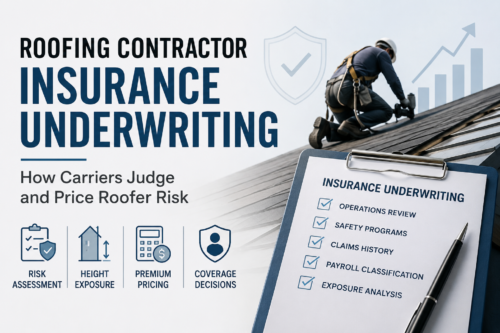
Navigating the complexities of roofing contractor insurance underwriting requires a deep understanding of how commercial insurance carriers calculate volatile construction hazards. Underwriters look past superficial company titles to evaluate working heights, material heating methods, subcontractor exposure, payroll classifications, and historical regulatory compliance.
These operational realities move through a sequence of distinct underwriting decisions before they become a bound policy: classification, exposure evaluation, base underwriting, carrier appetite, and account capacity all sit upstream of the coverage a contractor ultimately holds. A roofing account can be perfectly eligible and still fall outside what a given carrier is currently willing to write, or be welcomed by a carrier but offered less limit than the contract requires. This guide walks through that full sequence, providing contractors and risk managers with a blueprint to optimize account presentation and protect their coverage at every stage.
Why Roofing Contractors Face Higher Insurance Risk
Daily Physical and Environmental Realities
Roofing operators encounter intense physical and environmental friction. Daily exposure is defined by continuous steep-slope navigation, variable structural integrity of roof decks, and unmitigated climate conditions. These factors reduce physical grip, accelerate fatigue, and multiply mechanical error rates, turning routine movements into high-consequence safety risks within the broader Construction Workers Insurance ecosystem.
Injury and Illness Profile
Because of these environmental realities, the industry profile concentrates heavily on traumatic, permanent injuries rather than short-term illnesses. While lacerations, punctures from fastening tools, and acute musculoskeletal strains from handling heavy materials represent high-frequency claims, the trade is dominated by extreme severity risks. Falls from roof edges, scaffolding collapses, and catastrophic drops through unprotected skylights result in permanent orthopedic destruction, severe traumatic brain injuries (TBIs), or fatalities.
Why Roofing Injuries Create Long-Term Insurance Costs
When a roofing worker is injured, the claim experience is marked by severe friction. In disability insurance underwriting, insurers evaluate whether a claimant can realistically return to their exact trade. Because roofing requires perfect physical balance, mobility, and strength, even minor physical impairments can permanently prevent an employee from safely returning to steep-slope work.
This creates an extended financial tail on claims. Insurers realize that roofing firms have near-zero light-duty roles available on a job site, meaning injured workers often stay on total temporary disability or permanent partial disability benefits for maximum durations, driving up the ultimate cost of the file.
How Insurers Classify Roofing Contractors
Primary Regulatory Codes: NCCI, ISO, NAICS
Underwriters standardize this real-world risk using specific regulatory codes. For workers’ compensation, payroll must be allocated according to NCCI Class Code 5551 (Roofing – All Kinds), which carries some of the highest base rates in construction. For general liability, underwriters use one of two ISO codes depending on the height and occupancy of the work: ISO Code 98678 (Roofing – Residential, Three Stories & Under) or ISO Code 98677 (Roofing – Commercial or Residential Over Three Stories). On a broader macroeconomic scale, these businesses are tracked under NAICS Code 238160 (Roofing Contractors).
- NAICS 238160 — Industry classification
- SOC 47-2181 — Occupational classification
- NCCI 5551 — Workers’ compensation classification
- ISO 98678 / 98677 — General liability classification, depending on applicable operations and height
These aren’t a sequential chain — a business isn’t sorted from one code into the next. Underwriters use the relevant classification systems together to translate the contractor’s actual operations into insurance risk, each one answering a different regulatory or rating question.
The three-story distinction is embedded in the ISO classification structure itself. Individual carriers may then apply their own height, occupancy, material, territory, or other eligibility restrictions on top of that classification — a separate underwriting decision addressed in the underwriting section below.
Transitional Drift and Mismatch Risk
A major administrative breakpoint occurs through “transitional drift” — where an employee’s duties shift in the field, but their paperwork remains unchanged. In accordance with standard classification rules, risk evaluation is entirely exposure-based, meaning workers are classified by what they physically do, not by their official titles.
If a worker is hired as a low-risk “Siding Installer” or “Residential Carpenter” but is reassigned to patch a roof leak, they immediately drift into a higher-hazard classification system. These underlying alphanumeric sorting rules are detailed in our comprehensive guide on Occupational Class Ratings.
Audit and Payroll Exposure
At the annual premium audit, insurers verify operational reality by inspecting payroll ledgers, W-2 forms, 1099 certificates, and material invoices. NCCI’s classification rule for roofing payroll is stricter than many contractors assume: an employee who performs any roofing work during the policy period — not simply a majority of their time — can have their entire payroll assigned to the roofing classification, rather than being split proportionally between a lower-rated code and Code 5551. A “Supervisory Foreman” title does not protect payroll from this treatment if the person is also documented performing manual roofing work in the field.
For business owners, this means a foreman whose wages were coded at a lower supervisory rate can trigger a retroactive premium bill covering their entire annual payroll at the highest roofing classification rate. That surprise audit invoice is one of the most common and most avoidable financial shocks in the trade, and it’s why clean task documentation matters as much as the underlying safety record.
Roofing Exposures That Drive Underwriting
Height and Slope
The vertical scale of a project is the single most critical variable carriers evaluate, a process detailed in Height Exposure Underwriting. Extreme pitch and slope dramatically accelerate fall velocity and complicate standard personal fall arrest setups. The specific height thresholds carriers use to draw eligibility lines are addressed below.
Multi-Employer and Site Conditions
- Multi-Employer Site Friction: Operating on a single site alongside crane operators, structural steel workers, and masonry crews increases the likelihood of cross-liability accidents.
- High-Angle Evacuation Hurdles: Working on high-rise commercial skeletons where standard emergency services cannot easily extract an injured worker, requiring specialized high-angle rescue teams.
Hot Work and Material Heating Methods
Open-flame and heat-applied roofing systems — torch-down membranes, hot asphalt kettles — introduce a fire exposure that mechanically fastened or cold-adhesive systems don’t carry. The risk isn’t limited to the moment of application: smoldering ignition can develop inside insulation or decking and surface hours after a crew has left the site, which is what separates hot-work fire severity from an ordinary jobsite accident.
This exposure is why hot work is treated as a distinct underwriting category rather than folded into general roofing operations — it resurfaces below as a primary disclosure concern among underwriter red flags.
Subcontractor Exposure
Roofing operations frequently depend on subcontracted or 1099 crews, which introduces a control and insurance-transfer problem distinct from height or material exposure: the general contractor doesn’t fully control the sub’s safety practices, and the sub’s own coverage may not respond the way either party assumes at time of loss.
A certificate of insurance is evidence of coverage, not the coverage itself. A subcontractor without adequate evidence of workers’ compensation and liability coverage can create both insurance-transfer and audit problems for the general contractor. Where the subcontractor’s status or coverage cannot be substantiated, the contractor may face additional payroll exposure or classification consequences under the applicable rating and audit rules. The same control problem shows up on the liability side, addressed later in the “Your Work” exclusion discussion, and the mitigation step appears in the eligibility-improvement section.
Seasonal Labor Surge
The roofing sector is subject to intense seasonal volatility. During peak summer construction surges, payrolls expand rapidly with temporary or uncertified laborers, increasing frequency risk. What this surge does to underwriting margin specifically is addressed in the cost-factors section below.
How Roofing Contractor Insurance Underwriting Works
Base Rates
The underwriting process begins with the base rate, which is a fixed dollar amount charged per $100 of payroll or gross revenue. This base rate is determined by historical loss-cost data within a specific state or territory. Because roofing is actuarially categorized as a severe risk, its baseline pricing is heavily loaded before any individual company credits or safety factors are considered.
Experience Modification Rate (EMR): How It Affects Roofing Insurance
The primary mechanism used to adjust the base rate is the Experience Modification Rate (EMR), or “Mod.” The EMR acts as a direct mathematical reflection of a contractor’s safety record compared to the industry average (which is set at 1.0), and it applies as a direct multiplier to the manual premium — the base rate before other rating factors are layered on.
- An EMR of 0.85 means the contractor has a better-than-average safety record, which translates to roughly a 15% reduction on the manual premium portion of the workers’ compensation cost.
- An EMR of 1.35 signals a decaying safety framework, applying roughly a 35% surcharge to that same manual premium base.
The mod is a powerful lever, but it isn’t the only one: schedule credits or debits, rating deviations, expense constants, and state-specific rating plan rules are applied on top of the mod-adjusted premium, so the EMR’s effect on the final bottom-line premium a contractor actually pays can differ from a simple percentage of the total bill.
Eligibility Filters
To protect their portfolios, insurance companies establish hard eligibility filters that screen out high-risk processes. Standard, well-known insurance markets operate under strict guidelines that prohibit them from writing policies for roofing contractors who perform work above a specific story threshold or who use specific high-hazard materials. The three-story distinction embedded in the ISO classification structure, described above, establishes a natural reference point for these filters, but individual carriers set their own eligibility rules on top of that classification: some admitted markets draw the line at two stories, others apply height restrictions only to flat or torch-down work, and the specific threshold that applies to any given account is a carrier-level decision, not a fixed industry standard.
Contractors operating near any height boundary should not assume they fall within standard market appetite. The mechanics of how carriers evaluate vertical exposure and set these thresholds are broken down in Height Restriction Underwriting. Verify the specific threshold in your program guidelines before accepting a contract, not after signing one.
Breaching these filters triggers an immediate underwriting decision breakpoint, forcing the file out of standard lines.
Underwriter Red Flags
When reviewing an application, analysts look for specific red flags that indicate unpriced hazard exposure:
- Undeclared Hot-Process / Open-Flame Operations: Applications claiming 100% cold-applied or shingle work, but financial records showing bulk purchases of torch-down membranes or hot asphalt kettles.
- Gaps in Continuous Coverage: Historical periods where the business operated without active insurance policies, signaling financial instability or hidden losses.
- Rapid Multi-State Expansion: Moving into new state jurisdictions without establishing localized safety management or verified supervisor controls.
How Carrier Appetite Affects Roofing Insurance
Carrier appetite and underwriting eligibility are often used interchangeably, but they answer different questions. Eligibility is a hard filter — a roofing account either meets a carrier’s written guidelines (height, material, territory) or it doesn’t. Appetite is a separate, more fluid judgment: even an eligible account may fall outside what a carrier currently wants to write, based on factors that have nothing to do with that specific contractor’s own record. For a broader look at how appetite functions as an underwriting concept generally, see Insurer Risk Appetite Explained.
Why Two Identical Accounts Can Get Different Outcomes
Appetite operates at the portfolio level, not the individual account level. A carrier tracks its roofing book — every NAICS 238160 account it currently insures — against aggregate loss ratio, territorial concentration, and recent claim trends across that entire book, not just the applicant in front of the underwriter.
This means two contractors with identical NCCI 5551 classification, identical ISO code, and comparable safety records can receive different outcomes from the same carrier, depending on when each one applies. If a carrier’s roofing book has recently absorbed a concentration of weather-driven claims in one territory, or if aggregate loss ratio on the roofing segment has crossed the point where the carrier’s own management flags it for review, new roofing submissions in that territory may be declined or referred for additional underwriting — not because the specific applicant looks worse than average, but because the book itself has moved outside what the carrier is currently willing to add to.
What Separates a Referral from a Decline
Within an eligible account, underwriters commonly distinguish between three outcomes: bindable (fits appetite cleanly), referral (fits eligibility but requires manual underwriting review before a decision), and decline (falls outside appetite even though it may be technically eligible).
For roofing accounts, common referral triggers include a hot-work percentage of revenue that’s disclosed but elevated, a mix of project heights that sits near a carrier’s threshold rather than comfortably under it, incomplete safety documentation even when the underlying safety record is sound, or a subcontractor-heavy labor model without demonstrated COI-tracking discipline. None of these automatically produce a decline — they shift the account from automatic bindability into manual underwriting judgment, where the outcome depends on how the rest of the file supports the application.
Admitted Markets, Surplus Lines, and the Guaranty Fund Distinction
Current market trends show standard insurance providers limiting their footprint strictly to low-rise, non-hazardous residential work. Some standard markets restrict or exclude contractors using hot processes, torch-down systems, or certain commercial elevated-work operations, which can push those accounts toward specialty or surplus lines markets depending on the carrier, jurisdiction, and specific risk characteristics.
Contractors placed in surplus lines must understand a structural difference that is rarely explained clearly: non-admitted carriers are not backed by state guaranty funds. When an admitted carrier becomes insolvent, the state guaranty fund steps in to pay outstanding claims up to statutory limits. That backstop does not exist for surplus lines carriers. Because surplus lines policies generally are not protected by state guaranty funds, contractor recovery options may be limited if a non-admitted carrier becomes insolvent. Contractors should evaluate the carrier’s financial strength — a rating from an agency such as A.M. Best is a common starting point — and discuss these risks with their broker before binding coverage.
How Insurers Determine Roofing Insurance Limits and Capacity
Being within a carrier’s appetite doesn’t mean the carrier will offer whatever limit a contractor requests. Appetite determines whether a carrier is willing to write the account at all; capacity determines how much exposure that carrier is willing to put behind it.
Market-Level Capacity
Because roofing carries a high-severity loss profile, carriers may restrict the amount of liability exposure they are willing to retain on individual accounts or within the broader roofing portfolio. During a hard insurance market cycle, standard, well-known admitted carriers aggressively pull back their appetite, completely shutting down their roofing programs and refusing to write new accounts.
Account-Level Capacity and Layered Limits
Even within an eligible, appetite-fitting account, a single carrier rarely offers unlimited liability capacity on one policy. Carriers manage per-account exposure against their own net retention and reinsurance arrangements, which is why roofing GL and umbrella placements are frequently layered across more than one carrier rather than issued as a single large policy — particularly once a project’s contract requirements exceed what one market wants to retain net.
Contractual insurance requirements can exceed the primary GL limits a roofing contractor would otherwise purchase. Larger commercial, infrastructure, or high-value projects may require excess or umbrella layers above the primary policy, particularly for a trade carrying roofing’s severity profile. The required limits are contract-specific rather than universal regulatory minimums, set by the general contractor or project owner on a project-by-project basis — any specific project’s requirement should be confirmed against that project’s insurance exhibit rather than assumed.
Why Contractors Should Read the Aggregate Structure, Not Just the Limit
A per-occurrence limit and a general aggregate limit answer different questions, and roofing contractors running multiple simultaneous projects are exposed to a version of this that’s easy to miss: a standard general aggregate is typically shared across all of a contractor’s projects during the policy period, not held separately per job. A claim on one project can erode the aggregate that a different, unrelated project was counting on. Contractors running several active jobs at once should confirm with their broker whether a per-project aggregate endorsement is available, rather than assuming the stated aggregate limit is available in full for each individual job.
Additional Insured Requirements and Coverage Scope
When a roofing subcontractor is required to add a general contractor as an additional insured, this is fundamentally a coverage and contractual risk-transfer question, and the specific endorsement used determines whether that coverage extends to completed-operations exposure or only to active-operations exposure. CG 20 10 covers the additional insured for claims arising from ongoing operations; CG 20 37 covers the additional insured for claims arising from completed operations — GCs commonly require both, since CG 20 10 alone leaves the GC unprotected once the roofing sub has left the site, subject in each case to the exact edition and endorsement wording actually issued on the policy. This connects directly to the “Your Work” exclusion and its subcontractor exception discussed below.
Inland Marine Sublimits
Specialty-line capacity questions extend beyond GL. Inland marine policies covering roofing equipment — kettles, generators, rigging — commonly apply per-item or blanket sublimits below the policy’s headline limit, meaning a contractor’s actual equipment value on a given site can exceed what blanket coverage would pay out. Contractors carrying higher-value equipment concentrations on a single site should confirm with their broker whether scheduling specific high-value items is available, rather than relying on blanket inland marine coverage alone.
What Factors Increase Roofing Insurance Costs
Size and Scale
The premium and risk structure varies significantly based on the scale of the operation. Small, residential “Chuck-in-a-truck” firms face intense scrutiny regarding owner-operator exposure; if the owner is injured on the wood deck, the business loses its primary revenue driver and management layer simultaneously, spiking the risk of an extended disability claim. Conversely, large commercial roofing enterprises are evaluated on corporate risk management frameworks, subcontractor safety verification, and formal safety director roles.
Safety Controls
Carriers heavily favor contractors who back up their applications with documented, verifiable safety controls. This includes keeping flawless records of formal OSHA 10-hour or 30-hour cards, logging daily equipment and harness inspections, and utilizing engineered anchorage points rather than temporary job-built structural ties.
Historical OSHA citation patterns can materially influence underwriting decisions, premium calculations, and carrier appetite. OSHA Fall Violations and Insurance Costs explains how repeated safety violations affect pricing, renewals, and long-term insurability.
Seasonal Variability
Actuarially, the seasonal labor surge described above compresses the underwriter’s margin, prompting deep reviews of a contractor’s formal onboarding and safety training protocols for short-term workers.
Accumulation Risk
Insurers must manage “accumulation risk,” the concentration of multiple insured risks in a single geographic zone. If a carrier insures twenty roofing contractors in a single coastal city, a major severe weather event or hurricane could trigger simultaneous claims across all twenty policies, creating concentrated loss exposure within the insurer’s regional portfolio. Underwriters use strict territorial caps to limit their exposure to this aggregated risk — the same territorial concentration dynamic that shapes carrier appetite decisions described above.
What Insurance Policies Do Roofing Contractors Need?
Workers’ Compensation Interpretation
From a workers’ compensation standpoint, the insurer’s exposure is entirely focused on the human element, statutory medical coverage, lost wage replacement, and long-tail permanent disability. Because workers’ compensation is a “no-fault” statutory line, the carrier must pay for employee injuries sustained on the job, even if the worker violated a company safety policy. To price and manage this statutory exposure, underwriters enforce aggressive pricing loads via NCCI Code 5551.
General Liability and Completed Operations
General liability underwriters evaluate risk through a completely different lens: property damage and third-party bodily injury. These boundaries are structured as strict contractual caps, analyzed under height restrictions. For roofers, this exposure is split into two critical hazards:
- Operations Risk: An open asphalt kettle tipping over and causing an active fire, or rainwater penetrating an exposed roof deck during a tear-off, causing massive interior structural damage to a client’s building. This specific exposure is managed through General Liability Roofing Insurance policies.
- Completed Operations Risk: Completed operations is the single highest long-tail general liability exposure for commercial roofing contractors, and it is consistently the most misunderstood coverage in the trade. Unlike operations risk, which covers active job-site incidents, completed operations liability attaches after the work is finished and the contractor has left the site. A roof that fails two or three years post-installation due to a hidden membrane defect, improper flashing, or inadequate drainage design can collapse, flood a building interior, or injure a third party. Such claims are often evaluated under the completed operations portion of the commercial general liability policy, subject to policy terms, exclusions, and endorsements.
Occurrence vs. Claims-Made Forms
The policy form type is the threshold decision in completed operations coverage. An occurrence policy generally responds to bodily injury or property damage that takes place during the policy period, regardless of when the claim is filed. If a roof installed in 2023 fails in 2026 and causes a collapse, an occurrence policy active during the period of damage may respond, even if that policy has since been cancelled or the carrier has exited the market. Standard commercial GL for roofing is overwhelmingly written on this occurrence basis, precisely because of the multi-year lag between installation and structural failure.
Claims-made GL is less common in roofing but does appear in certain placements. A claims-made policy only responds if both the triggering incident and the formal claim filing occur while the policy is active. A contractor placed on a claims-made form who switches carriers, lets a policy lapse, or retires without purchasing tail coverage can find every project completed under the old policy suddenly uninsured. If a roofing account is offered on a claims-made basis, the long latency between project completion and detectable failure makes this form a structural coverage risk that contractors need to evaluate carefully before binding, and it’s worth asking the broker directly why an occurrence form isn’t available.
Extended Reporting Periods: Tail Coverage
Contractors on claims-made forms who change carriers, downsize, or exit the business must purchase an Extended Reporting Period (ERP), commonly called a “tail.” The tail extends the window during which a claim can be filed and still trigger the old policy’s coverage. Without it, every completed project from the claims-made policy period becomes uninsured the moment the policy lapses.
ERP pricing varies by line, carrier, and tail length, but commonly runs well above the expiring annual premium — figures anywhere from roughly 100% to 300% or more of that premium are seen across different tail lengths and lines of business, with longer tails costing proportionally more. This cost surprises most contractors who assumed that cancelling a policy ended all exposure. It does not. Cancellation closes the coverage window but leaves the underlying liability intact. Construction defect statutes of repose vary considerably by state — commonly falling somewhere in a six-to-ten-year range from substantial completion, but running as short as four years in some states and as long as fifteen in others — meaning in most jurisdictions the liability window outlasts the policy by years unless tail coverage is in place. Confirm the specific statute of repose in the relevant project’s state rather than assuming a standard figure.
The “Your Work” Exclusion
Standard commercial general liability policies contain a “your work” exclusion (ISO CG 00 01, Exclusion L) that eliminates coverage for property damage to the completed work itself. This is one of the most consequential and least-explained exclusions in roofing GL policies.
In practice, if a roof membrane fails due to faulty installation, the GL policy will typically cover resulting damage — water intrusion destroying interior finishes, electrical systems, stored inventory — but will exclude the cost of repairing or replacing the defective roof itself. The line between the defective work product and the consequential damage it causes determines what gets paid on a given claim, and that allocation is often disputed rather than automatic.
Contractors should also verify how the subcontractor exception within this exclusion is structured on their specific policy. ISO’s standard form can restore coverage for damage caused by a subcontractor’s work, but only when the endorsement language is correctly structured and the subcontractor’s operations are properly scheduled — the same CG 20 10 / CG 20 37 endorsements discussed above. Carriers routinely issue policies where this exception is narrowed or deleted, leaving the general contractor exposed for damage originating from subcontracted work. Confirm this language with your broker or coverage counsel before any commercial project involving subcontracted roofing labor.
Specialty Lines: Inland Marine and Commercial Auto
- Inland Marine (Equipment/Cargo): Covers expensive tools, asphalt kettles, generators, and safety rigging while in transit or stored on-site. Underwriters look at security storage protocols and theft history, and blanket coverage may carry sublimits that fall short of actual equipment value on a given site.
- Commercial Auto: Evaluates the risk of heavy supply trucks, dump trucks, and trailers transporting heavy materials. Carriers closely screen the Motor Vehicle Records (MVRs) of all drivers, since a single commercial auto collision involving a multi-ton roofing truck represents a severe liability exposure.
Common Roofing Insurance Coverage Failure Paths
Claim Failures
One important failure path begins when an undisclosed operation becomes relevant to a claim. If a residential contractor takes a high-margin commercial contract requiring an open-flame torch-down system without notifying their broker, any resulting fire or injury triggers an immediate, intense forensic investigation.
Coverage Gaps
A gap between actual field work and policy definitions is a common source of coverage disputes. The underwriting logic surrounding these vertical boundaries is broken down in Catastrophic Fall Risk in Occupational Insurance. If a contractor performs work outside a policy’s disclosed operations, stated eligibility parameters, or applicable endorsements — for example, working above a height restriction stated in the policy — the resulting claim may trigger a coverage investigation. Depending on the policy language and jurisdiction, that dispute may involve exclusions, misrepresentation, rescission, classification issues, or other coverage defenses, rather than an automatic denial.
Coverage Reliability Failures
If an underwriter discovers that a roofing firm deliberately hid its true operational hazards, such as misclassifying roofers as low-hazard siding installers on application questionnaires, this can expose the policy to rescission or other coverage defenses within the contestability window, subject to the specific policy language, the applicable state’s insurance law, and the facts of what was misrepresented.
Where rescission does apply, the consequence can be more severe than contractors expect: rather than voiding coverage only for the incident project, a rescinded policy may be treated as though it never existed, potentially affecting other projects completed during that same policy period. Whether and how broadly that applies depends on the jurisdiction, the policy’s own terms, and the specifics of the misrepresentation — it is not an automatic, universal outcome.
A forensic audit that leads to rescission can therefore expose the business to liability well beyond the incident that triggered the investigation. In high-severity cases, the resulting out-of-pocket defense costs and damage awards across multiple open claims can create serious financial strain, up to and including corporate liquidation in extreme cases.
Many of these breakdowns follow recurring patterns seen across hazardous occupations, which are examined in Common Reasons Claims Are Denied for Risk Jobs.
Claim Breakpoints
The ultimate breakpoint occurs when a claim is officially denied due to material misrepresentation. In high-severity cases, a denied third-party bodily injury or structural property claim forces the roofing contractor to pay defense costs and damages out of pocket, frequently leading to corporate liquidation or bankruptcy.
[Undisclosed Hazard Exposure] → [Loss / Claim] → [Coverage Investigation] → [Potential Coverage Defense or Rescission] → [Coverage Dispute / Uninsured Exposure]Why Roofing Insurance Availability Changes
Carrier appetite and capacity for roofing are not fixed — they move across the insurance market cycle, and understanding why helps explain sudden availability changes that have nothing to do with an individual contractor’s own record.
The roofing sector is highly sensitive to litigation surges and changes in local safety laws. In regions with strict structural liability rules or aggressive tort environments, third-party lawsuits against contractors spike sharply following site accidents, completely upending the standard Commercial Roofing Insurance Claims Process. When litigation costs rise, insurance carriers respond by increasing baseline premiums across the entire roofing pool, tightening exclusions, and reducing the availability of standard general liability coverage — one of the portfolio-level pressures that can push a carrier’s roofing book past the loss-ratio point described above, prompting broader non-renewal or appetite withdrawal rather than an account-by-account response.
A hard market cycle compounds this: when reinsurance becomes more expensive or scarcer, account-level capacity constraints tighten across the market simultaneously, independent of any single carrier’s own roofing-book performance. This is why availability can shift abruptly even for contractors with strong, unchanged safety records — the cycle is a market-wide condition, not a verdict on any one account.
How Roofing Contractors Can Improve Insurance Eligibility
Immediate Mitigation Wins
Contractors can secure immediate eligibility improvements and better pricing terms by implementing quick, transparent operational changes:
- Isolate Task Documentation: Maintain clean daily logs separating ornamental or gutter work from active roofing, preventing the automatic downward reclassification of lower-risk workers.
- Enforce Subcontractor Controls: Mandate that any hired subcontractor provide a valid Certificate of Insurance (COI) matching or exceeding your own general liability limits, with an explicit “Hold Harmless” indemnity agreement attached.
Structural Data Compliance
Achieve long-term compliance by aligning all internal payroll and operational records with standard institutional databases. Ensure your internal job cost data matches NCCI Code 5551 definitions, and audit your job titles against the federal 2018 SOC taxonomy before submitting your files to an underwriter. Providing an organized, database-compliant file signals a structured risk culture to the carrier’s automated screening software.
System-Compliant Account Presentation
When presenting an account to an underwriter, package your application as a professional, defensive submission. Do not simply fill out a generic questionnaire. Include a typed, formal safety manual modeled after the OSHA Roofing Safety Framework, provide a five-year verified EMR history report, include a written high-angle rescue protocol, and detail your sub-contractor pre-screening process.
A comprehensive, system-compliant presentation proves to the underwriter that you understand your hazards, separating your business from low-tier operations and unlocking access to competitive pricing and preferred carrier tiers.
Key Underwriting Takeaways
The Roofing Underwriting Sequence
Classification determines which codes apply to the business (NCCI, ISO, NAICS, SOC).
Exposure identifies the specific operational hazards — height, hot work, subcontractor use — that drive the underwriting decision.
Underwriting translates those exposures into base pricing, EMR adjustment, and eligibility filters.
Appetite determines whether a carrier currently wants this account, independent of whether it’s technically eligible.
Capacity determines how much limit that carrier is willing to put behind the account once appetite is confirmed.
Coverage defines what’s actually protected once a policy is bound.
Claims failure paths show where undisclosed or misrepresented exposure unravels that coverage after the fact.
A roofing account can clear every earlier stage and still stall at appetite or capacity — which is why understanding this full sequence, not just the coverage forms themselves, is what separates a defensible submission from one that keeps getting declined or underpriced for reasons that were never explained.
————————————————————————————————————–Institutional and Underwriting References
Occupational Safety and Health Administration (OSHA)
Roofing Fall Protection Standards (29 CFR 1926 Subpart M) — Referenced for fall-protection requirements, warning line systems, personal fall arrest standards, ladder safety, and regulatory compliance factors that influence roofing underwriting and claim investigations.
National Council on Compensation Insurance (NCCI)
Workers’ Compensation Classification Inspection & Class Code System — Referenced for NCCI Code 5551 payroll allocation, workers’ compensation rating structures, Experience Modification Rate (EMR) calculations, audit procedures, and multi-state roofing classifications.
U.S. Bureau of Labor Statistics (BLS)
Census of Fatal Occupational Injuries (CFOI) and Injury & Illness Statistics — Used to evaluate roofing fatality trends, injury frequency, claim severity patterns, and broader occupational risk characteristics across construction trades.
U.S. Bureau of Labor Statistics — Standard Occupational Classification (SOC) System
2018 Standard Occupational Classification (SOC) System — Referenced for occupational classification validation, task-based risk identification, roofing trade categorization under SOC 47-2181, and underwriting exposure verification.
National Institute for Occupational Safety and Health (NIOSH)
Construction Falls Prevention Research and FACE Program — Referenced for catastrophic fall exposure analysis, injury mechanisms, rescue challenges, and long-term disability implications associated with elevated work environments.
Insurance Services Office (ISO)
Commercial General Liability Classification System — Referenced for general liability classification structures under Codes 98677 and 98678, roofing operations coding, completed operations exposure, and third-party property damage risk evaluation.
U.S. Census Bureau
North American Industry Classification System (NAICS) — Referenced for industry-level business classification under NAICS 238160 (Roofing Contractors), supporting market segmentation and underwriting categorization.
A.M. Best
Financial Strength Ratings — Referenced for evaluating carrier solvency and claims-paying ability, particularly relevant when contractors are placed with non-admitted surplus lines carriers not backed by state guaranty funds.
National Association of Insurance Commissioners (NAIC)
Admitted and Surplus Lines Market Data — Referenced for the regulatory distinction between admitted and non-admitted carriers and the state guaranty fund protections that apply only to admitted markets.
Reviewed for Underwriting Accuracy
This article was reviewed for underwriting accuracy using:
- Roofing occupational classification analysis (SOC 47-2181, NCCI Code 5551, ISO Codes 98677 and 98678, and NAICS 238160)
- Elevated-work severity modeling and catastrophic fall exposure assessment
- Commercial lines risk engineering principles for roofing operations
- Workers’ compensation rating structures and Experience Modification Rate (EMR) frameworks, including the distinction between mod-adjusted manual premium and final bottom-line premium
- General liability underwriting for completed operations and third-party property damage exposures
- Subcontractor risk transfer analysis, Certificates of Insurance (COIs), and hold harmless agreements
- Payroll classification audits and occupational misclassification scenarios
- Carrier appetite and portfolio-level underwriting dynamics, distinct from account-level eligibility
- Account-level capacity, layered limit structures, and additional insured endorsement mechanics (CG 20 10, CG 20 37)
- Carrier eligibility filters, surplus lines placement, and market appetite restrictions
- Roofing contractor risk selection and carrier appetite analysis across admitted and surplus lines markets
Research and Underwriting Methodology
This article applies an occupational underwriting framework that translates real-world roofing operations into insurance-system classifications, pricing models, and coverage outcomes. The analysis integrates regulatory standards, occupational classification systems, and commercial underwriting practices commonly used across construction-related insurance markets.
Research and underwriting analysis for this article incorporates:
- Occupational classification frameworks, including the 2018 Standard Occupational Classification (SOC) system, NCCI workers’ compensation classifications, ISO liability classifications, and NAICS industry codes
- Regulatory guidance from OSHA roofing safety standards and fall-protection requirements
- Occupational injury and fatality datasets from the Bureau of Labor Statistics (BLS) and NIOSH research programs
- Workers’ compensation rating principles, including payroll allocation, experience modification, and audit procedures
- Commercial general liability underwriting, completed operations exposures, and third-party property damage analysis
- Roofing contractor eligibility filters, including height restrictions, open-flame operations, and subcontractor risk transfer mechanisms
- Carrier appetite dynamics at the portfolio level, including loss-ratio-driven underwriting decisions distinct from account-specific eligibility
- Account-level capacity, layered limit conventions, and additional insured endorsement structures common to commercial roofing contracts
- Market-capacity dynamics affecting admitted carriers and surplus lines placement for elevated-risk construction operations
The objective of this methodology is to translate institutional underwriting systems into practical operational consequences that roofing contractors can use to improve eligibility, strengthen risk presentation, and maintain coverage reliability.