Reviewed for underwriting accuracy by the RJI Underwriting Research Team | Published: June, 2026 | Last reviewed: June, 2026.
————————————————————————————————————–
Executive Summary
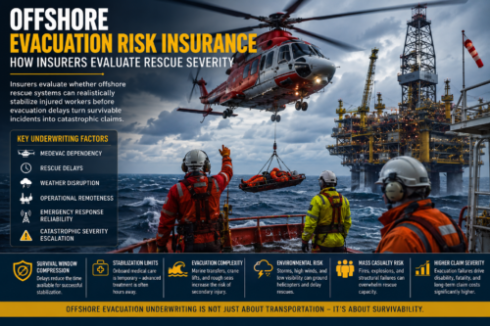
Offshore evacuation risk insurance measures how delays in extraction, stabilization, and transport increase claim severity after offshore injuries occur. Insurers evaluate rescue redundancy, medical access, weather dependency, and evacuation capacity because rescue performance often determines whether a survivable injury becomes a permanent disability or fatality claim.
Offshore evacuation risk insurance addresses a single, high-stakes underwriting variable: the measurable gap between when a worker is injured and when that worker reaches definitive medical care. Underwriters do not treat evacuation as a logistical line item. They treat it as a primary severity-control mechanism. How well your rescue system performs during that window determines whether a survivable injury stays survivable and whether your operation remains insurable at standard terms.
The central underwriting question is not whether evacuation is possible. It is whether survivability can be preserved while evacuation is taking place. As extraction delays increase, insurers assume both claim severity and long-term disability exposure increase as well.
What Is Offshore Evacuation Risk Insurance?
Offshore evacuation risk is the incremental injury severity and financial exposure created by operational remoteness. It quantifies the probability that a medically survivable event becomes a fatal, permanently disabling, or catastrophically expensive claim due to delays in extraction, stabilization, or transport to definitive care.
This variable is distinct from the underlying injury itself. It measures the compounding effect of distance, weather dependency, platform type, and rescue system reliability on the trajectory of any given claim.
Underwriters evaluate this risk across four dimensions:
- Extraction delay — time elapsed between injury and secured evacuation
- Stabilization capacity — the asset’s ability to maintain a patient’s vital signs during that delay
- Rescue system redundancy — the number of independent fallback pathways if the primary system fails
- Jurisdictional and regulatory complexity — the legal and rescue-coordination framework governing the operational zone
This variable sits at the foundation of our core pillar on Offshore Risk Underwriting: How Insurers Evaluate Marine & Remote Workers, which outlines how insurers measure an asset’s baseline survivability under deteriorating safety margins.
Why Insurers Care About Offshore Evacuation Risk
Onshore trauma systems are built around rapid stabilization. A severe crush injury near an urban trauma center is a serious but manageable claim because advanced surgical care is eight to twelve minutes away. Offshore, that same injury may not reach a trauma surgeon for eight to twelve hours.
That interval is where underwriting exposure is created. Insurers care about offshore evacuation risk for three structural reasons:
Severity Is Time-Dependent
Internal bleeding, compartment syndrome, severe burns, and cardiac events all deteriorate exponentially when definitive care is hours away. A claim that would cost $180,000 onshore can produce a permanent total disability payout offshore, not because the injury was worse, but because the response was slower. This dynamic is why Managing Remote Rescue Delays in Offshore Claims is a dedicated underwriting concern; extended extraction delays directly convert acute medical claims into long-term disability exposure.
Primary Rescue Systems Are Weather-Dependent
Most remote operations rely on helicopter medevac as their primary bridge to hospital care. But helicopter operations are acutely vulnerable to the same marine weather that creates offshore hazards in the first place, fog banks, gale-force winds, low ceilings, and deteriorating sea states. An operation’s flight contract is irrelevant if those rotors cannot legally turn. Our breakdown on Helicopter Transport Risk in Offshore Insurance details how carriers map flight safety logs and local climate risk directly into baseline premium structures.
Cascading Rescue Failure Creates Catastrophic Exposure
Insurers are not primarily worried about one system failing. They are worried about a single weather event simultaneously grounding the primary helicopter, disrupting satellite communications, and degrading vessel visibility, eliminating all rescue pathways at once. An operation with no documented fallback system gives the underwriter no mechanism to bound worst-case severity exposure.
OSHA 1915 emergency-response requirements recognize that rescue planning is not merely a safety obligation. From an underwriting perspective, documented emergency-response capability serves as evidence that extraction delays can be controlled before injury severity escalates into a materially larger claim.
How Insurers Model Offshore Evacuation Severity
Survival-Window Compression
Insurers apply survival-window compression models to offshore evacuation risk. Underwriters use this concept because time itself becomes a severity multiplier. The longer definitive care remains unavailable, the greater the probability that a manageable injury evolves into a permanent disability or fatality claim.
Data published by the National Institute for Occupational Safety and Health (NIOSH) confirms that delayed emergency access materially worsens fatality rates across remote and high-risk occupational environments. Underwriters translate this directly into claim severity projections.
The severity model accounts for four-layered variables:
Platform Type and Extraction Complexity
This materially affects baseline severity exposure. Fixed offshore platforms provide structurally consistent landing zones and extraction pathways. Floating infrastructure, drillships, FPSOs (Floating Production, Storage, and Offloading units), and semi-submersibles introduces vessel motion, shifting landing angles, and operational drift that complicate both helicopter landings and marine extractions as weather conditions deteriorate. Simultaneous movement of critically injured workers across moving vessels, cranes, and platforms represents the highest-severity transfer scenario underwriters encounter.
Evacuation Method Limitations
These are mapped against real-world operational thresholds:
| Evacuation Method | Real-World Operational Limit | Severity Modeling Implication |
|---|---|---|
| Personnel Baskets & Capsules | Sea State 4 or higher | High risk of basket impact against the vessel rail, converting a standard injury into catastrophic disability exposure. |
| Helicopter Medevac | Visibility below CAP 437 safety parameters | Loss of primary evacuation capability; treatable injury continues to deteriorate on the asset. |
| Fixed Platform Chutes | Structural fire or explosion masking | Saturated escape pathways; chaotic multi-worker evacuation; catastrophic loss limit exposure |
Evacuation Saturation Risk
This is a distinct severity threshold. A rescue plan that successfully handles one injured worker can collapse completely during a platform fire or structural failure. If a flash fire injures four workers simultaneously and the contracted medevac helicopter carries two litter patients at a time, the remaining crew faces an extended delay while the aircraft cycles to shore. Once onboard, incident volume saturates primary life-safety infrastructure, rescue timing collapses, and survival odds plunge.
Onboard Medical Capacity
Onboard medical capacity determines how long the asset can hold a patient before that delay becomes irreversible. An offshore medic can temporarily stabilize an airway. They cannot perform deep trauma surgery. The ceiling on that stabilization window, and its effect on long-term occupational survivability, is covered in depth in Remote Medical Access and Occupational Coverage.
How Offshore Evacuation Risk Affects Claims
Claim Severity Escalation
Failed or delayed evacuations do not generate simple medical cost claims. They generate career-ending disability claims.
A single prolonged stabilization delay can permanently end a maritime worker’s ability to return offshore. That conversion, from an acute injury claim to a lifelong disability payout, represents the primary claims consequence underwriters model for this variable.
Claim Investigation Triggers
When severe claims occur, insurers conduct thorough post-event investigations. Key scrutiny points include:
- Whether the crew followed approved rescue protocols documented in the original submission
- Whether on-deck emergency infrastructure matched what was disclosed during underwriting
- Whether contractor rescue responsibilities were clearly defined and non-overlapping
Transfer-Point Liability Disputes
Coverage disputes also frequently arise from transfer-point ambiguity. When a marine evacuation involves both a platform’s liability wrapper and a marine vessel’s Protection & Indemnity (P&I) club, responsibility for secondary injuries sustained during transfer can become actively contested.
Claim Severity Breakpoints
| Delay Outcome | Underwriting Shift |
|---|---|
| Medical-only claim | Routine reserve |
| Surgery required | Indemnity reserve |
| Permanent impairment | Long-term disability reserve |
| Total disability | Catastrophic reserve |
| Fatality | Maximum severity reserve |
How Offshore Evacuation Risk Affects Pricing
Offshore evacuation risk affects premium pricing through three mechanisms:
Helicopter Dependency
Helicopter dependency without documented weather alternatives triggers direct loading. Carriers pricing operations in high-weather-risk zones, the North Sea, Gulf of Alaska, West Africa offshore blocks, assess flight safety logs, local climate risk data, and documented fallback protocols. Operations that cannot demonstrate a viable surface extraction alternative when helicopter operations are grounded face material premium increases. This correlation is detailed in Helicopter Transport Risk in Offshore Insurance.
Floating Infrastructure Pricing Effects
Floating infrastructure consistently produces higher pricing than fixed platforms at comparable operational distances. The structural unpredictability of moving vessel extractions gives underwriters no consistent baseline for bounding worst-case severity, which is reflected in tighter terms and elevated rates.
Rescue Redundancy and Pricing Pressure
Absence of documented redundancy may be the single largest individual pricing driver. The emergency-preparedness guidance published by the International Marine Contractors Association (IMCA) for offshore operational resilience establishes layered, redundant rescue infrastructure as a baseline operational requirement. Operations without documented fallback systems, where the answer to “if your primary helicopter is grounded, what is your next option?” is effectively “we wait”, face significantly higher underwriting concern and pricing pressure.
How Offshore Evacuation Risk Affects Coverage Eligibility
When an operation pushes beyond standard rescue boundaries, carrier appetite may decline or trigger restrictive exclusions that narrow effective coverage.
Distance and Medevac Range Restrictions
Operations beyond regional helicopter range face the greatest eligibility pressure. As operational distance increases, underwriters assume a higher probability that delayed extraction will convert a medically manageable injury into a permanent impairment or fatality claim.
Public SAR Dependency Concerns
Sole reliance on national coast guards, naval vessels, or public SAR frameworks is also treated as an eligibility risk because those resources remain outside the employer’s direct operational control. Carriers generally favor operations with dedicated rescue agreements, onboard stabilization capability, and documented evacuation alternatives when primary systems fail.
Underwriting Preference for Dedicated Rescue Capability
The International Convention on Maritime Search and Rescue (SAR Convention) establishes regional rescue-coordination frameworks, but insurers generally do not treat public SAR availability as a substitute for employer-controlled evacuation capability. Carrier preference remains aligned with rescue systems that operators can directly activate, monitor, and verify during underwriting review.
Common Offshore Evacuation Failure Paths
The following scenarios illustrate how offshore evacuation risk converts into actual claim and coverage failures:
Helicopter Weather Grounding (North Sea)
A floorhand suffers an open compound leg fracture on a semi-submersible during a violent winter storm. Heavy fog rolls in below legal flight minimums, grounding the contracted medevac helicopter. The crew pivots to a surface emergency standby vessel (ESV), but sea state prevents a smooth transfer. Transit to a shore-based harbor takes approximately 11 hours instead of a 45-minute flight. The worker develops severe compartment syndrome during the delay, resulting in permanent amputation. What should have been a manageable, treatable injury converts into total disability exposure, severely damaging the employer’s long-term loss history.
Dynamic Motion Transfer Failure (West Africa)
During a nighttime evacuation for an acute appendicitis case aboard an FPSO, the helideck is offline for maintenance. The operator uses a crane-assisted basket transfer to an offshore supply vessel. Severe sea conditions cause the supply vessel to heave unexpectedly. The personnel basket impacts the steel deck rail, causing severe secondary lumbar spinal trauma. Claim complexity doubles immediately as coverage responsibility becomes disputed between the platform’s liability wrapper and the marine vessel’s P&I club.
Saturated Evacuation Pathways (Gulf of Mexico)
An isolated flash fire in a process module injures four personnel simultaneously, producing severe airway burns. The platform’s emergency response plan relies on a single contracted medevac helicopter capable of transporting two litter-bound patients at a time. The remaining two workers face a three-hour delay while the aircraft completes its first shore run and returns. The delay results in severe inhalation injury escalation, converting what could have been manageable medical-cure claims into fatality-related claim exposure.
Operational Controls That Improve Insurability
Operations demonstrating layered rescue infrastructure, documented evacuation drills, medical stabilization capability, and redundant communications consistently receive stronger carrier consideration. These controls materially improve operational survivability and directly reduce the severity of exposure underwriters are pricing.
To improve insurability and secure comprehensive offshore evacuation risk coverage at renewal, business owners should document and maintain seven core operational controls:
Layered Evacuation Pathways
Maintain active contracts for both dedicated aviation and specialized marine surface extraction, with documented operational procedures for each.
Documented Rescue Drills
Provide drill logs proving the crew regularly practices emergency extraction protocols under realistic stress conditions, not tabletop exercises alone.
Onboard Stabilization Equipment
Equip the asset’s medical clinic with advanced trauma-holding gear and dedicated telehealth connectivity to shore-based physicians, extending the survivable stabilization window.
Redundant Communications
Ensure backup satellite, radio, and secondary cellular pathways are fully operational and tested independently of primary systems.
Dedicated Rescue Agreements
Secure verified priority-response contracts with private rescue operators rather than relying solely on public emergency infrastructure.
Contractor Coordination
Ensure all subcontractors operating on the asset have clearly defined, non-overlapping emergency responsibilities documented in writing before operations begin.
Climate Risk Modeling
Adapt crew rotations and safety standby modes dynamically based on seasonal regional weather patterns, particularly in high-weather-risk operational zones.
This emphasis on layered rescue capability aligns closely with IOGP operational-risk guidance, which treats redundancy and escalation control as core safeguards against severe offshore loss events.
Key Takeaways
- Offshore evacuation risk is not a transport cost; it is a primary severity-control variable that directly shapes claim outcomes, premium pricing, and carrier eligibility decisions.
- Survival-window compression is the mechanism underwriters measure: the faster a rescue system degrades, the faster a survivable injury becomes a permanent disability or fatality claim.
- Helicopter dependency without documented surface extraction alternatives is a pricing and eligibility trigger, particularly in high-weather-risk operational zones.
- Floating infrastructure — drillships, FPSOs, semi-submersibles — produces structurally higher underwriting concern than fixed platforms due to motion-related extraction complexity.
- Evacuation saturation risk is an independent variable: a rescue plan that works for one worker may fail during a multi-casualty event.
- Sole reliance on public SAR frameworks is treated as an eligibility risk. Dedicated private agreements, redundant communications, and extended onboard stabilization capacity are baseline requirements for top-tier carrier consideration.
- Documented operational controls — drills, redundant pathways, telehealth connectivity, verified contractor responsibilities — are the most effective tools available to improve insurability and pricing at renewal.
———————————————————————————————————————
Research & Underwriting References
Operational concepts throughout this article align with guidance and frameworks associated with:
- OSHA 1915 Shipyard Employment Standards — marine emergency-response protocols
- NIOSH commercial fishing and offshore fatality prevention research
- IMCA M 203 offshore vessel operational guidance
- UK Civil Aviation Authority CAP 437 offshore helicopter standards
- International Convention on Maritime Search and Rescue (SAR Convention)
- IOGP offshore process-safety and operational-risk management guidance
Reviewed for Underwriting Accuracy: offshore evacuation survivability modeling; delayed-response severity exposure; rescue-system redundancy analysis; medevac dependency evaluation; catastrophic severity escalation; and offshore operational-risk assessment.