Reviewed for underwriting accuracy by the RJI Underwriting Research Team | Published: July, 2026 | Last reviewed: July, 2026.
Executive Summary
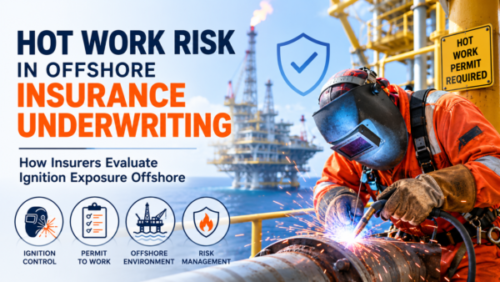
Offshore hot work is any activity that produces open flame, sparks, molten metal, or sufficient heat to serve as an ignition source — welding, flame cutting, grinding, brazing, gouging, and thermal cutting performed during fabrication, repair, or structural maintenance on rigs, platforms, FPSOs, and support vessels. Hot work risk in offshore insurance underwriting is treated differently from most offshore trades because hot work does not simply carry occupational injury risk; it introduces an active ignition source into environments that routinely contain hydrocarbons, confined spaces, and limited emergency egress. A single uncontrolled spark, under the wrong operational conditions, can escalate into a fire, an explosion, a total loss of the asset, and a business interruption claim that dwarfs the underlying repair cost.
Hot work influences underwriting because it changes the loss potential distribution of the risk being insured, not merely the frequency of injury claims. Underwriters are not pricing welding as an activity; they are pricing the reliability of the system that stands between an ignition source and a catastrophic loss. That system includes permit-to-work discipline, gas testing, isolation integrity, fire watch coverage, barrier maintenance, and the operational state of the asset at the time work is performed.
Operational evidence that improves underwriting confidence includes audited permit-to-work records, verified gas detection calibration logs, documented fire watch procedures, isolation certificates, contractor competency records, and a demonstrated history of shutdown planning that separates hot work from active production. Operators who can produce this evidence are treated as more predictable risks; operators who can only assert compliance verbally are treated as uncertain risks, regardless of how safety-conscious their culture may genuinely be.
Underwriting insight: Hot work is not underwritten as a task. It is underwritten as a controlled exposure to ignition, and the quality of that control, not the fact that welding occurs, determines pricing, eligibility, and claims expectations.
Insurance consequence: Because hot work sits at the intersection of property, business interruption, environmental, and liability exposure simultaneously, it receives underwriting attention disproportionate to its share of total offshore work hours.
Understanding Offshore Hot Work Exposure
What Is Offshore Hot Work?
Hot work covers a defined set of activities: welding, flame cutting, grinding, brazing, gouging, thermal cutting, and the fabrication or structural repair work that depends on them. On an offshore asset, these activities are not occasional; they are a recurring operational necessity. Steel corrodes, piping fails, structural members need reinforcement, and fabrication work supports ongoing modification projects. Hot work happens on drilling rigs, production platforms, FPSOs, offshore wind foundations, support and construction vessels, accommodation modules, process modules, ballast tanks, and machinery spaces. Because fabrication work recurs across nearly every one of these locations, offshore fabrication insurance and hot work exposure are evaluated together rather than as separate risk categories. Where hot work must be performed in a zone that cannot otherwise be fully cleared of a flammable atmosphere, operators sometimes use a sealed, positively pressurized hot work habitat as an engineering control, a recognized measure alongside permit-to-work and gas testing rather than a substitute for either.
Insurance consequence: The presence of hot work on an asset’s maintenance schedule automatically elevates underwriting attention, independent of the operator’s safety record. The insurance treatment of offshore hot work exposure begins the moment an intentional ignition source is introduced into a location that did not previously have one.
Where Offshore Hot Work Occurs
What separates offshore hot work from the same activity performed onshore is the operating environment surrounding it. A weld performed in an isolated onshore fabrication yard has no meaningful interaction with process hydrocarbons. The identical weld performed near a production module, inside a ballast tank with residual vapor, or adjacent to an export riser is operating inside, or immediately next to, a system that can supply the fuel component of a fire triangle. Offshore assets compress ignition sources, fuel sources, and confined or restricted egress into the same physical footprint. A platform’s process deck, accommodation block, and machinery spaces sit within a few hundred meters of each other, often connected by shared ventilation, cable runs, or piping corridors. There is no meaningful separation distance the way there might be onshore.
Insurance consequence: Underwriters classify hot work according to the operational environment surrounding it rather than the welding process itself, because identical work performed in different locations produces materially different loss potential.
Why Offshore Conditions Amplify Ignition Risk
Offshore installations cannot rely on rapid reinforcement from municipal fire services or nearby emergency responders. Initial containment depends almost entirely on the platform’s own engineering systems, trained personnel, and emergency procedures, a dynamic covered in detail under Remote Rescue Delays in Offshore Claims. Marine weather, helicopter-dependent evacuation (see Helicopter Transport Risk in Offshore Insurance), and delayed specialist firefighting support all compound the consequence of a control failure that might be minor onshore.
Insurance consequence: Offshore remoteness increases expected claim severity, because delayed intervention allows a relatively minor ignition event to escalate into a major insured loss before external assistance becomes available.
Hot Work as an Interaction Hazard
A welding operation rarely occurs in isolation. It frequently overlaps with active production, confined-space entry, heavy lifting, pressure testing, contractor mobilization, and the fatigue associated with extended offshore rotations (see Offshore Rotation Work and Disability Insurance). Individually, each of these is manageable. Collectively, they increase operational complexity and introduce multiple pathways through which a small control failure can develop into a significant insurance event.
Insurance consequence: Underwriters evaluate hot work not as a standalone activity but as one variable in a cluster of concurrent exposures, because the interaction between hazards, not any single hazard alone, most often determines claim severity.
Why Hot Work Receives Special Underwriting Attention
Why Offshore Hot Work Is Closely Regulated
Hot work is one of the most heavily regulated activity categories in offshore operations, and that regulatory weight is what gives underwriters a defensible basis for evaluation. This sits within the broader logic set out in Offshore Risk Underwriting: How Insurers Evaluate Marine & Remote Workers, available on the Offshore Hub: regulators and industry bodies have converged on a consistent control architecture: Permit-to-Work systems, dedicated Hot Work Permits, mandatory gas testing, assigned fire watches, formal isolation procedures, and integration into broader process safety management and simultaneous operations (SIMOPS) planning.
In the United States, this baseline is set out in OSHA’s general industry welding, cutting, and brazing requirements under 29 CFR 1910.252, which establish the underlying obligations around fire prevention, protection, and the conditions under which hot work may proceed. Internationally, the same architecture is reflected across a broader set of regulatory and industry references, cited throughout this article at the specific points where each one bears on a given underwriting judgment, rather than as a single list here.
None of these frameworks exist to satisfy a compliance checkbox. They exist because hot work sits at the intersection of ignition control, confined space management, and simultaneous operations — three of the highest-consequence hazard categories in offshore operations. An offshore permit to work system is the administrative backbone that forces a documented decision about whether hot work can proceed safely at a specific place and time; gas testing confirms the atmosphere is within safe limits before and during the work; fire watches provide continuous human monitoring for smoldering or delayed ignition; and isolation procedures ensure the equipment being worked on is not still connected to an energy or hydrocarbon source. Together, these controls define how hot work offshore risk is actually managed day to day, rather than how it is described in a safety policy.
Insurance consequence: These regulatory frameworks provide underwriters with an objective standard against which to measure operators. Compliance is not treated as a guarantee of safety, but as evidence that offshore ignition hazards have been designed against, documented, and integrated into routine operations, a documented baseline underwriters can request evidence against, rather than a compliance narrative they must take on faith.
How Insurers Evaluate Offshore Hot Work Risk
This is where regulatory compliance is translated into underwriting judgment. Assessing hot work risk in offshore insurance underwriting means insurers are not asking whether a permit-to-work policy exists on paper. They are asking how reliably that system performs under real offshore operating conditions, and what happens to loss severity if it fails.
Ignition Hazard Modelling
The underwriting logic behind hot work follows a simple causal chain:
Heat Source → Fuel Source → Ignition → Fire or Explosion → Catastrophic Insurance Loss
Every hot work activity intentionally introduces a heat source. Underwriters therefore concentrate on the remaining elements of the chain: whether combustible material or hydrocarbons can be present, whether oxygen can support combustion, whether ignition can spread beyond the immediate work area, and whether existing barriers can interrupt escalation before it does. Rather than assuming every welding operation presents identical risk, insurers model the probability that all components of the fire triangle can combine under actual operating conditions, which is why identical welding procedures receive different underwriting treatment depending on what surrounds them.
Insurance consequence: Underwriters price the completeness of the ignition pathway, not the welding process in isolation; a task with no plausible fuel source nearby is underwritten differently from an identical task performed a few meters from one.
Location Risk
Identical hot work receives materially different underwriting treatment depending on where it occurs. Location changes available fuel sources, evacuation difficulty, fire suppression effectiveness, explosion potential, and repair complexity, the variables that separate offshore fire risk insurance pricing from one asset to the next even when the underlying trade is identical.
Accommodation modules typically carry limited hydrocarbon exposure but high occupant density, so the primary concerns are smoke spread, evacuation, and electrical fire risk. The drilling floor introduces heavy machinery, drilling fluids, and rotating equipment, with ignition potential rising sharply during active drilling; the International Association of Drilling Contractors (IADC) addresses this directly in its guidance on drilling operations and contractor management, given how deep contractor layering typically runs on a drill floor specifically.
The production deck processes live hydrocarbons under pressure, so hot work near separators, manifolds, or process piping carries significantly greater fire and explosion consequence. Gas compression modules combine flammable gases with high operating pressures, meaning even a minor ignition event can develop rapidly into major offshore explosion risk if containment fails. Ballast and cargo tanks may carry lower hydrocarbon exposure but introduce confined-space uncertainty around atmospheric conditions, ventilation, and rescue capability, the mechanism examined in full under Confined Space Underwriting.
Offshore wind structures generally lack process hydrocarbon risk but introduce elevated access, structural, and weather-related evacuation challenges instead. Floating production and support vessels add a further layer specific to marine assets: their onboard fire safety systems fall under International Maritime Organization (IMO) SOLAS-related requirements, which underwriters cross-reference against the platform’s own permit-to-work controls whenever hot work occurs near vessel machinery spaces.
The welding operation itself may be identical across every one of these locations. The insurance exposure is not.
Insurance consequence: Asset location is frequently a stronger predictor of expected claim severity than the hot work process itself, which is why underwriters require location-specific detail in any hot work submission rather than a general description of the activity.
Operational State Underwriting
Hot work does not receive identical underwriting treatment throughout an asset’s operating life. Insurers evaluate each operational state on its own terms.
Active production. Live hydrocarbon systems create continuous ignition opportunities, and pressure, temperature, and product flow all add uncertainty on top of the hot work itself, precisely the scenario the American Petroleum Institute’s API RP 2009, Safe Welding, Cutting, and Hot Work Practices in the Petroleum and Petrochemical Industries (8th edition), was written to govern, since it addresses hot work performed on equipment that may still be in service rather than fully shut down. Insurance consequence: hot work performed during live production is priced at the top of the severity range, and coverage is frequently conditioned on additional isolation or continuous monitoring requirements.
Planned shutdowns. Production has stopped, systems have been depressurized and isolated, and engineering controls can often be verified before work begins. Insurance consequence: underwriting confidence generally improves, because shutdown planning allows barriers to be checked in advance rather than assumed.
Commissioning. New equipment introduces uncertainty because systems have not yet established an operational track record. Insurance consequence: underwriters treat commissioning-phase hot work cautiously even on new infrastructure, since barrier reliability has not yet been demonstrated under real operating conditions.
Decommissioning. Ageing infrastructure, degraded integrity, and unknown historical modifications often increase underwriting uncertainty despite production having stopped. Insurance consequence: reduced production does not automatically translate into reduced pricing — decommissioning hot work can carry elevated severity assumptions precisely because asset condition is less certain, not more.
Emergency repairs. Time pressure reduces planning quality, temporary engineering solutions become necessary, contractors mobilize rapidly, and documentation is often incomplete. Insurance consequence: emergency hot work represents a convergence of elevated operational uncertainty and reduced barrier reliability, and is underwritten and later investigated at claim time, with correspondingly higher scrutiny.
Asset Criticality
Underwriters evaluate the consequence profile of the specific equipment involved, process equipment, export risers, pressure vessels, accommodation blocks, electrical systems, and structural members, not simply its replacement cost. A relatively inexpensive valve located within a major process train may carry far greater underwriting significance than a larger structural component, because its failure could interrupt production, release hydrocarbons, or disable a safety system. Welding near an emergency shutdown control cabinet is a different underwriting concern than welding on secondary steelwork, even though both are technically “hot work.”
Insurance consequence: Underwriting reflects operational dependency and consequence modelling rather than replacement cost alone; the question is not “what does this component cost to replace” but “what does its failure cause downstream.”
Escalation Potential
Underwriters model the pathway from a minor event to a major loss:
Single spark → Local fire → Explosion → Structural damage → Platform evacuation → Major insurance loss
Each stage introduces an additional claim category — property damage, business interruption, pollution liability, contractor liability, employee injury, emergency response costs, regulatory investigation, and legal expense. Platform evacuation carries its own dedicated underwriting treatment, covered separately under Offshore Evacuation Risk and Insurance. Large offshore losses typically develop not because the initial ignition was unusually severe, but because it was not contained quickly enough to prevent secondary failures.
Insurance consequence: Expected claim severity depends far more on escalation potential than on the size of the original ignition event, which is why insurers devote disproportionate underwriting attention to early-intervention barriers, fire watch, gas detection, and isolation, relative to the ignition source itself.
Barrier Reliability
Barrier evaluation generally falls into three categories: engineering barriers (gas detection, automatic fire suppression, passive fire protection, isolation valves, and emergency shutdown systems, typically designed and tested to the API RP 14C safety-systems standard for offshore production facilities), procedural barriers (permits, hot work authorization, inspections, supervisory approval), and human barriers (competence, supervision, communication, procedural discipline). Human barriers often determine whether the other two function as intended; an engineering control that is technically installed but not maintained, or a permit that is technically issued but not enforced, provides no real protection.
Insurance consequence: Insurers do not credit a barrier for existing; they credit it for demonstrated, documented performance. A barrier that cannot be evidenced through maintenance or testing records is treated, for underwriting purposes, much like a barrier that is not there at all.
Permit Reliability
There is a meaningful underwriting distinction between a permit being issued and a permit being properly implemented. A permit may satisfy administrative requirements while failing operationally, work scope changes, atmospheric conditions deteriorate, supervision weakens, or barriers get bypassed under time pressure. Underwriters therefore look past permit volume to permit auditing, supervisory verification, compliance monitoring, and closure procedures, the same evidentiary standard reflected in the International Association of Oil & Gas Producers (IOGP) guidelines on permit-to-work systems (reference 6.29/189) and the UK Health and Safety Executive’s HSG250, Guidance on Permit-to-Work Systems, both of which treat audited implementation, rather than administrative issuance, as the marker of a functioning system.
Insurance consequence: Underwriting confidence increases when permit systems demonstrate consistent implementation, not administrative completion; a stack of correctly filled-out forms is not, by itself, evidence that the control worked.
Gas Detection Reliability
Atmospheric testing, continuous monitoring, calibration records, and verification procedures all factor into underwriting confidence. A gas detection program that is calibrated on a documented schedule and produces auditable logs is underwritten differently than one where testing occurs but is not consistently recorded.
Weak evidence typically looks like a single pre-permit reading with no record of who took it, no calibration date attached to the instrument used, and no retest requirement if the work extends beyond its original time window. Strong evidence looks different in kind, not just degree: instrument-specific calibration certificates, named personnel accountable for each reading, a documented retest interval tied to elapsed time or changing conditions, and — in higher-risk locations such as confined spaces — a continuous monitoring log rather than a series of spot checks. Underwriters read the second pattern as evidence the control is designed to catch a changing atmosphere, not just document a safe one at a single moment.
Insurance consequence: Verified gas detection reduces underwriting uncertainty by providing objective evidence that ignition conditions remain controlled throughout the work — absence of a testing record functions, in underwriting terms, much like absence of the testing itself.
Isolation Integrity
Lockout/tagout, depressurization, line blanking, and electrical isolation are the mechanisms that remove the fuel source from the ignition equation. Isolation failures appear repeatedly in major industrial loss investigations, almost always because equipment believed to be safe remained connected to a hazardous energy source.
Weak evidence of isolation is a signed isolation certificate with no independent verification step — the person who isolated the equipment is also the only one who confirmed it was done correctly. Strong evidence separates those two roles: an independent second check before the permit is authorized, a physical tag or lock keyed to a specific isolation point rather than a general work area, and — for line blanking or depressurization specifically — a positive confirmation method rather than an assumption based on a valve position. Underwriters treat the second pattern as materially more reliable, because it removes single-person error from the one step in the sequence where a mistake most directly reintroduces the fuel source.
Underwriting implication: Incomplete isolation directly reintroduces the fuel source the entire permit-to-work system was built to eliminate, which is why isolation verification — not just isolation procedure — is treated as a primary determinant of ignition probability.
Human Reliability Under Operational Pressure
Underwriters evaluate fatigue, production deadlines, contractor turnover, communication quality, supervision ratios, and schedule compression as organizational reliability factors, not as individual behavioral judgments. The objective is not to predict individual conduct but to assess whether the system holds up when operational pressure increases.
Underwriting implication: A permit system that performs well under normal conditions but degrades under schedule pressure is underwritten as a materially weaker control than one with evidence of holding up consistently, even though both may look identical on paper during a routine week.
Simultaneous Operations (SIMOPS)
Hot work frequently overlaps with lifting operations, confined-space entry, diving operations, helicopter activity, active production, and pressure testing. Each concurrent activity adds an independent hazard pathway to the same physical space and time window — Exposure Stacking. A welding operation conducted during isolated maintenance may be entirely acceptable; the same operation performed during active lifting over live hydrocarbon systems, while confined-space entry is also underway, presents a fundamentally different underwriting profile.
Insurance consequence: A hot work permit issued without visibility into concurrent SIMOPS activity is treated as a weaker control than one integrated into a coordinated operations plan, because the underwriting question shifts from “is this activity controlled” to “are all interacting activities controlled together.”
Contractor Interface Risk
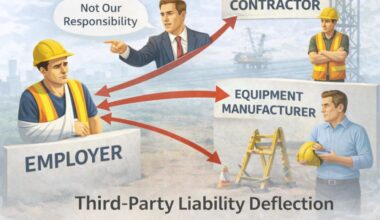
Offshore hot work frequently involves multiple contractual layers: Operator → Main Contractor → Subcontractor → Specialist Hot Work Contractor. Each layer may hold personnel, equipment, supervision, and permit responsibilities, and major offshore losses often expose failures not in technical procedure but at these organizational interfaces — where one party assumes another has completed a critical control. On international projects, this fragmentation compounds with jurisdictional questions covered under International Waters Insurance Exclusions, particularly when contractors are mobilized across flag states with different regulatory expectations.
Underwriting implication: Fragmented responsibility increases underwriting uncertainty independent of the technical quality of the work itself, which is why insurers ask specifically who owns the permit and who is accountable for isolation verification, not just whether isolation occurred.
Maintenance vs. Construction Underwriting
Construction hot work generally occurs before hydrocarbons are introduced, so while injury exposure may be substantial, catastrophic fire potential is often lower before production systems are live. Maintenance hot work, by contrast, typically occurs on assets with established operational histories, live process equipment, residual hydrocarbons, and legacy modifications, the setting where offshore maintenance insurance and hot work exposure are most tightly linked. Retrofit and asset modification work adds a further layer of uncertainty, because new systems must interact with existing infrastructure whose documentation may not fully reflect historical changes.
Underwriting implication: Maintenance and retrofit hot work generally attracts closer underwriting evaluation than construction hot work, because ageing infrastructure and undocumented modification history increase uncertainty even when the welding task itself is routine.
Temporary Repair Risk
Emergency clamps, temporary welds, reinforcement plates, or bypass piping may restore production quickly while postponing a permanent engineering solution. Temporary repairs can remain in service far longer than intended, and underwriters ask whether the original failure mechanism is fully understood, whether structural integrity is adequately restored, and whether documented inspection intervals and a replacement schedule exist.
Claims implication: Temporary repairs increase reserve uncertainty, because insurers cannot assume that a provisional engineering fix provides the same long-term reliability as the permanent repair it is standing in for.
Asset Age and Integrity
Corrosion, metal fatigue, coating degradation, weld fatigue, and undocumented historical modifications all change the underwriting assumptions behind hot work. Older assets frequently contain modifications completed over decades of operation that are not fully reflected in current documentation, which can alter structural behavior or process interactions in ways not visible during maintenance planning. On marine structures specifically, underwriters benchmark structural condition against International Association of Classification Societies (IACS) classification standards, since class survey status is often the most current independent record of hull and structural integrity available. Ageing assets are also where temporary repairs (see Temporary Repair Risk, above) tend to accumulate fastest, compounding uncertainty rather than resolving it over successive maintenance cycles.
Underwriting implication: The identical welding procedure performed on recently commissioned infrastructure and on an ageing, near-end-of-design-life platform can produce two different underwriting conclusions, because degraded asset integrity amplifies ignition consequences beyond original engineering assumptions.
Claims Inflation Pathways
A single ignition event rarely produces a single insurance claim:
Fire → Explosion → Business interruption → Environmental cleanup → Third-party liability → Reserve development → Large insurance claim
Property damage is often only the initial, and smallest, component. Production shutdown, specialist offshore firefighting, helicopter mobilization, temporary replacement equipment, environmental remediation, regulatory compliance costs, legal defense, and supply chain disruption frequently exceed it. Where injury results, claims interact with Remote Medical Access and Occupational Coverage, and in the most severe outcomes, with Marine Fatality Exposure in Insurance Underwriting.
Claims implication: Hot work receives enhanced underwriting scrutiny because ignition events tend to generate multiple interrelated claims whose combined cost substantially exceeds the physical damage estimate produced immediately after the loss.
Offshore Logistics
Helicopter availability, specialist vessel mobilization, weather windows, port accessibility, and spare parts transportation all extend claims duration and cost. Even a straightforward repair may require weeks of planning if specialist equipment cannot be mobilized immediately, and extended downtime compounds the business interruption exposure.
Claims implication: Remote logistics increase expected claim severity by extending repair duration and operational interruption, which is why identical physical damage frequently produces a substantially larger insured loss offshore than the same damage would onshore.
Regulatory Investigation Risk
Major offshore fires rarely conclude when the fire is extinguished. Regulators such as the U.S. Bureau of Safety and Environmental Enforcement (BSEE) or the UK HSE commonly investigate permit compliance, barrier performance, contractor management, and organizational governance, and restart approval is often delayed pending corrective actions.
Claims implication: Strong governance reduces underwriting uncertainty by limiting the likely duration and complexity of a post-loss regulatory investigation — insurers evaluate organizational maturity partly to control claims-tail risk, not only to prevent the initial incident.
Engineering Change Risk
Retrofits, tie-ins, and system modifications introduce more uncertainty than repetitive, well-understood maintenance hot work, because engineering changes interact with as-built conditions that documentation may not fully capture. Evidence of design review, management of change (MoC), and independent verification improves underwriting confidence in these cases.
Underwriting implication: Engineering modifications receive enhanced underwriting scrutiny because a changing system configuration increases uncertainty around ignition pathways beyond what historical loss data for that asset would suggest.
Exposure Interaction
Hot work risk does not exist in isolation from other offshore hazard categories. It interacts with confined space exposure, marine weather, rescue delays, helicopter evacuation capability, offshore medical access, and worker fatigue, each carrying its own dedicated underwriting mechanism, referenced throughout this article. What ties them together is that a hot work incident that escalates rarely stays contained to the ignition event itself; it typically becomes an evacuation, medical response, and rescue-timing problem as well, and each of those downstream problems has its own pricing and eligibility logic layered on top of the original ignition assessment.
Underwriting implication: Insurers evaluate hot work within this wider operational ecosystem because interacting exposures frequently determine catastrophic loss potential more accurately than the ignition source considered on its own.
How Hot Work Affects Insurance Decisions
Workers
For offshore welders, pipefitters, fabricators, riggers, and mechanical technicians, hot work is often experienced as a routine part of the job — occupations covered individually under Offshore Welder Insurance, Offshore Pipefitter Insurance, Offshore Fabricator Insurance, Offshore Rigger Insurance, and Offshore Mechanical Technician Insurance, with electricians performing adjacent ignition-adjacent work under Offshore Electrician Insurance. Underwriters, however, do not treat all offshore hot-work occupations identically — they weigh frequency of hot work, work location, asset type, hydrocarbon proximity, confined-space exposure, and historical claims experience, which is the core of how offshore welding underwriting differs from one assignment to the next for the same tradesperson. An offshore welder permanently assigned to production platform maintenance carries a different underwriting risk profile than one working exclusively on offshore wind foundation fabrication, despite comparable welding technique. The underlying reasons these distinctions exist at all are addressed more broadly in Why Offshore Workers Face Insurance Restrictions.
Coverage implication: Workers performing an identical trade may experience different insurance outcomes — different occupational questionnaires, exclusions, or employer coverage conditions, because underwriters classify exposure by operating environment rather than job title.
Employers
Employers influence underwriting confidence through organizational systems, not individual tasks: permit-to-work governance, contractor qualification systems, fire protection maintenance, gas detection verification, incident investigation quality, and management-of-change discipline. A company performing extensive hot work can receive more favorable underwriting consideration than one performing less, if it can consistently demonstrate stronger controls, a distinction that often surprises operators who expect underwriting to track hot work volume rather than hot work governance.
Underwriting implication: Employers improve underwriting confidence by demonstrating consistent operational discipline, not by minimizing the amount of hot work performed.
Brokers
Brokers occupy the position between operational reality and underwriting interpretation. A client will typically describe hot work in operational terms, “we only perform occasional welding.” An underwriter’s actual question set looks different: Where is the welding performed? During production or shutdown? What hydrocarbons are present nearby? How are permits verified, and who owns them? How is atmospheric testing documented? How are simultaneous operations coordinated around it? The broker’s job is to translate the first framing into the second, supported by permit procedures, fire watch protocols, contractor management records, barrier maintenance logs, and incident statistics.
Insurance consequence: A stronger underwriting submission does not persuade an insurer that hot work is safe; it reduces informational uncertainty by giving the underwriter something verifiable to price against instead of a general assurance.
Claims Professionals
Underwriters assess future uncertainty; claims professionals reconstruct what actually happened. Following a major ignition event, claims investigations typically examine permit compliance, atmospheric testing records, isolation verification, fire watch documentation, and contractor responsibilities in detail. Documentation created before the work began frequently becomes the central evidence at claim time.
Claims implication: Gaps between what was represented at underwriting and what the documented record actually shows at the time of loss can affect coverage interpretation and settlement outcomes, which is why documentation integrity is a live issue at claim time, not only at binding.
Risk Managers
Risk managers sit at the intersection of engineering, operations, and insurance, and are responsible for maintaining the evidentiary record, audits, competency records, near-miss trend analysis, and barrier maintenance logs that underwriters rely on at renewal. Insurers place particular weight on evidence of continuous improvement, not just isolated compliance.
Market implication: The strength and continuity of this evidence base directly affects renewal terms, available capacity, and the operator’s negotiating position, particularly in a hardening offshore energy market.
Pricing
Hot work primarily affects pricing by increasing expected claim severity rather than claim frequency — the concern is not that welding happens often, but that a low-frequency event can be extremely costly if it escalates. Pricing models weight asset type, operational state, hydrocarbon proximity, barrier reliability, and escalation potential accordingly, and higher uncertainty on any of these generally produces higher technical pricing.
Eligibility
Eligibility depends on an operator’s ability to demonstrate a reliable ignition-control system, not merely on satisfying minimum regulatory standards; the mechanics of this threshold are covered under Coverage Eligibility Gating. Weak governance, undocumented permits, unverifiable gas testing, and unclear contractor responsibility can lead insurers to restrict capacity or decline to participate altogether, independent of the operator’s technical compliance on paper.
Coverage Conditions
Where insurers accept hot work exposure, they frequently attach conditions intended to preserve the assumptions used to price the risk: approved permit-to-work systems, mandatory gas testing, documented fire watches, isolation verification, contractor competency requirements, and shutdown restrictions. These function as Coverage Activation Thresholds — the specific evidence a claim must satisfy for the policy to respond as priced.
Claims
A single hot work incident can touch property insurance, business interruption, marine liability, environmental liability, and workers’ compensation simultaneously, which typically means longer investigations, heavier documentation requirements, and more complex settlement than a single-line claim. Whether the operator meets the documented standard at the time of loss is assessed against Claims Qualification Criteria established at underwriting.
Market Capacity
Capacity for offshore ignition exposure often contracts industry-wide following a major loss, as catastrophe models are recalibrated using recent claims experience, a dynamic examined in Risk Model Lag. Operators who can demonstrate strong governance tend to retain broader access to capacity even during a contraction, while weaker operators feel the tightening first.
Reinsurance Considerations
Large offshore fires and explosions frequently affect property, marine, and energy treaties simultaneously, so primary underwriting decisions on hot work exposure are often shaped by broader catastrophe management strategy at the reinsurance level, not purely by individual-policy economics.
What Improves Underwriting Confidence?
Underwriting confidence is built on operational evidence, not generic safety commitments. The mechanisms that consistently improve underwriting outcomes include:
Audited permit-to-work systems
Independent review and periodic audit of permit issuance, implementation, and closure, not just availability of the permit template.
Documented fire watch procedures
Records showing fire watch assignment, duration, and extended post-work monitoring for delayed ignition.
Gas detection verification
Calibration schedules, testing frequency, and retained atmospheric testing logs, including continuous monitoring where the environment warrants it.
Engineering barrier maintenance
Routine testing records for fire suppression, passive fire protection, gas detection, and emergency shutdown systems.
Emergency response capability
Evidence that emergency plans are exercised and tested, not merely documented: drills, helicopter coordination, fire team training, medical evacuation planning.
Contractor qualification
Verified competency and certification records across every layer of a multi-party contractor structure.
Competency records
Training and certification currency for welders, fire watch personnel, and permit issuers and receivers, typically benchmarked against the equipment and procedural safety requirements set out in ANSI/AWS Z49.1.
Shutdown planning
Evidence that hot work is scheduled around depressurized, isolated conditions supported by documented hazard reviews, rather than performed reactively during live production.
Operational audits
Third-party or internal audit findings on permit-to-work performance, with evidence that corrective actions are actually closed out.
Incident trend analysis
Near-miss and permit-deviation data showing whether hot work controls are improving, static, or degrading over time, demonstrating organizational learning rather than isolated compliance.
Underwriting implication: Each of these mechanisms functions as evidence that the barrier system described in a submission is actually operating as represented — which is the single largest driver of underwriting confidence in hot work risk, and the single largest determinant of how a claim is interpreted if that system is ever tested.
Real-World Offshore Hot Work Underwriting Scenarios
Scenario 1 — Welding During Offshore Shutdown
- Operational exposure: Structural weld on a process module during a planned shutdown.
- Institutional basis: Permit issued under API RP 2009-aligned procedures with full isolation and depressurization verified in advance.
- Underwriting evaluation: The depressurized, isolated system substantially reduces fuel source availability, and shutdown planning allows barriers to be checked before work starts rather than assumed.
- Stakeholder translation: The operator benefits from favorable underwriting treatment, and the broker can present documented shutdown planning rather than a general safety assurance.
- Insurance consequence: Standard pricing applies with minimal hot work-specific conditions attached.
- Underwriting credit mechanism: Verified shutdown planning, isolation certificates, and independent permit audits.
Scenario 2 — Hot Work Inside a Ballast Tank
- Operational exposure: Confined-space welding with residual vapor risk following corrosion repair.
- Institutional basis: Gas testing and continuous monitoring required under confined-space and permit-to-work procedures.
- Underwriting evaluation: The primary concern is not hydrocarbons but confined-space uncertainty — ventilation, evacuation difficulty, and the possibility that atmospheric conditions change after the pre-entry test.
- Stakeholder translation: Risk managers must demonstrate continuous monitoring rather than relying on a single pre-entry reading, and claims professionals will scrutinize the atmospheric testing log closely if a loss occurs.
- Insurance consequence: Elevated pricing and coverage conditions tied specifically to verified, continuous gas testing.
- Underwriting credit mechanism: Continuous gas monitoring, rescue-team readiness, and independent confined-space supervision.
Scenario 3 — Structural Repair on an FPSO Process Module
- Operational exposure: Repair adjacent to live process equipment.
- Institutional basis: Isolation and SIMOPS coordination required given proximity to production systems.
- Underwriting evaluation: Asset criticality and escalation potential are both elevated because a single ignition source near process equipment could affect pressure systems, emergency shutdown function, and production continuity simultaneously.
- Stakeholder translation: The broker must explain not just the welding activity but how engineering barriers prevent interaction with the adjacent process system.
- Insurance consequence: Coverage conditioned on documented isolation and SIMOPS controls, with expected catastrophe exposure priced accordingly.
- Underwriting credit mechanism: Engineering isolation verification, fire suppression testing, and independent engineering approval.
Scenario 4 — Emergency Pipeline Repair Offshore
- Operational exposure: Unplanned hot work required to address an active subsea pipeline defect before production can safely resume.
- Institutional basis: Emergency permit procedures still apply, but under compressed timelines for gas testing and isolation verification.
- Underwriting evaluation: The principal concern is organizational reliability under pressure — emergency conditions increase the likelihood of schedule compression and incomplete documentation, even when the underlying repair is technically sound.
- Stakeholder translation: Claims professionals reconstruct whether emergency procedures still met minimum isolation and testing standards despite the time pressure.
- Insurance consequence: Claims scrutiny is heightened for emergency hot work losses, and coverage may hinge on whether disciplined decision-making was maintained despite commercial pressure to restart production quickly.
- Underwriting credit mechanism: Documented emergency response procedures, incident command structure, and independent verification before restart.
Scenario 5 — Hot Work During Simultaneous Lifting Operations
- Operational exposure: Welding proceeding while a crane lift occurs nearby during platform modification work.
- Institutional basis: SIMOPS planning required to coordinate lifting supervisors, permit issuers, and operations personnel.
- Underwriting evaluation: Neither activity may be unacceptable independently, but combined they produce Exposure Stacking — crane movement, suspended loads, and an active ignition source sharing the same time and space increase the number of independent hazard pathways at once.
- Stakeholder translation: Risk managers must demonstrate how work sequencing and communication protocols prevent the two activities from interacting badly, not just that each is individually permitted.
- Insurance consequence: Underwriting reflects the cumulative exposure of the combined operation rather than pricing each activity in isolation.
- Underwriting credit mechanism: SIMOPS coordination meetings, shared permit systems, and dedicated supervisory oversight across both activities.
Scenario 6 — Fire Watch Preventing Escalation
- Operational exposure: Smoldering insulation identified by an assigned fire watch after hot work concludes.
- Institutional basis: Extended fire watch duration required under NFPA 51B-aligned procedures.
- Underwriting evaluation: This scenario demonstrates a barrier functioning as intended — the human barrier interrupted the escalation pathway before ignition progressed into an open fire.
- Stakeholder translation: Claims professionals treat a well-documented near-miss like this as validation of the underwriting assumptions made at binding, not as a red flag.
- Insurance consequence: No claim results, and the documented event can support improved terms at the next renewal rather than working against the operator.
- Underwriting credit mechanism: Fire watch competency records, near-miss reporting, and a documented lessons-learned process.
Scenario 7 — Correctly Issued Permit, Failed Isolation Verification
- Operational exposure: Welding on a section of piping believed to be isolated from an adjacent process system.
- Institutional basis: A hot work permit was issued correctly under the operator’s PTW system, with all required signatures and a documented gas test at the start of the shift.
- Underwriting evaluation: The permit itself was administratively sound, but the isolation it relied on had not been independently verified — the valve believed to be closed had not been physically confirmed, only assumed from a control-room indication. Residual hydrocarbon migrated into the line during the work and ignited.
- Stakeholder translation: Claims professionals reconstructing the incident find a fully compliant permit file sitting alongside a missing verification step that no document captured, and risk managers face a governance gap that written procedure alone did not surface.
- Insurance consequence: The loss triggers a coverage dispute, because the insurer’s underwriting assumptions were built on a represented isolation-verification standard that the incident shows was not consistently applied — the claim turns on whether “permit issued” was ever equivalent to “isolation verified,” not on whether a permit existed.
- Underwriting credit mechanism: None present at the time of loss — this is the scenario audited isolation verification and independent double-checking exist to prevent. The operator’s post-incident corrective action (adding a mandatory independent isolation sign-off) becomes the credit mechanism it should present at the next renewal.
Final Underwriting Insight
Offshore hot work is not evaluated simply because it produces heat or sparks. Insurers assess the reliability of the entire ignition-control system, including operational conditions, asset criticality, barrier integrity, permit quality, emergency response capability, and organisational discipline. Underwriting confidence increases when operators can demonstrate that ignition hazards are systematically identified, controlled, and documented through evidence-based operational practices rather than procedural claims alone. Insurers do not underwrite whether welding occurs offshore — they underwrite how reliably that ignition source is prevented, contained, and managed under the real operating conditions of the asset. Hot work therefore serves as a proxy for a broader underwriting assessment of operational governance, because the reliability of ignition controls often reflects the reliability of the wider risk management system supporting the asset.
—————————————————————————————————————————
Sources & Underwriting References
Each reference below is cited in context at the point in this article where it validates a specific underwriting judgment, rather than as a standalone list; this section serves as a consolidated citation record.
- OSHA, 29 CFR 1910.252 — General Requirements for Welding, Cutting, and Brazing.
- API RP 2009, Safe Welding, Cutting, and Hot Work Practices in the Petroleum and Petrochemical Industries, 8th edition.
- NFPA 51B, Standard for Fire Prevention During Welding, Cutting, and Other Hot Work.
- ANSI/AWS Z49.1, Safety in Welding, Cutting, and Allied Processes.
- IOGP, Guidelines on Permit to Work Systems (reference 6.29/189).
- IADC guidance on offshore drilling operations and contractor management.
- IMO SOLAS-related fire safety requirements for vessel-based hot work.
- API RP 14C, Analysis, Design, Installation, and Testing of Safety Systems for Offshore Production Facilities.
- U.S. Bureau of Safety and Environmental Enforcement (BSEE).
- International Association of Classification Societies (IACS) classification standards.
- UK Health and Safety Executive (HSE), HSG250 — Guidance on Permit-to-Work Systems.