Reviewed for underwriting accuracy by the RJI Underwriting Research Team | Published: July, 2026 | Last reviewed: July, 2026
Executive Summary
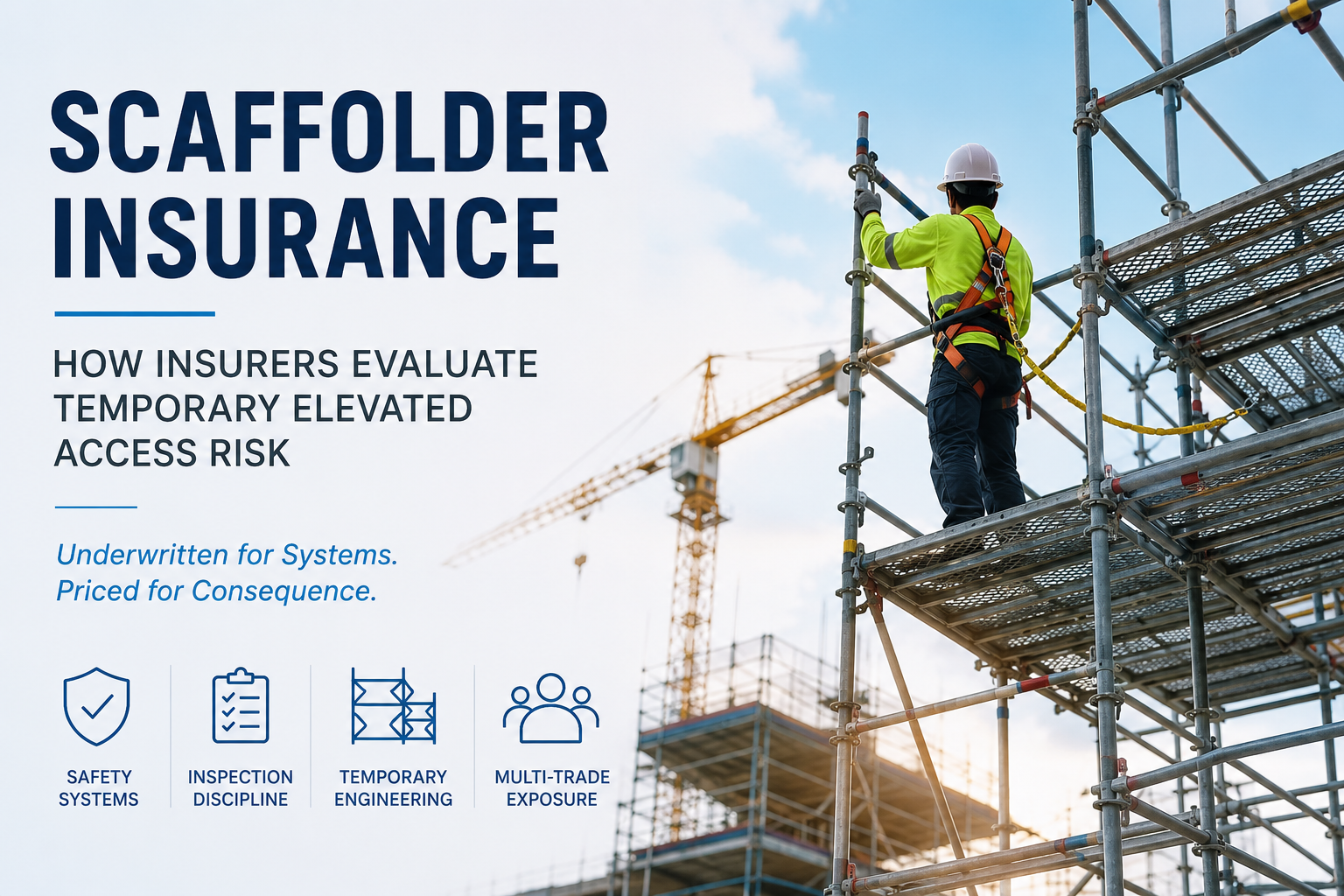
Scaffolder insurance refers to the insurance policies and underwriting practices used for businesses that erect, modify, inspect, and dismantle scaffolding. Insurers classify scaffolders as high-risk because they build temporary engineering systems whose failure can injure multiple workers, increasing both claim severity and liability exposure.
Scaffolders erect, modify, inspect, and dismantle the temporary access structures that carry nearly every other trade on a construction site. That single fact separates scaffolder insurance from most other construction underwriting categories. A carpenter’s tools do not become part of the building’s load path. A scaffolder’s work does. When a scaffold is built, it becomes, for the life of the project, a load-bearing system that other workers trust with their safety every time they climb it.
Insurers classify scaffolders as one of the highest-risk trades in construction, and not only because the work happens above the ground. The deeper reason is structural: a scaffold is a temporary engineered system, assembled and re-assembled under time pressure, inspected by people rather than certified once like a permanent structure, and exposed to weather, ground movement, and modification pressure throughout its working life. When it fails, it rarely injures one person. It tends to injure everyone standing on it, and often several people standing beneath it.
Underwriters do not price scaffolders on height alone. They price the reliability of the system: how the scaffold was designed, who inspected it and how often, whether modifications were controlled or improvised, how loads were managed, and how the contractor’s documentation would hold up after a loss. Four variables move pricing and eligibility more than any others: inspection discipline, modification control, load management, and the documented presence of a competent person across the full scaffold lifecycle.
Underwriting Insight
The question an insurer is actually answering is not how high scaffolders climb, but how reliable the system beneath them is, and how many people would be affected if that system failed. Scaffolder insurance is underwritten against operational reliability, not elevation.
| Temporary Structure | Operational Reliability | Underwriting Confidence | Insurance Pricing | Market Consequences |
Figure 1. The underwriting logic chain for temporary access systems. Each stage depends on the one before it, which is why operational discipline earlier in the chain has more influence on pricing than any single safety feature added later.
Scaffolder Job Risks: Why Scaffolders Face Higher Insurance Risk
Before an underwriter opens a file, a scaffold worker has already spent the day doing something few other trades are asked to do: build the platform they and everyone else will stand on, then trust it.
Scaffolders share this daily reality with every other trade that works above ground level, and much of the underwriting logic that follows draws on mechanics insurers apply across elevated occupations generally. Height Exposure Underwriting: How Insurers Evaluate Elevated Workers covers that shared foundation. What follows here is specific to scaffold operations.
Daily Job Duties and Work Environment of Scaffolders
A scaffolder’s day involves erecting scaffold structures from the ground or from an existing platform, dismantling them once work is complete, and modifying them in between as the project’s needs change. The work is repetitive in the way that matters to insurers: repeated climbing, repeated carrying of tubes, boards, couplers, and fittings, and repeated exposure to unstable working surfaces that are, by definition, not finished yet. Scaffolders move between residential jobs, commercial towers, and industrial sites, often within the same week, and interact constantly with electricians, painters, roofers, and inspectors who depend on the platform being where it is supposed to be.
None of this reads as unusual to a construction professional. To an underwriter, it reads as Exposure Stacking: a single worker accumulating multiple, overlapping sources of risk within a single shift, on a structure that is itself incomplete for most of the time the worker is exposed to it.
Common Scaffolder Injuries That Affect Insurance Risk
The injury profile associated with scaffold work is dominated by severity rather than frequency, and that distinction drives most of the underwriting logic that follows. Falls from height, scaffold collapse, dropped-object injuries, and crush injuries during erection or dismantling are the loss categories insurers watch most closely, alongside the slower-building toll of repetitive strain and musculoskeletal disorders that accumulate over a career. Roughly 2.3 million construction workers, about 65 percent of the U.S. construction workforce, work on scaffolds at some point, and the Bureau of Labor Statistics Census of Fatal Occupational Injuries has repeatedly found that scaffold-related incidents produce on the order of 60 to 80 fatalities and 4,500 injuries a year, figures that have stayed roughly stable even as overall construction safety has improved. CPWR’s analysis of scaffold-related risk attributes the large majority of these incidents to a small set of recurring causes: planking or support failure, slips and falls, and struck-by injuries from falling material.
Insurers place more weight on injury severity than injury frequency because a scaffolder’s claims profile skews toward catastrophic outcomes. A slip on a level floor is a minor claim. A slip at height, or a collapse that drops a working platform, is rarely minor. This is why loss ratios in scaffold-heavy classifications are driven less by how often something goes wrong and more by how badly it goes wrong when it does. Catastrophic Fall Risk in Occupational Insurance sets out the general severity mechanism behind this pattern across height trades, and Fall Severity Modeling in Disability Insurance covers how insurers translate fall outcomes into disability pricing specifically.
The long-term disability and fatality outcomes referenced above are not unique to scaffold work. Permanent Disability Risk from Elevated Work covers how insurers treat permanent impairment arising from height-related injury across occupations, and applies directly to scaffold crews without modification.
Why Scaffolder Insurance Claims Become Complex
When a scaffold-related injury occurs, the claim rarely resolves cleanly. Investigations are complex because scaffolds are frequently erected by one contractor, modified by another, and used by several more, which raises immediate questions about shared responsibility. Was the failure a design defect, an erection error, an unauthorized modification, or a loading violation by a trade that had no role in building the structure? Contractor disputes over who controlled the scaffold at the time of failure routinely delay claim resolution, complicate return-to-work planning, and increase documentation demands on every party involved.
For the worker, this translates into a claims experience that is slower and more adversarial than in trades where liability is easier to isolate. For the insurer, it translates into reserve uncertainty. Both consequences trace back to the same structural fact: a scaffold is a shared system, not a single worker’s tool, and that shared character is exactly what makes it hard to insure cleanly.
How Scaffolders Are Classified for Insurance Underwriting
Before a policy is priced, an underwriter has to decide what the worker actually is. That sounds simple. In scaffold operations, it rarely is.
NCCI, ISO, and NAICS Codes for Scaffolders
Insurance for scaffolders begins with classification, not with a rate. What gets called scaffolding insurance or scaffold worker insurance in the market is really several distinct coverage decisions bundled under one label, and classification is the first of them. In the United States, workers’ compensation classification systems built around NCCI codes, along with ISO general liability classifications and NAICS industry codes, determine which base rate a scaffold operation is measured against before any modifier is applied. These systems exist to group similar exposures together so that loss data stays comparable across thousands of policyholders, and scaffold erection and dismantling operations are typically coded separately from general construction labor because their loss patterns are measurably different.
In practice, scaffold erection and removal is most often assigned to NCCI Class Code 9529, covering scaffolds and sidewalk bridges built, repaired, or removed by a specialist contractor rather than as an incidental part of a general contractor’s own work. Suspended, swinging, and outrigger scaffold operations are generally rated separately under Code 9530, reflecting the different failure mode and rescue profile of hanging systems compared with ground-supported ones. Within Code 9529, ground-built scaffolds are commonly priced at the Code 5057 rate and single-story sidewalk bridges at the Code 5403 rate, which is one reason a single scaffold contractor’s payroll can legitimately span more than one classification on the same job. Underwriters treat a submission that collapses all of this into one generic construction code as a sign that classification has not been reviewed carefully, independent of the contractor’s actual safety performance.
Why Scaffolders Receive Different Insurance Classifications
Scaffolders are classified differently from carpenters, laborers, ironworkers, roofers, and general construction helpers because the underwriting question is not what trade a worker belongs to, but what structural role the worker performs. A carpenter who occasionally climbs a completed scaffold is exposed to fall risk. A scaffolder who builds, modifies, and dismantles that same structure is exposed to fall risk plus structural failure risk plus the liability of every other trade that will rely on the platform. This is why scaffolding contractor insurance and scaffold contractor insurance programs are built around the erection and dismantling function specifically, not around a generic elevated-work label.
Classification Errors That Increase Insurance Risk
Classification boundaries blur in practice. Crews that mix scaffold erection with demolition support, insulation staging, or industrial shutdown and turnaround work often drift across classification lines without anyone updating the payroll code. Maintenance scaffolding on an operating facility, in particular, tends to get bundled into general maintenance payroll rather than coded as scaffold erection, which understates the true exposure the carrier is actually holding. Underwriters who see project scopes that do not match the classification on file treat that mismatch as a signal worth investigating, not an administrative footnote.
Payroll Audits and Workers’ Compensation for Scaffolders
Because scaffold crews are frequently subcontracted, staffed with temporary labor, or shared across multiple concurrent projects, payroll allocation becomes one of the more fragile parts of the underwriting file. Workers compensation for scaffolders is priced per payroll dollar within the applicable classification, so misallocated payroll, whether from mixed operations, subcontractor pass-through, or inconsistent job costing, directly distorts the premium relative to the true exposure. Audit adjustments after policy expiration are common in this trade precisely because the payroll picture at binding rarely matches the payroll picture at year end.
How Insurers Underwrite and Price Scaffolder Insurance
Classification tells an underwriter what box a risk sits in. What happens next is where the file starts to separate from every other file in that box.
Why Scaffolder Insurance Starts With Higher Base Rates
Scaffold operations begin underwriting review with elevated base rates relative to general construction labor, reflecting the expected loss characteristics of the trade: a higher proportion of severe, elevation-related claims, a meaningful chance of multi-claimant events, and litigation exposure that tends to run longer and cost more than single-worker injury claims. The base rate is a starting point, not a conclusion. It represents what the class of business has historically cost insurers before anything is known about a specific contractor’s operational quality. Why Elevated Workers Pay More for Insurance explains the general premise behind elevated base rates for height work; what matters for scaffolders specifically is how far the modifiers below move a given contractor away from that starting point.
Experience Modification Rate (EMR) and Other Pricing Factors
From that starting point, underwriters apply modifiers that reflect the individual account. The Experience Modification Rate (EMR) compares a contractor’s actual loss experience to the expected losses for its classification and payroll size, and it remains one of the single most influential figures in the file. Schedule rating allows underwriters to adjust further for operational quality factors that EMR does not fully capture, such as safety program maturity, and project complexity is weighed separately because a scaffolder erecting residential staging faces a different risk profile than one erecting a large area scaffold inside an operating refinery.
How Claims History Affects Scaffolder Insurance
Underwriters read claims history for pattern, not just total cost. A history that includes scaffold collapse events, fall claims, or dropped-object claims is weighted more heavily than an equivalent dollar amount spread across minor strain injuries, because collapse and fall events indicate a structural or procedural failure rather than an isolated accident. Reserve development matters as much as the incurred total: claims that keep growing after the initial estimate suggest the original investigation understated the exposure, and underwriters treat a pattern of reserve growth as a signal about claims-handling discipline as much as about loss severity. Incidents involving multiple injured workers on the same scaffold are reviewed with particular care, since they demonstrate the accumulation risk that defines this trade.
Insurance Requirements for Scaffold Contractors
Before price is even discussed, most specialty carriers apply eligibility filters specific to scaffold operations. A documented competent person program, written inspection procedures, a rescue plan for suspended and elevated work, engineered drawings for complex or non-standard scaffold configurations, and documented erection and dismantling procedures are treated as baseline requirements rather than enhancements.
Many of these requirements trace back to the ANSI/ASSP A10 construction safety standards, which the American Society of Safety Professionals maintains as the reference framework underwriters and loss-control consultants point to when a contractor’s own written program is incomplete. Contractors who cannot produce these documents are not simply priced higher. In many markets, they are not eligible for standard placement at all. These filters sit on top of the general height thresholds and coverage triggers described in Height Restrictions in Occupational Insurance Policies, which governs policy-level eligibility mechanics for elevated work generally.
Red Flags That Make Scaffold Contractors Harder to Insure
- Repeated OSHA scaffold citations, particularly under 29 CFR 1926 Subpart L
- Undocumented or inconsistent scaffold inspections
- Evidence of scaffold modification without engineering or supervisory approval
- Prior scaffold collapse history, regardless of injury outcome
- Weak subcontractor management and unclear chain of responsibility on multi-trade sites
- Inconsistent or fragmented payroll reporting across projects
- Rapid, uncontrolled expansion into larger or more complex project types without a matching increase in supervisory capacity.
Operational Risks That Increase Scaffolder Insurance Costs
Underwriting logic only holds up if it reflects how scaffolds actually behave on a real site, across a real project, in real weather. This section is where that logic gets tested.
Size and Scale
Underwriting treatment shifts meaningfully across project types. Residential scaffold work tends to involve simpler configurations, shorter durations, and lower project complexity, while commercial buildings introduce taller supported scaffold systems, more interface points with other trades, and longer exposure periods. Industrial facilities, refineries, bridge projects, and power stations sit at the far end of the spectrum, where scaffolders may erect large area scaffold systems around live process equipment, work adjacent to energized lines, or support turnaround schedules where speed and safety compete directly. Carriers that write industrial and refinery scaffold risk are a smaller group than the general construction insurance market, and they price accordingly.
Why Insurers Treat Scaffolds as Temporary Engineering Systems
The most important conceptual shift in scaffolder underwriting is treating scaffolds as temporary engineering systems rather than simply as safety equipment. Unlike permanent structures that are engineered once and expected to remain largely unchanged, scaffolds are assembled, modified, inspected, and dismantled throughout a project’s life as work progresses.
RJI uses the term temporary engineering underwriting to describe how insurers evaluate structures whose reliability depends on continuous engineering, inspection, and modification rather than permanent construction. This reflects established industry practice. For example, the National Access & Scaffolding Confederation (NASC) distinguishes between standard scaffold configurations built within published design limits and non-standard systems requiring bespoke engineering calculations. U.S. underwriters apply similar principles when assessing engineered scaffold installations.
Because the engineering changes throughout the project, scaffold risk also changes. Underwriters evaluate the entire scaffold lifecycle: planning, foundation preparation, erection, inspection, modification, active use, and dismantling, because each stage presents different failure modes. Rather than asking whether a scaffold is safe at one moment, insurers assess how consistently the contractor maintains engineering reliability throughout its operational life. This is why inspection discipline, modification control, and competent-person oversight influence underwriting confidence more than working height alone.
How Shared Scaffold Access Increases Insurance Risk
A scaffold is not only a workplace for the scaffolder who built it. It is access infrastructure for everyone who uses it afterward. Electricians, painters, roofers, ironworkers, and inspectors all rely on a platform they did not build and often cannot independently verify. When a scaffold fails, the injuries are rarely limited to the scaffold crew, which is precisely why insurers treat scaffold reliability as a multi-trade exposure rather than a single-contractor concern.
How Scaffold Modifications Affect Insurance Underwriting
Modification is where a compliant scaffold most often becomes a non-compliant one. Removed guardrails, added lifts that were never accounted for in the original load calculation, altered tie-ins, and other unauthorized changes are among the most consistent contributors to scaffold failure investigations. Underwriters examine modification history closely, because a scaffold that was correctly engineered at erection but modified without review has effectively become a different, unverified structure.
Load Management
Height alone does not determine scaffold risk. Load management does. Underwriters evaluate how a contractor controls personnel loads, material loads, equipment loads, dynamic loading from tools and movement, and uneven loading across a platform, because a scaffold rated for a specific load and then loaded unevenly or beyond its rating fails regardless of how well it was built. This is why loss-control questionnaires for scaffold contractors focus heavily on load planning and posted capacity signage rather than on height restrictions alone.
Ground Condition Stability
Many scaffold failures begin below the structure rather than within it. Soft ground, recent excavation, and inadequate settlement of the base are common precursors to collapse, which is why foundation preparation is treated as a distinct underwriting concern rather than folded into general erection quality. A scaffold built to specification on unstable ground carries the instability of the ground into every stage of the lifecycle above it.
Multi-Trade Exposure and Interface Risk
Scaffolds rarely operate in isolation. They interact with cranes, forklifts, aerial lifts, demolition activity, overhead power lines, and moving site vehicles, and each of these interfaces introduces exposure that has nothing to do with the scaffold’s own structural integrity. RJI refers to the underwriting treatment of these overlapping exposures as interface-risk underwriting: the recognition that a well-built scaffold can still produce a severe claim if it sits too close to a crane swing radius or an energized line.
Why Human Error Still Matters in Scaffolder Insurance
Communication, supervision, inspection discipline, and procedural compliance determine whether a well-designed scaffold system performs the way it was engineered to. Production pressure and fatigue are the two factors most likely to erode that discipline, since they push crews toward shortcuts, most commonly skipped inspections or unapproved modifications made to save time rather than to solve an engineering problem. Underwriters treat evidence of strong supervisory discipline as a meaningful offset to the trade’s inherent hazard.
Safety Controls
The controls that matter most to underwriters translate directly into operational confidence: competent-person inspections performed and documented on a defined schedule, scaffold tagging systems that make inspection status visible to every worker who approaches the structure, properly installed guardrails and tie-ins, engineering sign-off on non-standard configurations, active supervision, retained inspection records, and a documented rescue plan for suspended and elevated work. Each of these controls answers a specific underwriting question, which is why their absence is read as a specific gap rather than a general weakness.
NIOSH’s investigations into suspension scaffold fatalities found that equipment failure and inadequate fall protection were involved in the large majority of the deaths reviewed, which is part of why suspended systems draw closer underwriting scrutiny than ground-built ones. Competent-person qualification itself is not self-certified: the Scaffold & Access Industry Association sets the training curriculum most U.S. carriers expect a contractor’s competent person to have completed. Rescue planning deserves particular attention on scaffold sites, since suspended and multi-level configurations raise the same access and timing problems addressed in Rescue Difficulty in High-Elevation Underwriting.
Seasonal Variability
Wind, rain, snow, ice, heat, and reduced visibility all affect scaffold safety differently depending on scaffold type, and insurers look for documented shutdown thresholds, specific wind speeds or precipitation conditions at which work stops, rather than a general commitment to weather awareness. A contractor with defined, enforced thresholds demonstrates the kind of operational maturity that underwriters reward.
How One Scaffold Failure Creates Multiple Insurance Claims
This is the concept that most distinguishes scaffolder insurance from other elevated-work underwriting. A single scaffold failure can simultaneously injure the scaffolders who built it, the electricians, painters, and inspectors who were using it, and workers or members of the public beneath it. This is accumulation risk: exposure that does not stay contained to one worker or one policy limit, but spreads across multiple claimants and, frequently, multiple lines of coverage at once. Accumulation risk is the mechanism that turns an ordinary construction incident into a catastrophic claim severity event, and it is the single largest reason scaffold operations are underwritten more conservatively than trades with comparable elevation exposure but less shared structural dependency.
Underwriting Summary: Operational Realism
Scaffold risk is not a single, static exposure. It moves through the scaffold lifecycle, concentrates at points of modification and interface with other trades, and can accumulate across multiple claimants when the underlying temporary structure fails. Insurers price the discipline applied at each stage, not the height of the structure alone.
Why Scaffolder Insurance Claims Fail or Become More Expensive
Every underwriting control described so far exists because, somewhere, a scaffold contractor did not have it. This section translates those gaps into concrete failure points.
Where Scaffolder Insurance Claims Break Down First
Claims most often unravel at the documentation layer rather than at the medical layer. Undocumented inspections leave an insurer unable to establish that the scaffold was compliant at the time of loss. Poor erection procedures make it difficult to distinguish a design failure from a workmanship failure. Missing training records weaken a contractor’s defense in third-party litigation, and delayed incident reporting narrows the window in which physical evidence and witness accounts can be reliably gathered.
Common Coverage Gaps for Scaffold Contractors
Coverage gaps in scaffold operations frequently trace back to assumptions rather than exclusions. A general contractor may assume a scaffold subcontractor’s policy covers an incident that the subcontractor’s policy actually excludes. Equipment ownership disputes, whether the scaffold materials were owned, leased, or borrowed, can complicate which policy responds to a structural failure claim. Uninsured or under-insured scaffold operations, particularly smaller subcontractors working under a larger general contractor’s program, remain one of the more persistent gaps in multi-trade construction insurance.
When Scaffolder Insurance Coverage Becomes Unreliable
Disputes over scaffold ownership, who authorized a given modification, and which contractor bore inspection responsibility at the time of a loss are among the most common sources of coverage reliability failure. These disputes do not necessarily reduce the total insured loss, but they extend claim timelines, increase legal cost, and erode the predictability that makes a class of business attractive to carriers in the first place.
Events That Trigger Large Scaffold Insurance Claims
Certain events function as breakpoints that shift a claim from routine to structurally significant: a full or partial scaffold collapse, any incident involving multiple injured workers, a fatality, third-party losses to members of the public or adjacent trades, and structural damage to the building or surrounding property. Each of these breakpoints changes how a claim is reserved, how it is litigated, and how it is weighed in the contractor’s future underwriting file.
What Insurance Do Scaffold Contractors Need?
A scaffold failure rarely stays inside a single policy. Understanding why requires looking at how each line of coverage interprets the same event differently.
Workers’ Compensation Insurance for Scaffolders
Workers’ compensation responds to injuries suffered by the scaffold contractor’s own employees, regardless of fault, and is the line most directly shaped by the classification and payroll issues discussed earlier in this article.
General Liability Insurance for Scaffold Contractors
General liability responds to third-party injuries: other trades, inspectors, or members of the public affected by a scaffold failure. Because scaffolds are shared infrastructure, general liability exposure in this trade is unusually broad relative to the size of the scaffold crew itself.
Builders Risk Insurance and Scaffold Damage
Builders risk coverage addresses damage to the project itself, relevant when a scaffold collapse damages the structure under construction, adjacent finishes, or materials staged nearby.
Inland Marine Insurance for Scaffold Equipment
Inland marine coverage typically addresses the scaffold equipment, the tubes, couplers, boards, and proprietary system components, when it is owned rather than rented, and becomes relevant in disputes over equipment failure versus erection error.
Commercial Auto Insurance for Scaffold Contractors
Where scaffold contractors transport their own systems between sites, commercial auto coverage intersects with the operation, particularly for loading and securement practices that affect both transportation risk and the condition of components on arrival.
A single scaffold collapse can trigger workers’ compensation, general liability, and builders risk simultaneously, and occasionally inland marine and commercial auto as well. Insurers evaluating a scaffold contractor’s overall program look across these lines together rather than in isolation, because a weakness visible in one line, such as loose modification control, is a weakness that every other line inherits.
Why Scaffolder Insurance Is Expensive and Hard to Obtain
The operational and coverage realities already described do not stay confined to individual policies. Over time, they shape which insurers are willing to write this trade at all.
Why Fewer Insurers Cover Scaffold Contractors
Fewer carriers specialize in scaffold contractor risk than in general construction liability, a direct consequence of the accumulation risk and cross-line exposure described above. Carriers that do write this class typically maintain dedicated underwriting guidelines for scaffold operations rather than treating them as a subset of general construction, which narrows the field of available markets, particularly for contractors working in industrial or high-complexity environments.
How OSHA Violations Affect Scaffolder Insurance
Scaffolding remains one of OSHA’s most frequently cited standards in construction, and enforcement trends move underwriting appetite over time. Periods of heightened enforcement or high-profile collapse investigations tend to tighten eligibility criteria across the market, not just for the contractor involved. Litigation trends follow a similar pattern: jurisdictions with strong scaffold-specific liability statutes see more conservative underwriting terms across the board, reflecting the higher expected cost of an adverse outcome. OSHA Fall Violations and Insurance Costs sets out the general mechanism linking citation frequency to pricing across height trades; scaffold-specific Subpart L enforcement is simply the most active instance of that pattern.
What Insurers Look for Before Covering Scaffold Contractors
When evaluating whether to write or renew a scaffold contractor, carriers weigh collapse history, inspection culture, documented competent person compliance, EMR trend over multiple years rather than a single snapshot, and overall operational maturity. Contractors who can demonstrate consistent improvement across these variables tend to see broadening market access even within a generally cautious class of business, which is the underwriting basis for the recovery path described in the next section.
How Scaffold Contractors Improve Insurance Eligibility
None of the constraints described above are permanent. Scaffold contractors improve their standing with insurers the same way they improve the reliability of the structures they build: deliberately, and with documentation to show for it.
What Underwriters Want to See First
The fastest improvements in underwriting standing typically come from formalizing what many contractors already do informally: documented inspections on a consistent schedule, a written rescue plan for elevated and suspended work, clear competent-person oversight with named individuals and defined authority, engineering review for non-standard scaffold configurations, and a formal modification control process that requires sign-off before any change to guardrails, lifts, or tie-ins.
Documentation That Improves Underwriting Confidence
Beyond immediate fixes, insurers reward contractors who can produce a complete audit trail: inspection logs retained across the full project duration, training records tied to individual workers, maintenance documentation for scaffold components, accurate payroll records aligned to classification codes, and engineering calculations for complex configurations. This documentation does not just support a specific claim if one occurs. It supports the entire underwriting file at renewal.
Presenting a Scaffold Business to Insurance Underwriters
Contractors who present their operation in a way that demonstrates operational maturity, underwriting confidence, quality management, exposure transparency, disciplined claims management, and clear contractor control over subcontracted scaffold work consistently see broader market access and more favorable terms than contractors with comparable loss history but weaker documentation. In a class of business defined by shared responsibility and accumulation risk, the ability to show an insurer exactly how risk is controlled, stage by stage through the scaffold lifecycle, is often worth more than an unusually clean claims history alone.
Real-World Scaffolder Insurance Examples
The following examples translate common scaffold-related events into the sequence an underwriter actually follows: what happened, how it is interpreted, and what it means for coverage.
Example 1: Collapse from Poor Foundation Preparation
Operational event. A supported scaffold erected on recently backfilled ground settles unevenly over several days of active use, leading to a partial collapse.
Underwriting interpretation. Underwriters trace the failure to ground condition stability rather than erection quality, and treat it as a foundation preparation failure, a distinct control category from structural assembly.
Insurance consequence. The claim engages both workers’ compensation and general liability, and the contractor’s future file is flagged for foundation documentation on future submissions, regardless of how well the scaffold itself was built.
Example 2: Unauthorized Scaffold Modification
Operational event. A crew removes a guardrail section to move materials more quickly and does not reinstall it before the next shift begins.
Underwriting interpretation. This is read as a modification control failure, not an isolated safety lapse, because it indicates the contractor’s process allows undocumented changes to an engineered structure.
Insurance consequence. Even without an injury, the event affects renewal terms once documented, since it demonstrates a systemic gap rather than a one-time error.
Example 3: Overloaded Working Platform
Operational event. Multiple trades stage materials on the same scaffold level simultaneously, exceeding the platform’s rated capacity.
Underwriting interpretation. Underwriters interpret this as a load management failure and examine whether the contractor had posted capacity limits and load planning procedures in place.
Insurance consequence. Absent documented load controls, the incident supports a red flag on eligibility review, particularly if it recurs across multiple projects.
Example 4: Wind-Related Scaffold Failure
Operational event. A scaffold section fails during high winds after work continued past the contractor’s stated shutdown threshold.
Underwriting interpretation. Underwriters treat this as a seasonal variability and human reliability failure jointly, since the structural exposure was known and a documented threshold existed but was not enforced.
Insurance consequence. Insurers weigh this differently than an unforeseeable weather event, since it indicates a gap between written procedure and field practice.
Example 5: Competent-Person Inspection Preventing a Catastrophic Loss
Operational event. A scheduled competent-person inspection identifies corrosion in a suspended scaffold’s hoist mechanism before it is placed back into service.
Underwriting interpretation. Underwriters treat this as direct evidence of a functioning control system rather than a neutral event, because it demonstrates the inspection program operating as intended under real conditions.
Insurance consequence. Documented near-miss identification of this kind is one of the strongest pieces of evidence a contractor can present to support improved eligibility and terms at renewal.
Key Scaffolder Insurance Takeaways
- Scaffolders are treated as a high-risk occupation because they build, modify, and dismantle the temporary structures other trades depend on, not only because they work at height.
- Temporary engineering systems create underwriting concerns that permanent structures do not, because the engineering is re-created throughout the project rather than fixed once.
- Operational controls, inspection discipline, modification control, and load management in particular, translate directly into underwriting confidence and pricing.
- Scaffold failures frequently produce complex, multi-claimant, multi-line insurance claims because of the accumulation risk built into shared access infrastructure.
- Contractors improve their insurability by documenting operational maturity across the full scaffold lifecycle, not simply by reducing claims after the fact.
Final Underwriting Insight
Scaffolder insurance is driven by more than work at height. Insurers evaluate the reliability of temporary engineering systems, the quality of scaffold lifecycle management, the interaction between multiple trades, and the potential for catastrophic multi-party losses. The stronger a contractor’s ability to demonstrate disciplined engineering, inspection, and operational control, the greater the underwriting confidence, and the broader the insurance options available.
—————————————————————————————————————————
Institutional & Underwriting References:
- Occupational Safety and Health Administration (OSHA) — 29 CFR 1926 Subpart L (Scaffolds) and applicable Fall Protection standards
- National Institute for Occupational Safety and Health (NIOSH) — Construction safety research and occupational injury prevention guidance
- U.S. Bureau of Labor Statistics (BLS) — Occupational injury, illness, and fatality statistics for construction and scaffolding occupations
- National Council on Compensation Insurance (NCCI) — Workers’ compensation classification methodology, payroll classification principles, and experience rating guidance
- Insurance Services Office (ISO) — Commercial General Liability classification framework and underwriting reference materials
- Center for Construction Research and Training (CPWR) — Construction safety research, scaffold hazard analysis, and injury prevention resources
- Scaffold & Access Industry Association (SAIA) — Scaffold engineering practices, competency guidance, inspection procedures, and temporary access system standards
- American Society of Safety Professionals (ASSP) — Occupational risk management and construction safety best practices
- National Access & Scaffolding Confederation (NASC) — Scaffold design, inspection, temporary works guidance, and industry technical publications
RJI Underwriting Methodology:
This article translates operational realities into underwriting logic by integrating regulatory requirements, occupational classification systems, engineering principles, historical loss patterns, and insurance market practices. The analysis reflects how insurers assess operational reliability, temporary engineering systems, catastrophic claim potential, and underwriting confidence rather than providing legal, regulatory, or insurance advice.