Reviewed for underwriting accuracy by the RJI Underwriting Research Team | Published: July, 2026 | Last reviewed: July, 2026
————————————————————————————————————–
Executive Summary
Remote rescue delays in offshore claims are best understood as the interval between an offshore incident and the moment an injured worker reaches definitive medical care. On a fixed platform, drillship, FPSO, or offshore wind installation, that interval is never zero, and it is rarely fixed. It is produced by distance from shore, helicopter and vessel availability, sea state, and the handoff between several response organizations that were never designed to function as a single continuous system.
Insurers care about rescue delay because it does not simply postpone treatment. It changes what treatment can accomplish. An injury that would resolve with prompt intervention can become a permanent impairment when hours pass instead of minutes. That shift is what converts a routine medical claim into a long-tail disability claim, and it is the reason rescue delay sits inside underwriting analysis rather than outside it.
Why does rescue time influence offshore insurance? Because it is one of the few operational variables that links conditions on a vessel or platform directly to claim severity, independent of what caused the injury in the first place. A fractured limb two hours from a trauma center does not behave, financially, the way the same fracture behaves ninety minutes from shore. Remote rescue delays are underwriting variables rather than operational inconveniences. As rescue time becomes less reliable, insurers increase expected claim severity, reserve uncertainty, pricing pressure, and eligibility scrutiny.
What changes when rescue capability improves is not the probability that an incident occurs. It is the distribution of outcomes once one does: fewer permanent impairments, shorter disability duration, and reserve development that insurers can model with more confidence.
Underwriting insight: insurers do not underwrite whether rescue is possible. They underwrite how reliably rescue can occur under realistic offshore operating conditions, and that reliability, not the theoretical existence of a rescue plan, is what moves pricing and eligibility.
How Remote Rescue Delays Occur Offshore
Rescue delay sits inside the broader discipline covered in Offshore Risk Underwriting: How Insurers Evaluate Marine & Remote Workers, but it earns separate treatment because it is not created by a single point of failure. It emerges from the interaction of several operating conditions that are ordinary features of offshore work, not unusual circumstances.
Why Offshore Assets Experience Longer Rescue Times
Fixed platforms sit inside a defined rescue infrastructure, standby vessels, helideck access, and often a resident medic, but even a mature platform can be hours from a trauma center once weather grounds the helicopter. Drillships and mobile offshore drilling units add a second variable: they relocate, so the rescue plan that applied at the last well site may not match the distance, jurisdiction, or asset availability at the current one.
This is precisely why IADC’s HSE Case Guidelines for Mobile Offshore Drilling Units require emergency response to be built into the case a contractor submits for each unit rather than inherited from the last one; the rescue plan travels with the rig, but the rescue conditions do not. Floating production, storage and offloading vessels (FPSOs) often operate in deeper, more remote water than fixed installations, and their production schedules rarely stop for a medevac, which pressures the timeline between detection and extraction.
Offshore wind farms introduce a different profile entirely: turbines are individually remote, technicians frequently work alone or in pairs at height or inside confined nacelles, and rescue often depends on a single crew transfer vessel reaching a specific tower rather than a platform-wide muster.
Support vessels connect these assets to shore, but they are also exposed workplaces in their own right, and a vessel casualty offshore faces the same distance problem as the platform it services.
Why Distance from Shore Is Not the Primary Underwriting Variable
Distance from shore is the variable most people assume drives rescue delay, and it matters, but it is not the whole picture. A location forty nautical miles out with a dedicated standby vessel and a contracted helicopter on short recall can outperform a location half that distance with neither.
Helicopter Dependence and Rescue Time Reliability
Helicopter dependence is the clearest illustration: offshore medevac relies overwhelmingly on rotary-wing transport, a reliance IOGP’s recommended practices for offshore emergency response services address directly by treating medical evacuation flights as a distinct, contract-managed asset rather than an incidental helicopter task. That single-mode dependence, examined in more depth in Helicopter Transport Risk in Offshore Insurance, means visibility, wind, and icing conditions can suspend the primary rescue asset entirely, sometimes for hours. Weather interruption therefore does not just make rescue harder, it can remove the fastest option from the table and force reliance on marine transport that takes substantially longer.
Communication Delays and Offshore Medical Limitations
Communication delay compounds all of this. Detection is not instantaneous offshore, and once an incident is recognized, coordinating between the installation, the vessel operator, onshore medical control, and, in many jurisdictions, a national search-and-rescue authority introduces sequential handoffs, each with its own latency. Offshore medical limitations close the loop: most installations have first aid or paramedic-level capability, not surgical capability, a ceiling OSHA‘s hazard guidance for oil and gas extraction acknowledges by directing operators toward broader occupational health research rather than treating onboard first aid as sufficient on its own, so stabilization has a limit, and the clock keeps running until the worker reaches a facility that can do more.
Why Rescue Delays Result from Multiple Operational Conditions
None of these conditions is unusual on its own. What matters for underwriting is that they interact, and the combination, not any single failure, is what produces the delay that eventually shows up in a claim file.
Rescue delay is therefore an emergent operational exposure rather than the product of one isolated failure. Weather, helicopter availability, communication latency, medical capability, transport logistics, and jurisdictional coordination each introduce uncertainty into the rescue chain. When these conditions occur simultaneously, their combined effect is greater than the sum of their individual impacts. This interaction is precisely why insurers evaluate rescue reliability as a system rather than measuring distance offshore or evacuation time in isolation.
Why Rescue Time Matters in Offshore Insurance
Offshore Emergency Response Standards
Offshore emergency response is not left to individual operator judgment. It sits inside a layered system of institutional standards, industry guidance, and operational frameworks that define what an adequate emergency response capability should look like, even though none of them guarantees a specific rescue time. Industry bodies such as the International Association of Oil & Gas Producers (IOGP) and the International Association of Drilling Contractors (IADC) treat evacuation, escape, and rescue as disciplines separate from general safety management because emergency response requires dedicated planning, resources, and continuous testing.
For insurers, these standards establish the operational baseline against which rescue capability can be evaluated.
Maritime Search and Rescue Frameworks
Beyond industry guidance, offshore rescue operates within international maritime search and rescue frameworks. The International Maritime Organization (IMO) coordinates search and rescue responsibilities across national boundaries through the SAR Convention, ensuring that designated coastal states maintain responsibility for emergency response within defined search and rescue regions.
These frameworks do not guarantee identical rescue performance. Instead, they establish the institutional structure that determines how rescue coordination occurs once an offshore emergency has been reported.
From an underwriting perspective, rescue capability depends not only on operator preparedness but also on the responsiveness of the wider maritime rescue system.
Regulatory Expectations for Offshore Emergency Planning
National regulators incorporate emergency response directly into offshore safety management requirements. Agencies such as the U.S. Bureau of Safety and Environmental Enforcement (BSEE) require operators to integrate emergency response into their Safety and Environmental Management Systems (SEMS), conduct realistic rescue drills, and report evacuation-triggering incidents. Occupational safety authorities, including OSHA, alongside occupational health research published by NIOSH, further reinforce the importance of emergency preparedness by documenting how delayed evacuation contributes to injury severity and fatality outcomes.
Rather than prescribing a universal rescue time, regulators require operators to demonstrate that emergency response systems remain appropriate for the operational risks they face.
How Institutional Standards Become Underwriting Variables
Each institutional layer answers a different part of the same underwriting question:
What level of rescue capability should reasonably be expected, and how does this operator compare with that expectation?
Insurers do not adopt institutional standards as insurance rules. Instead, they translate those standards into underwriting evidence. Rescue plans, evacuation drills, emergency audits, helicopter agreements, communication systems, and medical preparedness become measurable indicators of rescue reliability rather than simple compliance documents.
This translation is where operational guidance becomes insurance analysis. For remote rescue delays in offshore claims specifically, a rescue standard has underwriting value only when it demonstrates how consistently an operator can detect, stabilise, evacuate, and deliver injured workers to definitive medical care under realistic offshore conditions.
How Insurers Interpret Remote Rescue Delays in Offshore Claims
This is where rescue delay stops being an operational fact and becomes a pricing variable. Insurers do not evaluate rescue in the abstract. They break it into components that can each be evidenced, scored, and weighed against claims history.
Rescue Capability Underwriting
Insurers evaluating an offshore risk look past the existence of an emergency response plan and ask what the plan actually produces under real conditions. Average evacuation time from incident to definitive care is the anchor figure, drawn from past drills, past claims, or operator-submitted data, not from the theoretical best case in a procedures manual.
Rescue contracts matter as much as the plan itself: whether standby vessel and helicopter coverage is a dedicated, contracted asset or a shared regional resource that may be tasked elsewhere when needed changes how much weight underwriters give it. Helicopter availability is scrutinized separately from vessel availability because the two fail under different conditions; a vessel can usually still move in weather that grounds a helicopter, so an operator dependent on a single mode has a narrower operating envelope than one with both.
Onboard medics extend the window before extraction becomes urgent, and their presence or absence shifts how underwriters weight every other factor in the chain. Rescue drills function as evidence, not formality: BSEE’s Safety and Environmental Management Systems rule requires operators in U.S. federal waters to run periodic drills based on realistic scenarios and to critique each one to identify and correct weaknesses, and a documented, critiqued drill history built on that standard tells an underwriter the response plan has been tested against something closer to real conditions, while an unrehearsed plan is treated as unproven.
Communication redundancy, multiple independent channels between the installation, the vessel, and shore, reduces the chance that a single equipment failure adds hours to detection or coordination. Each of these factors converts into the same place: a rescue capability assessment underwriters use to calibrate expected claim severity for that specific asset, not for offshore work in general.
Rescue Time Thresholds and Claim Severity
Every additional hour of rescue delay does not carry the same cost. Underwriters think in terms of thresholds because the relationship between delay and outcome is not linear. Early hours matter disproportionately for trauma, cardiac events, and airway compromise, where survivability curves fall sharply, the mechanics of which are treated in their own right in Marine Fatality Exposure in Insurance Underwriting, while later hours matter more for recoverability, the difference between a full return to function and a permanent impairment.
Beyond a certain point, additional delay stops changing whether the worker survives and starts changing how much function they keep. That shift has a direct reserve consequence: claims that cross a rescue time threshold move from a short-tail medical profile into a long-tail disability profile, with permanent disability probability rising and reserve development becoming harder to predict in the early stages of a claim, before the full extent of impairment is known. The scale of the variable is not theoretical.
A BSEE safety alert reviewing high-risk events and non-operational deaths in the Gulf of Mexico found it took an average of 6.8 hours from the time an incident occurred to the time evacuees arrived at a medical center, and identified inadequate medical supplies and outdated emergency action plans as contributing factors. For underwriters, a figure like this is not a compliance statistic. It is a direct input into how much reserve uncertainty an offshore medical claim should carry before the specifics of any individual case are known.
Rescue Chain Underwriting
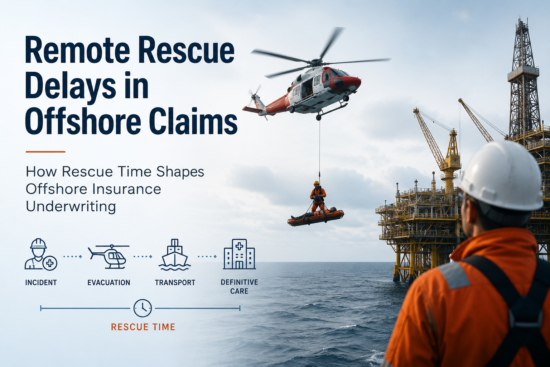
Underwriters do not evaluate rescue as a single event. They evaluate it as a chain, a framing that mirrors IOGP’s own risk assessment data guidance for evacuation, escape and rescue, which analyzes EER as a sequence of discrete stages rather than a single outcome because the personnel risk at each stage compounds rather than averages out. A chain is only as reliable as its weakest link, not its average link:
- Incident — the triggering event itself, which sets the clock running regardless of what happens next.
- Detection — how quickly the incident is recognized, which depends on personnel tracking, monitoring, and whether the worker was alone.
- Communication — how the incident is reported and escalated between the installation, vessel operators, and shore-based medical control.
- Medical stabilisation — what onboard capability can do before extraction, bounded by whether a medic, paramedic, or first-aid-trained crew member is present.
- Extraction — physically removing the worker from the incident location to a transport asset, which is its own operation on a platform or turbine.
- Transport — the helicopter or vessel movement from the installation to shore or another facility.
- Definitive medical care — the point at which the worker reaches a facility capable of resolving the injury, which is what stops the clock that matters for outcome.
A gap at any single stage, a communication failure, a grounded helicopter, an untrained bystander, extends the whole chain, and underwriters increase uncertainty in proportion to how many links rely on assumption rather than demonstrated performance. The final link deserves its own scrutiny: reaching a facility is not the same as reaching a facility capable of resolving the specific injury, a distinction covered directly in Remote Medical Access and Occupational Coverage, and one that can add hours back onto an outcome even after transport itself has succeeded.
Rescue Reliability
The distinction underwriters draw is between probable rescue and planned rescue. A written plan describes what should happen. Probable rescue describes what is likely to actually happen given the weather patterns, sea states, and equipment availability the asset experiences over a policy period, not on an average day. An installation in a basin with frequent fog or high sea states has a rescue plan that looks identical on paper to one in calmer waters, but the probable performance of that plan differs substantially, and underwriters price the difference.
Jurisdiction adds a further layer: the IMO’s Search and Rescue Convention divides the world’s oceans into search and rescue regions with assigned coastal-state responsibility, which means two installations with identical equipment can face different probable response times depending entirely on which authority covers that water and how well-resourced its SAR service is. Equipment availability matters at the same level of specificity: a helicopter contracted for daylight visual-flight operations only behaves differently than one contracted for instrument conditions, and that distinction changes probable rescue time on a foggy night far more than it changes the plan document.
Operational maturity, how long an operator has run the specific asset and how it has responded to past near-misses, gives underwriters a track record to weigh against the plan. Contingency planning closes the gap between probable and planned: operators who can show a fallback when the primary rescue asset is unavailable, a secondary vessel, a mutual aid agreement with a nearby operator, are underwritten differently than operators whose plan has no answer for that scenario.
Exposure Interaction
Rescue delay rarely sits in isolation from other offshore exposures, and underwriters evaluate it as part of a connected system rather than a standalone variable. Fatigue affects both the likelihood of an incident and the quality of the initial response to it, since a fatigued crew is slower to detect and communicate a problem in the first place. Severe weather is the common thread running through nearly every rescue delay scenario, since it is the single condition most likely to remove the fastest transport option and force reliance on slower alternatives, while simultaneously raising the likelihood of the incident that triggered the rescue in the first place. When several of these conditions land on the same asset in the same window, poor visibility, a fatigued crew, and a primary rescue asset already tasked elsewhere, underwriters treat it as exposure stacking rather than three unrelated variables, because the combined effect on rescue delay is worse than any single factor would predict on its own. Underwriters who evaluate rescue delay in isolation from adjacent exposures tend to understate reserve uncertainty for exactly this reason.
How Rescue Delays Affect Offshore Insurance
Workers
For an injured worker, rescue delay determines far more than how long the trip to shore takes. Longer time to definitive care extends recovery timelines, raises the probability that a treatable injury becomes a permanent disability, and shapes how much wage replacement and rehabilitation the claim eventually requires. Workers on assets with weaker rescue reliability carry a different practical risk profile than their job title alone would suggest, even when the underlying hazard exposure looks similar on paper.
Employers
For employers, rescue delay shows up first as operational disruption, since any incident serious enough to require evacuation interrupts production and consumes a rescue asset that may be shared across multiple duties. It shows up second, and more durably, as insurer scrutiny: underwriters ask increasingly specific questions about rescue capability at renewal, and operators who cannot answer them with documentation face harder negotiations. Emergency preparedness expectations have moved from a safety department concern to a commercial one, because the answers now shape renewal terms directly.
Brokers
Brokers sit at the point where operational reality has to be translated into underwriting language. Demonstrating rescue capability means assembling evidence, drill records, rescue contracts, response-time data, rather than restating the emergency plan’s narrative description. Presenting operational maturity, how the specific asset has actually performed, not how the fleet performs on average, is what differentiates a submission that moves pricing from one that doesn’t. Answering underwriting questionnaires accurately on rescue-specific questions, rather than defaulting to general safety management answers, is increasingly what separates a fast placement from a stalled one.
Claims Professionals
For claims professionals, rescue delay is a causation and reserve issue from the first notice of loss. Reserve development on an offshore injury claim depends heavily on how much delay occurred before definitive care, information that needs to be captured early rather than reconstructed later. Evidence collection around the rescue timeline, dispatch logs, weather records, communication logs, becomes as important as medical evidence when a claim’s severity turns on how long extraction actually took. Claim complexity rises accordingly, since causation arguments increasingly involve the rescue chain itself, not just the original incident.
Risk Managers
Risk managers use rescue delay data operationally, not just for insurance purposes. Emergency planning benefits from treating rescue time as a measurable performance indicator rather than a compliance checkbox. Contractor coordination, ensuring third-party crews on an asset are covered by the same rescue plan as direct employees, closes a gap that otherwise surfaces only after an incident. Rescue performance monitoring, tracking actual drill and incident response times against plan, and operational audits that test the plan under realistic conditions are what convert a paper emergency plan into the kind of documented evidence underwriters credit.
Insurance Consequences of Remote Rescue Delays
Premium Pricing and Reserve Uncertainty
Rescue delay uncertainty feeds directly into premium loading, since insurers price for the reserve volatility that unreliable rescue produces, not only for the underlying hazard frequency. Reserve uncertainty on assets with weak or undocumented rescue capability pushes pricing higher even when incident frequency looks comparable to a better-supported asset, because severity, not frequency, is what rescue delay moves. Catastrophe assumptions built into offshore pricing models increasingly account for the possibility that a single severe weather event both increases incident likelihood and simultaneously removes the primary rescue asset, compounding both sides of the loss equation at once.
Coverage Eligibility and Underwriting Restrictions
Underwriting restrictions can attach directly to rescue capability gaps, limiting coverage for specific operations, seasons, or locations where probable rescue performance falls below what the insurer is willing to underwrite. Operational requirements, mandated standby vessel coverage, minimum drill frequency, communication redundancy, are increasingly written into policy conditions rather than left as informal expectations. Rescue documentation itself has become an eligibility gate: operators unable to produce drill records, response-time data, or rescue contracts face coverage eligibility gating that has little to do with their underlying safety record and everything to do with what they can prove. That expectation has regulatory precedent behind it; BSEE’s incident reporting rule already treats any injury requiring evacuation of a worker from a facility to shore as its own specific reportable event, which means the underlying data an underwriter wants often already exists inside an operator’s compliance file and simply needs to be surfaced.
Claims Development and Long-Term Disability
Disability duration lengthens as rescue delay increases, and litigation risk rises alongside it, since a documented delay in the rescue chain becomes a natural focus of causation disputes over how much of the resulting impairment is attributable to the original incident versus the time before treatment. Rehabilitation needs shift from short, defined programs toward extended, uncertain ones as more injuries cross the threshold from recoverable to permanent. Psychological injury claims, arising from the incident itself or from an extended, isolated wait for rescue, increasingly accompany the physical claim, adding a layer of complexity that a fast rescue would have prevented from developing at all. Permanent impairment ratings, once they attach, drive a claim’s long-term financial tail far more than the initial injury severity did.
Offshore Insurance Market Consequences
Insurer appetite for offshore risk concentrates around operators and asset classes with demonstrable rescue reliability, which narrows offshore capacity for operators who cannot produce that evidence, regardless of their underlying safety culture. Reinsurance treaties increasingly reflect rescue and evacuation capability as a rating factor in their own right, not merely a sub-element of general safety management, a shift supported by independent data: NIOSH’s Fatalities in Oil and Gas Extraction database specifically includes offshore transportation fatalities, aircraft and vessel events among them, because traveling to a remote offshore facility is itself considered work-related exposure given how remote the work is, confirming that transport and rescue-adjacent events are a central category of offshore risk rather than a peripheral one. Catastrophe aggregation modeling, particularly for basins prone to severe weather, treats rescue delay as a correlated variable across an entire portfolio of offshore risks, since the storm that grounds one operator’s helicopter is often grounding several others’ at the same time, a dynamic that overlaps closely with the large-scale, weather-driven crew evacuations covered in Offshore Evacuation Risk and Insurance, where the same storm system competes for the same limited pool of vessels and aircraft across an entire basin.
What Improves Rescue Reliability?
Documented Emergency Response Planning
What changes an insurer’s confidence in remote rescue delays in offshore claims is not a safety pledge. It is evidence that the rescue chain has been tested and performs as claimed. Documented rescue plans that specify actual response times, contracted assets, and named responsibilities carry more underwriting weight than generic emergency procedures copied across a fleet.
Demonstrating Rescue Performance
Response-time monitoring, an operator that tracks its own actual drill and incident response times against target and can show the trend, gives underwriters a data series to evaluate instead of a static document. Rescue drills, conducted regularly and critiqued honestly rather than run as a compliance formality, demonstrate that the plan has been stress-tested under conditions closer to reality. Helicopter agreements that specify dedicated, contracted coverage rather than shared regional availability reduce the uncertainty underwriters otherwise have to price for. Standby rescue vessels, particularly where contracted rather than opportunistically available, shorten the probable extraction time in exactly the weather conditions where a helicopter is most likely to be grounded.
Strengthening Rescue Capability
Communication redundancy, multiple independent channels between installation, vessel, and shore, closes one of the more common gaps in the rescue chain.
Emergency audits conducted by an independent party, rather than self-assessed, carry more underwriting credibility because they test the plan without the operator’s own incentive to present it favorably. Offshore medical capability, whether a medic or paramedic is present and what their scope of practice covers, extends the window before extraction becomes the deciding factor in outcome. Contractor coordination, making certain third-party crews are covered by the same rescue plan and drilled alongside direct employees, removes a common blind spot.
Operational Maturity as an Underwriting Asset
Taken together, these measures demonstrate operational maturity rather than isolated safety improvements. Underwriters ultimately extend credit to evidence rather than intention. Rescue capability becomes an underwriting asset only when operators can consistently demonstrate that the rescue chain performs as expected under realistic offshore operating conditions. The more reliable that evidence becomes over successive policy periods, the greater the insurer’s confidence in claim predictability, pricing stability, and long-term eligibility.
Real-World Scenarios
Scenario 1: Helicopter Grounding Extends Rescue Time
Operational Situation: A worker suffers a serious hand injury on a fixed platform sixty nautical miles offshore during a period of low visibility and high wind that grounds the contracted rescue helicopter for eleven hours.
Institutional Basis: The installation’s emergency response plan, built around IADC-aligned HSE case principles, specifies the helicopter as the primary extraction asset with a standby vessel as backup.
Underwriting Interpretation: Because the plan lacked a tested vessel-based contingency for extended grounding, the underwriter treats the incident as evidence of a single point of failure in the rescue chain, not an isolated weather event.
Stakeholder Impact: The worker’s injury, treatable with prompt surgery, progresses toward permanent impairment during the extended wait, while the claims team faces a causation dispute over how much of the outcome is attributable to the delay itself.
Insurance Consequence: Reserve development on the claim exceeds initial estimates, and the operator’s renewal includes a specific rescue diversification requirement.
Underwriting Credit: The operator’s subsequent addition of a contracted standby vessel with proven foul-weather capability restores broader eligibility at the next renewal.
Scenario 2: Standby Vessel Improves Rescue Reliability
Operational Situation: A drillship operating in a remote block maintains a dedicated standby vessel positioned within thirty minutes of the rig at all times, independent of helicopter availability.
Institutional Basis: This arrangement exceeds baseline expectations in IOGP’s emergency response services guidance, which treats marine assets as a core component of the response system rather than a fallback.
Underwriting Interpretation: The underwriter credits the dedicated vessel as reducing probable rescue time in the weather conditions where helicopter access is least reliable, not just in the average case.
Stakeholder Impact: When a crew member requires evacuation for a cardiac event during a period of poor helicopter visibility, the vessel reaches the rig and begins transport within the window that preserves treatment options.
Insurance Consequence: The claim resolves as a short-tail medical claim rather than a long-tail disability claim.
Underwriting Credit: The operator’s rescue reliability record supports continued favorable terms at renewal, with the dedicated vessel specifically cited in the underwriting file.
Scenario 3: Communication Failure Delays Evacuation
Operational Situation: An offshore wind technician working alone inside a nacelle is injured, but a satellite communication outage delays the report reaching the onshore operations center by nearly two hours.
Institutional Basis: Communication redundancy is a stated expectation in offshore emergency planning frameworks precisely because single-channel dependency is a known failure mode.
Underwriting Interpretation: The underwriter treats the outage as a detection and communication failure within the rescue chain, distinct from the injury itself, and assigns it independent weight in the risk assessment.
Stakeholder Impact: The extended time before the incident was even known lengthens every subsequent stage of the chain, and the eventual claim reflects a disability duration longer than the injury alone would predict.
Insurance Consequence: The renewal underwriting questionnaire adds specific communication redundancy requirements for lone-worker operations.
Underwriting Credit: Installing a secondary, independent communication channel and a scheduled check-in protocol for lone technicians becomes the documented evidence that restores confidence at the next renewal.
Scenario 4: Onboard Medical Capability Reduces Claim Severity
Operational Situation: A worker suffers a serious fall on an FPSO with a dedicated onboard medic and stabilization capability beyond basic first aid.
Institutional Basis: This capability aligns with the offshore medical response expectations referenced across IOGP and BSEE guidance for higher-risk installations.
Underwriting Interpretation: The underwriter weights the presence of a trained medic as extending the window before extraction timing becomes the deciding factor in outcome.
Stakeholder Impact: The medic’s stabilization keeps the injury within a recoverable range through a transport delay that would otherwise have pushed it toward permanent impairment.
Insurance Consequence: The claim develops with a shorter disability duration and lower reserve than a comparable claim on an asset without onboard medical capability.
Underwriting Credit: The operator’s investment in medical capability is reflected in more favorable eligibility terms across the broader FPSO fleet.
Scenario 5: Rescue Drills Increase Underwriting Confidence
Operational Situation: A platform operator runs a documented, critiqued rescue drill program on a quarterly schedule, with each drill’s weaknesses formally logged and corrected.
Institutional Basis: This practice reflects the training and drill requirements built into BSEE’s Safety and Environmental Management Systems rule, which calls for realistic scenarios and post-drill analysis.
Underwriting Interpretation: The underwriter treats the drill history as tested evidence of rescue chain performance rather than an unproven plan on paper.
Stakeholder Impact: The broker is able to present a specific, documented response-time trend at renewal rather than a generic emergency response narrative.
Insurance Consequence: The underwriter reduces the reserve uncertainty loading applied to the account relative to operators without comparable drill documentation.
Underwriting Credit: Consistent drill performance over multiple renewal cycles becomes a durable underwriting asset, supporting broader eligibility even as the operator expands into more remote locations.
Final Underwriting Insight
Remote rescue delays in offshore claims are not evaluated simply by measuring distance from shore. Insurers assess the reliability of the entire rescue chain because every stage, from incident detection and medical stabilisation to evacuation and definitive treatment, changes claim severity, reserve development, underwriting confidence, and long-term insurance costs. Operators who can demonstrate reliable rescue capability through documented operational evidence are more likely to achieve stronger eligibility, broader coverage, and more favourable underwriting outcomes.
As offshore operations move into deeper water, harsher environments, and more remote energy developments, rescue reliability is likely to become an even more significant underwriting differentiator between otherwise similar offshore risks.
—————————————————————————————————————————
Institutional & Underwriting References
- International Association of Oil & Gas Producers (IOGP)
- International Maritime Organization (IMO)
- International Association of Drilling Contractors (IADC)
- U.S. Bureau of Safety and Environmental Enforcement (BSEE)
- Occupational Safety and Health Administration (OSHA)
- National Institute for Occupational Safety and Health (NIOSH)
- International Organization for Standardization (ISO)
- Offshore Energies UK (OEUK)
- International SOS
Research & Underwriting Methodology
This article translates offshore operational realities into institutional standards, underwriting evaluation, stakeholder consequences, insurance outcomes, and underwriting credit mechanisms. Rather than explaining emergency response procedures alone, the article examines how insurers evaluate rescue reliability as a severity-control variable affecting pricing, eligibility, reserve development, and long-term claims performance. The analysis draws upon internationally recognized offshore safety guidance, maritime regulatory frameworks, occupational safety research, and established commercial underwriting practices.