Reviewed for underwriting accuracy by the RJI Underwriting Research Team | Published: Aug, 2026 | Last reviewed: Aug, 2026.
Executive Summary
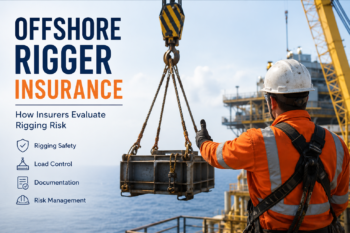
An offshore rigger is the worker who connects loads to lifting equipment and controls how those loads move once they leave the deck. Riggers select slings, shackles and spreader beams, calculate sling angles, attach and detach loads, and guide suspended weight through a working envelope shared with cranes, vessels and personnel. Offshore rigger insurance is underwritten around that specific function: the rigger does not operate the crane; the rigger is responsible for the load connection and rigging configuration that determine how the load interfaces with the lifting system.
Offshore rigging presents a high-severity occupational exposure because the consequences of a rigging failure can scale with the weight, height and proximity of the load involved. A dropped or swinging load offshore can injure multiple workers at once, damage production or subsea infrastructure, and interrupt operations on an asset that cannot simply be shut down and reopened the next day. For offshore rigging insurance, frequency is only one part of the underwriting picture. Severity, accumulation potential, predictability and the contractor’s ability to demonstrate control can become particularly important because a single loss of load control may affect several people or high-value assets simultaneously.
A recurring source of confusion in this space is the assumption that rigger and offshore crane operator represent a single underwriting profile. They do not. The crane operator operates and controls the lifting machinery. The rigger connects, configures and guides the load within that lifting system. The two roles are interdependent and carry distinct competency requirements and failure modes; this article addresses the rigger specifically and cross-references Offshore Crane Operator Insurance where the two occupations intersect.
Underwriting confidence in this occupation is built on documentation: current lifting plans, rigging inspection records, equipment certification, sling and shackle traceability, and a claims history that shows whether previous incidents reflect isolated error or a recurring pattern. Where that documentation is thin or inconsistent, an underwriter has less evidence with which to distinguish a controlled exposure from an unmanaged one; depending on the carrier, jurisdiction and account, that uncertainty may affect pricing, terms, capacity or eligibility. The core insight for Offshore Rigger Insurance is that insurers are not pricing the act of rigging a load; they are pricing the reliability of the load-control system around the rigger, from planning through execution.
The Operational Reality of Offshore Rigger Work
Before any classification code or premium modifier is applied, an underwriter needs an accurate picture of what an offshore rigger actually does during a working shift. Rigging is frequently folded into broader descriptions of deck work or construction labor, which understates the degree of technical judgment involved and, in turn, distorts how the exposure is evaluated.
What Does an Offshore Rigger Do?
On a typical offshore installation, construction vessel or drilling rig, a rigger’s tasks include selecting the correct rigging configuration for a given load, inspecting slings, shackles, hooks and wire rope before use, attaching loads to the crane hook, communicating with the crane operator during the lift, and guiding the load through a restricted deck environment. Riggers work on routine material transfers, scheduled maintenance lifts, and less frequent critical lifts involving high-value equipment or unusually complex rigging; on some projects they also support subsea lifting, module handling or offshore wind component transfers. None of this occurs in a controlled, static environment. Vessel motion, wind, sea state, restricted deck space and simultaneous operations are constant background variables rather than occasional complications, and each is not simply a safety consideration but an input into how an underwriter assesses the likelihood that a given lift proceeds as planned.
Common Offshore Rigger Injuries and Illnesses
The injury exposure associated with rigging work is dominated by a small number of high-consequence mechanisms rather than a broad spread of minor incidents: struck-by and caught-between injuries from swinging or shifting loads, crush injuries during load attachment, dropped-object injuries from rigging or component failure, and hand and finger injuries during sling handling. These mechanisms can produce severe claims because the worker may be positioned close to suspended loads, lifting accessories and moving equipment during the operation. Musculoskeletal strain and fatigue-related error are also present, particularly on extended rotations, but a single rigging failure has the potential to produce a high-severity claim in a way routine strain injuries generally do not.
For offshore rigging, frequency is only one part of the underwriting picture. Severity, accumulation potential, predictability and the contractor’s ability to demonstrate control can become particularly important because a single loss of load control may affect several people or high-value assets simultaneously. A rigger who performs hundreds of routine lifts without incident does not by itself reduce underwriting concern if the operational controls behind those lifts are undocumented, because the absence of a claim is not the same as evidence of a reliable system.
Why Offshore Rigging Creates Insurance Friction
Serious rigging incidents offshore carry insurance complications beyond the injury itself. Medical response is delayed by distance and transport logistics; a worker with a crush injury or major trauma may require helicopter evacuation before definitive treatment can begin. This broader exposure is examined in Offshore Evacuation Risk and Insurance and Remote Rescue Delays in Offshore Claims. Where a subcontracted rigging crew is involved, incident investigations frequently surface disputes over contractual responsibility between the vessel operator, the lifting contractor and any equipment supplier, extending claims timelines and creating third-party exposure alongside the primary employers’ liability claim.
These complications place offshore rigger insurance within the wider offshore workers insurance framework, where occupational injury, remote location, evacuation requirements and jurisdiction can interact in determining the insurance response.
How Offshore Riggers Are Classified for Insurance
Occupational classification for offshore rigging is not standardized across a single universal code. Systems such as NCCI and ISO classify operations and employer industry activity, not individual job titles, and the appropriate classification depends on jurisdiction, the employer’s overall operations, and whether the work occurs in a construction, marine or offshore energy context. A rigging crew working for a marine construction contractor on a fixed platform may fall under different treatment than a similarly skilled crew working for a drilling contractor, even though the physical tasks look identical. This article does not present a universal rigger classification code, because no such single code accurately applies across jurisdictions and lines of business.
Offshore Rigger vs. Offshore Crane Operator: Why Insurers Separate the Roles
A useful underwriting distinction is functional rather than titular: the rigger controls the load connection and load path, while the crane operator controls the lifting machinery. This matters because the two roles carry different competency requirements and different points of failure. A crane operator’s profile centers on machine control (load charts, boom angle, mechanical condition); a rigger’s profile centers on the physical connection between the load and that machine (sling selection, lifting point integrity, communication during the lift). Underwriters reviewing a rigging contractor insurance account want both functions addressed, but do not treat them as interchangeable.
The distinction becomes clearer when the rigger is compared with the offshore crane operator, whose primary occupational exposure centers on operating and controlling the lifting machinery rather than configuring the load connection.
The distinction does not mean that the rigger and crane operator can be underwritten independently. A lifting loss can arise from the interaction between load configuration, rigging equipment, crane operation, communication and environmental conditions. The occupational distinction is therefore useful for classification and exposure analysis, while the lifting operation itself remains a connected system.
Duty Drift, Payroll Classification and Audit Exposure
Offshore riggers frequently perform adjacent duties: signalling to the crane operator, acting as lifting supervisor on smaller lifts, or supporting subsea operations alongside a dive team. Each additional duty shifts the exposure profile in ways a static job title does not capture, and underwriters want the payroll and duty description to reflect what the workforce actually does. This matters most where mixed-duty crews or shutdown projects blend marine and platform-based work: reporting rigging labor under a broader construction classification, without separating out the higher-severity lifting exposure, can understate the risk transferred. A mismatch between reported operations and actual duties can create audit and claim-evaluation issues, particularly where policy terms depend on the nature of the insured operations.
How Underwriters Evaluate Offshore Rigger Insurance Risk
Offshore rigging insurance underwriting begins from an elevated baseline relative to many onshore trades, reflecting load-handling exposure, marine environment and offshore consequence severity. From that starting point, pricing and terms are shaped by a specific set of variables rather than a single formula; this article does not state a universal premium, since no single figure applies across carriers, jurisdictions and programme structures.
The factors affecting an offshore rigger are part of a broader marine and remote-worker underwriting system. Our guide to Offshore Risk Underwriting: How Insurers Evaluate Marine & Remote Workers examines how insurers translate offshore location, remoteness, operational complexity and accumulated exposures into underwriting decisions across different occupations.
Depending on the account and applicable insurance programme, underwriting review may consider:
- the type of lifting work performed (routine transfers versus critical or heavy lifts)
- load complexity and the rigging configurations required to manage it
- the crane interface, including the condition and capacity of the lifting equipment involved
- the operating environment (fixed platform, floating production vessel, drilling rig, construction vessel)
- the nature of the project (routine maintenance versus a construction or shutdown campaign)
- documented claims history, including near-miss and dropped-object records where available
- workforce competence and certification currency
- equipment condition, inspection cadence and traceability.
- the operational maturity of the contractor managing the rigging programme.
What Underwriters Look for in Offshore Rigging Operations
Where applicable, experience modification factors and broader workers’ compensation experience inform pricing, but the underwriting read goes beyond the headline modifier. Claims history can be evaluated not only by frequency and total incurred cost, but by the mechanism of loss, severity, recurrence and the corrective actions taken afterward; reserve development on open claims can suggest whether an incident description understated the eventual cost. Incidents involving dropped loads, struck-by or crush injuries, or equipment failures may warrant closer examination because they can reveal different underlying control problems. Repeated near-miss patterns can provide evidence that a control problem may be recurring, even where no major claim has yet resulted; their significance depends on the quality of the reporting and corrective-action record.
How Claims History Affects Offshore Rigger Insurance
Documentation functions as the primary evidence of operational control in this occupation, because rigging quality is difficult to observe directly at the underwriting stage. Reviewers look for current rigger qualifications, documented lifting plans, rigging inspection records, equipment traceability, and evidence of active contractor supervision rather than self-certification alone. These records do not eliminate the underlying exposure, but their presence and consistency materially improve underwriting confidence.
Underwriter Red Flags in Offshore Rigging
Certain patterns may prompt closer underwriting scrutiny and, depending on the account, may affect terms, pricing or capacity:
- repeated dropped-load incidents, even where injury did not result
- visibly damaged or improperly stored rigging equipment
- inconsistent or missing inspection documentation
- expired or unverifiable rigger certification
- unclear or informal lifting plans for non-routine work
- personnel performing lifts outside their documented experience or certification scope
- limited contractor oversight of subcontracted rigging crews
What Drives Severity in Offshore Rigging Operations
This is the section where the occupational exposure is most directly translated into underwriting judgment, because the severity of a rigging failure is not fixed. It scales with the specific conditions of the lift being performed, and insurers evaluating offshore rigging risk are, in effect, evaluating how well a contractor manages that variability.
How Lift Complexity and Heavy Lifting Affect Insurance Risk
Not all lifts carry the same exposure. Routine material transfers from a supply vessel involve relatively standardized rigging and lower consequence potential; scheduled maintenance lifts introduce more variation in load type and lifting point condition. Heavy lifts and critical lifts, involving high-value equipment, multiple rigging points, narrow margins or proximity to critical assets, are treated as a distinct category, often warranting engineering review before the work proceeds. Construction and subsea lifting add further complexity through added rigging points and interaction with dive teams. Underwriters do not price these categories identically, because losing control of a heavy critical lift is a materially different consequence from losing control of a routine transfer.
Why Suspended Loads Are a Core Offshore Rigging Risk
Suspended-load exposure sits at the center of how insurers think about offshore lifting operations insurance. The underlying mechanism is straightforward to describe and difficult to fully control:
Load Identified for Lifting
↓
Rigging Connection Established
↓
Load Path Defined
↓
Load Suspended and In Motion
↓
Loss of Control (if it occurs)
↓
Dropped or Swinging Load
↓
Injury or Property Damage
↓
Insurance Loss
The rigger occupies a critical position in this chain because the rigging connection and load path decisions sit almost entirely within the rigger’s control, even though the ultimate outcome also depends on the crane operator, the vessel and the environment. A failure anywhere along the chain can produce the same downstream loss.
How Load Weight, Energy and Proximity Affect Claim Severity
A load’s nominal weight is only one input into severity. Lifting height, center of gravity, likely trajectory if control is lost, and proximity to personnel or critical assets all affect the potential energy involved in a failure. A moderately heavy load lifted low over open deck carries a different severity profile than a lighter load lifted over an area where personnel are working. Underwriters are, in practice, evaluating potential loss severity rather than simply reading load weight off a lift plan.
How Dynamic Loading and Load Swing Change Rigging Risk
Sling angles, load distribution across multiple lifting points, the condition of padeyes and lifting lugs, and the selection of shackles, spreader beams, hooks, wire rope and chain all determine whether a configuration is appropriate for a given load. More complex configurations introduce more opportunities for error and correspondingly more underwriting uncertainty. This is closely tied to load path integrity: the continuous chain from the load, through the lifting point and rigging equipment, to the hook, to the crane, to the crane’s supporting structure. A failure at any single point can alter the entire loss pathway, which is why underwriters treat load path integrity as a system-level property rather than a single equipment specification.
Load
↓
Lifting Point
↓
Rigging Equipment
↓
Hook
↓
Crane
↓
Supporting Structure
Sharp or unfinished edges on structural steel present a specific, preventable failure point within this chain: a sling drawn tight against an unprotected edge can shear even at a properly rated load. Engineered edge softeners placed between sling and load are a low-cost control underwriters look for on structural or angular lifts, and their absence is read as a gap in an otherwise sound configuration.
Center of gravity, load stability and dynamic loading
Irregular loads, shifting cargo and structural components with an uneven mass distribution create greater control difficulty than a symmetrical, well-understood load. Where a load’s center of gravity is not accurately known or communicated, the rigging configuration selected may be inadequate even for a load of the same weight. This interacts directly with dynamic loading: vessel motion, sudden loading events and wave action can all introduce forces well beyond a load’s static weight during marine lifting. Pitch, roll and heave are active variables that a land-based lifting operation would not need to account for, and their presence is one of the clearest structural differences between offshore and onshore rigging exposure.
How Weather, Sea State and Crane Interface Affect Offshore Lifting
Wind speed and gusting, visibility, sea state and the length of available weather windows all affect whether a lift can be performed reliably. Marginal weather does not necessarily halt lifting operations, but it narrows the tolerance for error, which is why documented weather-monitoring protocols and defined go/no-go criteria are treated as meaningful underwriting evidence rather than procedural formality. The crane interface referenced earlier applies directly here: a rigging configuration can be flawless and a lift can still fail because of a crane fault under marginal conditions, which is one more reason underwriters reviewing either occupation without reference to Offshore Crane Operator Insurance are seeing only part of the exposure.
Dropped objects, critical lifts and personnel lifting
Dropped-object exposure extends beyond the primary load: rigging failure, component failure and unsecured tools can all become secondary falling objects, with consequences for personnel, equipment, production systems and subsea assets below the lift path. Critical lifts receive closer scrutiny precisely because the consequence of a failure is disproportionate to the frequency of such lifts. Personnel lifting, where it occurs, is a distinct exposure category, since losing control of a load carrying people differs in kind from losing control of cargo; not all offshore riggers perform it, and where it is part of an account’s operations it should be identified specifically rather than folded into general rigging exposure.
Subsea Rigging and Commercial Diver Exposure
Where rigging operations extend below the waterline, additional variables apply: reduced visibility, remote or diver-assisted load control, vessel motion affecting subsea lifting points, and the presence of a dive team near the load path. Subsea rigging introduces a layer of remote coordination and diver-interaction risk that changes how the underwriting review is conducted. Where a commercial dive team guides or connects subsea loads, the exposure interacts with Commercial Diver Insurance as a related but separate profile. One mitigation seen on some subsea programmes is a remotely operated release mechanism that disconnects a load without a diver at the point of connection during the highest-risk phase of a lowering, which can reasonably be read as reducing the diver-interaction exposure, though how much weight any given underwriter gives it depends on the broader programme.
SIMOPS and Exposure Stacking in Offshore Rigging
Rigging rarely occurs in isolation on an active offshore asset. Welding, other crane operations, diving, cargo transfers, production activity and scaffolding work frequently proceed at the same time, in close physical proximity. This is Exposure Stacking: each additional concurrent operation raises both the likelihood that a rigging incident affects other personnel and the potential severity if it does. Simultaneous operations planning, and the discipline with which a contractor enforces it, is one of the more direct indicators of operational maturity an underwriter can assess.
Communication, Human Factors and Load Control
Rigging depends on close, real-time coordination between the rigger, the crane operator, a banksman or signalman, and deck crew. A breakdown in that chain, whether from ambiguous signals or miscommunication under time pressure, is a recognized underwriting variable separate from equipment condition. Broader human reliability (fatigue, schedule pressure, crew experience, supervision adequacy and contractor turnover) shapes how consistently a rigging programme performs under realistic rather than ideal conditions; the underwriting focus is on whether the operational structure supports consistent performance, not on attributing failure to individual workers.
Equipment condition and asset criticality
Corrosion, worn slings, damaged shackles and degraded lifting-point integrity are foreseeable failure sources in a marine environment, which is why inspection quality and traceability carry underwriting weight; a fleet with clear inspection records signals a different level of control than one assessed informally. Lifting over or near accommodation areas, hydrocarbon systems or critical subsea equipment raises the potential severity of a failure, since the consequence of a dropped load depends on what sits beneath the load path, not the load itself.
Accumulation risk
A single rigging failure can affect more than one party at once: the rigger, the crane operator, a banksman, nearby deck crew, other contractors, and in some cases production personnel or the asset itself. This is accumulation risk, and it is a major reason offshore rigging carries elevated severity assumptions even before claims history is reviewed: an incident generating one workers’ compensation claim in an isolated context can generate multiple simultaneous claims across several coverage lines in a stacked offshore environment.
Seasonal and weather-driven variability
Two further points apply to the controls above. First, they matter only to the extent implementation appears reliable rather than nominal; a lift plan filed once and never updated carries less weight than one that visibly governs how work is sequenced. Second, storm seasons, cyclone exposure and winter sea states concentrate offshore construction activity into narrower weather windows, a secondary but relevant input into how underwriters view the pacing of a rigging programme’s activity across a policy period.
How Offshore Rigger Insurance Claims Can Fail
Coverage adequacy in offshore rigging is tested most clearly at the point of a claim, and several recurring failure patterns account for a disproportionate share of disputed or complicated outcomes.
Documentation and Evidence Breakpoints
Incomplete lift documentation, missing inspection records, unclear or absent load calculations, an inconsistent incident chronology, disputed responsibility between a vessel operator and a rigging subcontractor, and inadequate contractor recordkeeping all slow claims resolution and can affect coverage outcomes. These are rarely the proximate cause of the incident itself, but they materially affect how the incident is interpreted after the fact.
Coverage gaps
Potential coverage gaps can arise around rigging performed by subcontractors, crane operations where responsibility between rigger and crane owner is unclear, marine operations from a vessel not clearly addressed in the policy, unanticipated personnel lifting, specialist rigging equipment, and territorial restrictions where a programme extends beyond the policy’s intended scope, an issue addressed at greater length in International Waters Insurance Exclusions. Actual policy wording on each point varies by insurer and jurisdiction.
Coverage reliability failures
In some cases coverage technically exists but a claim becomes complicated because of undisclosed rigging activities, incorrect occupational classification, an unreported shift from routine to heavy-lift or subsea work, undocumented subcontractors, or poor recordkeeping. This is the pattern addressed under Coverage Eligibility Gating: the issue is rarely whether insurance was purchased, but whether the exposure presented at underwriting still matches what was actually being run at the time of loss. These issues rarely invalidate coverage outright, but they extend claims timelines and increase the likelihood of disputed elements.
How rigging failures actually unfold into claims
Three recurring breakpoints illustrate how an operational failure translates into an insurance consequence.
Rigging Failure Breakpoint
Rigging Failure
↓
Load Instability
↓
Dropped Load
↓
Worker Injury
↓
Emergency Evacuation
↓
Major Claim
Critical Asset Damage Breakpoint
Rigging Failure
↓
Impact With Critical Equipment
↓
Production Interruption
↓
Property Damage
↓
Business Interruption
Multi-Party Loss Breakpoint
Dropped Load
↓
Multiple Personnel Exposed
↓
Workers’ Compensation / Employers’ Liability Claims
↓
General Liability Claims
↓
Property Damage Claims
Each of these breakpoints shows why underwriters price the load-control system as a whole rather than any single item: the same initiating event (a rigging failure) can resolve into an injury claim, a property and business-interruption claim, or a multi-party claim, depending almost entirely on what happened to be within the load’s path when control was lost.
How Offshore Rigging Exposure Crosses Insurance Coverage Lines
Offshore rigging exposure rarely sits within a single line of coverage, which is part of why it is reviewed carefully at the underwriting stage rather than treated as a standard inclusion.
Workers’ Compensation and Employers’ Liability for Offshore Riggers
This line addresses direct employee injury arising from rigging duties: the rigger’s own injuries, and those of crew members caught in the path of a dropped or swinging load. Given the severity profile discussed above, this exposure is generally underwritten with close attention to claims history and reserve development rather than frequency alone.
General Liability for Offshore Rigging Contractors
General liability responds to third-party injury, third-party property damage, and, where applicable, completed-operations exposure for rigging work performed under contract. Because offshore worksites routinely host multiple contractors, GL exposure for rigging operations is closely tied to the accumulation risk discussed earlier.
Marine Liability and Offshore Rigging Operations
Where rigging operations are conducted from or in connection with a vessel, marine liability exposure may apply. The boundary between marine liability and general liability in a rigging context is policy-specific and frequently contested rather than governed by a clean, universal rule.
Inland Marine and Rigging Equipment Coverage
Rigging equipment (slings, shackles, spreader beams and other specialist lifting accessories, along with mobile equipment used in support of lifting operations) may be insured under specialist equipment, inland marine or other property arrangements depending on ownership, mobility, policy structure and the jurisdiction involved. The applicable treatment should be confirmed against the actual policy wording rather than assumed as a fixed arrangement.
Builders Risk and Commercial Auto Considerations
Where rigging supports offshore construction involving modules, turbine components or major equipment installation, builders risk coverage may intersect with the rigging exposure, particularly where a dropped or mishandled load damages a partially completed structure. Commercial auto exposure, by contrast, is relevant only where onshore logistics connect to an offshore lifting programme, such as equipment transport to a marine terminal ahead of a lift; the boundary between the two is generally clear in practice and is not a significant driver of rigging risk.
Offshore Rigger Insurance Market Consequences
Insurance Capacity and Specialist Underwriting Review
Complex offshore rigging can require more specialized underwriting review, particularly where heavy lifts, critical lifts, subsea operations or significant marine exposure materially change the loss profile; capacity availability depends on the carrier, programme structure and market conditions. Major lifting incidents, especially those involving fatalities or significant property damage, tend to prompt increased regulatory scrutiny and, in some markets, litigation that influences how subsequent similar risks are priced, making carrier appetite for this occupation sensitive to the broader claims environment in the sector rather than solely to an individual account’s own history.
How Insurer Appetite Varies for Offshore Rigging Risks
Within that broader sensitivity, insurers still differentiate between individual accounts: an experienced contractor with an established programme against a newer operator without a track record; routine lifting against critical or subsea work; a well-maintained, traceable equipment fleet against an older one. Appetite varies by insurer and market conditions, and a contractor’s standing can shift as sector-wide loss experience evolves, independent of its own claims record.
How to Improve Offshore Rigger Insurance Eligibility
For a rigging contractor facing restricted terms, reduced capacity or unfavorable pricing, the path back to more favorable underwriting treatment runs through demonstrable operational control rather than simply time passing without a further incident.
Immediate Steps to Improve Offshore Rigging Underwriting
- formalizing lift planning, including documented critical-lift procedures for non-routine work
- establishing a consistent rigging inspection cadence with retained records
- confirming current equipment certification across the rigging equipment fleet
- verifying and documenting rigger competency and qualification status
- implementing defined weather-monitoring and go/no-go criteria
- formalizing communication protocols between riggers, crane operators and lifting supervisors
- instituting a review process for critical or heavy lifts before they proceed
Presenting a system-compliant account
Sustained improvement depends less on any single fix than on recordkeeping maintained as routine practice rather than assembled for a renewal. A submission built on complete, current, and honestly presented records gives an underwriter a basis to distinguish a genuinely controlled programme from one that has simply not yet had a severe loss, which is what ultimately improves both the terms offered and the range of carriers willing to consider the risk.
Offshore Rigging Underwriting Case Scenarios
The following scenarios illustrate how the concepts above translate into underwriting judgment. They are presented as illustrative case patterns rather than accounts of specific incidents.
Scenario 1: Routine Equipment Transfer From a Supply Vessel
| Operational Situation | A rigging crew transfers a standard equipment load from a supply vessel to a fixed platform in moderate seas, using a documented, previously used configuration. |
| Underwriting Interpretation | Routine, lower-severity activity when supported by current inspection records and a repeatable lift procedure. |
| Insurance Consequence | Underwriting significance is lower for routine, repeatable, well-documented work; actual treatment remains carrier- and programme-specific. |
| Operational Improvement | Consistent inspection and lift-log records for routine work strengthen the baseline exposure history an underwriter relies on. |
Scenario 2: Critical Lift With Multiple Rigging Points
| Operational Situation | A heavy module lift requires multiple lifting points, a custom spreader-beam configuration, and coordination across several crew roles. |
| Underwriting Interpretation | Classified as a critical lift; underwriters look for a documented procedure, engineering-reviewed calculations, and evidence of pre-lift planning. |
| Insurance Consequence | The added complexity can lead an underwriter to request more detailed engineering or loss-control information before setting terms and capacity. |
| Operational Improvement | A formal critical-lift review process, retained in writing, is one of the more direct ways a contractor demonstrates readiness. |
Scenario 3: Lifting Operation During Deteriorating Weather
| Operational Situation | A scheduled lift is underway as wind speed and sea state begin to exceed the crew’s usual operating parameters. |
| Underwriting Interpretation | Underwriters assess whether defined go/no-go criteria exist and were followed, rather than the weather event alone. |
| Insurance Consequence | A documented decision to suspend the lift supports underwriting confidence; proceeding without justification raises concern regardless of outcome. |
| Operational Improvement | Written weather-monitoring protocols with clear suspension thresholds let underwriters evaluate judgment independent of any single incident. |
Scenario 4: Dropped Load During Simultaneous Operations
| Operational Situation | A rigging failure occurs during a lift while welding and maintenance work continue nearby on the same deck area. |
| Underwriting Interpretation | Reviewed through exposure stacking: concurrent operations near the lift raise both the likelihood of secondary injury and the claim’s scope. |
| Insurance Consequence | Likely to implicate multiple coverage lines simultaneously, consistent with the multi-party loss breakpoint described above. |
| Operational Improvement | Simultaneous-operations planning that restricts concurrent high-risk activity near active lifts reduces both likelihood and scope. |
Scenario 5: Subsea Rigging Operation Involving a Dive Team
| Operational Situation | A rigging crew coordinates with a commercial dive team to connect and guide a subsea load under reduced-visibility conditions. |
| Underwriting Interpretation | Reviewed jointly with diving exposure; underwriters look for defined surface-to-subsea communication protocols. |
| Insurance Consequence | Closely integrated rigging and diving operations may warrant consideration of both occupational profiles and the applicable insurance structure. |
| Operational Improvement | Documented subsea lift procedures defining surface-to-diver communication strengthen the underwriting picture for this higher-complexity work. |
Regulatory and Insurance Classification for Offshore Riggers
Offshore rigging operations intersect several regulatory and legal frameworks depending on jurisdiction, vessel type and facility, and the summary below is offered as general orientation rather than legal guidance; actual coverage determinations depend on case-specific facts and should be confirmed with qualified maritime counsel. In United States federal waters, which of several federal statutory frameworks applies to an injured rigger generally turns on the nature of the worker’s duties and where those duties are performed.
LHWCA, Jones Act and OCSLA Considerations
Riggers whose work is land-based or dockside but connected to maritime commerce commonly fall under the Longshore and Harbor Workers’ Compensation Act (LHWCA), administered by the U.S. Department of Labor’s Office of Workers’ Compensation Programs. Riggers with a substantial connection to a vessel in navigation, in both the duration and nature of their duties, may instead qualify for Jones Act seaman status, which is generally understood to provide broader remedies than the LHWCA but is not automatically available to platform-based workers. Riggers working on a fixed offshore platform on the U.S. Outer Continental Shelf, who typically do not qualify as Jones Act seamen because a fixed platform is not treated as a vessel, are commonly covered instead through the Outer Continental Shelf Lands Act (OCSLA), which extends LHWCA-type benefits to that group of workers rather than establishing a separate, freestanding compensation scheme. The U.S. Supreme Court has held that OCSLA coverage turns on whether a substantial nexus exists between the worker’s injury and the employer’s extractive operations on the shelf, a fact-specific standard rather than a bright-line location test. A rigger who splits time between vessel-based and platform-based duties over the course of a project may fall under different frameworks for different assignments, which is one reason accurate duty and location records matter as much for legal classification as they do for insurance classification.
OSHA and Offshore Rigging Requirements
Beyond workers’ compensation classification, Occupational Safety and Health Administration (OSHA) standards addressing cranes and rigging inform onshore and near-shore lifting practice. OSHA’s jurisdiction on the U.S. Outer Continental Shelf itself is limited; offshore-specific safety oversight there is primarily exercised by the Bureau of Safety and Environmental Enforcement (BSEE). Internationally, guidance from the IOGP, IADC and IMO informs lifting practice on drilling units and marine vessels. Where a specific requirement differs by jurisdiction, statute or facility type, that variation should be treated as the norm and confirmed against the framework applicable to the operation in question.
Insurance Programmes for Offshore Riggers
Programmes commonly associated with offshore rigging operations include workers’ compensation and, in the United States federal maritime context, coverage commonly marketed as USL&H and Jones Act coverage where applicable; general liability, including completed-operations exposure; marine liability, where operations connect to a vessel; inland marine or specialist equipment coverage for rigging gear; and, on construction-related programmes, builders risk coverage. Which combination applies to a given contractor depends on the nature of the operations, the jurisdictions involved, and the vessels or facilities in use, and should be confirmed against actual operations rather than assumed from occupational title alone.
Offshore Rigging Insurance Policy Conditions
Policy conditions relevant to offshore rigging risk vary meaningfully by carrier and jurisdiction, and this analysis does not present specific exclusions, sublimits or coverage triggers as universal. Contractors and brokers evaluating a specific programme should confirm, directly against policy wording, how personnel lifting, subsea and diving-adjacent operations, subcontracted labor, and critical or heavy lifting are addressed, since these are the areas where offshore rigging programmes most commonly diverge from standard terms.
Final Underwriting Insight
Offshore Rigger Insurance is shaped by more than the handling of lifting equipment. Insurers evaluate the integrity of the entire load-control system, from load identification and rigging configuration to equipment condition, communication, crane interface, weather and execution, because a failure anywhere in the load path can produce severe injury, property damage, business interruption and multi-party claims. Offshore rigging contractors that demonstrate competent personnel, reliable equipment, disciplined lifting systems, transparent claims history and strong operational documentation strengthen underwriting confidence and improve their ability to obtain appropriate insurance capacity.
The practical underwriting distinction is therefore between individual competence and system reliability. A capable rigger operating within a poorly controlled lifting system still presents unresolved exposure; a mature contractor can demonstrate how competence, equipment integrity, planning, communication and supervision work together to control that exposure.
—————————————————————————————————————————
Sources & Underwriting References
Regulatory / Government Sources
- Occupational Safety and Health Administration (OSHA) – Cranes and Derricks in Construction, 29 CFR 1926 Subpart CC, and the qualified rigger requirements it sets out.
- U.S. Department of Labor, Office of Workers’ Compensation Programs – Division of Longshore and Harbor Workers’ Compensation, administering the LHWCA and its OCSLA extension referenced above.
- National Institute for Occupational Safety and Health (NIOSH) – Oil and Gas Extraction Program, including offshore fatality and injury surveillance.
- S. Bureau of Labor Statistics (BLS) – Occupational Outlook Handbook, material moving machine operators; no dedicated occupational page for riggers was identified.
- Bureau of Safety and Environmental Enforcement (BSEE) – Regulations and standards governing safety on the U.S. Outer Continental Shelf.
Industry Standards & Guidance
- American Petroleum Institute (API) – API Recommended Practice 2D-2, Training for Offshore Pedestal-Mounted Crane Riggers, Operators, and Inspectors; the standard itself is a paid publication, this links to API’s public announcement page.
- International Association of Oil & Gas Producers (IOGP) – publisher of lifting and mechanical-handling safety guidance for the upstream sector.
- International Association of Drilling Contractors (IADC) – offshore HSE guidance and competency frameworks for drilling-unit personnel.
Recognized national and international lifting-equipment and crane standards bodies, applied per jurisdiction, are not separately linked here since the applicable body varies by country and vessel flag.
Marine / Offshore Technical Sources
- International Maritime Organization (IMO) – the United Nations agency governing international maritime safety and cargo-securing standards.
Insurance / Underwriting References
General underwriting practice patterns as commonly applied in offshore energy, marine construction and specialty casualty markets. Underwriting practices vary by carrier, jurisdiction and policy wording; this article does not represent any single insurer’s guidelines, requirements or appetite. No dedicated, freely accessible primary source specific to offshore rigging underwriting practice was identified for direct linking; readers seeking carrier-specific guidance should consult their broker or underwriter directly.
No single public regulatory or technical source establishes universal underwriting rules for offshore riggers. The underwriting analysis in this article is a synthesis of occupational exposure, classification principles, claims considerations and insurance-market structure. Actual underwriting practices vary by carrier, jurisdiction, policy wording and programme structure.
Note: the links above were checked at the time of this review and lead to publicly accessible regulatory or organizational pages. Links to specific technical standards (for example, API RP 2D-2) lead to the publisher’s public landing page; the full standard itself is a paid publication. Agency pages are restructured periodically, so links should be re-verified before publication.