Executive Summary
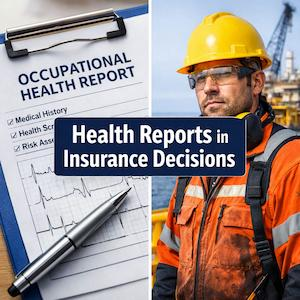
Occupational health reports are core underwriting inputs used to assess medical fitness relative to job-specific risk exposure. According to regulatory bodies such as OSHA and NIOSH, injury patterns and occupational disease risks vary significantly by industry. Insurers use these reports to determine eligibility, pricing, exclusions, and claim defensibility in high-risk job insurance systems.
Introduction
Occupational health reports in underwriting decisions are core risk evaluation tools used by insurers to assess high-risk workers. These reports determine eligibility, pricing, exclusions, and long-term claim defensibility by linking medical conditions to occupational exposure risk. This process is part of the broader underwriting system explained in How Insurance Underwriting Works for High-Risk Jobs, where insurers translate occupational and medical risk into approval decisions.
Occupational health reports are not administrative medical documents; they are risk verification instruments within insurance underwriting systems.
This distinction is further shaped by occupation class ratings, which determine how job risk interacts with medical conditions.
For high-risk occupations such as offshore work, construction, mining, and heavy industry, insurers must evaluate not just whether a worker is healthy, but whether that worker’s health profile can withstand sustained exposure to occupational hazards.
This distinction is critical.
A worker may be medically cleared to perform a job (“fit-for-duty”), yet still fall outside an insurer’s acceptable risk threshold due to:
- Exposure intensity
- Injury recurrence probability
- Long-tail disability risk
- Cumulative occupational strain
Underwriting decisions are therefore built on the interaction between:
- Medical condition
- Occupational hazard class
- Exposure duration and severity
This is why occupational health reports in underwriting decisions are treated as primary risk inputs rather than supporting documents.
Evidence Base: Occupational Health Risk and Insurance Exposure
According to the Occupational Safety and Health Administration (OSHA) and the National Institute for Occupational Safety and Health (NIOSH), injury frequency and occupational disease exposure vary significantly across industries such as construction, offshore energy, and manufacturing. The International Labour Organization (ILO) further estimates that occupational diseases are a major contributor to long-term disability globally.
From an underwriting perspective, these datasets establish that medical conditions must be evaluated relative to occupational exposure patterns, not in isolation. This is why occupational health reports in underwriting decisions are required to translate medical data into insurable risk classifications.
Why Health Data Drives Underwriting
These regulatory datasets reinforce that occupational health risk is unevenly distributed across industries, requiring structured underwriting interpretation.
- The Occupational Safety and Health Administration (OSHA) tracks industry-specific injury and illness rates, highlighting elevated risks in construction, offshore energy, and manufacturing.
- The National Institute for Occupational Safety and Health (NIOSH) documents long-term exposure risks such as respiratory disease, hearing loss, and musculoskeletal disorders.
- The International Labour Organization (ILO) estimates that occupational diseases contribute significantly to long-term disability globally.
From an underwriting perspective, this means:
Medical history alone is insufficient. Health data must be interpreted in the context of occupational exposure patterns.
This is why insurers require occupational health reports, not just general medical exams.
This reinforces why occupational health reports in underwriting decisions are required instead of general medical evaluations.
Underwriting System Insight
Occupational health reports in underwriting decisions function as standardized risk translation tools, allowing insurers to align medical data with occupational exposure classifications and portfolio risk limits.
These systems ensure that occupational health reports in underwriting decisions are applied consistently across applicants, reducing subjective judgment and aligning decisions with insurer risk tolerance models.
How Health Reports Feed Risk Classes
These classifications operate within broader eligibility criteria for high-risk workers used by insurers.
Occupational health reports directly influence risk classification, which determines how an applicant is grouped within underwriting systems.
Core Classification Inputs:
- Pre-existing medical conditions
- Occupational exposure compatibility
- Functional capacity relative to job demands
- Evidence of chronic or progressive conditions
How Insurers Classify Applicants:
- Standard Risk: No material health concerns relative to job exposure
- Substandard (Rated): Manageable condition with increased risk → premium loading
- Restricted: Approved with exclusions tied to specific conditions
- Declined: Risk exceeds acceptable underwriting thresholds
Critical Distinction:
- Acute conditions (temporary injuries) may result in postponement
- Chronic or degenerative conditions (e.g., spinal disorders, COPD) often trigger exclusions or declines
What Insurers Actually Evaluate
Occupational health reports are broken down into specific risk indicators, each mapped to underwriting decisions.
These filters are also influenced by insurer-specific thresholds defined in insurer risk appetite frameworks.
1. Respiratory Function
- Relevant for: offshore workers, miners, chemical exposure roles
- Tests: spirometry, lung capacity
- Impact:
- Reduced function → exclusion or decline
- Mild impairment → rated premium
2. Hearing Capacity
- Relevant for: industrial and construction environments
- Impact:
- Existing hearing loss → partial disability limitations
- Progressive loss risk → coverage restriction
3. Musculoskeletal Integrity
- Relevant for: manual labor, lifting-intensive jobs
- Focus:
- Spine health
- Joint stability
- Impact:
- Prior injuries → exclusion riders
- Chronic pain → decline or heavy rating
4. Cardiovascular Risk
- Relevant for: remote, high-stress, physically demanding roles
- Impact:
- Elevated risk → postponement or decline
- Controlled conditions → rated approval
5. Neurological Stability
- Relevant for: safety-critical roles (e.g., offshore platforms)
- Impact:
- Seizure history → automatic decline in many cases
- Mild conditions → strict underwriting conditions
Occupational Health Reports in Underwriting Decisions: How Insurers Translate Medical Data
Occupational health reports in underwriting decisions are translated into structured outcomes as shown below:
| Health Outcome | Underwriting Decision | Result |
|---|---|---|
| Clean report + low exposure conflict | Standard approval | Normal premium |
| Manageable condition | Rated policy | Higher premium |
| Condition tied to job hazard | Exclusion rider | Limited coverage |
| Unstable or unclear condition | Postponement | Delayed decision |
| High-risk profile | Decline | No coverage |
Underwriting Reality
Passing a medical exam does not guarantee insurance approval.
Insurers evaluate:
- Whether the condition is compatible with job risk
- Whether it increases claim probability
- Whether it introduces long-term liability
Occupational health reports in underwriting decisions are not evaluated in isolation. Insurers cross-reference medical findings with occupational classification systems and internal risk appetite thresholds before issuing coverage decisions.
Failure Paths: Where Coverage and Claims Break
Occupational health reports are one of the most common sources of claim failure.
Key Failure Pathways:
- Non-disclosure of pre-existing conditions
→ Claim denial due to misrepresentation - Mismatch between job role and medical clearance
→ Insurer disputes risk classification - Outdated health reports
→ Coverage issued on invalid assumptions - Ignored progressive conditions
→ Claim rejected due to foreseeable risk
System Insight
Occupational health reports are cross-referenced with:
- Job classification
- Policy disclosures
- Incident cause
Any inconsistency creates a claim vulnerability.
Claim Breakpoints: When Health Data Determines Outcomes
At the claims stage, insurers revisit occupational health reports to assess:
- Whether the condition existed before policy issuance
- Whether the injury is linked to occupational exposure
- Whether disclosure was complete and accurate
Common Claim Disputes:
- Work-related vs pre-existing condition
- Aggravation vs new injury
- Fitness certification vs actual medical condition
Example
A construction worker with a prior back injury files a disability claim.
Insurer review:
- Pre-policy health report shows spinal weakness
- Job classification indicates heavy lifting exposure
Outcome:
- Claim partially denied or limited due to pre-existing condition
Structural Exclusions Linked to Health Reports
These limitations align with standard policy exclusions in high-risk insurance applied across hazardous occupations.
Occupational health reports frequently trigger policy exclusions, including:
- Pre-existing condition exclusions
- Degenerative disease limitations
- Occupational disease waiting periods
- Partial disability restrictions
These exclusions are not incidental; they are systematically applied based on medical evidence.
Practical Interpretation for High-Risk Workers
Workers often misunderstand how insurers interpret health reports.
Key Realities:
- “Fit-for-duty” ≠ insurable
- Minor conditions can trigger major underwriting changes
- Incomplete reports create long-term claim risk
What to Verify Before Submission:
- Accuracy of medical history
- Alignment between job duties and health status
- Documentation of controlled conditions
What Can Kill Your Coverage or Claim (Failure Checklist)
- Undisclosed medical conditions
- Inconsistent health documentation
- Job role mismatch with medical clearance
- Unsupported fitness certifications
- Missing periodic health updates
- Ignoring known progressive conditions
How Insurers Interpret Occupational Health Reports
| Health Indicator | Risk Signal | Underwriting Outcome | Potential Restriction |
|---|---|---|---|
| Reduced lung function | High exposure sensitivity | Rated or declined | Respiratory exclusion |
| Hearing loss | Progressive impairment | Limited coverage | Partial disability cap |
| Back injury history | Recurrence risk | Exclusion rider | Spine-related claims excluded |
| Cardiovascular issue | Sudden event risk | Postpone or rate | Event-based exclusions |
| Neurological condition | Safety risk | Decline | Full coverage denial |
Conclusion
Occupational health reports in underwriting decisions are not passive documents; they are active decision engines in underwriting systems.
They determine:
- Whether coverage is issued
- How much it costs
- What is excluded
- Whether a future claim will be paid
For high-risk workers, understanding how these reports are interpreted is essential, not just for approval, but for long-term claim security.
For full system understanding, see:
- How Insurance Underwriting Works for High-Risk Jobs
- Occupation Class Ratings Explained
- Insurer Risk Appetite Explained
- Eligibility Criteria for High-Risk Workers
- Policy Exclusions in High-Risk Insurance