Executive Summary
Eligibility criteria for high-risk job insurance are underwriting filters used to evaluate whether a high-risk worker qualifies for approval, modified pricing, or coverage restrictions. Unlike entry requirements, these criteria determine risk acceptability, directly shaping approval outcomes, premium loadings, and structural exclusions within high-risk job insurance systems.
Introduction: Eligibility Criteria as Evaluation Logic
Eligibility criteria are not entry requirements; they are evaluation mechanisms applied after a risk has passed initial screening.
Insurers do not approve high-risk workers based on documents alone; approval depends on structured eligibility criteria that determine how risk is evaluated, priced, and restricted.
Before these criteria are applied, risks must first pass the eligibility requirements for high-risk job insurance, which determine whether evaluation is possible at all.
Once inside the underwriting process, eligibility criteria function as decision filters, translating raw applicant data into:
- Approval decisions
- Pricing adjustments
- Coverage exclusions
In practice, these eligibility criteria act as the core evaluation logic used by insurers.
This article sits within the cluster “How Insurance Underwriting Works for High-Risk Jobs”, where eligibility criteria act as the decision engine of underwriting, translating classification, medical inputs, and risk models into final approval outcomes.
Evidence Base
According to occupational risk data published by OSHA, NIOSH, and the ILO:
- Injury frequency varies significantly across industries (e.g., offshore drilling vs. administrative roles)
- Fatality rates are disproportionately concentrated in construction, oil & gas, and heavy industry
- Long-tail disability risk differs based on exposure type and duration
Because of this variability, insurers cannot rely on simple acceptance rules. They apply structured eligibility criteria to standardize:
- Risk comparability
- Pricing consistency
- Claims predictability
These criteria are informed by risk models and scoring systems explained in risk assessment tools used by insurers, where exposure probability and loss severity are quantified before decisions are made.
Without criteria, underwriting decisions would be inconsistent and financially unstable.
These variations force insurers to rely on eligibility criteria rather than fixed approval rules.
Classification Logic
Eligibility criteria operate within a broader classification system that groups applicants into three core categories:
Standard Risk
- Acceptable exposure levels
- Stable health profile
- Predictable risk pattern
Outcome: Standard approval, baseline pricing
Substandard Risk
- Elevated exposure or moderate medical concerns
- Increased probability of claims
Outcome: Rated premiums, exclusions, or limitations
Declined Risk
- Excessive exposure or unstable conditions
- High likelihood of catastrophic or unmanageable loss
Outcome: Application declined
These classifications are not arbitrary; they are outputs of eligibility criteria evaluation.
These classification outcomes are driven by structured systems such as occupation class ratings explained, where jobs are grouped based on loss behavior before criteria are applied.
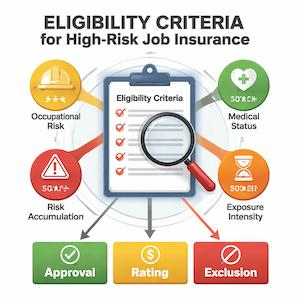
Eligibility Criteria for High-Risk Job Insurance (Core Filters)
Occupational Risk Compatibility
What insurers check:
- Job role vs. insurer risk appetite
- Hazard type (explosive, height, confined space, offshore)
These decisions are governed by the insurer’s insurer risk appetite framework, which defines which occupations and hazard profiles are acceptable at a system level.
Decision impact:
- Compatible → Proceed to evaluation
- Partially compatible → Rating or exclusions
- Incompatible → Decline
Medical Acceptability
What insurers check:
- Chronic conditions
- Functional limitations
- History of injury or disability
Medical evaluation is often supported by occupational health reports in underwriting decisions, where insurers translate medical data into exposure-specific risk signals.
Decision impact:
- Stable → Approval
- Managed but risky → Rated policy
- Unstable → Decline
These assessments may also include direct medical screening, as explained in medical exams for high-risk insurance, where insurers evaluate severity risk, recovery potential, and long-term claim exposure.
Exposure Intensity
What insurers check:
- Frequency of hazard exposure
- Duration per shift
- Severity potential
Decision impact:
- Low/moderate → Standard pricing
- High → Premium loading or restrictions
- Extreme → Decline
Risk Accumulation
What insurers check:
- Combined risk factors (job + health + environment)
- Stacking of hazards
Decision impact:
- Isolated risks → Manageable
- Compounded risks → Substandard or decline
Stability and Predictability
What insurers check:
- Employment consistency
- Work environment variability
- Contract vs. permanent roles
Decision impact:
- Stable → Favorable underwriting
- Unpredictable → Higher premiums or rejection
Underwriting Translation: From Criteria to Decisions
Eligibility criteria are translated into four core underwriting outcomes:
| Criteria Result | Underwriting Decision |
|---|---|
| Acceptable risk | Approval |
| Elevated risk | Premium rating |
| Specific hazard | Exclusion applied |
| Unacceptable risk | Decline |
This translation layer is where underwriting becomes financial decision-making, not just assessment.
This is why high-risk jobs face stricter insurance approval, as elevated exposure levels push criteria outcomes toward rating, restriction, or decline.
Failure Paths (Where Criteria Breaks)
These failure paths represent underwriting breakpoints where insurers transition from acceptance to restriction or outright decline.
Applications typically fail eligibility criteria due to:
- Unacceptable risk combinations
(e.g., hazardous occupation + unstable medical condition) - Unstable health profiles
(conditions that increase claim probability unpredictably) - Exposure mismatch
(risk exceeds insurer’s defined tolerance thresholds)
These failure paths are critical; they define why coverage is denied, not just that it is denied.
Claim Breakpoints
Eligibility criteria are not only used at underwriting; they reappear during claims evaluation.
Insurers reassess:
- Whether the declared risk matched actual exposure
- Whether medical conditions were accurately represented
- Whether exclusions triggered at the time of loss
If criteria assumptions are violated, claims may:
- Be reduced
- Be denied
- Trigger policy disputes
Structural Exclusions
Eligibility criteria directly generate exclusions when risks are:
- Too specific to price accurately
- Too volatile to insure fully
Examples include:
- Exclusion of offshore helicopter transport
- Exclusion of pre-existing musculoskeletal conditions
- Limitation on high-altitude operations
These exclusions are not arbitrary; they are products of failed or borderline criteria filters.
Practical Interpretation
For high-risk workers, eligibility criteria determine:
- Whether you are insurable
- How much you will pay
- What events are covered or excluded
Understanding criteria allows workers to:
- Anticipate underwriting outcomes
- Identify risk factors affecting approval
- Avoid claim disputes
This is not about paperwork; it is about how insurers think about your risk.
Understanding eligibility criteria for high-risk job insurance helps workers anticipate underwriting outcomes and avoid unexpected exclusions.
Failure Checklist
What Makes You Fail Eligibility Criteria
- High-risk occupation outside insurer appetite
- Unstable or unmanaged medical condition
- Excessive exposure frequency or severity
- Multiple overlapping risk factors
- Unpredictable or inconsistent work environment
Data Table: Eligibility Criteria → Underwriting Outcome
The table below summarizes how eligibility criteria for high-risk job insurance translate into underwriting outcomes.
| Criteria Dimension | Low Risk | Moderate Risk | High Risk | Outcome |
|---|---|---|---|---|
| Occupation | Compatible | Partially compatible | Incompatible | Approve / Rate / Decline |
| Health | Stable | Managed | Unstable | Approve / Rate / Decline |
| Exposure | Low | High | Extreme | Standard / Load / Decline |
| Accumulation | Isolated | Layered | Compounded | Approve / Restrict / Decline |
| Stability | Predictable | Variable | Unpredictable | Favorable / Load / Reject |
Understanding eligibility criteria requires viewing how they interact with the broader underwriting system:
Eligibility requirements for high-risk job insurance — defines which risks can enter evaluation.
Insurer risk appetite explained — defines system-level exposure boundaries.
Risk assessment tools used by insurers — explains how exposure and severity are modeled.
Why high-risk jobs face stricter insurance approval — explains how criteria translate into acceptance thresholds.
Occupational health reports in underwriting decisions — explains how medical data is interpreted within risk evaluation.
Key Takeaways
- Eligibility criteria for high-risk job insurance determine approval, pricing, and exclusions
- Criteria are applied after eligibility requirements are met
- Underwriters evaluate risk using occupational, medical, and exposure filters
- Failure occurs when risk exceeds acceptable thresholds or becomes unpredictable
- Criteria are reused at claims stage, affecting payout decisions