Editor’s Notice: Reviewed for underwriting accuracy by the RJI Institutional Review Team | Published: May, 2026 | Last reviewed: June, 2026.
—————————————————————————————————————————
Executive Summary
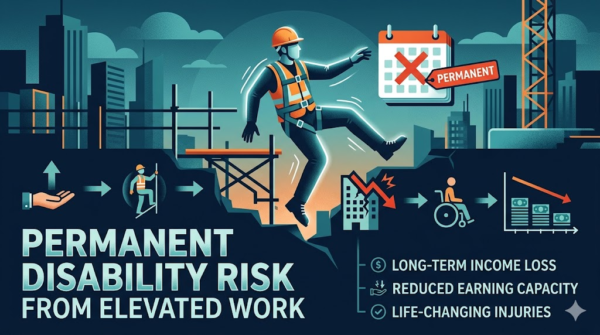
Permanent Disability Risk from Elevated Work is a major concern in disability underwriting because severe falls from roofs, towers, scaffolding, bridges, and industrial structures often create long-term physical limitations that prevent workers from safely returning to elevated labor. Disability insurers evaluate whether these injuries could permanently reduce earning capacity and create long-duration income-loss exposure.
Underwriting severity model: As elevation increases, disability insurers become less concerned about minor injury frequency and more concerned about catastrophic long-duration claims.
What Is Permanent Disability Risk in Elevated Occupations?
Permanent disability risk refers to the possibility that a worker suffers injuries severe enough to permanently reduce their ability to safely perform their occupation.
In elevated occupations, this concern is especially serious because falls from height often create life-changing injuries rather than temporary setbacks.
Disability insurers evaluate whether a worker could experience:
- Permanent occupational disability
- Long-term physical impairment
- Reduced earning capacity
- Permanent physical limitations
- Long-duration income loss
Examples of severely elevated work injuries include:
- Spinal injuries
- Traumatic brain injuries
- Paralysis
- Chronic pain conditions
- Mobility loss
- Balance disorders
- Neurological damage
A worker may survive a severe fall yet never safely return to elevated labor again.
For example:
- A roofer may permanently lose balance and stability after a traumatic brain injury.
- A tower climber may lose lower-body mobility after spinal damage, which is one reason tower climbers insurance often faces strict disability underwriting.
- A scaffold worker may develop chronic pain severe enough to prevent climbing safely.
Disability insurers focus heavily on these outcomes because permanent disability risk is not just about surviving an accident; it is about long-term earning-capacity loss.
Disability insurers closely evaluate return-to-work probability because elevated occupations often have lower successful return rates after catastrophic injuries.
Why Elevated Work Creates Severe Permanent Disability Exposure
Why do elevated occupations create higher disability severity?
Disability insurers closely evaluate return-to-work probability because elevated occupations often have lower successful return rates after catastrophic injuries.
Elevated work environments expose workers to catastrophic fall potential.
As working height increases, injuries become more severe, recovery periods become longer, and the likelihood of permanent impairment rises significantly.
Disability insurers evaluate several factors that increase permanent disability exposure:
- High-impact fall injuries
- Repetitive elevated exposure
- Rescue delays
- Difficult recovery conditions
- Severe orthopedic trauma
- Long rehabilitation periods
- Permanent balance limitations
- Reduced climbing capability
From an underwriting perspective, disability insurance protects a worker’s future earning capacity, making permanent occupational impairment one of the largest long-term financial risks insurers evaluate.
A worker may survive a severe roofing or tower fall but permanently lose the balance, mobility, or physical strength needed for elevated work.
This creates severe claim-duration exposure for disability insurers because benefits may continue for years if the worker cannot safely return to their occupation.
Elevated occupations also create a unique underwriting problem:
Insurers evaluate not just whether a worker can survive an injury, but whether they can safely return to physically demanding elevated labor afterward.
That distinction matters heavily in disability underwriting.
Why Disability Insurers Focus on Work Ability
Why does disability insurance focus so heavily on occupational work ability?
Disability insurance primarily protects income.
Because of this, insurers evaluate whether injured workers can realistically return to the duties that generate their income.
For elevated workers, this evaluation becomes far stricter.
Disability insurers analyze whether a worker could safely return to:
- Roofing
- Tower climbing
- Bridge work
- Scaffold installation
- Offshore elevated work
- Heavy industrial climbing
- Utility line maintenance
The Functional Capacity Gap
The primary challenge for insurers is the Functional Capacity Gap. This occurs when a worker recovers enough to lead a “normal” life but lacks the specific physical benchmarks required for high-risk labor.
Benchmarks required for Elevated Work often include:
-
Proprioception: Inner-ear stability required for walking on narrow beams.
-
Grip Strength: Vital for 3-point contact climbing.
-
Cognitive Load: Ability to follow complex safety protocols under environmental stress.
If a worker reaches 90% recovery, they are “healthy” for an office job but “unfit” for a tower, triggering a permanent disability payout in “Own Occupation” policies.
For elevated occupations, losing the final 10% of balance, coordination, or climbing tolerance may permanently eliminate safe return-to-work eligibility.
The key issue is not simply whether the worker can perform some work. The major concern is whether the worker can safely return to their occupation.
For example:
A roofer who suffers spinal damage may still physically perform desk work or light-duty administrative tasks. However, that same worker may permanently lose the ability to safely climb ladders, maintain roof balance, or work near fall edges.
This underwriting concern closely connects with why roofers face strict insurance underwriting, where insurers evaluate roofing exposure as a combination of catastrophic fall severity, repetitive elevated exposure, and long-term disability risk.
That distinction often determines how disability claims are evaluated.
Temporary Injury vs Permanent Occupational Disability
| Temporary Injury | Permanent Occupational Disability |
|---|---|
| Worker expected to recover | Long-term or permanent impairment |
| Short-term income interruption | Long-duration income loss |
| Return to occupation is likely | Return to elevated work unlikely |
| Limited claim duration | Extended disability exposure |
| Lower underwriting severity | Higher underwriting severity |
This is why elevated occupations often face stricter disability evaluations compared to standard office or low-risk occupations.
The Compound Risk Model
Why do elevated occupations trigger stacked underwriting concerns?
Elevated occupations rarely involve only one risk factor.
Instead, insurers often evaluate multiple exposure systems simultaneously.
These may include:
- Catastrophic fall exposure
- Rescue difficulty
- Severe disability exposure
- Weather exposure
- Repetitive physical strain
- Long-term rehabilitation concerns
- Emergency-response limitations
When these exposure systems combine, disability severity increases dramatically.
For example:
Workers covered under wind turbine technicians insurance often operate hundreds of feet above ground in remote weather conditions and may face:
- Severe fall exposure
- Delayed rescue access
- Difficult evacuation
- Long rehabilitation periods
- Permanent mobility impairment risk
This stacked exposure model increases underwriting severity because insurers see a higher probability of catastrophic long-term earning-capacity loss.
This exposure-stacking system closely connects with catastrophic fall severity modeling used in elevated-work disability underwriting, especially in occupations where rescue difficulty increases long-term disability exposure.
As working height increases, the insurer’s exposure shifts from Frequency Risk to Severity Risk.
That framework appears repeatedly throughout elevated-work disability underwriting.
Occupations With High Permanent Disability Exposure
Which elevated occupations create the greatest disability concerns?
| Occupation | Why Permanent Disability Exposure Is Elevated |
|---|---|
| Roofers | Frequent ladder use, edge exposure, steep-surface falls |
| Tower Climbers | Extreme climbing height and difficult rescue access |
| Bridge Workers | High-elevation structural exposure over water or traffic |
| Wind Turbine Technicians | Remote elevated work with difficult evacuation conditions |
| Utility Linemen | Elevated electrical exposure combined with climbing risk |
| Structural Ironworkers | High steel-frame exposure and severe fall potential |
| Offshore Elevated Workers | Elevated work combined with offshore rescue delays |
| Scaffold Workers | Repetitive climbing and unstable elevated work surfaces |
The risks associated with bridge workers insurance often extend beyond fall exposure to include suspended work platforms, environmental hazards, and difficult rescue conditions.
These occupations often receive stricter disability underwriting classifications because insurers evaluate both injury probability and long-term work-loss severity.
How Insurers Evaluate Permanent Disability Exposure
What factors do disability insurers analyze?
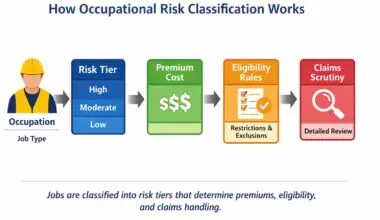
Many insurers apply automatic occupational class downgrades once elevated duties become a primary job function rather than occasional exposure.
Disability insurers typically evaluate:
- Working height
- Climbing frequency
- Physical intensity of work
- Rescue accessibility
- Offshore elevated duties
- Repetitive exposure
- Prior injuries
- Medical history
- Severe fall history
- Worker age
- Ability to transition into lighter work
Why modified-duty limitations matter
Modified-duty limitations are a major underwriting concern for elevated workers.
Many elevated workers cannot easily transition into safer desk or light-duty jobs after severe injuries, increasing long-term disability exposure.
For example:
- A tower climber cannot easily transition into remote climbing work after spinal impairment.
- A structural ironworker may lack alternative light-duty pathways after major mobility damage, which helps explain why structural ironworkers insurance receives heightened disability underwriting scrutiny.
- A roofer may permanently lose climbing tolerance after chronic pain development.
Because of this, insurers often apply:
- Occupational class downgrades
- Stricter underwriting classifications
- Reduced benefit structures
- Higher disability premiums
- Additional underwriting reviews
Elevated occupations frequently receive more restrictive disability structures than lower-risk professions with easier modified-duty transitions.
How Permanent Disability Risk Affects Insurance Coverage
How does permanent disability exposure affect insurance decisions?
Permanent disability exposure directly affects disability insurance availability and pricing.
Common underwriting outcomes include:
- Higher disability premiums
- Occupational class downgrades
- Policy exclusions
- Reduced monthly benefit limits
- Stricter medical underwriting
- Waiting periods
- Limited benefit periods
- Denied applications
- Limited insurer availability
Some disability carriers impose internal maximum exposure thresholds for elevated occupations, limiting how much monthly benefit they are willing to issue for workers with severe height exposure.
Insurers impose these restrictions because elevated-work disability claims can involve:
- Long rehabilitation periods
- Permanent work-loss exposure
- Multi-year benefit payments
- Reduced return-to-work probability
Connection:
elevated injury → permanent work-loss exposure → insurance restriction
Workers in severe elevated occupations may also encounter fewer carriers willing to provide comprehensive disability coverage.
Long-duration disability claims create some of the largest financial exposures in disability insurance because benefits may continue for years or even decades after catastrophic elevated-work injuries.
“Own Occupation” vs “Any Occupation” Disability Definitions
Why do policy definitions matter heavily for elevated workers?
Disability policy definitions strongly influence whether benefits continue after severe injuries.
Own Occupation Disability
An “own occupation” definition generally means benefits may continue if the worker cannot safely perform their specific occupation.
Any Occupation Disability
An “any occupation” definition is usually stricter.
Benefits may stop if the worker can perform another type of job, even if they cannot return to elevated work.
Under an “any occupation” definition, benefits may become more limited.
Comparing Claim Scenarios
| Feature | Own Occupation | Any Occupation |
| Scenario | A Bridge Welder develops vertigo. | A Bridge Welder develops vertigo. |
| Medical Status | Cannot climb; can drive a truck. | Cannot climb; can drive a truck. |
| Benefit Trigger | Paid. The worker cannot weld on bridges. | Denied. The worker can drive a truck. |
| Cost | High premiums (Preferred by specialists). | Lower premiums (Standard in group plans). |
The TPD Lump-Sum Trap vs. Continuous Income Protection
Generic consumer insurance platforms often point workers toward Total and Permanent Disability (TPD) riders, which offer a one-time lump-sum payout. For elevated trades, standard retail TPD policies contain two major structural flaws:
-
The Six-Month Limbo Rule: Traditional retail TPD clauses frequently require a worker to be absent from all work for a minimum of six consecutive months, with zero medical expectation of ever returning to any form of employment, before a claim is evaluated. For a worker facing immediate household bills, this creates a catastrophic cash-flow gap.
-
The Superannuation/Group Policy Default: TPD coverage bundled into standard group employer plans or retirement accounts almost universally defaults to a restrictive “Any Occupation” definition. If an inner-ear balance disorder prevents you from stepping onto a wind turbine nacelle, the policy will deny the lump sum the moment it is proven you possess the education or baseline physical capacity to work an inventory logging computer on the ground. Continuous, private Income Protection with a dedicated “Own Occupation” rider ensures monthly check replacement without forcing you to prove total career abandonment.
Residual Disability
Residual disability definitions may provide partial benefits if workers can still perform limited duties but experience reduced earnings.
These definitions matter heavily because elevated workers often remain physically capable of some work while permanently unable to safely return to elevated occupations.
The Workers’ Compensation Illusion
Many elevated workers assume they do not need private disability coverage because they are protected by employer-mandated Workers’ Compensation. In reality, relying solely on state-regulated systems introduces severe long-term financial vulnerability due to how “Modified Duties” are handled:
-
The Settlement Cap: Workers’ Comp systems typically pay out temporary total disability (TTD) or permanent partial disability (PPD) based on rigid statutory caps, which rarely match a specialized worker’s true lifelong earning potential.
-
The Reintegration Pressure: If a state-appointed board determines that an injured worker is partially recovered, the system aggressively pushes for a return to the workforce under “modified duties.”
-
The Career Clash: A Workers’ Comp doctor may declare an ironworker or tower climber “healed” because they can safely sit at an office desk. While the state system views this as a successful reintegration, allowing them to reduce or terminate their benefits, the worker is effectively locked out of their high-paying, elevated trade forever. Private disability coverage is designed to fill this exact void.
Why Severe Elevated Injury Claims Receive Heavy Investigation
Why are permanent disability claims investigated aggressively?
Large disability claims involving elevated occupations often receive extensive underwriting and claims investigation.
Insurers commonly investigate:
- Undisclosed elevated duties
- Hidden tower-climbing exposure
- Offshore work omissions
- Side climbing jobs not reported
- Prior injuries not disclosed
- Inaccurate occupational descriptions
- Subcontract elevated work exposure
Why?
Because occupational classification directly affects disability pricing and approval decisions.
If a worker classified as “standard construction labor” was actually performing high-risk tower climbing duties, insurers may argue that underwriting information was inaccurate.
A worker who reports “general maintenance duties” but regularly performs tower climbing may face claim disputes if elevated exposure was not disclosed during underwriting.
This creates major claim-dispute exposure.
Connection:
occupational misclassification → claim disputes → denial risk
Insurers frequently compare application disclosures against payroll records, subcontract duties, OSHA reports, and post-claim interviews when evaluating severe elevated-work disability claims.
Severe elevated injury claims receive heavier scrutiny because permanent disability claims often involve substantial long-term financial exposure for insurers.
Real-World Disability Underwriting Examples
Roofer vs Warehouse Worker
A roofer faces greater permanent disability exposure because balance loss, spinal injuries, or mobility impairment may permanently prevent safe elevated work.
A warehouse worker may have more modified-duty alternatives after injury.
Tower Climber vs Office Electrician
Tower climbers face catastrophic fall severity and difficult rescue conditions.
Office electricians generally face lower long-term climbing impairment exposure.
Wind Turbine Technician vs Low-Risk Maintenance Worker
Wind turbine technicians combine:
- Extreme elevation
- Remote rescue conditions
- Repetitive climbing
- Severe fall exposure
Low-risk maintenance workers typically operate in controlled environments with easier recovery pathways.
Offshore Ironworker vs Standard Construction Laborer
Offshore ironworkers combine:
- Elevated structural exposure
- Offshore rescue limitations
- Severe injury potential
- Long rehabilitation difficulty
Standard construction laborers may face lower combined disability severity.
These examples demonstrate how disability underwriting evaluates both physical danger and long-term return-to-work probability.
OSHA, Safety History & Permanent Disability Exposure
How do insurers evaluate safety history?
Disability insurers review safety indicators because repeated violations or incidents may increase long-term disability exposure.
Common underwriting considerations include:
- OSHA fall violations
- Prior incidents
- Rescue preparedness
- Safety certifications
- Repetitive injury history
- Employer safety culture
- Fall-protection compliance
Insurers are not simply evaluating workplace safety.
They are evaluating whether the work environment increases the probability of severe permanent impairment and extended disability claims.
For example:
Repeated fall-protection violations may suggest elevated catastrophic injury exposure, increasing underwriting severity.
Similarly, poor rescue planning may increase severe injury outcomes after falls due to delayed medical intervention.
How Elevated Workers Can Reduce Disability Underwriting Problems
How can elevated workers improve disability underwriting outcomes?
Workers can reduce future underwriting and claim problems by:
- Accurately disclosing elevated duties
- Clearly documenting climbing responsibilities
- Maintaining safety certifications
- Reducing preventable claims history
- Completing fall-protection training
- Understanding disability policy definitions
- Reporting offshore work honestly
- Updating insurers after occupational changes
Accurate occupational disclosure is especially important.
If elevated duties are hidden or understated during application review, insurers may later investigate claims more aggressively after severe injuries occur.
Clear disclosure helps reduce:
- Occupational misclassification disputes
- Underwriting inconsistencies
- Claim investigation conflicts
- Coverage interpretation problems
Workers should also understand whether their disability policy uses:
- Own occupation definitions
- Any occupation definitions
- Residual disability structures
Those definitions can significantly affect future claim outcomes after permanent elevated-work injuries.
In disability underwriting, height exposure does not simply increase accident probability; it increases the likelihood that a single injury permanently ends a worker’s ability to safely perform their occupation.
Frequently Asked Questions: Permanent Disability & Elevated Work
Can I be denied disability coverage just because I work at heights?
Not necessarily. While insurers view elevated work as a “Severity Risk,” they typically manage this through higher premiums or specific exclusions rather than a flat denial. However, if your role involves extreme elevated exposure, such as high-lead tower climbing, you may be redirected to a specialized high-risk insurance carrier.
Does an OSHA violation on my record affect my disability claim?
It can. Insurers review safety history to evaluate overall safety culture and operational risk. A history of OSHA fall-protection violations may lead to more aggressive claim investigation or disputes if insurers believe the worker was operating outside normal safety expectations.
What happens if my job title changes to a lower-risk role after I buy a policy?
You should notify your insurer immediately. This process, known as occupational reclassification, may reduce premiums or improve policy terms. Failing to update occupational duties could create occupational misclassification disputes if a future injury occurs while performing duties not listed on the original application.
Is “Total Disability” different for a roofer than for an office worker?
Yes, especially under an “Own Occupation” disability definition. For a roofer, total disability may result from a permanent balance issue that prevents safe climbing or elevated work, even if the worker can still perform basic ground-level activities. That same condition may not qualify as total disability for an office worker.
Key Takeaways
- Elevated occupations create severe permanent disability exposure because falls often produce long-term physical limitations.
- Disability insurers focus heavily on whether workers can safely return to elevated labor after injuries.
- Permanent disability risk is about long-term earning-capacity loss, not just accident survival.
- Modified-duty limitations increase underwriting severity for physically demanding elevated occupations.
- Occupational classifications strongly affect disability pricing, eligibility, and benefit structures.
- Own occupation and any occupation definitions can dramatically affect disability benefits.
- Accurate occupational disclosure helps reduce future claim disputes and denial risk.
- As working height increases, the insurer’s exposure shifts from Frequency Risk to Severity Risk.
Institutional & Underwriting References
- OSHA — Fall Protection Standards
- NIOSH — Occupational Fall Injury Research
- Disability underwriting occupational classification frameworks
- Workers’ compensation return-to-work systems
- Occupational impairment and claim-duration modeling principles
Reviewed for Underwriting Accuracy
This article was reviewed for:
- occupational disability severity analysis
- elevated-work claim-duration exposure
- catastrophic fall underwriting logic
- occupational class downgrade systems
- return-to-work probability evaluation
- modified-duty transition limitations
Research & Underwriting Methodology
This article applies disability underwriting principles used to evaluate elevated occupational exposure, catastrophic injury severity, permanent impairment probability, return-to-work limitations, occupational classification systems, and long-duration claim exposure within high-risk trades.
Published: May, 2026.
Last reviewed: June, 2026.
For deeper underwriting explanations, see:
- Height Exposure Underwriting: How Insurers Evaluate Elevated Workers
- Catastrophic Fall Risk in Occupational Insurance
- Fall Severity Modeling in Disability Insurance
- Rescue Difficulty in High-Elevation Underwriting
- Why Elevated Workers Pay More for Insurance
- Disability Insurance for High-Risk Workers
- Occupational Hazard Classification in Insurance
- Common Reasons Claims Are Denied for Risk Jobs