Introduction: When Coverage Exists, but the Payout Feels Too Small
Many high-risk workers only discover how policy limits in high-risk insurance work when a serious incident occurs. A claim may be approved, coverage may apply, yet the payout falls far short of the actual financial impact.
This experience often feels confusing or unfair. After all, if coverage exists, why does it stop before the loss is fully addressed?
For workers in dangerous jobs, lower policy limits are common. Construction workers, offshore crews, industrial operators, transport workers, and others in hazardous roles frequently encounter insurance limits that feel modest compared to the risks they face.
These limits are not accidental, and they are not designed to diminish the value of a worker’s loss. They are structural features of how insurance functions when work involves higher-than-average danger.
This guide explains why insurance policies for high-risk jobs often have lower limits, how those limits are set, and what they actually mean in practice.
What an Insurance Limit Actually Is
Limits make more sense when you understand why high-risk insurance relies on exclusions, which we explain in Why Insurance Policies for High-Risk Jobs Have More Exclusions.
An insurance limit is the maximum amount an insurer agrees to pay under a policy.
It is not a prediction of loss, and it is not a promise that the full limit will be paid. It represents the outer boundary of the insurer’s financial obligation for a covered event or period.
Limits apply regardless of how severe the loss is to the worker experiencing it. Once the limit is reached, the insurer’s responsibility ends, even if financial consequences continue.
This is an important distinction. Limits do not measure the importance of an injury or the seriousness of its impact. They define how much risk the insurance system agreed to absorb.
Why High-Risk Jobs Trigger Lower Limits
Evidence block:
Global occupational safety data published by the International Labour Organization shows that hazardous jobs experience higher injury severity and longer recovery periods, which directly influences how insurers cap exposure.
Insurance systems must balance availability with sustainability.
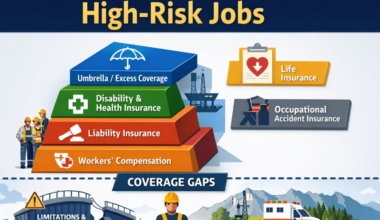
These limit structures operate within a broader system of workers’ compensation, disability insurance, occupational accident coverage, and liability protection explained in types of insurance for high-risk jobs.
High-risk jobs introduce two challenges at the same time: claims happen more often, and they tend to be more expensive when they do. Severe injuries, long recovery periods, and permanent impairment are more common in hazardous work.
If insurers offered very high limits across all high-risk roles, a small number of severe claims could overwhelm the risk pool.
To prevent this, insurers control exposure in multiple ways. One of the most important tools is limiting the maximum payout.
Insurers also use policy limits to reduce correlated-loss exposure, where multiple severe claims within the same occupational category can threaten portfolio stability across an insurance pool.
Lower limits allow insurers to offer coverage at all.
Limit structures are also influenced by reinsurance arrangements, where insurers transfer portions of catastrophic occupational exposure to larger risk-sharing entities.
Reinsurance providers may impose their own exposure ceilings on hazardous occupational categories, indirectly shaping the limits available to workers.
Without these controls, premiums would rise sharply or coverage would be withdrawn entirely from dangerous occupations.
Limits are therefore not a reflection of skepticism toward workers. They are a response to concentrated risk.
These limits exist for the same structural reasons explained in our guide on why high-risk jobs require special insurance rules, where dangerous work changes how insurers manage exposure.
How Policy Limits in High-Risk Insurance Are Set During Underwriting
Policy limits are determined during underwriting, not during claims.
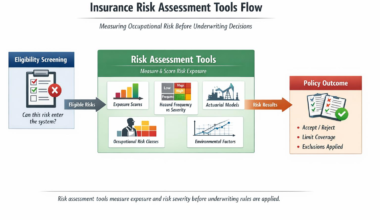
Before a policy is issued, insurers assess how much exposure they can reasonably accept. This assessment considers:
– The nature of job duties
– The environment in which work occurs
– The likelihood of severe injury
– Typical recovery costs and timelines
In some forms of high-risk insurance, insurers also evaluate income stability and earnings consistency when determining policy limits. Disability and income protection policies, for example, frequently apply benefit caps tied to a percentage of documented earnings rather than the worker’s perceived financial need after injury.
Based on this evaluation, insurers decide what level of financial exposure can be supported across the insured population. That decision becomes the policy limit.
Decision breakpoint (limit-setting):
Policy limits in hazardous occupations often decrease when underwriting crosses specific exposure thresholds, including:
– Daily rather than occasional high-risk activity
– Offshore, underground, or remote operational environments
– High-severity equipment exposure
– Extended recovery probability
– Elevated likelihood of permanent disability
– Multi-party contractor environments
As occupational exposure intensifies, insurers may reduce available limits, narrow benefit duration, or apply additional structural restrictions to control concentrated loss exposure.
Additional limit reductions may occur when underwriting identifies factors associated with elevated claim instability, including inconsistent employment history, frequent contractor transitions, undeclared secondary duties, or operations conducted across multiple high-risk jurisdictions.
Limits are set during underwriting and remain fixed once the policy is issued, the same stage where insurers evaluate duties, environments, and exposure, as explained in how insurers underwrite high-risk jobs.
Limits do not change in response to individual claims. Claims are evaluated against limits that were already defined.
How Occupational Classification Influences Policy Limits
Classification model: Insurers reduce available policy limits as occupational exposure severity, operational instability, and catastrophic injury probability increase.
Insurers do not set policy limits using job titles alone. Limits are heavily influenced by occupational classification systems that group workers according to exposure severity, injury frequency, recovery probability, and operational environment.
Two workers with similar titles may receive very different limit structures depending on:
– Height exposure
– Offshore or underground operations
– Heavy equipment usage
– Frequency of hazardous task performance
– Remote or isolated worksites
– Contracting and subcontracting arrangements
As occupational hazard classifications increase, insurers often reduce available policy limits to control maximum exposure within high-severity risk categories.
This classification process allows insurers to maintain consistency across underwriting decisions while limiting concentrated financial exposure within dangerous industries.
Common Types of Limits in High-Risk Insurance
Limits appear in different forms depending on the type of coverage.
Per-incident limits
These cap how much can be paid for a single accident or operational event. High-risk occupations with elevated catastrophic injury potential often receive stricter per-incident ceilings because one severe event can generate exceptionally large financial losses.
Aggregate limits
These restrict the total amount payable across all covered claims during a policy period. Aggregate controls become more important in hazardous industries where repeated incidents or multiple simultaneous injuries can rapidly increase insurer exposure.
Time-based benefit limits
Some policies limit how long benefits can be paid, even if recovery is ongoing.
Condition-specific caps
Certain injuries or conditions may have their own maximum payouts.
Each type exists to control a different aspect of exposure. Together, they shape how much protection is available and for how long.
Group vs Individual Policy Limit Structures
Policy limits often differ significantly between employer-sponsored group coverage and individually underwritten insurance.
Group policies typically apply standardized benefit ceilings across large worker populations. These structures prioritize administrative consistency and broad eligibility, which can result in lower individual payout limits.
Individually underwritten policies may allow more customized limit structures because insurers evaluate the worker’s specific occupational exposure, income profile, and operational environment directly.
However, individualized structures may also produce stricter underwriting scrutiny, narrower eligibility acceptance, or additional exclusions for extreme occupational hazards.
The difference reflects structural design priorities rather than overall policy quality.
Why Limits and Exclusions Work Together
Limits and exclusions serve different purposes, but they work together.
Exclusions remove certain risks entirely. Limits cap the cost of risks that remain covered.
When fewer exclusions apply, limits often become more restrictive. This balancing process allows insurers to broaden eligibility while still containing maximum financial exposure within high-volatility occupational categories. This trade-off allows insurers to offer broader coverage while still controlling total exposure.
Limits tend to matter most in situations involving severe injuries, long recoveries, repeated incidents, or compounding financial pressures. These are the situations where workers first notice that coverage helps, but does not fully replace what was lost.
Understanding this relationship helps explain why policies with fewer exclusions do not always provide higher payouts.
How Limits Affect Claims in Real Situations
Limits become most visible when a claim is approved but does not fully address the loss.
In these cases, workers may feel the claim was mishandled. In reality, the claim may have been processed correctly but constrained by the policy’s limits.
This distinction matters. A claim can be valid, covered, and properly paid while still leaving financial gaps. That outcome reflects the structure of the policy, not a failure of the claims process.
Recognizing this helps separate denial from limits, which are not the same thing.
Where Workers Misunderstand Policy Limits
Coverage disputes involving policy limits frequently arise from structural misunderstandings rather than claim-processing errors.
Common misunderstanding patterns include:
– Assuming approval guarantees full financial replacement
– Confusing aggregate limits with per-incident limits
– Overlooking time-based benefit caps
– Expecting employer-provided policies to scale automatically with increased duties
– Assuming higher premiums automatically produce higher payout ceilings
In many cases, the claim itself is valid, but the worker’s expectations exceed the exposure boundaries originally defined during underwriting.
Why Higher Limits Are Not Always Offered
It is natural to ask why higher limits cannot simply be purchased.
In high-risk work, offering higher limits is not always possible. Increased limits amplify volatility. A single catastrophic claim can consume years of collected premiums, destabilizing the insurance pool.
Because of this, insurers may restrict available limits regardless of willingness to pay more. The constraint is structural, not negotiable.
In hazardous occupation insurance, premium increases alone do not always offset catastrophic exposure potential. Beyond certain risk thresholds, insurers may restrict limits regardless of pricing because severe correlated-loss events can destabilize long-term portfolio performance.
This is one of the reasons insurance behaves differently in dangerous work than in low-risk environments.
This constraint mirrors the same pricing logic discussed in why insurance costs more for high-risk jobs, where higher exposure increases volatility rather than just premiums.
How Limits Fit Into Risk Job Insurance as a System
Limits are one component of a larger system.
Within risk job insurance, coverage is shaped by:
-
Eligibility, which determines whether coverage can exist
-
Underwriting, which defines acceptable exposure
-
Pricing, which reflects probability and severity
-
Exclusions, which remove unmanageable risks
-
Limits, which cap remaining exposure
-
Claims, which enforce these boundaries
At claim stage, policy limits function as hard structural boundaries rather than negotiable guidelines. Once contractual payout ceilings are reached, additional financial losses typically remain outside insurer responsibility unless supplemental coverage layers exist.
Limits operate alongside exclusions and definitions to keep insurance aligned with real-world risk. These structural relationships are explained further in how risk job insurance policies are structured, which breaks down how coverage definitions, exclusions, and payout boundaries function together inside hazardous occupation insurance contracts.
Frequently Asked Questions
Why do insurers reduce limits for hazardous occupations instead of only increasing premiums?
Because severe occupational risks create concentrated financial exposure that cannot always be stabilized through pricing alone. In some high-risk categories, increasing premiums does not adequately offset the possibility of catastrophic or repeated large-loss claims, so insurers also restrict maximum payout exposure through policy limits.
Why do workers with similar jobs receive different insurance limits?
Because insurers evaluate operational exposure rather than titles alone. Factors such as offshore work, equipment usage, hazardous task frequency, remote locations, and contractor arrangements can all change underwriting classifications and available payout limits.
Can policy limits change after a job role changes?
Yes. Significant changes in occupational duties, operational environment, or exposure severity may require underwriting reassessment at renewal or policy modification stage.
Conclusion: Limits Define Exposure, Not Worker Worth
Insurance policies for high-risk jobs often have lower limits because dangerous work concentrates risk in ways that must be controlled.
Limits are not judgments about workers or signals that losses matter less. They are structural tools that define how much risk the insurance system can absorb while remaining available.
For high-risk workers, understanding how limits work reduces shock at claim time and clarifies why coverage may help without fully resolving financial consequences.
In structural terms, policy limits function as exposure-management mechanisms that allow insurance systems to remain financially viable within occupations characterized by elevated injury severity and unpredictable claim costs.
Final underwriting insight:
Policy limits are not designed primarily around the maximum possible loss experienced by an individual worker. They are designed around the maximum exposure insurers can absorb sustainably across an entire occupational risk category.
Understanding policy limits helps high-risk workers evaluate not only whether coverage exists, but also how much occupational exposure insurers are structurally willing to absorb within hazardous industries.