Editorial notice: Reviewed for underwriting accuracy by the RJI Institutional Review Team | Published: May, 2026 | Updated: June, 2026
—————————————————————————————————————————
Elevated workers often pay higher insurance premiums because insurers view falls from roofs, towers, scaffolding, bridges, and industrial structures as severe long-term financial risks. Underwriters calculate pricing based on height exposure, rescue difficulty, catastrophic injury potential, occupational classification, safety history, and the likelihood of expensive disability or fatality claims.
Executive Summary
Why elevated workers pay more for insurance comes down to how insurers evaluate catastrophic fall exposure, long-term disability risk, rescue difficulty, and severe injury potential. Workers on roofs, towers, scaffolding, bridges, and industrial structures often face higher premiums because elevated work can create expensive long-term claims across disability, workers’ compensation, occupational accident, and life insurance coverage.
Why Do Elevated Workers Often Pay More for Insurance?
Insurers charge elevated workers more because serious falls often create large and long-lasting financial losses.
A severe fall can permanently prevent a worker from returning to physically demanding labor. This severe-injury exposure is one of the central issues explored in Catastrophic Fall Risk in Occupational Insurance, which explains how insurers evaluate fatality probability, permanent impairment exposure, and long-term claim severity after elevated workplace accidents.
Insurers price that long-term financial risk into disability insurance, workers’ compensation, occupational accident coverage, and life insurance policies.
Understanding why elevated workers pay more for insurance requires understanding how insurers calculate catastrophic fall severity, long-term disability exposure, and occupational risk classification.
From an underwriting perspective, elevated work increases exposure to:
• catastrophic injuries
• spinal damage
• traumatic brain injuries
• multiple-fracture surgeries
• permanent mobility limitations
• long-term rehabilitation costs
• income replacement exposure
• fatality claims
• legal liability exposure
The higher the potential severity of a fall, the more financial risk insurers must absorb.
For example, a warehouse maintenance worker occasionally using a ladder creates a very different underwriting profile than a tower climber working hundreds of feet above ground in changing weather conditions.
The concern is not simply whether a fall may happen.
The concern is how financially severe the outcome could become if the fall occurs.
That connection drives pricing:
height exposure → higher injury severity potential → larger possible claims → higher premiums
Workers in elevated occupations are often viewed as higher-severity occupational classes because even a single accident can create years of claim costs.
Industry injury data from the National Institute for Occupational Safety and Health (NIOSH) continues to influence how insurers evaluate severe fall-related occupational risk.
Underwriters do not simply label all elevated work as “high risk.” They use actuarial data to project the probability of a fall against the likely financial severity of the injury. This calculation often involves an Experience Rating Modification (MOD), which compares an employer’s specific claim history against the industry average.
In simple terms, insurers compare a company’s past accident history against similar employers to determine whether its insurance costs should increase or decrease.
These pricing adjustments are often influenced by occupational classification systems and Experience Modification Rate (EMR) calculations, which help insurers compare an employer’s historical loss performance against industry peers. These underwriting mechanisms are explained in greater detail in NCCI Occupational Classification and EMR Systems.
By breaking height exposure into smaller pricing factors, insurers can determine whether a risk is “standard,” “substandard,” or “uninsurable.”
Underwriting decisions often become stricter when multiple elevated-risk factors combine together, such as severe height exposure, offshore assignments, prior fall claims, and weak safety documentation.
This underwriting framework is explained in greater detail in “Height Exposure Underwriting: How Insurers Evaluate Elevated Workers,” which breaks down how insurers classify elevated occupations, measure fall severity exposure, and calculate underwriting risk across different work environments.
What Maximum Working Height Do Insurers Evaluate?
Maximum working height is one of the biggest pricing factors.
Generally:
• higher elevations increase injury severity potential
• rescue operations become more difficult
• survival probabilities may decrease
• permanent disability exposure rises
A roofer working one-story residential projects may receive different pricing than a telecommunications tower climber working hundreds of feet above ground.
Insurers also evaluate how often workers leave ground level.
For example:
• occasional ladder use creates lower exposure
• daily scaffold work creates higher exposure
• full-time tower climbing creates continuous exposure
Frequent elevation increases the probability of future claims, which usually increases premiums.
Why Does Equipment Type Matter?
Underwriters often separate:
• ladder work
• scaffold work
• suspended platform work
• structural steel work
• tower climbing
• rope-access work
Each creates different injury patterns and rescue concerns.
Tower climbing and suspended access work often receive stricter underwriting because evacuation after an injury may be slower and more dangerous.
Insurers often classify delayed extraction and complex emergency access as major underwriting concerns, particularly in the rescue-difficulty scenarios explained in Rescue Difficulty in High-Elevation Underwriting.
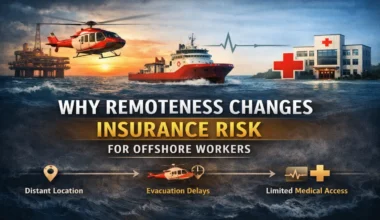
Why Do Offshore Elevated Workers Often Pay More?
Offshore elevated work combines multiple risk layers together.
Insurers may evaluate:
• elevation exposure
• remote rescue difficulty
• severe weather exposure
• heavy industrial hazards
• delayed emergency medical access
This combination can substantially increase claim severity projections.
An offshore ironworker working elevated structures in harsh weather conditions typically creates far greater underwriting concern than a land-based maintenance worker.
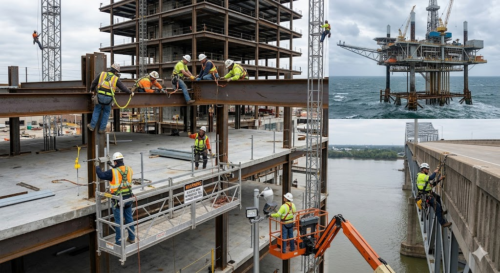
When elevated work is combined with structural steel erection, insurers must evaluate both offshore exposure and the catastrophic fall hazards associated with unfinished steel frameworks. Connector work, open-edge exposure, and complex rescue conditions can significantly increase projected claim severity.
These structural-elevation risks are examined in greater detail in Ironworkers Insurance: Why Structural Steel Work Faces Strict Underwriting.
How Do Weather Conditions Affect Insurance Pricing?
Environmental exposure matters heavily in elevated underwriting. Insurers may increase concern when workers regularly operate in:
• high winds and gust-prone zones
• heavy rain or high-humidity environments
• ice and freezing conditions
• lightning-prone or high-altitude environments
• offshore storms and unpredictable maritime weather
These conditions act as risk multipliers, significantly increasing the probability of a slip-and-fall while simultaneously making rescue operations more hazardous for emergency teams.
Why Do Prior Claims and Safety History Matter?
Underwriters closely examine:
• prior fall injuries
• repeated accidents
• employer incident history
• OSHA violations
• disability claim history
• unsafe work patterns
A worker or employer with repeated fall-related incidents may be viewed as statistically more likely to generate future claims. Repeated elevated-work injuries may also increase concern around permanent disability risk from elevated work. This is especially true when prior accidents involve spinal trauma, balance impairment, or long-term mobility limitations.
That perception can lead to higher premiums, stricter exclusions, lower coverage limits, delayed approvals, and policy declines.
How Do Safety Certifications Affect Underwriting?
Safety training can sometimes improve underwriting confidence.
Insurers may respond more favorably when workers maintain:
• fall-protection certifications
• OSHA safety training
• documented rescue procedures
• recurring safety compliance programs
• specialized climbing certifications
Strong documentation may help reduce uncertainty during underwriting reviews.
Why Do Some Elevated Occupations Cost More Than Others?
Not all elevated occupations create the same insurance exposure.
Underwriters classify jobs based on:
• fall severity potential
• rescue difficulty
• environmental conditions
• frequency of elevation
• physical dependency on the body for income
• claim history within the occupation class
This creates major pricing differences between occupations that may appear similar to workers.
Residential Roofer vs Tower Climber
A residential roofer may face frequent fall exposure, but tower climbers often face:
• extreme elevation
• difficult evacuation conditions
• remote communication sites
• prolonged suspension risk
• severe weather exposure
Because claim severity potential is higher, tower climbers often receive stricter pricing.
Tower climbers often represent one of the highest-severity height-exposure classes in occupational underwriting because insurers must account for extreme elevation, rescue complexity, prolonged suspension exposure, and catastrophic fall potential. These underwriting considerations are explored further in Tower Climbing Insurance: Why Carriers Scrutinize Extreme Elevation Exposure.
Roofing occupations also face aggressive underwriting scrutiny because of repetitive fall exposure, liability severity, and workers’ compensation loss history. These factors are examined in Why Roofers Face Strict Insurance Underwriting.
Bridge Ironworker vs Warehouse Maintenance Worker
Bridge ironworkers may work over water, traffic systems, or large industrial structures.
Warehouse maintenance workers may occasionally use ladders but usually face lower elevation exposure and easier emergency access. Insurers price the bridge worker’s catastrophic injury exposure much higher.
Insurers price the bridge worker’s catastrophic injury exposure much higher because falls often involve greater severity potential, difficult rescue conditions, environmental hazards, and complex infrastructure work environments.
These underwriting concerns frequently appear in large-scale infrastructure projects where workers operate above waterways, traffic corridors, and unfinished structures, as explained in Bridge Workers Insurance: Understanding Infrastructure Construction Risk.
Offshore Elevated Worker vs Land-Based Elevated Worker
Offshore work combines:
• remote medical access
• transportation difficulty
• weather risk
• industrial hazards
• evacuation complexity
This layered exposure often increases underwriting severity projections.
Wind Turbine Technician vs Standard Electrician
Wind turbine technicians frequently work at extreme heights in isolated environments.
Standard electricians may still face occupational hazards, but many operate in lower-elevation environments with easier rescue access.
Remote access, internal ladder systems, confined nacelle environments, and difficult rescue logistics are among the factors discussed in Wind Turbine Technician Insurance: How Insurers Evaluate Renewable Energy Height Exposure.
Insurers classify turbine technicians as a much more severe fall-risk occupation.
Case Studies: High-Risk Underwriting in Action
The following scenarios illustrate how underwriters apply the logic of height, safety history, and environment to actual policy pricing.
The following underwriting scenarios are illustrative examples designed to demonstrate how insurers may evaluate elevated occupational risk in real-world pricing situations.
Scenario A: The “Rescue Difficulty” Premium
-
The Subjects: Two industrial maintenance contractors. Contractor A works on roof-mounted HVAC units (15–20 feet). Contractor B specializes in interior warehouse lighting on suspended platforms (40+ feet).
-
The Risk Delta: While both are “maintenance,” Contractor B faces higher Rescue Difficulty. If an injury occurs on a suspended platform, extraction requires specialized teams and equipment.
-
The Pricing Result: Contractor B’s Disability Insurance premium is rated 35% higher than Contractor A’s, reflecting the increased severity potential of a “suspended” rescue.
Scenario B: The “Safety Documentation” Credit
-
The Subject: A residential roofing company applying for a new Workers’ Compensation policy.
-
The Action: The company provided 3 years of clean “Loss Runs” (zero claims) and a documented OSHA-compliant Fall Protection Plan including weekly safety briefings.
-
The Risk Delta: Underwriters view documented safety systems as a “Risk Mitigator” that lowers the probability of human error.
-
The Pricing Result: The underwriter applied a 12% Schedule Rating Credit, effectively lowering the premium below the standard industry “manual rate” for roofers.
Scenario C: The “Offshore Multiplier”
-
The Subject: A structural ironworker moving from a land-based bridge project to an offshore wind farm installation.
-
The Risk Delta: The height remains similar, but the Remote Medical Access factor changes drastically. A fall on land leads to an ER visit in 20 minutes; a fall offshore may involve a 2-hour medevac.
-
The Pricing Result: The Life Insurance policy included an Occupational Flat Extra (an additional fee per $1,000 of coverage) specifically because of the maritime evacuation complexity.
Underwriting scenario modeling: Elevated occupational pricing is often adjusted using severity projections, rescue complexity analysis, historical loss patterns, and occupational classification thresholds.
These variables contribute to the standard classifications seen in the table below.
Occupations Commonly Facing Higher Insurance Costs
The following occupations commonly receive higher pricing because of elevated injury severity exposure.
| Occupation | Primary Underwriting Concern | Risk Severity Factors |
| Roofers | Frequent fall exposure | Repetitive movement on sloped surfaces; residential vs. commercial height. |
| Tower Climbers | Extreme elevation | Difficult rescue conditions; remote locations; prolonged suspension. |
| Offshore Workers | Combined hazard layers | Remote medical access; maritime weather; heavy industrial machinery. |
| Wind Turbine Techs | Isolated elevation | Limited emergency exit points; internal/external climbing hazards. |
| Ironworkers | Structural instability | Catastrophic fall potential during initial steel erection. |
| Utility Linemen | Multi-hazard exposure | Combined electrical arc-flash and high-elevation fall risks. |
These classifications help insurers estimate the potential financial severity of future claims.
Underwriting classification model: Elevated occupations are segmented by projected claim severity, rescue complexity, environmental exposure, and long-term disability potential.
Which Types of Insurance Are Most Affected by Height Exposure?
Disability Insurance
Disability Insurance policies are heavily affected by elevated work because insurers evaluate whether a serious fall could permanently prevent a worker from returning to physically demanding labor.
Long-term disability exposure is one of the biggest pricing concerns for elevated occupations.
Much of this pricing behavior is driven by fall severity modeling in disability insurance, where underwriters estimate whether a worker could permanently lose the ability to perform physically demanding labor after a severe fall injury.
Workers’ Compensation Insurance
Workers’ Compensation Insurance pricing often rises when employers have frequent elevated operations, repeated fall claims, or poor safety records.
Severe fall injuries can create large medical and wage-replacement costs.
Related reading: “Workers’ Compensation for Hazardous Occupations.”
Occupational Accident Insurance
Occupational Accident Insurance underwriting often focuses on independent contractors, subcontract climbing work, and high-severity injury exposure.
Insurers may impose stricter occupational classifications for elevated contractors.
Life Insurance
Life Insurance underwriters evaluate whether occupational hazards materially increase fatality risk.
Workers in severe height-exposure occupations may face:
• higher premiums
• occupational ratings
• reduced coverage availability
Accidental Death & Dismemberment Coverage
Accidental Death & Dismemberment Insurance pricing may increase because elevated work raises the probability of catastrophic accidental injuries.
Some policies may include occupational restrictions or exclusions for extreme-height work.
Why Does Claims History Increase Insurance Costs?
Claims history strongly influences how insurers price future risk.
Underwriters often review:
• previous fall injuries
• prior disability claims
• repeated accident patterns
• OSHA fall violations
• employer incident records
• workers’ compensation history
Insurers use past behavior to estimate future claim probability.
For example, a worker with multiple prior fall injuries may be viewed as having elevated future disability exposure.
An employer with repeated OSHA violations may also be viewed as having weaker safety controls, which increases insurer concern.
That concern often leads to:
• higher premiums
• reduced underwriting flexibility
• stricter exclusions
• increased documentation requirements
The pricing logic is straightforward:
poor claims history → higher expected future losses → higher insurance costs
How Does Job Misclassification Create Insurance Pricing Problems?
Problems often occur when workers inaccurately describe elevated duties. If the true exposure is more severe than disclosed, insurers may determine that material misrepresentation has occurred.
Underwriting concern usually escalates when undisclosed elevated duties materially increase projected claim severity beyond the occupational class originally approved by the insurer.
This can result in:
-
Claim Denials: The insurer may refuse to pay for an injury if the work being performed was not disclosed.
-
Policy Rescission: The policy may be voided entirely, leaving the worker or company with no backdated coverage.
-
Premium Audits: Drastic retroactive pricing adjustments that can bankrupt a small operation.
Accurate disclosure helps reduce future disputes and improves underwriting reliability.
Common underwriting failure paths include:
• undisclosed tower climbing duties
• inaccurate working-height disclosures
• omitted offshore assignments
• unreported subcontract climbing work
• conflicting employer safety records
• repeated OSHA violations combined with severe prior claims
These classifications are closely tied to occupational class ratings, which insurers use to group workers into pricing categories based on injury severity exposure, claims probability, and underwriting risk.
How Do OSHA Records and Safety Data Affect Insurance Pricing?
Occupational Safety and Health Administration safety data plays a major role in underwriting decisions.
Insurers frequently evaluate:
• OSHA fall violations
• employer inspection history
• incident frequency
• safety compliance records
• documented fall-protection systems
• employee training programs
Insurers also review federal fall-protection standards published by the Occupational Safety and Health Administration (OSHA) when evaluating employer safety compliance and elevated work exposure.
Strong safety systems may help reduce underwriting concern because they suggest lower accident probability.
Repeated violations often create the opposite effect. This relationship between regulatory violations and premium escalation is examined further in OSHA Fall Violations and Insurance Costs, which explains how repeated safety failures can increase underwriting scrutiny and projected loss exposure.
For insurers, safety records help answer a critical pricing question:
How likely is this worker or employer to generate a serious future claim?
Poor safety culture often increases both accident frequency and claim severity projections.
Related reading: “Why High-Risk Jobs Face Stricter Insurance Approval.”
How Elevated Workers May Improve Insurance Approval and Pricing
Elevated workers cannot remove occupational risk entirely, but they can improve underwriting reliability.
Practical steps include:
• using accurate occupational descriptions
• honestly documenting elevated duties
• reporting offshore assignments clearly
• maintaining fall-protection certifications
• completing OSHA training programs
• maintaining strong safety records
• reducing preventable claims where possible
• documenting safety compliance consistently
Accurate disclosure is especially important because it reduces future disputes during claims investigations.
While elevated occupations will almost always carry higher baseline risk classifications, strong safety documentation, clean claims history, accurate occupational disclosures, and recurring fall-protection training may help reduce underwriting concern and improve pricing outcomes over time.
Insurers generally respond more favorably when occupational exposure is clearly documented and supported by strong safety practices.
Related reading: “Factors That Determine Risk Job Premiums.”
Final underwriting insight:
Elevated work does not automatically make insurance unavailable, but it fundamentally changes how insurers model severity exposure, long-term disability probability, rescue complexity, and catastrophic claim potential. In elevated occupations, pricing is driven less by the possibility of an accident occurring and more by how financially severe the outcome could become if a fall happens.
Key Takeaways
- Elevated workers often pay more because falls can create severe long-term financial losses for insurers.
- Insurers evaluate height exposure, rescue difficulty, environment, claims history, and occupational classification when calculating premiums.
- Some elevated occupations cost more because they involve more severe injury potential and harder rescue conditions.
- Prior claims history and OSHA violations can increase underwriting concern and future insurance costs.
- Accurate occupational disclosure helps prevent pricing disputes, underwriting problems, and future claim complications.
- Height exposure underwriting directly affects disability insurance, workers’ compensation, occupational accident coverage, life insurance, and AD&D policies.
- Why elevated workers pay more for insurance is directly tied to how insurers estimate severe injury costs, long-term disability exposure, and catastrophic fall risk.
—————————————————————————————————————————
Sources & Underwriting References
Construction Industry Institute (CII) —
Research on elevated construction exposure, fall-risk management systems, and infrastructure safety performance trends affecting high-risk occupational environments.
OSHA Fall Protection Standards —
Federal elevated-work safety requirements used to evaluate fall-protection systems, scaffold operations, ladder safety, suspended access exposure, and rescue-planning procedures in hazardous occupations.
National Institute for Occupational Safety and Health (NIOSH) —
Occupational injury research analyzing severe fall exposure, long-term disability patterns, traumatic injury severity, and elevated-work fatality risk across construction and industrial sectors.
National Council on Compensation Insurance (NCCI) —
Occupational classification frameworks and workers’ compensation rating systems used to segment elevated-risk occupations by claim severity potential, frequency exposure, and underwriting loss projections.
Reviewed for underwriting accuracy by:
Reviewed for underwriting accuracy by the RJI Institutional Review Team
Review includes:
height-exposure underwriting systems,
occupational class rating analysis,
catastrophic fall-severity modeling,
workers’ compensation pricing structures,
rescue-complexity evaluation,
and elevated occupational risk segmentation.
Last reviewed: May 2026
Research & Underwriting Methodology
This article combines elevated-risk underwriting frameworks,
occupational classification systems,
workers’ compensation severity modeling,
OSHA fall-protection guidance,
NIOSH injury-severity research,
and catastrophic fall-exposure analysis
to explain how insurers evaluate elevated occupational risk and calculate insurance pricing for height-related work environments.
Published: May, 2026.
Last Updated: June, 2026.
For deeper underwriting explanations, explore:
- Occupational Hazard Classification in Insurance
- Height Restrictions in Occupational Insurance Policies
- Catastrophic Fall Risk in Occupational Insurance
- Factors That Determine Risk Job Premiums
- Height Exposure Underwriting: How Insurers Evaluate Elevated Workers
- Disability Insurance for High-Risk Workers
- Workers’ Compensation for Hazardous Occupations
- Permanent Disability Risk from Elevated Work