Reviewed for underwriting accuracy by the RJI Institutional Review Team | Published: July 2026 | Updated: July 2026
………………………………………………………………………………………………………………………………………
Executive Summary
When an offshore helicopter fails, the consequences rarely stop at the aircraft. A single incident over open water can simultaneously exhaust a primary liability policy, trigger multiple workers’ compensation claims, initiate a months-long investigation across three jurisdictions, and leave injured workers waiting hours for extraction because the weather has grounded the backup aircraft.
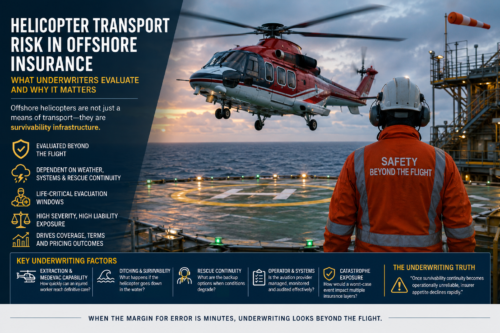
Specialist marine and energy underwriters do not treat offshore helicopters as transportation assets. They treat them as survivability infrastructure, and price, restrict, or decline coverage accordingly.
This article explains that underwriting logic: what drives offshore helicopter underwriting, how airborne survivability continuity translates into pricing and coverage restrictions, what operators can do to improve their underwriting position, and what offshore workers should know before they board.
For the wider marine risk framework this mechanism sits inside, see Offshore Risk Underwriting: How Insurers Evaluate Marine & Remote Workers.
What Helicopter Transport Risk Underwriting Actually Evaluates
Standard aviation insurance focuses on hull value, pilot hours, and mechanical maintenance records. Offshore helicopter underwriting asks a different question: can this airborne system still get an injured worker to definitive care if weather deteriorates, mechanical systems fail, communications break down, or platform instability compromises normal operations?
That reframe is why underwriters spend more time evaluating post-incident survivability systems than pre-flight safety records. A clean flight history does not tell them what happens when things go wrong. Emergency flotation reliability, underwater egress training, dedicated search-and-rescue access, and medevac extraction timelines do.
This is why helicopter transport risk offshore insurance functions as survivability-continuity underwriting rather than simple transportation-risk underwriting. Underwriters model evacuation continuity risk and airborne operational reliability when mechanical systems, weather windows, and structural environments degrade simultaneously, not routine blue-sky flights.
The International Association of Oil & Gas Producers (IOGP) publishes an annual aviation safety data series tracking offshore helicopter accident rates, fatal accidents per flight hour, and survivability outcomes across global operators. Underwriters use this data, and operator-specific deviations from it, as a baseline for catastrophic offshore severity modeling. Operations that cannot demonstrate performance at or above IOGP benchmarks face heightened scrutiny.
When survivability continuity can no longer be demonstrated, underwriters may: impose aviation-related exclusions, reduce liability participation, require dedicated SAR agreements, apply passenger aggregation limits, increase offshore aviation premium loadings, or decline coverage entirely; the point at which the risk shifts from standard offshore underwriting into restricted-market severity underwriting.
Why Offshore Remoteness Changes the Severity Math
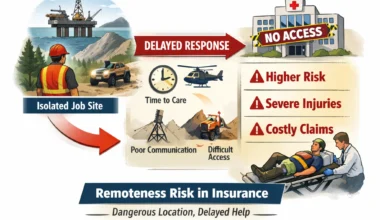
On a land-based worksite, a serious injury sets off a largely predictable chain: emergency services are called, an ambulance arrives within minutes, and the worker reaches a trauma centre within the golden hour. Delays are measured in minutes.
Offshore, the same injury sets off a chain where every link is conditional. The helicopter must be airworthy. The weather must be within limits. The helideck must be accessible. Communication must be functioning. A dedicated medevac aircraft or standby vessel must be within range.
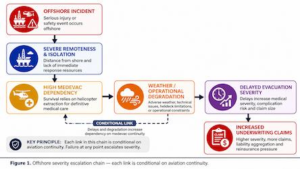
The further an operation sits from shore, and the more it depends on a single aviation provider for emergency extraction, the more steeply offshore medevac dependency scales with operational degradation, what specialists call rescue continuity exposure.
Airborne Survivability Continuity: The Factors Underwriters Evaluate
No single factor determines the insurability of an offshore helicopter operation. Underwriters assess multiple interdependent factors that influence survivability continuity, operational resilience, and catastrophic claim severity. Some relate directly to the aircraft and flight environment, while others reflect the broader offshore systems that support emergency response and operational continuity. Together, they form the basis of offshore helicopter underwriting.
Extraction Window and Medevac Capability
Offshore medevac dependency is governed by remote medical access standards: local medical bays provide basic stabilisation only, and extraction-window benchmarks under 2 hours for dedicated on-site SAR versus 6+ hours for mainland-dispatched aircraft are the reference underwriters use to classify medical continuity risk. Once extraction timelines exceed survivability assumptions for severe trauma, underwriters treat the operation as medically unstable from a continuity perspective, triggering aviation-related exclusions, restricted limits, or mandatory standby rescue requirements.
This exposure also shapes coverage decisions directly. For the full stakeholder and insurance-consequence treatment, see Remote Medical Access and Occupational Coverage and Offshore Evacuation Risk and Insurance.
Ditching Survivability and Emergency Egress Capability
A helicopter forced onto the water does not usually kill its occupants at impact. It kills them afterward, through rapid flooding, inversion disorientation, failed flotation systems, or cold-water exposure. Industry safety frameworks, including CAA offshore helicopter safety standards and OPITO-approved HUET training requirements, identify emergency egress capability as the primary survivability lever after water impact.
Underwriters evaluate whether emergency flotation systems are fitted and maintained to current standards, whether passengers hold current HUET certification with compressed-air EBS use, whether survival suits meet thermal protection standards for the operating water temperature, and whether personal locator beacons are fitted and registered. OEUK safety guidance and North Sea survivability reviews consistently emphasize survival suit compliance and current HUET training as the critical determinants of post-ditching survival.
What this means for workers: this is the single training investment with the clearest survival payoff. For operators: gaps here are the fastest route to an exclusion, since egress equipment and training are verifiable at audit and not easily disputed after the fact. Operators who demonstrate a full equipment and training stack across all transported personnel materially reduce their ditching severity exposure and the associated premium loading.
Crew Concentration and Accumulation Risk
A helicopter carries many workers at once, so a single crash event can generate simultaneous fatality claims, permanent disability claims, specialist-crew operational interruption, and hull/third-party liability exposure across correlated policy lines. This is what makes offshore aviation claims reinsurance-sensitive: a single event can exhaust primary layers across life, employers’ liability, and marine liability at once.
Offshore aviation produces relatively infrequent losses compared with many other occupational hazards, but when losses occur they often involve multiple insured individuals simultaneously. Underwriters therefore evaluate not only the probability of an accident but also the concentration of insured lives, specialist personnel, and contractual liabilities within a single flight. This severity profile, distinct from frequency risk, is why passenger concentration limits and reinsurance participation play such a central role in offshore helicopter underwriting.
Insurers respond to this concentration with passenger limits and crew-spreading protocols for key personnel. For the full accumulation-risk mechanism, see Marine Fatality Exposure in Insurance Underwriting.
Weather Exposure, Night-Flight Severity, and Flight Reliability Degradation
Underwriters build premium models around the specific weather profiles of the regions where insured personnel operate, referencing mandatory weather-cancellation thresholds set under CAA CAP 437 and equivalent regional standards. Three variables receive the most scrutiny:
- SAR visibility collapse — sudden fog, lightning, or turbulence can degrade visibility to zero in minutes, making airborne rescue detection functionally impossible and drifting survivors unrecoverable before hypothermia sets in.
- Night-flight severity — operating over open water in darkness removes visual horizons, increasing pilot disorientation risk and extending survivor detection timelines for rescue assets.
- Weather grounding — prolonged severe-weather shutdowns freeze emergency-response capability, converting a survivable injury into a catastrophic disability or fatality claim through treatment-delay escalation alone.
Operators who regularly fly near the edge of safe parameters signal a risk appetite that underwriters price accordingly through flight reliability degradation loadings. Workers retain the right to refuse flights that appear to exceed stated weather limits.
Floating Platform Landing Instability and Dynamic Positioning Risk
Fixed platform helidecks are challenging enough. Floating asset helidecks on FPSOs, drillships, and semi-submersibles introduce continuous motion variables: heave, pitch, roll, and dynamic-positioning failures that can produce sudden, large deck movements mid-approach. IOGP Report 590 establishes performance benchmarks for real-time helideck monitoring systems (HMS) that stream live pitch, roll, heave, and wind velocity data directly to incoming pilots.
Underwriters evaluate whether an operator’s floating assets meet IOGP Report 590 benchmarks. Platforms without live helideck telemetry are treated as presenting higher landing-accident probability, particularly during deteriorating sea states, and are priced or restricted accordingly.
SAR Visibility Collapse and Offshore Rescue Fragmentation
When a helicopter goes down, the speed of the search-and-rescue response determines whether survivors are recovered. Offshore rescue fragmentation regional operators, military assets, and private contractors failing to coordinate under unclear command authority is most acute in international waters where rescue jurisdiction is ambiguous.
Operationally, operations without dedicated, tested SAR coordination protocols move from standard-market underwriting into restricted-placement review because recoverability probability becomes too uncertain under severe offshore conditions. For the full rescue-delay mechanism, see Remote Rescue Delays in Offshore Claims and Offshore Evacuation Risk and Insurance.
Human Reliability: Fatigue Accumulation and Rotational Scheduling
Offshore helicopter transport is a system of repeated crew rotations under high-stress environmental conditions. Offshore operational fatigue, accumulating across flight crews and helideck officers, is benchmarked by underwriters against ICAO Annex 6 fatigue management guidance. Underwriters examine whether operators exceed minimum-hour compliance and maintain documented safety management systems; operations demonstrating only minimum-hour compliance face greater scrutiny.
From a claims perspective, the full disability-exposure mechanism is examined in Offshore Rotation Work and Disability Insurance.
Contractor Chain Integrity and Claims Complexity
Offshore helicopter operations typically involve multiple contractual layers: an aircraft owner, an aviation operator, a charter broker, a primary energy company, and tiers of subcontracted personnel. IS-BAO / IBAC certification is the reference standard underwriters use to independently verify an aviation provider’s safety management system.
When an incident occurs, contractor-chain fragmentation, determining which party’s insurance is primary and which policy conditions apply, can take years to resolve. Underwriters scrutinise contractor documentation for independently audited safety records, up-to-date indemnity agreements across all tiers, and clear contractual definitions of primary liability. Offshore evidence degradation compounds this: aircraft wreckage in deep water is difficult and expensive to recover, flight data recorders may be unrecoverable, and incident reconstructions become more contested the longer recovery takes.
As a result, weak contractor documentation extends claims timelines and increases the probability of coverage disputes between layers, which underwriters price into contractor-chain risk loadings.
International and Cross-Border Airborne Complexity
Operations near jurisdictional boundaries introduce offshore jurisdiction ambiguity, rescue authorization delays, and conflicting liability frameworks that extend extraction timelines. Cross-border evacuation often requires rapid customs clearances and airspace authorization delays that, in a medical emergency, can be life-altering. A lack of clear command structures in international zones leads to airborne operational-control degradation when a crisis unfolds.
From an eligibility standpoint, the full jurisdictional mechanism is examined in International Waters Insurance Exclusions.
Communication Redundancy and Emergency Command Continuity
When a major offshore emergency unfolds, safety depends on maintaining clear lines of communication between the asset, the aircraft, and onshore command centres. Underwriters assess whether an operator’s backup communications can survive the triggering event itself, an explosion that disables primary radio and satellite systems simultaneously, and whether emergency command continuity protocols are documented and regularly exercised.
Flight crews left without real-time updates on deck hazards face sharply elevated accident probability. Airborne rescue fragmentation caused by communication failure is treated as a direct underwriting severity driver rather than a peripheral operational issue.
How These Factors Combine Into Pricing Outcomes
Underwriters do not price each factor independently and sum the results. They model scenarios: what does a credible worst-case event look like for this operation, and what would it cost?
For a deepwater FPSO operation, a credible worst case might be a helicopter crash during a storm carrying 14 workers, with a 6-hour SAR delay, in waters where survival suit thermal protection is marginal and the aviation provider holds no independent safety certification. An underwriter builds that scenario, models probable claims outcomes, multiple fatalities, multiple permanent disabilities, business interruption, hull loss, third-party liability, and prices the policy to reflect both probability and catastrophic airborne severity.
Operations that can demonstrably reduce the severity of that scenario change the modelled worst case. A shorter extraction window reduces the proportion of incidents that escalate to fatalities. Better egress equipment reduces offshore helicopter fatality exposure per ditching event. Dedicated SAR access reduces the probability of failure. Each reduction in expected severity translates directly into a premium.
| Mitigation | Underwriting Interpretation |
| Dedicated on-site SAR with ALS aircraft | May improve insurer appetite and reduce severity-related pricing pressure |
| Full HUET/EBS compliance across all transported personnel | Improves ditching survivability assumptions and offshore recoverability expectations |
| Helideck motion telemetry on floating assets | Reduces offshore landing degradation uncertainty for floating platforms |
| IS-BAO certified aviation provider | Improves contractor-chain defensibility and operational reliability confidence |
| Audited fatigue management exceeding regulatory minimums | Strengthens human-reliability controls and claims defensibility |
| Pre-authorised cross-border emergency routing | Reduces offshore rescue fragmentation and operational-control uncertainty |
Figure 2. Directional impact of key mitigations — indicative only; actual outcomes vary by insurer, jurisdiction, and portfolio.
Elevated catastrophic severity exposure combined with complex open-water rescue operations drives higher reinsurance capital requirements, which in turn drives higher premium rates for high-risk offshore sectors. When an operator cannot demonstrate strong, redundant survivability systems, underwriters reduce coverage limits or raise premiums to protect capital reserves from catastrophic losses.
How Offshore Aviation Insurance Programs Are Structured
Offshore helicopter operations are rarely insured through a single standalone aviation policy. Insurers typically structure exposure across multiple interconnected coverage layers, because one incident can simultaneously trigger hull loss, passenger injury claims, workers’ compensation exposure, employers’ liability claims, third-party liability, operational shutdown costs, and catastrophic accumulation losses.
| Coverage Type | Operational Scope |
| Hull Coverage | Protects against physical damage to or total loss of the helicopter during flight, taxiing, or ground storage. Commonly structured using an agreed hull value system rather than actual cash value. |
| Passenger Liability | Covers bodily injury or fatality claims involving transported personnel, often structured as Combined Single Limit (CSL) programs with layered catastrophe protection. |
| Employers’ Liability / Workers’ Compensation | Covers employee injury, disability, fatality, and survivor-benefit exposure. |
| Third-Party Liability | Covers injury or property damage involving non-employee parties. |
| Excess Catastrophe Layers | Additional protection for severe multi-fatality or mass-casualty events. |
| Reinsurance Participation | Spreads catastrophic offshore aviation exposure across multiple insurance and reinsurance markets. |
Underwriting breakpoint
A single ditching event can generate hull-loss exposure, multiple disability claims, survivor compensation obligations, operational interruption, and catastrophic passenger-liability exposure at the same time. This correlated-loss dynamic is the primary reason offshore helicopter underwriting receives intense catastrophe-severity scrutiny from both insurers and reinsurers.
What Airborne Survivability Continuity Means for Each Stakeholder
| Stakeholder | What Changes For Them |
| Worker | Survival outcomes hinge on personal HUET/EBS currency, survival-suit fit, and knowing the aviation provider’s certification status, not just on the underwriter’s pricing decision. |
| Employer / Operator | Underwriting appetite and premium are directly responsive to documented investment in SAR access, egress training, and helideck telemetry; these are the levers operators control. |
| Broker | Placement strategy depends on assembling the evidence package (IS-BAO status, extraction-window documentation, fatigue audits) before approaching the market, not after a quote comes back restrictive. |
| Claims Professional | Contractor-chain fragmentation and offshore evidence degradation are the two variables most likely to extend settlement timelines; early documentation requests matter more than in most claim types. |
| Risk Manager | Airborne survivability continuity should be tracked as a standing operational-risk indicator, not reassessed only at renewal. |
For Offshore Workers: What You Should Know Before You Board
Underwriting discussions happen far from the workers at the centre of the risk. But workers are the ones who face the consequences when survivability systems fail. Here is what you are entitled to know and ask.
- Your HUET certification. You should hold a current BOSIET or FOET certificate that includes helicopter underwater escape training with compressed-air EBS use. These typically expire every four years. Your employer must ensure your certification is current before you fly offshore.
- Your survival suit. In cold-water environments, you should be issued a survival suit rated for the water temperature of your operating area. You are entitled to ask what thermal rating your suit provides and how it was selected.
- Your aviation provider. You are entitled to know which aviation company is operating the flight and whether they hold current IS-BAO or equivalent independent safety certification.
- Weather limits. You are entitled to know your operator’s stated weather operating limits. If you are pressured to board a flight in conditions that feel unsafe, you have the right to refuse, and in most offshore jurisdictions cannot be penalised for doing so in good faith.
- What to do if the helicopter goes down. Brace position, wait for movement to stop, exit toward the nearest window, activate your EBS if the cabin floods before you can escape, surface, and activate your personal locator beacon. Reviewing this sequence before each trip is reasonable and encouraged by most safety management systems.
- Your coverage. Depending on jurisdiction, employment classification, and contractual structure, employers’ liability, maritime liability, or workers’ compensation arrangements may provide coverage for medical expenses, lost earnings, disability benefits, or survivor compensation following an incident.
If the incident involves a contractor aircraft, multiple insurers and liability structures may be involved, which significantly increases claims complexity. Workers should retain copies of certifications, flight manifests, offshore assignments, and any communications relating to operational safety concerns before an incident occurs.
How Operators Improve Their Underwriting Position
Not all mitigations carry equal weight in underwriting terms. The following is prioritised by underwriting impact per unit of investment; each entry names a specific document, threshold, or program, not a general safety instinct.
Priority 1 — Non-Negotiable Baseline
Ensure your aviation provider holds IS-BAO certification or an equivalent, independently audited safety accreditation. Ensure all transported personnel hold current HUET certification with EBS. Without these, exclusions or sublimits are likely regardless of everything else.
Priority 2 — High Impact, Moderate Investment
Establish a formal, dedicated SAR partnership with a contracted, all-weather capable provider. Document extraction window guarantees in writing and disclose them to your underwriter. This single change compresses the extraction window that drives medevac dependency exposure more directly than almost any other factor.
Priority 3 — Floating Asset Specific
Install real-time helideck monitoring systems meeting IOGP Report 590 benchmarks. For FPSOs or semi-submersibles, this directly reduces offshore landing degradation probability and the associated premium loading.
Priority 4 — Systemic Risk Culture
Implement and document a fatigue management system with third-party audit capability, aligned to ICAO Annex 6. Establish incident-reporting cultures where crews can flag concerns without career consequences; this supports claim defensibility and signals to underwriters that operational pressure does not override safety margins.
Priority 5 — International Operations
If you operate near jurisdictional boundaries or in international waters, commission a legal review of cross-border emergency routing and establish pre-authorised clearance agreements. This is low cost relative to the rescue-authorization-delay costs it prevents. For the full mechanism, see International Waters Insurance Exclusions.
For a broader treatment of why some offshore operations face airborne coverage restrictions and how to address them, see Why Offshore Workers Face Insurance Restrictions.
Occupations Most Affected by Helicopter Transport Risk Underwriting
Although helicopter transport is used across many offshore industries, underwriting scrutiny is concentrated on occupations that depend on routine aviation access for workforce transport, emergency medical evacuation, specialist intervention, or operational continuity. These occupations share common exposure characteristics, even when their day-to-day work differs.
| Occupation | Primary Exposure |
| Offshore Oil Rig Workers | Daily dependence on helicopter transport and emergency medevac |
| Offshore Drilling Crew | Remote deepwater operations with limited evacuation alternatives |
| Offshore Production Operators | Continuous offshore deployment requiring aviation continuity |
| Offshore Maintenance Technicians | Frequent crew rotations and remote platform access |
| FPSO Workers | Floating production facilities dependent on helideck operations |
| Offshore Construction Workers | Heavy-lift projects in isolated marine environments |
| Offshore Crane Operators | Personnel concentration and offshore rescue dependency |
| Subsea Engineers | Remote intervention work requiring rapid emergency extraction |
| ROV Pilots and Technicians | Specialized offshore personnel with limited replacement availability |
| Commercial Divers | Time-critical medical evacuation following diving emergencies |
| Well Intervention Specialists | High-consequence offshore operations with aviation dependency |
| Offshore Electrical Technicians | Remote maintenance work across multiple offshore installations |
| Offshore Instrumentation Technicians | Routine helicopter transfers between production assets |
| Offshore HSE Officers | Emergency-response leadership during offshore incidents |
| Offshore Logistics Coordinators | Aviation planning and operational continuity responsibilities |
| Offshore Geologists | Exploration campaigns in remote offshore locations |
| Offshore Surveyors | Vessel-based operations requiring helicopter access |
| Offshore Wind Turbine Technicians | Offshore wind farms dependent on helicopter or marine transfer for rescue |
| Helideck Crew (HLO/HDA) | Safe aircraft arrival, departure, and emergency coordination |
| Offshore Inspection Engineers | Remote asset inspections requiring aviation-supported deployment |
Why These Occupations Share Similar Underwriting Outcomes
These occupations are more likely to experience underwriting restrictions because they share several operational characteristics:
- Routine reliance on helicopter transport for workforce access.
- High dependency on rapid aeromedical evacuation following serious injury.
- Work in remote offshore environments where alternative rescue options are limited.
- Greater exposure to weather-related transport disruption.
- Higher potential for catastrophic accumulation losses when multiple personnel travel together.
- Increased operational consequences if aviation continuity is interrupted.
As helicopter dependency increases, insurers place greater emphasis on survivability continuity, rescue capability, and operational resilience when determining coverage eligibility, policy conditions, and premium adequacy.
Common Claim Problems and How to Protect Against Them
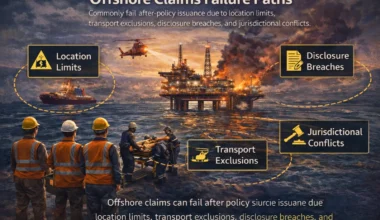
- Unauthorised transport systems. Using aviation vendors that have not passed mandatory independent safety audits is a frequent basis for claim disputes and denial.
- Undeclared offshore zones. Operating flights into ultra-deepwater regions outside the geographical boundaries specified in the policy exposes operators to uncovered claims.
- Weather-protocol violations. Launching flights in conditions approaching or exceeding stated safety limits is one of the most heavily scrutinized operational issues during offshore aviation claim investigations.
- Expired offshore certifications. Transporting personnel whose BOSIET or FOET certifications have lapsed is both a safety failure and a policy condition breach.
- Contractor chain disputes. Inadequate indemnity agreements across subcontractor tiers turn routine liability questions into prolonged legal proceedings that extend worker settlement timelines.
- Offshore evidence degradation. Deep-water wreckage recovery is expensive and often incomplete. Documentation discipline, written contracts, training records, weather decision logs, and incident reports convert contested facts into established ones before degradation begins.
Insurers also closely investigate altered or incomplete weather decision logs, undocumented charter substitutions, expired EBS inspection records, inconsistent passenger manifests, undeclared maintenance deferrals, and discrepancies between flight records and contractor disclosures. These inconsistencies frequently trigger deeper forensic reviews because insurers evaluate whether operational noncompliance materially weakened airborne survivability continuity before the incident occurred.
Final Underwriting Insight
In helicopter transport risk offshore insurance, underwriters are not merely evaluating whether helicopters can move workers offshore. They are evaluating whether survivability systems remain operational after offshore conditions begin degrading rescue continuity, medical access, communication stability, and extraction controllability simultaneously.
Once survivability continuity becomes operationally unreliable, insurer appetite declines rapidly, because the exposure is no longer viewed as a transportation problem, but as a systemic offshore catastrophe-risk problem.
Key Takeaways
- Offshore helicopter underwriting evaluates airborne survivability continuity, what happens when systems degrade, not just routine flight safety.
- The extraction window and medevac capability are the single most consequential variables in offshore severity modeling.
- Ditching survivability depends more on post-impact systems flotation, emergency egress, SAR access than on crash prevention. Underwriters price this separately.
- Crew concentration creates an accumulation risk that makes offshore aviation claims reinsurance-sensitive; a single event can exhaust multiple policy lines simultaneously.
- Operators can materially improve their underwriting position through prioritised investment: IS-BAO provider certification and HUET compliance first, dedicated SAR partnership second, floating-asset helideck telemetry third.
- Workers are entitled to know their certification status, their aviation provider’s credentials, their operator’s weather limits, and their rights if pressured to fly in unsafe conditions.
- Contractor-chain fragmentation and offshore evidence degradation are the two factors most likely to extend and complicate claims; documentation discipline is the primary defence.
In offshore helicopter underwriting, the aircraft is only one component of the exposure. The insurable risk is the continuity of the entire survivability system that supports it.
—————————————————————————————————————————
Institutional & Underwriting Reference
This article references offshore aviation underwriting frameworks, survivability-continuity modeling systems, catastrophe-severity analysis principles, and marine operational-risk standards associated with:
- International Association of Oil & Gas Producers (IOGP) — Offshore Helicopter Recommended Practices (Report 690), Aircraft Management Guidelines (Report 590), and annual offshore aviation safety data.
- ICAO — Annex 6: Operation of Aircraft, including helicopter operational standards and fatigue management guidance.
- CAA (UK) — CAP 437: Standards for Offshore Helicopter Landing Areas.
- BSEE (US) — Offshore helicopter operations regulations under 30 CFR Part 250.
- OEUK — Annual Health, Safety & Environment reports and offshore helicopter operational guidance.
- IS-BAO / IBAC — International Standard for Business Aircraft Operations, administered by the International Business Aviation Council.
- OPITO — BOSIET, FOET, and HUET training standards governing helicopter underwater escape training and emergency breathing system certification.
Reviewed for Underwriting Accuracy
Reviewed for underwriting accuracy involving: offshore helicopter survivability underwriting, medevac dependency severity analysis, offshore rescue-fragmentation exposure modeling, ditching survivability and emergency-egress evaluation, airborne catastrophe accumulation-risk assessment, offshore extraction-window severity modeling, helideck operational degradation exposure, offshore aviation liability-layer interaction, contractor-chain and claims-defensibility analysis, and offshore operational-continuity and recoverability evaluation.
—————————————————————————————————————————
This article is an educational reference for underwriting concepts in offshore aviation risk. It does not constitute insurance advice. Specific coverage terms, premium outcomes, and regulatory requirements vary by jurisdiction, insurer, and operation. Operators and workers should consult qualified marine insurance brokers and legal counsel for guidance specific to their circumstances.