Editorial notice: Reviewed for underwriting accuracy by the RJI Institutional Review Team | Published: June, 2026 | Last reviewed: June, 2026.
————————————————————————————————————–
Executive Summary
Bridge workers face strict insurance underwriting because the occupation involves extreme elevation, suspended work environments, structural-construction hazards, limited access for rescue, and a high risk of catastrophic injury. Insurers carefully evaluate the bridge environment, rescue complexity, disability severity, industrial construction exposure, and safety history when determining pricing, eligibility, and policy restrictions.
Why Are Bridge Workers Considered High-Risk by Insurers?
In insurance underwriting, risk isn’t just about how often accidents happen (frequency); it is about how severe and costly those accidents are when they do occur (severity). Heavy civil infrastructure projects represent one of the highest-severity occupational construction classes evaluated by commercial insurers, which explains why bridge worker insurance underwriting requires such stringent, specialized evaluation systems.
[Bridge-Work Exposure] ➔ [Simultaneous Environmental Hazards] ➔ [High Severity Risk Rating]
Underwriters define the core risks of bridge work by evaluating several interconnected exposures:
-
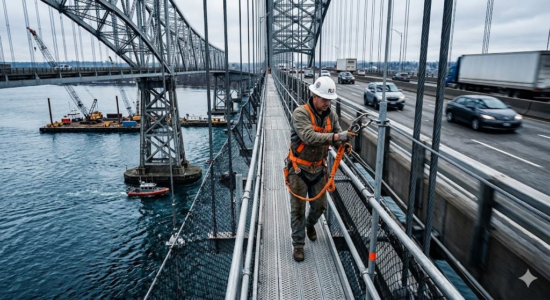
Extreme Elevation & Severe Fall Exposure: Working hundreds of feet above water, concrete, or live roadways means any fall is likely catastrophic.
-
Suspended Work Platforms & Confined Spaces: Workers often operate from temporary scaffolding, catenary platforms, or specialized rigging where movement is restricted, and structural stability is dynamic.
-
Water & Traffic Exposure: Falls into fast-moving rivers or tidal oceans introduce drowning hazards, while working adjacent to active highways exposes crews to high-speed vehicle strikes.
-
Industrial Crane & Heavy Equipment Interaction: Structural steel erection requires constant coordination with massive cranes, increasing the risk of crush injuries or rigging failures.
-
Rescue Difficulty & Isolated Environments: If an incident occurs inside a bridge pier or on a suspended cable, standard emergency services cannot easily reach the worker.
-
Weather & Environmental Instability: High winds, temperature swings, and moisture cause structural vibration and slick surfaces, compounding human fatigue and repetitive physical strain.
The Shift from Frequency to Severity Risk
A fundamental actuarial rule guides the mechanics of bridge worker insurance underwriting:
The Height-Severity Rule: As working height increases, the insurer’s exposure shifts from Frequency Risk to Severity Risk. This principle forms the foundation of Height Exposure Underwriting: How Insurers Evaluate Elevated Workers.
In standard low-rise Construction Workers Insurance underwriting, an underwriter expects a higher frequency of minor claims, like a sprained ankle or a minor cut. On a bridge project, however, an accident is rarely minor. Insurers design their underwriting frameworks around catastrophic fall risk.
When an underwriter looks at a bridge worker, they are calculating the lifetime costs of:
-
Severe spinal cord injuries
-
Traumatic brain injuries (TBIs)
-
Massive crush injuries and mobility loss
-
Long-term income replacement and permanent disability claims
Because a survivable fall from a bridge often results in permanent disability, insurers know the worker will likely never be able to safely return to elevated infrastructure work. This relationship between severe injuries and Permanent Disability Risk from Elevated Work is a major driver of bridge-worker underwriting decisions. This reality is heavily backed by Bureau of Labor Statistics data on severe construction injuries, which underwriters use to map baseline risk.
Underwriting Decision Breakpoints
Bridge-work underwriting often shifts from standard commercial evaluation to restricted or specialty-market review when insurers identify one or more of the following thresholds:
- Sustained exposure at extreme elevations
- Suspended-platform or catenary scaffold operations
- Marine or offshore bridge access requirements
- Inadequate rescue infrastructure
- Prior violations of OSHA Fall Protection Standards for High-Risk Work
- Multi-worker catastrophic exposure potential
Once these thresholds combine, many standard insurers either impose restrictive endorsements, require specialty-market underwriting, or decline the risk entirely.
For bridge contractors, this often means fewer insurance options, longer underwriting reviews, and significantly higher coverage costs.
Bridge Work Combines Multiple Underwriting Risk Systems
Most occupations fit neatly into a single insurance risk category. A commercial truck driver faces transportation risks; a factory welder faces industrial risks; a commercial diver faces marine risks. However, the core of bridge worker insurance underwriting is that it forces insurers to stack multiple risk evaluation systems simultaneously.
This cross-system risk profile heavily impacts everything from standard workers’ compensation severity to general liability exposures.
| Underwriting Risk System | Specific Bridge Exposure | Insurer Concern | Insurance Outcome |
| High-Elevation System | Suspended platforms, catenary scaffolding, and open steel tying. | Catastrophic falls, structural rigging failures. | High premium surcharges; strict fall-protection compliance warranties. |
| Marine & Water System | Working over rivers, bays, or the open ocean, tidal currents. | Water-recovery complications, drowning, hypothermia. | Stricter underwriting; exclusion of maritime claims unless specialized endorsements are purchased. |
| Transportation/Traffic System | Operating on or adjacent to active highways and rail lines. | Third-party vehicle strikes, traffic-control failures. | Elevated public-liability pricing; mandatory multi-employer project reviews. |
| Industrial Structural System | Heavy crane operations, large steel erection, and structural vibration. | Multi-worker catastrophic exposure, rigging collapses. | Intensive scrutiny of contractor safety history and OSHA compliance records. |
| Disability Modeling System | High physical demands at extreme heights. | Zero tolerance for minor balance or mobility impairments post-injury. | Extended claim durations, restricted policy eligibility, and limited transition to modified-duty work. |
For bridge workers, these overlapping risks mean a single mistake can trigger multiple hazards simultaneously, from falls and water exposure to rescue delays and crane-related injuries.
Why Stacked Exposures Maximize Severity
When these underwriting systems overlap, they create a compounding effect that insurers call exposure stacking. This compounding effect is one reason Catastrophic Fall Risk in Occupational Insurance becomes such a dominant concern for bridge-worker underwriters. For example, on a standard building site, a worker who experiences a medical emergency can be reached by paramedics within minutes.
On a bridge project, a worker on a suspended platform over water faces a medical emergency, a rigging failure, and a difficult rescue simultaneously. The rescue requires specialized industrial teams and water-recovery units, delaying trauma care. For the insurer, this delay turns a survivable injury into a fatal or permanently disabling claim, drastically increasing the financial severity of the file.
How Do Insurance Companies Classify Bridge Workers?
Insurers do not view “construction workers” as a single group. Underwriters rely on strict occupational hazard classifications to set rates, establish exclusions, and determine policy eligibility. How your specific job title is classified directly impacts your insurance options.
Workers’ Compensation Classification Systems
Underwriters use specialized codes, such as NCCI codes in workers’ compensation, to sort workers by their exact risk profiles. Reviewing standard NCCI occupational classification scopes reveals how a bridge ironworker faces completely different underwriting scrutiny than a residential framer.
Underwriters use specialized codes, such as NCCI codes in workers’ compensation, to sort workers by their exact risk profiles. These classification frameworks and their relationship to employer loss history are examined in greater detail in NCCI Occupational Classification and EMR Systems.
These distinctions form part of broader Occupational Class Ratings systems that insurers use to price risk, determine eligibility, and establish underwriting restrictions.
Underwriters slice these classifications by specific job duties and environmental exposures:
-
Bridge Ironworkers & Structural Steel Erectors: Evaluated for extreme height, crane interaction, and structural instability.
Many of these underwriting principles also apply to Structural Steel Workers Insurance, where elevated work, crane coordination, and catastrophic fall exposure remain primary insurer concerns. -
Bridge Painters & Suspended-Platform Crews: Scrutinized heavily for rigging safety, containment system wind-loads, and toxic exposure at elevation.
-
Inspection Workers & Cable-Bridge Technicians: Assessed based on their specialized access methods (rope access, climbing) and their exposure hours spent at height versus lower-risk groundwork.
-
Underwater Bridge Crews & Marine Contractors: Certain bridge projects performed over navigable waters may trigger specialized maritime or Longshore and Harbor Workers’ Compensation Act (LHWCA) underwriting systems. When bridge workers operate from barges, floating platforms, or other marine-support vessels, insurers may require separate federal workers’ compensation evaluations due to the unique jurisdictional and marine-risk exposures involved. This distinction is explained further in our guide to Bridge Workers and the Longshore and Harbor Workers’ Compensation Act (LHWCA).
Underwriting Distinctions: Union vs. Subcontractor Crews
Underwriters look closely at how a bridge crew is organized. Union crews often benefit from standardized, mandatory safety training programs, which underwriters view favorably.
Conversely, complex chains of subcontractors receive deeper scrutiny. If a primary contractor hires a subcontractor for high-rise bridge repair, the underwriter will audit the contract to ensure the risk hasn’t been shifted onto an under-insured entity. If exposure hours at height are hidden or misclassified, it can trigger an occupational class downgrade, premium spikes, or a complete cancellation of coverage.
Why Do Bridge Workers Pay More for Insurance?
The economics of insurance are simple: premium costs reflect the total projected financial payout of future claims. Because bridge work involves high-severity infrastructure claims, the cost of insurance for bridge workers is among the highest in the construction sector.
[Complex Rescue/Water Exposure] ➔ [Delayed Medical Care] ➔ [Extended Disability/High Claim Cost]
Several unique factors explain why elevated workers pay more for insurance, a pricing dynamic explored in greater detail in Why Elevated Workers Pay More for Insurance:
1. Long-Term Rehabilitation and Claim Duration
A fall or crush injury on a bridge rarely results in a quick return to work. These incidents often involve complex fractures, traumatic brain injuries, or internal organ damage requiring years of medical procedures, physical therapy, and specialized rehabilitation.
2. Occupational Destruction Economics
If a retail worker suffers a partial mobility loss in their leg, they can often transition to a desk job or modified-duty role relatively quickly. If a bridge worker suffers the exact same injury, their career at elevation is over. They can no longer safely balance on an open steel beam or climb a suspended ladder.
Because there are limited options for low-risk modified duty within heavy infrastructure companies, the insurer is often forced to pay out long-term or lifetime income replacement claims.
3. Public-Liability and Multi-Worker Catastrophe Exposure
Bridges are public infrastructure. A structural failure, a dropped tool hitting a vehicle below, or a crane collapse doesn’t just harm the workforce; it can kill or injure the public and cause millions of dollars in property damage. The public liability severity of a bridge project means insurers must hold massive financial reserves, which is reflected directly in high premium costs.
Why Disability Insurers Closely Scrutinize Bridge Workers
Disability underwriters evaluate risk through a unique lens: Can this person realistically perform the specific duties of their job after an injury? Because bridge work demands flawless physical conditioning, disability insurance for high-risk workers is strictly policed.
[Minor Balance/Mobility Impairment] ➔ [Unfit for High-Elevation Duty] ➔ [Permanent Disability Claim]
Fall Severity Modeling in Disability Insurance
When analyzing a disability policy for a bridge worker, underwriters use fall severity models to calculate the likelihood of “occupational destruction.” They focus on specific medical outcomes that completely disqualify a worker from returning to suspended infrastructure work:
-
Minor Balance Impairments: An inner-ear or neurological injury that causes occasional dizziness might be manageable in an office, but it is fatal on a bridge girder.
-
Chronic Orthopedic Damage: Fused vertebrae or limited shoulder mobility prevent a worker from navigating suspended platforms or managing heavy rigging.
-
Loss of Agility: Underwriters know that any reduction in a worker’s ability to react quickly to dynamic bridge movement makes them a liability to themselves and their crew.
Because many bridge-work injuries are survivable but still permanently prevent workers from returning to their trade, disability insurers face massive claim payouts. To mitigate this, they apply strict policy limitations, require higher premiums, and frequently limit the “own-occupation” definition of disability to a shorter window of time before requiring the worker to seek alternative employment.
How Rescue Difficulty Affects Bridge Worker Insurance Costs
From an operational standpoint, underwriters evaluate how a crew plans to handle an emergency. Rescue difficulty in high-elevation underwriting is a massive pricing lever because time directly correlates with injury severity.
[Suspended Rigging Incident] ➔ [Delayed/Complex Rescue Access] ➔ [Increased Underwriting Severity Rating]
The Logistics of Delayed Trauma Access
If a worker is injured on a standard job site, emergency personnel can treat them quickly. On an infrastructure span, bridge worker insurance underwriting evaluates the “rescue chain” to assess potential complications:
-
Suspended-Worker Rescue: If a worker falls and is suspended in a safety harness, they face orthostatic intolerance (suspension trauma), which can become fatal within minutes if they aren’t retrieved immediately.
-
Confined Suspended-Access Environments: Getting a backboard and medical equipment into a bridge pier box girder or up a suspension tower requires complex rigging and trained rescue teams.
-
Water Recovery Complications: Falling into a river beneath a bridge adds currents, cold-water shock, and drowning hazards. Underwriters assess whether the contractor has active rescue boats on standby.
If a project relies solely on local municipal emergency services, who may not have the training or gear for high-angle or swift-water rescue, the underwriter views the risk as significantly higher. This lack of emergency infrastructure automatically increases underwriting severity and premium costs.
How Traffic Exposure and Heavy Equipment Increase Bridge Insurance Risk
Bridge construction occurs within active transportation corridors. This environmental pressure introduces two major underwriting concerns: live traffic and heavy industrial equipment.
Live Traffic and Vehicle-Strike Risk
Whether a crew is retrofitting a highway overpass or painting a span over an interstate, they are exposed to the public. Underwriters look closely at traffic-control plans. A failure in traffic-control barriers can lead to a vehicle entering the work zone, causing multi-worker fatalities and severe liability claims.
Crane Operations and Suspended-Load Hazards
Bridge components are exceptionally heavy, requiring continuous crane picks over water or active roadways. Underwriters evaluate:
-
Rigging and Crane Logistics: The potential for a catastrophic drop that causes infrastructure collapse.
-
Multi-Employer Projects: The coordination between the general contractor, steel subcontractors, and crane operators.
Miscommunication between these groups often leads to multi-employer liability disputes, which makes insurers highly cautious during the underwriting phase.
Why Marine and Offshore Bridge Work Costs More to Insure
When bridge construction moves over major waterways or involves advanced engineering like cable-supported structures, the underwriting appetite shifts dramatically. Many standard commercial insurers will completely decline these risks, forcing contractors into specialized global reinsurance and specialty-market pools.
[Marine/Cable-Bridge Project] ➔ [Dynamic Movement & Weather Volatility] ➔ [Specialty Market Underwriting Only]
Underwriters classify marine and offshore bridge projects as ultra-high-risk due to specific operational realities:
-
Dynamic Bridge Movement & Vibration: Cable-stayed and suspension bridges are designed to move. Underwriters evaluate how wind, structural vibration, and environmental instability affect worker footing and equipment stability.
-
Severe Weather Instability: Marine environments face sudden squalls, fog, high winds, and corrosive salt air that degrades safety rigging and increases the rate of mechanical failures.
-
Remote Rescue & Evacuation Complexity: If an incident occurs miles offshore on a sea span, water-recovery complications and weather-delayed rescues are a virtual certainty.
Because of this extreme profile, offshore risk underwriting requires specialized marine endorsements, Jones Act coverage evaluations, and significantly higher retention limits (deductibles) for the insured contractor.
How OSHA Violations Affect Bridge Worker Insurance
Underwriters do not just look at the physical bridge; they audit the contractor’s operational habits and regulatory compliance. An underwriter reads OSHA histories and safety documentation to evaluate a contractor’s safety culture.
Key areas of focus during an underwriting review include:
-
OSHA Fall Violations and Insurance Costs: A history of citations for improper guardrails, lack of personal fall arrest systems (PFAS), or poor harness compliance signals systemic risk. Insurers strictly evaluate compliance with OSHA fall protection standards for construction, charging punitive rates or declining coverage for companies with repeated violations.
-
Suspended-Platform and Rigging Compliance: Underwriters verify that all scaffolding and platform systems are designed by a qualified person and inspected daily. Gaps in safety logs indicate poor site management.
-
Rescue-Planning and Certification Deficiencies: Underwriters look for written, project-specific rescue plans. If a contractor cannot prove their workers have valid certifications for suspended-access rescue or fall protection, the insurer assumes any incident will result in a worst-case financial outcome.
Underwriters interpret repeated OSHA fall-protection violations as indicators of unmanaged severity exposure, because recurring compliance failures statistically correlate with catastrophic construction-loss events.
Why Bridge Worker Insurance Claims Get Denied
Because bridge-work claims involve substantial sums of money, insurance companies investigate them thoroughly. Claims fail, and policies are voided when there is a mismatch between the risk described during underwriting and the reality on the job site.
[Undisclosed Marine/Suspended Work] ➔ [Severe Incident Occurs] ➔ [Claim Investigation & Potential Denial]
Common Reasons Claims Are Denied for Risk Jobs
-
Undisclosed Marine or Offshore Duties: A contractor buys a policy for standard “highway construction,” but a worker is injured while operating on a barge over a navigable waterway. If marine exposure was hidden, the claim will likely be denied.
-
Concealed Suspended-Platform or High-Elevation Work: Understating the maximum height exposure or omitting the use of catenary scaffolding to get lower premium rates constitutes material misrepresentation.
-
Lapsed Rescue or Safety Certifications: If a policy requires workers to maintain specific safety certifications (such as OSHA 30-hour or specialized rigging cards) and a claim reveals those certifications were expired, the insurer may dispute the claim.
-
Inaccurate Occupational Descriptions: Classifying a bridge ironworker as a low-level concrete laborer to avoid high premium classes is a frequent trigger for severe claim disputes and policy cancellations.
A core truth of bridge worker insurance underwriting is that occupational misclassification directly equals claim disputes and denial risk. If bridge work insurance exclusions are triggered because of inaccurate application descriptions, the financial consequences fall squarely on the contractor and worker.
Structural exclusion model (bridge underwriting): Insurers restrict or exclude exposures that cannot be accurately priced within standard construction-risk assumptions, particularly marine, suspended-access, and catastrophic multi-worker environments.
How Workers’ Compensation Claims Affect Bridge Insurance Pricing
For commercial insurance underwriters, a bridge contractor’s Experience Modification Rate (EMR) is a primary baseline metric. An EMR tracks a company’s past claim history against the industry average.
[Poor Safety Culture/High EMR]➔[Increased Workers' Comp Pricing]➔[Restricted Policy Eligibility]
In bridge construction, a single severe incident can damage an EMR for years, driving up workers’ compensation premiums significantly. To keep costs manageable, contractors must demonstrate an exceptional safety culture during the underwriting process.
Underwriters look for specific indicators of high-level safety culture:
-
Active, documented daily toolbox safety talks focused on weather and height hazards.
-
Comprehensive, project-specific fall-protection plans that exceed minimum OSHA standards.
-
Redundant rescue systems, including on-site rescue teams and dedicated recovery boats.
-
Clear policies allowing any worker to stop work if they identify an environmental or rigging hazard.
Contractor Chains, Infrastructure Projects & Liability Complexity
Bridge projects are rarely simple. They typically involve a complex web of general contractors, structural engineering firms, steel fabrication subcontractors, crane rental companies, and traffic-control specialists. This interconnected structure creates significant liability risk.
[Multi-Employer Incident] ➔ [Complex Subcontractor Chain] ➔ [Extended Liability & Legal Disputes]
When an accident happens on a multi-employer bridge project, determining fault is a complex process. If a crane line snaps and drops a structural girder onto a suspended platform, the resulting legal disputes involve multiple insurance carriers:
-
The primary contractor’s workers’ compensation carrier
-
The crane subcontractor’s general liability carrier
-
The engineering firm’s professional liability insurer
Underwriters manage this complexity by conducting thorough audits of contractor-chain liability. They require clear hold-harmless agreements, robust additional insured endorsements, and strict verification that every subcontractor carries insurance limits that match the primary contractor’s risk profile.
Real-World Bridge Worker Underwriting Examples
To see how insurers evaluate these risks in practice, consider how changing a worker’s environment alters their occupational risk rating:
Example 1: Bridge Worker vs. Warehouse Laborer
-
Warehouse Laborer: Operates at ground level in a controlled environment. High frequency of minor strains, but low severity. High insurer appetite, low premiums.
-
Bridge Worker: Operates at extreme elevation in an open, unpredictable environment. Low frequency of incidents, but catastrophic severity. Highly restricted insurer appetite, exceptionally high premiums.
Example 2: Suspended-Platform Painter vs. Industrial Maintenance Worker
-
Industrial Maintenance Worker: Works inside a factory at fixed, low-elevation platforms with permanent guardrails. Predictable risk profile.
-
Suspended-Platform Painter: Operates over water on temporary rigging exposed to high winds and maritime elements. The added water-recovery complications and rigging risks push this into a specialty high-severity underwriting category.
Example 3: Marine Bridge Worker vs. Low-Rise Construction Worker
-
Low-Rise Construction Worker: Builds three-story commercial offices. Falls are dangerous but accessible by local paramedics within minutes.
-
Marine Bridge Worker: Works on a pylon in an open bay. A fall involves water rescue, potential drowning, and significant extrication delays. The stacked marine risks require specialized maritime insurance systems and separate premium structures.
Why Some Insurance Companies Decline Bridge Workers
Because the financial downside of a bridge construction accident can be severe, the market for this insurance is highly restricted. Many standard insurance carriers simply do not have the financial appetite to take on these risks.
[High Catastrophic Exposure] ➔ [Reinsurance Sensitivity] ➔ [Reduced Insurer Appetite/Specialty Markets]
This restricted market is driven by several commercial factors:
-
Reinsurance Sensitivity: Primary insurance companies buy their own insurance (reinsurance) to protect against massive losses. Reinsurance companies set strict limits on high-severity occupations, often forcing primary insurers to exclude or heavily restrict bridge-work policies.
For contractors and workers, this reduced insurer appetite often means fewer available carriers, stricter underwriting reviews, and higher insurance costs.
-
Multi-Worker Exposure Concerns: A single structural failure on a bridge can injure or kill an entire crew at once. This concentration of risk makes standard underwriters cautious about insuring large infrastructure projects.
For bridge contractors, this means even companies with strong safety records may face higher premiums simply because a single incident can affect an entire crew.
-
Specialty-Market Reliance: Because standard commercial policies often exclude these hazards, contractors must frequently purchase coverage through surplus lines or specialized infrastructure insurance pools, where underwriting is rigorous, and pricing reflects the true high-risk nature of the work.
How Contractors Can Improve Bridge Worker Insurance Eligibility
Whether you are an independent subcontractor or an employer managing an infrastructure crew, you can take practical steps to improve your insurance profile, secure better rates, and avoid catastrophic claim denials.
-
Provide Detailed, Honest Occupational Disclosures: Never try to blend bridge-work exposure into general construction descriptions. Clearly state your maximum working heights, rigging systems, and operational environments to optimize the bridge worker insurance underwriting review.
-
Document and Limit Exposure Hours at Height: Keep meticulous logs of how many hours your crew spends at extreme elevations versus ground-level work. Underwriters use this data to price policy risks accurately.
-
Maintain and Present Safety and Training Certifications: Provide your underwriter with updated documentation for your crew’s certifications, including suspended-platform operations, fall protection, and specialized rescue training.
-
Establish Clear, Written Rescue Plans: Show your insurer that you have dedicated, project-specific rescue plans for both high-angle extraction and water recovery. Prove you aren’t relying solely on local emergency services.
-
Disclose Marine and Traffic Duties Transparently: If your work requires operating from barges or adjacent to live traffic corridors, ensure your broker secures the appropriate marine and transportation endorsements up front. This direct approach eliminates misclassification risks and protects your coverage if an incident occurs.
Frequently Asked Questions
Why do bridge workers pay higher insurance premiums than residential construction workers?
Insurers price coverage based on severity risk rather than frequency risk. While a residential worker might experience a higher frequency of minor injuries, a single incident on a bridge project often results in a catastrophic fall, traumatic brain injury, or water drowning hazard. Because these severe outcomes require millions of dollars in long-term rehabilitation, public liability coverage, and lifetime income replacement, underwriters must charge significantly higher premiums to balance the severe financial exposure.
Can a bridge worker lose their disability benefits if an injury is technically survivable?
No, but a survivable injury can permanently end a bridge worker’s career. Disability underwriters utilize strict fall severity modeling because bridge construction demands flawless physical conditioning, balance, and agility. If a worker suffers chronic orthopedic damage or minor balance impairments, they cannot safely return to elevated or suspended-platform environments. Because there are limited low-risk modified-duty options within heavy infrastructure settings, many survivable injuries result in total “own-occupation” career destruction, forcing long-term disability payouts.
How do underwriters distinguish between different roles on a bridge project?
Underwriters rely on precise occupational hazard classifications and audited exposure hours at height. They separate workers into distinct risk tiers based on their specific daily environments. For example, a cable-bridge technician or suspended-platform painter faces a much higher severity classification than a ground-level concrete laborer. If your actual duties involve marine exposure or extreme elevation, but your job title is understated on your application, it triggers an automatic class downgrade or severe coverage gaps during a claim audit.
Why do insurance companies heavily investigate bridge-work claims?
Because bridge-construction accidents involve high-dollar commercial liabilities, workers’ compensation severity, and multi-employer project disputes, insurers audit claims intensely to prevent material misrepresentation. Investigators look closely to see if a contractor hid high-elevation exposure, omitted undisclosed marine duties, or allowed safety and rigging certifications to lapse. If an unrated or undisclosed hazard caused the incident, the carrier may dispute or deny the claim entirely.
What is the height-severity rule in infrastructure underwriting?
The Height-Severity Rule is an underwriting principle stating that as a worker’s operational height increases, the insurer’s primary risk shifts from frequency (how often minor accidents happen) to severity (how catastrophic and costly a single accident will be). Beyond certain elevation thresholds, any fall or rigging failure is modeled as a total or fatal loss, which alters the policy’s premium surcharges, exclusion structures, and mandatory fall-protection compliance warranties.
Key Takeaways
-
Severity Over Frequency: Insurers focus on bridge underwriting because the extreme height and environmental factors shift risks from minor, frequent injuries to rare, catastrophic events.
-
Stacked Exposures Increase Risk: Bridge work combines multiple risk systems including elevation, water recovery, crane operations, and live traffic, which compounds underwriting severity.
-
Rescue Access Drives Pricing: Delayed trauma access due to complex suspended platforms or water hazards significantly increases the projected cost of a claim, leading to higher premiums.
-
Careers Can End from Survivable Injuries: Disability insurers scrutinize bridge workers heavily because even minor permanent mobility or balance losses can permanently end an elevated infrastructure career.
-
Accurate Job Classification is Crucial: Misclassifying bridge work to lower premium costs often leads to intense claim investigations, coverage disputes, and denied claims.
-
Specialized Markets Dominate: Due to the potential for multi-worker catastrophic events, standard insurers often restrict or decline bridge risks, requiring coverage from specialized infrastructure and surplus lines networks.
Final underwriting insight:
Bridge-worker insurance pricing is driven less by accident frequency and more by catastrophic severity concentration, where a single incident can create simultaneous disability, liability, rescue, and infrastructure-loss exposures across multiple insurance systems.
Within the broader Construction Workers Insurance market, bridge workers represent one of the highest-severity occupational classes evaluated by insurers. The combination of extreme height exposure, rescue complexity, marine hazards, and catastrophic-loss potential places bridge underwriting in a specialized category that requires stricter risk assessment, enhanced safety controls, and more restrictive underwriting standards than most construction occupations.
—————————————————————————————————————————
Institutional & Underwriting References
Occupational Safety and Health Administration (OSHA)
Reference: OSHA 29 CFR Part 1926 Subpart M – Fall Protection Standards
Underwriting Relevance: Establishes mandatory fall-protection requirements used by insurers to evaluate elevated-work safety controls, compliance history, and catastrophic fall exposure.
National Council on Compensation Insurance (NCCI)
Reference: Occupational Classification System and Workers’ Compensation Class Codes
Underwriting Relevance: Provides the classification framework used to separate bridge construction, structural steel erection, and other high-severity construction occupations from lower-risk construction classes.
Bureau of Labor Statistics (BLS)
Reference: Injuries, Illnesses, and Fatalities (IIF) Program and Census of Fatal Occupational Injuries (CFOI)
Underwriting Relevance: Supplies injury-severity, fatality, and occupational-loss data used by insurers to model claim frequency, catastrophic injury exposure, and long-term disability costs.
Longshore and Harbor Workers’ Compensation Act (LHWCA)
Reference: U.S. Department of Labor LHWCA Program
Underwriting Relevance: Governs workers engaged in certain maritime and waterfront construction activities, creating specialized underwriting requirements for bridge projects involving marine exposure.
Reviewed for Underwriting Accuracy
This article has been reviewed for:
- Occupational classification analysis
- Bridge-worker risk segmentation
- High-elevation severity modeling
- Workers’ compensation underwriting principles
- Disability underwriting exposure evaluation
- Marine and infrastructure construction risk assessment
- Rescue-complexity and delayed-trauma severity analysis
- Catastrophic loss concentration modeling