Reviewed for underwriting accuracy by the RJI Underwriting Research Team | Published: Aug, 2026 | Last reviewed: Aug, 2026.
Executive Summary
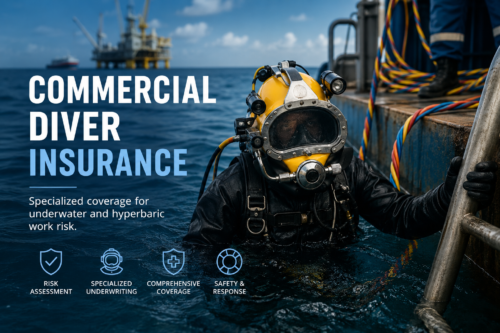
A commercial diver is an occupational specialist who performs inspection, construction, repair, maintenance and salvage work underwater, typically using surface-supplied air, mixed-gas or saturation diving systems rather than recreational scuba equipment. Commercial diver insurance exists as a distinct underwriting category because the occupation combines several compounding exposures that rarely appear together in other trades: sustained pressure exposure, mandatory decompression physiology, total dependence on mechanical life-support, materially harder rescue conditions than surface work, and frequently limited access to definitive medical care during the window that matters most.
Underwriters treat commercial diving as a high-loss occupation not because water itself is dangerous, but because a single equipment or procedural failure can convert an otherwise minor incident into a severe or fatal event before intervention becomes possible. Put simply, commercial diver insurance is an assessment of whether a contractor can reliably control a chain of interdependent exposures, pressure, decompression, life support, equipment, environment, rescue and medical access, and produce evidence that those controls hold up in practice rather than only on paper. No single link in that chain is underwritten in isolation: a life-support failure becomes a rescue problem, a rescue delay becomes a medical problem, and a medical delay becomes a severe claim. The insurer is ultimately underwriting the diving system as a whole, not the diver as an individual risk.
The exposures that most influence pricing and eligibility are depth and dive profile, whether the work involves saturation systems, the reliability and redundancy of life-support equipment, the diving contractor’s safety management record, and the claims history attached to the account. Evidence that improves an underwriter’s read of the account includes dive logs, equipment inspection and maintenance records, standby diver and emergency response arrangements, and a transparent account of prior incidents rather than an absence of any recorded history, which underwriters tend to treat as a gap in the record rather than a safety strength.
Underwriting Insight
Commercial diving is not underwritten as a single risk category. It is underwritten as a spectrum, from harbor inspection dives measured in minutes to saturation operations that keep divers under pressure for days at a stretch. Where an operation sits on that spectrum, and how well it can prove control over pressure, gas and rescue timing, determines both its price and its insurability.
What Commercial Diver Insurance Actually Has to Solve
Before getting into mechanism and classification, it helps to name the practical questions this article answers, since they are usually what brings a diver, contractor or broker to a page like this in the first place.
- Will my occupation make coverage harder to obtain? Relative to most trades, yes, but the degree varies by depth, dive mode and claims history, not by job title alone.
- Does offshore or saturation diving change the insurance? Saturation is generally underwritten as its own category, not simply deeper diving, given its distinct life-support and evacuation profile.
- What happens if I also weld underwater? Hot work adds a severity layer on top of the base diving exposure and typically needs its own documented competency and permit conditions.
- Why does my employer’s classification matter? Classification often determines which legal framework and benefit scale apply, and misclassification is a common source of coverage disputes.
- Why can two commercial divers receive different underwriting treatment? Underwriters price the operation’s demonstrated ability to control its exposures, not the occupation in the abstract, so equally skilled divers can land in different places on the underwriting scale depending on their contractor’s preparation.
What Commercial Divers Do and Where They Work
Commercial diving covers a wide range of underwater work rather than a single task. Divers perform underwater construction and inspection on bridges, dams, pipelines and port infrastructure; repair and maintain vessel hulls, propellers and intakes; support marine salvage after groundings or sinkings; and carry out subsea installation and maintenance for offshore energy operators. Some divers also perform underwater welding and cutting, though welding is one activity within the broader occupation rather than its defining feature. According to the U.S. Bureau of Labor Statistics, commercial divers are classified under a dedicated occupational code reflecting this work below the surface using surface-supplied air or scuba to inspect, repair, remove or install equipment and structures.
The operating environment varies enormously by project. Harbor and inland diving typically involves shorter, shallower dives with faster surface access. Offshore energy and subsea infrastructure diving, by contrast, routinely involves greater depth, longer bottom time, colder water, stronger currents and far greater distance from a hospital or recompression chamber. Commercial diving is one of the most specialized occupations within the broader Offshore Workers Insurance landscape because the worker’s exposure can combine marine operations, remote locations, pressure, life-support dependency and difficult emergency access.
Underwater visibility, currents, cold water temperature, marine growth and vessel traffic all shape how reliably a dive can be planned, executed and, if necessary, aborted. A diver working in clear, calm, shallow water with a well-marked worksite operates under a fundamentally different risk profile than one working in low-visibility current near an active subsea intake, even though both may be described generically as commercial diving.
Not all commercial diving carries the same underwriting weight, and RJI treats this as a spectrum rather than a single occupational bucket. This distinction places commercial diving within the broader Offshore Risk Underwriting: How Insurers Evaluate Marine & Remote Workers framework, where marine location, remote access, evacuation difficulty and operational accumulation interact with the underlying occupational exposure. Routine commercial diving, such as harbor inspection, hull cleaning or shallow infrastructure repair, typically involves short, well-planned dives with fast surface access and low decompression obligation. Offshore energy diving and saturation operations sit at the opposite end, combining greater depth, longer exposure, colder and more remote environments, and materially more complex life-support and rescue arrangements.
Common Commercial Diving Injuries and Illnesses
The injury and illness profile that drives commercial diving underwriting centers on a small number of high-severity exposures rather than a long tail of minor incidents. Decompression illness, sometimes called the bends, results from inadequately managed ascent and can produce anything from joint pain to permanent neurological injury. Drowning remains a persistent exposure whenever breathing-gas supply, buoyancy control or surface access is compromised. Breathing-gas interruption, whether from equipment failure, contamination or umbilical damage, can escalate from a controllable emergency to a fatality within minutes.
Other significant exposures include entanglement and entrapment in subsea structures, cables or umbilicals; differential-pressure incidents near intakes, pipelines or valves; crush injuries from underwater equipment or moving vessel components; burns and arc-related injuries during underwater welding; hypothermia in cold-water operations; and falls or impact injuries during access and egress from diving stations. What matters to an underwriter is not a medical description of these conditions but their downstream consequence: treatment requirements, likely recovery duration, disability potential and the probability that a single incident produces a severe, long-tail claim rather than a routine one.
Why Diving Claims Become Complicated
Commercial diving claims carry a distinctive kind of insurance friction that has less to do with the injury itself and more to do with how the incident is documented and resolved. Delayed access to specialized medical care, particularly hyperbaric and recompression treatment, can affect both clinical outcomes and how a claim is later evaluated, and reconstructing what happened often depends on dive records, equipment logs and decompression schedules that may be incomplete on smaller or newer operations.
Multi-contractor projects add another layer of complexity. An offshore or marine construction project may involve a diving subcontractor, a vessel operator, a client engineering firm and an equipment supplier, each with a different insurance program and a different view of responsibility when an incident occurs. Combined with the jurisdictional questions that arise whenever work occurs offshore, in territorial waters, or across state or national boundaries, this is why a well-documented diving operation is not simply a safety asset. It is also a claims-resolution asset.
Commercial Diver Insurance Classification and Class Codes
Occupational classification is the starting point for underwriting any commercial diving account, and it is more variable than many brokers assume. In the United States, the Bureau of Labor Statistics assigns commercial divers their own Standard Occupational Classification code, 49-9092, distinct from general marine, construction or oil and gas occupations. For workers’ compensation and general liability purposes, however, the applicable rating classification depends on the state, the rating bureau and the nature of the underlying contract. Most states rely on the National Council on Compensation Insurance classification system, while several states, including California, New York, New Jersey, Pennsylvania and Delaware, operate independent rating bureaus with their own class code structures.
There is no single universal NCCI or ISO code that applies uniformly to every commercial diving operation. Instead, classification typically depends on how the diving work is contracted: as marine construction, as a support activity for offshore oil and gas operations, as inland or harbor construction, or as a specialist subcontracted service. NAICS classification follows a similar logic, with commercial diving contractors often falling under support activities for water transportation, support activities for oil and gas operations, or heavy and civil engineering construction depending on the nature of the work performed.
Regulatory Classification Reference
The table below summarizes the classification systems most relevant to commercial diving accounts. It is provided as an orientation reference, not as a definitive coding guide. Actual classification should always be verified against the applicable state, rating bureau and policy terms, since practice varies by jurisdiction and by insurer.
| System | Relevance to Commercial Diving | Key Variability |
| SOC (BLS) | 49-9092, Commercial Divers, used for labor statistics and occupational benchmarking | Federal standard; does not govern insurance rating |
| NCCI | No single universal diving code; classification typically follows the governing marine, construction or oilfield support contract | Varies by state and by how the diving contract is structured |
| Independent state bureaus | California, New York, New Jersey, Pennsylvania and Delaware maintain their own class code systems | Class definitions and rates diverge from NCCI states |
| NAICS | Commonly support activities for water transportation, support activities for oil and gas operations, or heavy and civil engineering construction | Depends on the diving contractor’s primary declared activity |
| ISO | General liability and inland marine forms reference diving and underwater operations through occupational and operations descriptions rather than a single code | Policy wording and endorsement structure vary by carrier |
Figure 1. Classification reference for commercial diving accounts. Classification always requires verification against jurisdiction, rating bureau and policy wording.
NCCI Diving-Marine Classification Codes
Where a diving contractor’s work falls under admiralty jurisdiction, meaning it takes place on navigable waters, NCCI does maintain specific classification codes rather than leaving the work entirely uncoded. Code 7394 covers diving, salvage and marine wrecking operations under admiralty law, Program I, and includes divers and diving-tender support personnel such as line handlers and pump operators, whether based on a vessel or on shore. Codes 7395 and 7398 apply to the same diving and salvage operations under Program II, distinguished by whether state act or federal Longshore and Harbor Workers’ Compensation Act benefits govern the claim.
These codes are scoped narrowly to navigable, admiralty-jurisdiction work and do not automatically extend to inland diving on non-navigable lakes, reservoirs or municipal water systems, which is typically rated under the applicable state classification for the underlying construction or inspection activity rather than a dedicated diving code. The water body’s legal status and the governing benefits act, not the depth or difficulty of the dive, are central to determining whether Program I, Program II state act, or Program II USL&H coverage is the correct fit.
The NCCI scope also expressly includes underwater demolition and installation of underwater oil or gas flow lines from drilling rigs to production platforms, illustrating how the classification reaches into specialized offshore diving operations.
Underwriters draw a firm line between commercial divers and other occupations that share a marine or offshore setting, including general offshore workers, marine construction crews and shipyard employees. The distinguishing factor is not the marine location itself but the combination of underwater work, pressure exposure and life-support dependence: a marine technician who works from a vessel deck faces a materially different exposure than a diver who depends on an umbilical and a controlled decompression schedule to return safely to the surface. This distinction also separates commercial divers from underwater welders, whose insurance profile shares much of the diving exposure base but adds hot-work-specific severity considerations, discussed further in Offshore Welder Insurance.
Multi-Duty Commercial Diver Classification
Many commercial divers perform more than diving alone. A single diver may also carry out underwater welding, rigging, marine construction tasks, inspection and reporting, salvage operations or subsea equipment handling within the same engagement, and each additional duty can shift the occupational risk profile in ways that are easy to under-report. A diver whose job description reads simply as inspection diving but who regularly performs hot work or rigging underwater is operating under a materially different exposure than the job title suggests, and insurers who are not made aware of this drift may be pricing and covering the wrong risk entirely.
Commercial Diving Payroll and Workers’ Compensation Audits
Diving contractor payroll audits present their own accuracy challenges. Mixed marine operations, project-specific subcontractor arrangements, specialist saturation dive teams and the split between offshore and nearshore work all affect how payroll should be allocated across classifications. A diving contractor that reports all personnel under a single generic classification, without separating divers, tenders, life-support technicians and surface crew, invites both premium leakage and coverage ambiguity, and auditors tend to treat blended, undifferentiated payroll reporting as a signal that the account’s broader risk management may be similarly undifferentiated.
How Insurers Evaluate Commercial Diver Insurance Risk
Commercial diving begins underwriting consideration with elevated baseline assumptions relative to most occupational classes, reflecting the severity potential inherent in the work rather than any single fixed premium figure. There is no universal rate that applies across the occupation. Actual pricing depends on depth and dive type, the operating environment, the account’s claims history, the condition and redundancy of diving equipment, the contractor’s medical and rescue capability, the governing jurisdiction and the complexity of the project itself.
Commercial Diving Insurance Rating Factors
Beyond base classification, underwriters weigh a set of modifiers that shift pricing up or down within the diving category. Where applicable, experience modification rating reflects the account’s own claims history relative to its peer group. Contractor experience matters heavily: a diving contractor with a long, well-documented track record in its declared operating profile is viewed differently than a newly formed operation entering the same work. Safety management systems, project complexity and workforce competency round out the modifiers most likely to move a diving account’s terms, and no single modifier is weighed in isolation from the rest.
How Underwriting Certainty Shapes Market Access
Underwriters do not evaluate a diving account as simply insurable or uninsurable. The more useful frame is that greater underwriting certainty tends to translate into broader potential market appetite, and less certainty narrows it, rather than treating any single exposure as automatically disqualifying.
| Underwriting Posture | What Tends to Place an Account There | Typical Market Response |
| Standard risk | Surface-supplied, no-decompression diving; clean claims history; safety program matched to the declared scope | Priced within the occupation’s normal range by generalist marine or specialty carriers |
| Increased scrutiny | Staged decompression or mixed-gas work; thinner documentation; recent change in operating profile | Additional questions, higher deductibles, or narrower sublimits rather than decline |
| Restricted terms | Repeated red flags; unclear contractor-client responsibility; work outside the demonstrated operating history | Tightened warranties, exclusions on the unproven activity, or conditional renewal terms |
| Specialist / E&S capacity | Often includes saturation diving or a severe loss history, though neither guarantees this outcome on its own | More likely, not certain, to require specialist marine or offshore placement |
Figure 2. An illustrative escalation pattern, not a fixed formula. Saturation diving or a difficult loss history does not automatically force excess and surplus placement; where a specific account lands depends on the underwriter, the carrier’s appetite and the full submission.
What changes across this scale is not the underlying hazard, which is constant for a given operation, but the underwriter’s certainty that the operation controls that hazard reliably, and certainty, not the hazard itself, is what expands or narrows an account’s realistic market options.
How Claims History Affects Commercial Diver Insurance
Underwriters weigh diving claims history along two separate dimensions: frequency and severity. A moderate frequency of minor incidents, properly reported and resolved, is not necessarily disqualifying. A small number of severe losses, including diving fatalities, major equipment failures, underwater entrapment events or claims involving permanent disability, can materially affect underwriting appetite regardless of how infrequent they are. Reserve development on open diving claims is also scrutinized closely, since decompression-related and traumatic injuries often carry uncertain long-term treatment and disability trajectories that take years to fully resolve.
Commercial Diver Insurance Eligibility Requirements
Before terms are offered, underwriters look for evidence across several dimensions: diver qualifications, dive-team competency and supervision structure, formal dive planning, medical fitness requirements, emergency response and recompression capability, standby diver arrangements, life-support system reliability, and equipment inspection and maintenance records including dive logs. Requirements are not identical across insurers; specialist marine and offshore underwriters often apply more granular questions than generalist commercial lines carriers, particularly around saturation diving and mixed-gas operations.
Commercial Diving Insurance Underwriter Red Flags
Unexplained or poorly documented diving incidents with no clear investigation trail
Inadequate or missing dive logs, equipment inspection and maintenance records
Repeated decompression-related claims without evidence of procedural correction
Insufficient emergency response or standby diver capability for the declared operating depth
Unclear division of responsibility between the diving contractor and the client operator
Work performed outside the contractor’s documented operational experience
Rapid expansion into deeper, saturation or more technically complex diving operations without a matching increase in documented competency.
Commercial Diving Risk Factors That Affect Insurance Underwriting
This is the section where commercial diving risk is most concretely translated into underwriting consequence. Diving operations range enormously in scale and complexity, from short harbor inspection dives to sustained offshore energy diving to saturation operations that keep personnel under pressure for extended periods. Each step up in operational scale changes not just the probability of an incident but the severity ceiling if one occurs, and underwriters price accordingly.
How Diving Depth Affects Commercial Diver Insurance
Depth is one of the clearest severity amplifiers in commercial diving, and it is also one of the clearest drivers of where an account sits on the underwriting scale described above. As depth increases, pressure exposure rises, decompression requirements become longer and more technically demanding, breathing-gas requirements shift from simple compressed air to mixed-gas formulations, and both rescue complexity and medical response time increase. The shift from no-decompression diving to staged decompression diving is a natural point where an underwriter’s questions become more granular, since the margin for a controlled recovery from an equipment or procedural failure narrows. Dive duration compounds this effect. Extended bottom time, repetitive dives within a single operating day, and prolonged underwater exposure all increase cumulative physiological load and the corresponding decompression obligation the diver must satisfy before safely returning to the surface.
Saturation Diving Insurance and Underwriting
Saturation diving should not be treated as simply deeper diving. It is a structurally different operational model in which divers live under pressure inside a saturation system for extended periods, transferring to and from the underwater worksite through a diving bell, rather than decompressing after every dive. This dramatically reduces the cumulative decompression burden per excursion but introduces sustained life-support dependency, specialist personnel requirements, and a fundamentally more complex emergency evacuation profile. Saturation diving is generally evaluated as a distinct underwriting exposure precisely because the failure modes, particularly around life-support and evacuation, differ meaningfully from surface-oriented or single-dive operations, and it is typically saturation exposure that moves an account toward specialist marine capacity rather than a standard commercial market.
Life-Support Systems and Commercial Diving Insurance Risk
Few occupations depend as completely on mechanical systems as commercial diving does at depth. Breathing-gas supply, umbilicals, communications, environmental control and monitoring systems are not conveniences; they are the diver’s connection to survival. Underwriters read equipment reliability as a direct proxy for how well an operation can be trusted to manage a crisis it cannot fully prevent. A diving contractor that can demonstrate redundant breathing-gas supply, documented umbilical inspection, tested communications and monitored life-support systems is presenting a materially different risk than one that cannot, even if both operate at similar depths.
Visibility, Currents and Environmental Diving Conditions
Darkness, turbidity, current, cold water, marine growth and restricted physical access all reduce a diving operation’s margin for error. These conditions do not need to cause an incident directly to matter to underwriting; they reduce the reliability of every other control in place, from communications to rescue response, and are weighed accordingly.
Differential Pressure and Commercial Diving Risk
Differential pressure deserves specific attention because it is one of the more severe and underappreciated exposures in commercial diving. Uncontrolled pressure differentials around intakes, pipelines, valves, pumps and subsea structures can create powerful suction or discharge forces capable of causing entrapment or drowning with very little warning. Because these incidents can develop and escalate faster than a diver or standby team can react, differential-pressure exposure is treated as a severity-defining hazard in underwriting review, not a routine operational risk. Work near an unverified or unisolated pressure differential is one of the more reliable triggers for an underwriter to move an account from standard terms to increased scrutiny, regardless of how the rest of the submission looks.
Entanglement and Entrapment Risk for Commercial Divers
Interaction with subsea structures, cables, umbilicals, pipelines and marine equipment creates ongoing entanglement risk throughout a dive. The underwriting concern is less about the entanglement event itself than about what it implies for rescue: an entangled diver is, by definition, harder to reach and extract quickly, which extends the time to breathing-gas restoration or surface access precisely when time matters most.
Marine Traffic and Vessel Interaction
Diving around vessels, ports, construction barges and offshore facilities introduces third-party and accumulation exposure alongside the diver’s own risk. Vessel movement near an active dive site can affect diver safety directly and can expose the diving contractor to liability if vessel and diving operations are not properly coordinated.
Underwater Welding and Commercial Diver Insurance
Where underwater welding and hot work form part of the diving scope, the exposure compounds further, combining thermal and arc-related hazards with the underlying pressure and life-support risk already present; These addresses this combination in depth in Hot Work Risk in Offshore Insurance Underwriting. Similarly, where diving work occurs within confined or restricted subsea environments, rescue complexity increases further, as explored in Confined Space Underwriting.
Remote Medical Access and Rescue Dependency
Access to definitive medical care, and specifically to hyperbaric and recompression treatment, is one of the defining underwriting variables in commercial diving. Underwater rescue differs meaningfully from rescue in an ordinary workplace: it requires specialized personnel, equipment and often a recompression chamber positioned close enough to matter clinically. This examines the underwriting implications of distance from care in Remote Medical Access and Occupational Coverage, and the specific dynamics of delayed underwater rescue in Remote Rescue Delays in Offshore Claims. Where offshore aviation and medevac form part of the emergency response chain, particularly for saturation and deepwater operations, Helicopter Transport Risk in Offshore Insurance becomes directly relevant to the diving account’s overall recovery profile.
Safety Controls That Improve Commercial Diving Underwriting
Diving supervision, formal dive planning, standby diver capability, tested communications, breathing-gas monitoring, equipment inspection, decompression management, emergency drills and documented rescue planning are not generic safety recommendations from an underwriting standpoint. Each is a specific input underwriters use to gauge whether the operation can control its own severity exposure rather than simply hoping an incident does not occur.
Seasonal Conditions and Accumulation Risk
Storms, sea state, water temperature, current strength and visibility all vary seasonally and can materially change a diving operation’s exposure profile across a project’s duration. Underwriters also assess accumulation risk: a single incident involving differential pressure, entrapment or a life-support failure can affect the diver, the standby diver, the surface-support tender, the broader dive team and support vessel personnel simultaneously, which is why diving accounts are reviewed for concentration risk rather than as independent individual exposures. The same logic extends to underwater tools and equipment generally: a diver cannot set down a malfunctioning tool and walk away from it, so underwriters look at maintenance discipline across the full equipment set, not only the systems that carry the greatest severity.
Commercial Diving Insurance Claims and Coverage Gaps
Even well-priced commercial diving accounts can experience coverage friction when documentation, contract structure or policy wording do not align cleanly with what actually happened underwater. Understanding these failure paths is as important to underwriting eligibility as understanding the physical hazards themselves.
Common Commercial Diving Insurance Claim Problems
- Incomplete dive records that leave gaps in the reconstructed timeline of an incident
- Equipment documentation gaps, particularly around inspection and maintenance history for life-support and breathing-gas systems
- Unclear incident chronology when multiple contractors or vessels were present at the time of the event
- Inadequate medical documentation connecting the diving exposure to the reported injury or illness
- Disputes over contractor responsibility when diving, vessel and client personnel operate under separate contracts
Commercial Diving Coverage Reliability Failures
Policy wording varies significantly across carriers and jurisdictions, and RJI does not state that any specific exclusion applies universally to commercial diving. That said, coverage gaps commonly arise at the boundary between offshore and onshore operations, in the treatment of saturation operations, around territorial restrictions, for specialist equipment not clearly scheduled, and in subcontractor arrangements where responsibility for insurance is assumed rather than confirmed in writing. A related but distinct problem is coverage reliability: the policy technically responds, but claim resolution becomes complicated by unclear occupational definitions, undisclosed diving activities not reflected in the original submission, territorial restrictions the insured was unaware of, or incorrect classification carried over from an earlier policy period.
Commercial Diving Insurance Claim Breakpoints
A typical severe claim in commercial diving tends to follow one of a small number of recognizable failure chains. Two of the most common are illustrated below.
Equipment Failure
↓
Breathing-Gas or Life-Support Interruption
↓
Emergency Response
↓
Delayed Recovery
↓
Severe Injury
↓
Long-Term Disability Claim
Figure 3. A common claim breakpoint chain beginning with equipment failure and life-support interruption.
Differential Pressure Event
↓
Entrapment
↓
Rescue Difficulty
↓
Medical Deterioration
↓
Major Claim
Figure 4. A common claim breakpoint chain beginning with a differential-pressure event.
Both chains translate directly into underwriting consequence: the further a claim progresses down either path before intervention occurs, the more severe and reserve-uncertain it becomes, and the more it shapes future underwriting appetite for that account and, in aggregate, for the broader diving segment.
Commercial Diver Insurance Coverage and Related Insurance Lines
A serious commercial diving incident rarely stays confined to a single insurance line. Understanding how exposures cross lines is central to how RJI evaluates commercial diver insurance coverage as a whole rather than as an isolated policy.
- Workers’ compensation responds to the diver’s own injury or occupational illness, and is typically the first line implicated in a diving incident.
- General liability addresses third-party injury and property damage where diving or support operations affect people or property outside the direct employment relationship.
- Marine liability applies where vessel operations or marine project liability intersect with the diving work, particularly on projects involving chartered or owned support vessels.
- Professional liability or errors and omissions coverage may be relevant where the contractor also provides inspection, engineering-related services or technical reporting, though it should not be assumed as standard.
- Inland marine or equipment coverage protects diving equipment, compressors, communications systems and support gear, which represent significant standalone value on many projects.
- Environmental liability becomes relevant where diving work touches subsea pipelines or offshore energy infrastructure, given the pollution exposure that can follow equipment or structural failure.
Workers’ Compensation, USL&H and the Jones Act: Three Governing Frameworks
For U.S. diving contractors, workers’ compensation is not a single uniform system. Which framework governs a diver’s injury claim depends on where the work occurred and the diver’s legal status, and getting this wrong is one of the more consequential classification errors a diving account can carry.
State workers’ compensation applies to diving conducted on inland, non-navigable waters, such as municipal reservoirs or enclosed water systems, and follows the statutory benefit scale of the applicable state. Where diving takes place on navigable waters or adjoining piers, docks and wharves, the Longshore and Harbor Workers’ Compensation Act (LHWCA) typically governs instead, administered by the U.S. Department of Labor and providing a materially different federal benefit framework from most state systems.
A separate question is whether a diver qualifies as a seaman under the Jones Act (46 U.S.C. § 30104), which turns on the nature and duration of the diver’s connection to a vessel or fleet in navigation. Unlike workers’ compensation and the LHWCA, the Jones Act is a fault-based negligence statute rather than a no-fault benefit scheme, allowing an injured seaman to sue their employer directly rather than accept a fixed statutory benefit. Because a diver’s status can be genuinely unclear until a claim is underway, particularly for divers who split time between vessel-based and shore-based work, diving contractors typically need policy language broad enough to respond regardless of which framework ultimately applies, rather than a policy written to a single assumed status.
Insurance Programmes Commonly Associated With Commercial Diving
| Programme | Typical Role in a Diving Account |
| Workers’ Compensation | Core coverage for diver and dive-team injury and occupational illness |
| General Liability | Third-party injury and property damage arising from diving and support operations |
| Marine / Protection & Indemnity | Vessel-related liability where diving is conducted from or alongside marine assets |
| Inland Marine / Equipment Floater | Diving equipment, compressors, communications and support gear |
| Umbrella / Excess Liability | Additional limits layered above primary lines given the severity potential in diving losses |
| Environmental / Pollution Liability | Relevant where diving supports subsea pipeline or offshore energy infrastructure |
Figure 5. Insurance programmes commonly associated with commercial diving contractor accounts. Actual program design varies by operation and should be confirmed with a specialist broker.
Underwater Welding and Hot Work Insurance
Where underwater welding or other hot work forms part of a diving contractor’s scope, policies frequently carry specific endorsements addressing that activity separately from the base diving exposure, covering permit-to-work procedures, fire watch arrangements adapted for underwater conditions, and competency requirements for personnel performing hot work at depth. As with classification generally, this varies by carrier and should be confirmed against the specific policy.
Commercial Diving Insurance Market Capacity and Carrier Appetite
Commercial diving occupies a specialist corner of the insurance market, and capacity does not appear to be evenly distributed across the occupation. High potential claim severity, the specialist expertise required to evaluate diving accounts properly, and the complexity of resulting claims all tend to limit the number of insurers actively competing for this business at a given time. Consistent with RJI’s broader observation of the offshore risk market, specialist capacity appears concentrated among a smaller group of carriers with dedicated marine and offshore expertise, though the exact distribution of capacity shifts over time and this article does not attempt to quantify it.
Regulatory and Litigation Factors in Commercial Diving Insurance
Market appetite for commercial diving risk is also cyclical. Major diving fatalities, high-profile offshore incidents or new regulatory developments, whether from OSHA, BSEE, or international bodies overseeing marine safety, can shift carrier sentiment industry-wide, sometimes independent of any individual account’s own performance. Litigation exposure follows a similar pattern: severe, long-tail diving claims involving permanent disability or fatality attract closer legal scrutiny than comparable losses in lower-severity occupations, and underwriters price with that awareness.
Within that broader cycle, underwriters distinguish between experienced diving contractors and newly established operators, and between routine inspection diving and complex subsea or saturation work. A well-documented safety history in the declared profile remains one of the strongest levers a contractor has over its own market access, even in a constrained capacity environment.
How to Improve Commercial Diving Insurance Eligibility
Diving contractors with a difficult claims history, thin documentation or a recent expansion into more complex operations are not permanently locked out of the market. Eligibility can be rebuilt, but it depends on specific, demonstrable evidence rather than general assurances.
How can I improve my commercial diving insurance?
- Strengthening dive documentation so that logs, profiles and incident records form a complete, reconstructable history
- Bringing equipment inspection current and keeping maintenance records organized and accessible
- Running emergency-response exercises that test standby diver and rescue arrangements under realistic conditions
- Clarifying contractor responsibilities in writing wherever multiple parties operate on the same project
- Improving rescue planning specific to the depth, environment and dive type actually being performed
- Verifying and documenting diver and dive-team competency against the operations actually being undertaken
Structural Data Compliance and Account Presentation
Beyond immediate fixes, underwriters expect a diving contractor to maintain a complete evidentiary record: dive logs and profiles, equipment inspection and maintenance history, training and certification records, incident records, and a clear account of project exposure and contractor responsibilities. That record, presented alongside a demonstrated operating history in the profile being declared and a transparent claims history, is what lets an underwriter treat the account as a known quantity rather than an open question, which is what ultimately drives pricing and capacity decisions in this segment of the market.
Commercial Diver Insurance Scenarios
The following scenarios illustrate how operational situations translate into underwriting interpretation and, ultimately, insurance consequence. They are composite illustrations built from common patterns in commercial diving operations, not accounts of specific real incidents.
Commercial Diver Insurance Scenario: Subsea Inspection in Strong Current
Operational situation. A diver conducting routine subsea inspection encounters unexpectedly strong current partway through the dive, extending bottom time and complicating a controlled ascent.
Underwriting interpretation. Underwriters view unplanned deviation from the dive plan, even without injury, as a signal worth tracking; repeated deviations suggest weak dive planning discipline.
Insurance consequence. No claim results, but the incident is logged, and a pattern of similar deviations could affect future renewal terms if not addressed.
Operational improvement. Strengthened pre-dive current assessment and clearer abort criteria reduce recurrence and demonstrate proactive risk management at renewal.
Commercial Diver Insurance Scenario: Differential Pressure Near a Subsea Intake
Operational situation. A diver works in proximity to an active subsea intake where isolation procedures were not fully verified before the dive began.
Underwriting interpretation. This is treated as a severity-defining near-miss regardless of outcome, given the potential for entrapment or drowning inherent in uncontrolled differential pressure.
Insurance consequence. Underwriters may require documented isolation and lockout procedures for future work near similar structures as a condition of continued coverage.
Operational improvement. Formal isolation verification protocols, confirmed in writing before every dive near active intakes, directly address the concern.
Commercial Diver Insurance Scenario: Saturation Diving and Extended Decompression
Operational situation. A saturation diving project requires an extended decompression schedule following a technical issue with the saturation system.
Underwriting interpretation. Underwriters evaluate the redundancy and backup capability of the saturation system itself, not just the decompression schedule that resulted.
Insurance consequence. Claims exposure remains contained if the redundant capability functioned as designed, reinforcing the underwriter’s read of the saturation program.
Operational improvement. Documented system redundancy and a tested contingency plan for extended decompression support continued eligibility for saturation work.
Commercial Diver Insurance Scenario: Underwater Welding During Offshore Maintenance
Operational situation. A diver performs underwater welding as part of a broader maintenance scope, combining hot work with standard diving exposure.
Underwriting interpretation. Underwriters assess whether hot work competency and permit procedures were documented separately from general diving qualifications.
Insurance consequence. Absence of hot-work-specific documentation can trigger closer claims scrutiny even when the work proceeds without incident.
Operational improvement. Maintaining separate, current hot work certification and permit records alongside standard dive logs closes the gap.
Commercial Diver Insurance Scenario: Umbilical Entanglement
Operational situation. A diver’s umbilical becomes entangled with subsea structure during an inspection dive, requiring standby diver intervention to resolve.
Underwriting interpretation. Underwriters focus on how quickly the standby diver responded, since this reflects actual rescue capability rather than the documented plan.
Insurance consequence. A well-executed standby response reinforces the underwriter’s read of the account; a delayed or improvised response raises concern regardless of outcome.
Operational improvement. Regular standby diver drills specific to entanglement scenarios keep response capability aligned with procedure.
Commercial Diver Insurance Scenario: Remote Medical Response
Operational situation. A diver requires recompression treatment following a dive, but the nearest chamber and specialist medical support are several hours away.
Underwriting interpretation. Underwriters weigh remote medical access as a standing feature of the operation’s risk profile, not an unforeseeable circumstance, when it is predictable from the project’s location.
Insurance consequence. Outcomes here often shape future underwriting requirements around pre-positioned medical response for similarly remote projects.
Operational improvement. Establishing a documented medical evacuation plan and confirmed recompression access before mobilization addresses this exposure directly.
Final Underwriting Insight
The insurer is underwriting the diving system as a whole, not the diver as an individual risk. Every mechanism in this article, classification, claims history, depth and duration, saturation, life support, rescue distance, safety controls, feeds one judgment: how reliably does this operation control its own hazards under real conditions. The hazard itself is fixed. What moves an account across the underwriting scale, and ultimately its price and its market options, is the strength of the evidence that the operation controls it. That evidentiary case is the actual product commercial diver insurance is pricing.
————————————————————————————————————–
Sources & Underwriting References
OSHA, 29 CFR Part 1910, Subpart T, Commercial Diving Operations sets the federal occupational safety framework for commercial diving in U.S. general industry and construction settings, covering dive team qualifications, safe practices manuals, pre-dive and post-dive procedures, and recordkeeping.
NIOSH, Commercial Diving provides occupational research and hazard information on commercial diving, including exposure to drowning, respiratory and circulatory complications, and hypothermia associated with the work.
U.S. Bureau of Labor Statistics, Commercial Divers (SOC 49-9092) defines the occupational classification and reports national employment and wage data used for occupational benchmarking.
UK Health and Safety Executive, Diving at Work Regulations 1997 establishes the approved codes of practice governing commercial diving projects in UK waters, differentiated by offshore, inland and inshore, media, scientific and recreational categories.
Bureau of Safety and Environmental Enforcement (BSEE) provides regulatory oversight of worker safety and environmental protection for offshore oil and gas operations on the U.S. Outer Continental Shelf, relevant to offshore diving support activity.
U.S. Department of Labor, Longshore and Harbor Workers’ Compensation Act governs federal workers’ compensation benefits for maritime employment on navigable waters and adjoining areas, a framework directly relevant to diving conducted in that jurisdiction.
Jones Act, 46 U.S.C. § 30104 establishes a seaman’s right to bring a fault-based negligence claim against an employer, relevant where a diver’s connection to a vessel meets the legal test for seaman status.
Association of Diving Contractors International (ADCI), International Consensus Standards publishes widely referenced consensus standards for commercial diving and underwater operations, cited by OSHA and other regulators as representing industry best practice.
International Marine Contractors Association (IMCA), International Code of Practice for Offshore Diving provides international guidance for offshore diving contractors, including diving management systems, competency assurance and safety documentation expectations.
NCCI, Diving-Marine Classification Codes 7394, 7395 and 7398 defines the scope of diving and marine salvage classifications under admiralty jurisdiction, distinguished by Program I and Program II state act or USL&H act benefits.
Underwriting practices, classification approaches and coverage structures referenced in this article vary by insurer, jurisdiction and account, and should be confirmed directly with a specialist marine or offshore underwriter or broker rather than treated as fixed market standards.