Reviewed for underwriting accuracy by the RJI Underwriting Research Team | Published: Aug, 2026 | Last reviewed: Aug, 2026.
What Is Offshore Welder Insurance?
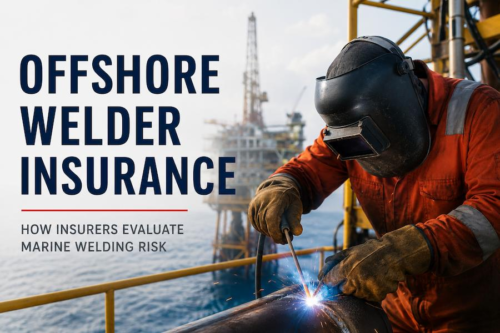
An offshore welder joins metal under conditions no onshore welding code fully anticipates. The work happens on platforms, FPSOs, drilling rigs and offshore wind structures where flammable atmospheres, confined compartments, moving decks and hours of travel from a hospital bed all coexist with an open arc. Structural repair, fabrication and shutdown maintenance are the daily assignment; ageing steel, corroded members and production pressure are the daily backdrop.
Why Offshore Welders Are Considered High-Risk by Insurers
Insurers do not classify offshore welders as high-risk because welding itself is dangerous. Every welding occupation carries ignition exposure. Offshore welders are underwritten differently because the occupation stacks ignition hazard on top of confined-space entry, elevated work, marine isolation, ageing asset repair and a rescue chain measured in hours rather than minutes. No single exposure explains the rating. The combination does.
How Offshore Welding Changes Insurance Risk
The exposures that most influence underwriting are not abstract. They are the permit-to-work discipline governing when a torch may be lit, the gas-testing regime that determines whether a tank is safe to enter, the evacuation plan that determines how a burned or overcome worker actually reaches a trauma surgeon, and the inspection history that tells an underwriter whether the steel being welded has been maintained or merely tolerated.
Insurability improves when an employer can document, not merely assert, that these systems function under real offshore conditions. Underwriters evaluate offshore welders by assessing how reliably catastrophic welding hazards are identified, controlled and documented under realistic offshore operating conditions. Everything that follows in this article traces that single evaluative question through classification, rating, claims behavior and market response.
Underwriting Insight
Offshore welders are underwritten not simply because they perform hot work, but because they combine ignition hazards, confined-space operations, elevated work, marine isolation, structural repair, ageing infrastructure and delayed emergency response into one occupational risk profile.
What Do Offshore Welders Do?
Daily Work on Offshore Platforms, FPSOs and Rigs
An offshore welder’s task list reads like a catalogue of separate hazards that happen to share one worker. Structural welding on jacket legs and topside modules. Fabrication of spool pieces and support steel. Shutdown maintenance during planned turnarounds, when weeks of deferred repair work is compressed into days. Emergency repairs performed after a leak, a fire, or a structural finding that cannot wait for the next scheduled window. Each of these tasks is routine in isolation. Offshore, they are performed on a moving or vibrating structure, in marine weather that can close in with little warning, at elevation, and often inside confined compartments such as ballast tanks, void spaces, and closed process vessels.
Confined Space Underwriting treats restricted-entry work as its own mechanism because atmosphere, egress and rescue time all change once a worker is inside a tank rather than standing on open deck. Layered onto an offshore welder’s hot-work exposure, confined-space entry does not add risk in a simple sum. It compounds it: the same spark that would singe open air can flash an unventilated space, and the same worker who could self-rescue on deck cannot climb out of a manway unassisted.
Ageing infrastructure adds a further layer that new construction does not carry. Much offshore welding work today is repair and life-extension welding on platforms and pipework installed decades ago, where corrosion, prior repairs and unknown internal conditions make every cut and every weld an encounter with uncertainty rather than a known specification. The
American Petroleum Institute’s Recommended Practice 2009 on safe welding, cutting and hot work exists precisely because petroleum and offshore facilities present hazards that general industry welding codes do not fully address.
Common Offshore Welding Injuries That Affect Insurance
Underwriters weigh offshore welding losses by severity far more than by frequency. Burns, flash injuries and smoke inhalation are the direct products of hot work. Explosions and fires are the catastrophic tail. Falls from elevation, electrocution, and crush injuries during rigging and fit-up round out the mechanism list. Musculoskeletal disorders accumulate from awkward welding positions in confined spaces and at height, and permanent disability, rather than short-duration recovery, is the underwriting concern that shapes reserving on the more severe claims.
NIOSH’s Oil and Gas Extraction Program is the federal research effort tracking fatality and injury data across this occupational category, including welding, and underlies much of the severity orientation underwriters apply here.
This severity orientation is the reason offshore welding underwriting reads differently from a general liability or property submission built around loss frequency. A hot-work incident offshore rarely produces a single minor claim. It tends to produce either a routine, well-controlled repair with no loss at all, or a severe, multi-party, multi-line event. Underwriters price for the tail, not the average.
The Bureau of Labor Statistics’ Census of Fatal Occupational Injuries is the federal dataset underlying that tail-severity framing, since it is where the fatality patterns behind offshore welding’s rating assumptions are ultimately drawn from.
Why Offshore Welding Claims Become More Severe
When an offshore welder is injured, the claim does not begin with an ambulance ride. It begins with a muster, a medic assessment on an installation that may be hours from a hospital, and a decision about whether the injury justifies a helicopter evacuation. Remote Rescue Delays in Offshore Claims and Remote Medical Access and Occupational Coverage both examine how this gap between injury and definitive care changes claim severity, and the same gap governs the workers’ compensation and disability exposure specific to welders. Delayed treatment converts injuries that would be minor onshore into disability claims offshore. Rehabilitation is complicated by contractor status, jurisdiction, and the involvement of multiple carriers across workers’ compensation, marine liability, and general liability lines simultaneously. What starts as a single burn incident can generate parallel investigations, coverage disputes between operator and contractor policies, and reserve development that continues for years after the incident closes operationally.
How Insurers Classify Offshore Welders
Classification is where underwriting begins, and offshore welders are persistently difficult to classify cleanly. Workers’ compensation rating relies on NCCI class codes, general liability underwriting draws on ISO classification, and payroll and exposure data are frequently organized around SOC occupational codes and NAICS industry codes for benchmarking. None of these systems was built around the specific combination of hazards an offshore welder carries, so underwriters routinely layer judgment on top of code assignment rather than relying on the code alone.
SOC Classification for Offshore Welders
There is no dedicated SOC occupation titled offshore welder. Most offshore welders are classified under SOC 51-4121, Welders, Cutters, Solderers, and Brazers, the same code that captures a shop welder, a construction welder, and a pipeline welder. Insurers treat the occupational environment, not the SOC code itself, as the determining underwriting factor: a welder working on an FPSO or production platform presents a materially different insurance exposure from a welder employed in a fabrication workshop, even though both share the identical occupational classification. SOC tells an underwriter what the worker does with a torch. It says nothing about where.
NAICS Industry Classification
The NAICS code attaches to the employer’s business activity, not the welder’s job title, which means two offshore welding crews performing similar work can carry different NAICS codes depending on how their employer is organized. Common examples include:
| NAICS | Description |
| 211120 | Crude Petroleum Extraction |
| 213112 | Support Activities for Oil and Gas Operations |
| 237120 | Oil and Gas Pipeline Construction |
| 238190 | Other Foundation, Structure, and Building Exterior Contractors (certain offshore structural contractors) |
An underwriter reviewing an offshore welding submission reads the NAICS code as a statement about the employer’s business, an extraction operator, an oilfield services contractor, a pipeline constructor, or a structural contractor, rather than as a description of the welder’s own duties.
NCCI Workers’ Compensation Classification
NCCI classifies operations, not occupations, which means offshore welders are not assigned a universal class code. Payroll is instead assigned according to the employer’s classified operations, and different operations receive different classifications even where the welder standing at the joint is doing identical work: general fabrication operations, structural steel erection, oil and gas lease servicing, shipbuilding, and marine construction each carry their own codes, ranging from 3365, Welding or Cutting NOC, as a baseline, to oil-and-gas-specific codes such as 6216 and 6233, to Longshore and Harbor Workers’ Compensation Act codes such as 6829F for offshore rig building, where the work is performed under federal maritime jurisdiction rather than a state act. This operations-based logic is a stronger underwriting explanation than a single occupational code could ever provide: it is precisely why the same welder’s payroll can be rated differently depending on which employer operation the work falls under, and why classification disputes described later in this article originate here. Exact code assignment also varies by carrier and by state, since several states, including California, New York, and Texas, run independent rating bureaus rather than adopting NCCI codes directly.
ISO Liability Classification
There is no ISO code called offshore welder either. ISO classifies the contractor performing offshore construction, welding, fabrication, maintenance, or marine contracting, reflecting the operations being insured, completed operations exposure, contractual risk transfer, and third-party liability, rather than occupation alone. Two contractors whose welders perform similar structural repair work can carry different ISO classifications depending on how their contracts allocate liability and what completed-operations exposure they retain after the job is finished.
Underwriting Insight
Unlike many occupational systems used for employment statistics, insurance classification does not rely on job title alone. Offshore welders are underwritten through the interaction of occupational role (SOC), employer industry (NAICS), workers’ compensation operations (NCCI), and liability operations (ISO). The combination of these classifications, not any single code, determines how insurers evaluate eligibility, premium, and coverage.
Why Offshore Welders Do Not Have One Insurance Code
The core distinction insurers draw is between offshore welders and every adjacent welding occupation: construction welders on land-based sites, fabrication welders in a controlled shop, shipyard welders in drydock rather than at sea, industrial welders in fixed plants, and pipe welders whose exposure is largely limited to the joint itself. Each performs hot work. None combines it with marine isolation, platform elevation, and confined-space entry in the same package. Insurers separate offshore welders from these adjacent classes because the claim experience, when it materializes, behaves differently in severity and in the number of policies it touches.
Offshore Welder vs Other Welding Occupations
Placing offshore welders alongside adjacent welding occupations on a single severity scale makes the classification logic above concrete.
| Occupation | Typical Underwriting Severity |
| Fabrication Welder | Moderate |
| Shipyard Welder | Elevated |
| Pipeline Welder | Elevated |
| Offshore Welder | Very High |
| Underwater Welder | Exceptional |
Fabrication welders perform hot work in a controlled shop with fixed ventilation, established egress, and no marine or elevation exposure, which keeps severity moderate. Shipyard and pipeline welders introduce confined-space entry and, for pipeline work, remote or right-of-way locations, which raises severity without adding marine isolation or rescue dependency to the mix. Offshore welders sit above both because they combine confined-space entry, elevated work, marine isolation and rescue dependency, ageing-asset repair, and accumulation risk in one occupation, which is the exposure-stacking logic this article has traced throughout. Underwater welders sit above offshore welders again, because hyperbaric and saturation diving conditions add decompression physiology and dive-specific rescue constraints on top of the same hot-work and confined-space base, which is why that occupation is treated separately in RJI’s cluster rather than folded into this article.
The American Welding Society’s D3.6M underwater welding code is the governing process standard for that adjacent occupation, and its existence as a separate code from standard structural welding qualification is itself evidence of why underwater welding is priced apart from offshore welding rather than folded into the same class.
Transitional Drift and Mismatch Risk
Offshore welders rarely perform welding in isolation from other trades. The same worker who welds a repair patch may also fit and align pipe as a pipefitter, rig the load that positions the section being welded, enter a confined space to complete the joint, and participate in surrounding shutdown maintenance. Underwriters call this transitional drift, and it creates two problems at once: it can misclassify payroll under a lower-rated code than the actual hazard warrants, and it can produce classification disputes after a loss, when carrier and insured disagree about which duties the worker was actually performing at the moment of the incident.
Audit and Payroll Exposure
Shutdown projects are where this drift is most visible. A turnaround compresses months of deferred hot work, confined-space entry, and structural repair into a short, intensely staffed window, frequently using subcontractors brought in specifically for the shutdown. Payroll allocation across these mixed duties is an audit flashpoint. An underwriter who finds welding payroll under-allocated relative to actual duties performed does not simply issue a correction; the finding becomes evidence about the insured’s classification discipline generally, and typically produces a premium adjustment that extends beyond the specific misallocation identified.
How Underwriters Evaluate Offshore Welders
For offshore welders, underwriting translation runs through five stages: the starting rate, the modifiers applied to it, the interpretation of claims history, the eligibility filters an account must clear, and the red flags that stop a submission before it reaches a quote.
Base Insurance Rates
Offshore welding begins underwriting review from a materially elevated base rate relative to onshore welding occupations, set before any account-specific information is considered. The elevation reflects the combined severity potential already built up through this article: ignition hazard layered onto confined-space entry, elevated work, marine isolation, ageing-asset repair, and a rescue chain measured in hours rather than minutes. A base rate calibrated only to hot work, the way a general industrial welding class might be, would understate offshore severity from the outset. Underwriters treat the offshore base rate as the price of the occupation’s default exposure profile, with every subsequent adjustment measured against that elevated starting point rather than against an onshore benchmark.
Experience Modification Rating (EMR)
Experience Modification Rating remains the primary lever for translating an employer’s own claims history into a workers’ compensation price, but for offshore welding accounts the modifier is read alongside operational context that a bare EMR number does not capture: safety performance trends rather than a single-year snapshot, the maturity of the contractor’s operational systems, contractor history across multiple client operators, and the complexity of the specific projects being staffed. Two accounts with an identical EMR can receive materially different terms once an underwriter has reviewed how that number was earned.
Claims History Interpretation
Underwriters read burn claims, fire losses, explosion claims and confined-space incidents as a set, not individually, because they typically share root causes in permit and control failures. Reserve development matters as much as the initial reported amount: a burn claim that reserves modestly at first notice and then develops significantly over eighteen months signals either a misjudged initial severity or a complication in treatment and disability, and underwriters weight incurred-versus-paid patterns accordingly when they assess whether an account’s claims are fully resolved or still building toward their true cost.
Insurance Eligibility Requirements
- Documented hot work permit systems that specify authorization, gas testing, and fire watch requirements before ignition sources are introduced
- Confined-space entry permits with atmospheric testing and rescue planning specific to the compartment being entered
- Competency verification for welders performing structural and pressure-boundary work, not just general welding certification
- Contractor qualification programs that screen subcontractors before they are placed on an installation
- Emergency response capability appropriate to the installation’s actual distance from onshore medical care
Insurers require these controls because each one addresses a specific point at which an ordinary welding task can become a catastrophic loss. A permit system that exists on paper but is not enforced under production pressure provides no real eligibility improvement; underwriters increasingly ask for evidence of enforcement, not just the existence of the document.
OSHA’s permit-required confined space standard, 29 CFR 1910.146 is the baseline most offshore confined-space entry permits are built against, even though offshore installations themselves generally fall outside OSHA’s general industry jurisdiction.
Underwriter Red Flags
- Repeated hot-work incidents across a policy period, even where individual losses were minor
- Permit failures identified during audits or after a loss investigation
- Fire losses attributed to inadequate isolation or fire watch coverage
- Poor documentation of gas testing, competency, or rescue planning
- Rescue failures or significant delays identified in prior incident investigations
- High contractor turnover, which erodes institutional safety knowledge on an installation
- Ageing assets undergoing repair without a current inspection record
- Emergency repairs performed under production pressure without documented risk assessment
Why Offshore Welders Cost More to Insure
Underwriting an offshore welder requires evaluating how several distinct exposures interact on one installation type, rather than pricing each exposure separately. This evaluation runs across five coordinate dimensions: the scale of the asset the welder is working on, the specific hazards that amplify severity, the controls in place to manage those hazards, the seasonal timing of the work, and the way a single incident can accumulate losses across people and policies at once.
Offshore Installations and Marine Working Environments
The same welder faces a different underwriting profile depending on the asset involved, since installation age, layout, manning, and evacuation infrastructure vary across the offshore sector. A fixed production platform differs from an FPSO, where repair proceeds on ageing hull and process steel while production continues nearby, or from a mobile drilling rig, where welding ties to the rig’s own structure rather than a fixed asset. A newer offshore wind foundation can still sit further from emergency response infrastructure than a mature asset in a developed basin, and decommissioning work combines the highest uncertainty about asset condition with the least current documentation. Underwriters adjust for scale and installation type rather than applying one offshore welder rate, because the same welding task carries different consequence potential depending on where, and on what, it is performed.
The International Association of Drilling Contractors publishes the HSE case guidance many drilling contractors build their own welding and hot-work permit systems against, which is why rig-specific welding submissions are read differently from platform submissions.
Operational Severity Amplifiers
A single ignition source does not, by itself, explain offshore welding severity. The mechanisms below convert an ordinary hot-work task into a high-consequence exposure, and they are evaluated together because they rarely occur in isolation on an actual offshore job.
Hot Work → Confined Space → Marine Isolation → Rescue Dependency → Catastrophic Severity
Figure 1. The offshore welder’s severity amplifiers do not add; they compound. Each layer changes the probability and consequence of the layer beneath it
Hot Work
Offshore welders perform hot work more continuously than almost any trade on the installation, so permit discipline and ignition control are the first thing underwriters check for this occupation. Hot Work Risk in Offshore Insurance Underwriting develops the mechanism; here the exposure is constant, not incidental.
Confined Space Operations
A welder enters confined spaces routinely, since ballast tanks and void spaces are simply where a platform’s ageing steel is located, so underwriters weight this occupation’s confined-space frequency more heavily than an occasional entrant’s. Confined Space Underwriting covers the mechanism in full.
OSHA’s 29 CFR 1915 Subpart B sets confined and enclosed space and hot work provisions for marine and shipyard employment, the closest general-industry analogue underwriters have for offshore confined-space welding.
Marine Isolation
A welder’s own injuries, burns and smoke inhalation, are unusually sensitive to treatment delay, which is what makes marine isolation matter more for this occupation than most. Remote Medical Access and Occupational Coverage quantifies that distance; here it is the gap between a minor burn and a severe claim.
Rescue Dependency
Because burns and inhalation are time-sensitive, offshore welders depend on rescue speed more than most trades on the same installation. Remote Rescue Delays in Offshore Claims develops the mechanism; underwriters read it here as a direct multiplier on this occupation’s own injury severity.
The IMO’s International Convention on Maritime Search and Rescue is the treaty framework underlying offshore search and rescue coordination, and the maturity of an installation’s SAR arrangements under that framework is one of the harder-to-substitute factors in this occupation’s rescue-dependency profile.
Helicopter Evacuation
For a welder with a serious burn, helicopter evacuation is frequently the only realistic route to a trauma center, so aircraft availability and weather are underwriting-relevant facts about this occupation’s evacuation reality. Helicopter Transport Risk in Offshore Insurance covers the mechanism directly.
Elevated Work
Offshore welders regularly work at height on jacket legs and topside steel, so a fall during welding compounds two severity amplifiers at once. Height Exposure Underwriting: How Insurers Evaluate Elevated Workers covers the elevation mechanism; here the welder carries an open arc while elevated, not merely standing at height.
Asset Integrity and Corrosion
Much of a welder’s work is repairing the corroded steel that marine exposure produces, a materially different proposition than welding new construction. A current inspection record tells an underwriter what the welder is actually cutting into; its absence forces pricing for the worse plausible condition.
Simultaneous Operations (SIMOPS)
A welder’s hot work is rarely paused for other offshore activity, so it frequently proceeds while lifting or other confined-space entries continue nearby. This is why underwriters ask how an account coordinates welding against competing operations, not just how it manages welding alone.
Exposure Interaction
None of these mechanisms act on an offshore welder independently. Exposure Stacking is the underwriting concept for the combination, and an account that manages each in isolation but has never assessed how they interact for its own crews has not demonstrated the maturity underwriters are evaluating for.
Safety Controls Insurers Evaluate
Permit-to-work systems, fire watches, gas testing, and inspection programs map directly to the severity amplifiers above, and for this occupation what matters is demonstrated enforcement, not paper existence: a control system with audit trails showing it functions under production pressure carries the underwriting weight; one that exists only in a manual does not.
BSEE’s Safety and Environmental Management Systems program under 30 CFR Part 250 Subpart S is the federal framework US Outer Continental Shelf operators build these control systems against, and an account’s SEMS audit history is frequently the first place an underwriter looks for evidence of enforcement rather than mere documentation.
Seasonal Weather and Marine Operations
Storm seasons, cyclone windows, and winter conditions change both the likelihood of an incident and the feasibility of evacuation and rescue at the same time. Offshore shutdown seasons frequently concentrate maintenance and hot work into narrower windows to work around weather, which compresses the same volume of exposure into less time and fewer resources. Underwriters account for this seasonal concentration when evaluating an operator’s shutdown planning, since a maintenance program that spreads risk evenly through the year behaves differently than one that compresses it.
Accumulation Risk
A single welding incident offshore rarely stays contained to the welder. A fire or explosion on a platform can simultaneously affect welders, riggers, electricians, scaffolders and production personnel working nearby, and can damage the asset itself. This is the mechanism behind accumulation risk: one event generating losses across multiple workers and multiple coverage lines at once, which is why offshore welding losses periodically produce the catastrophic severity that shapes market appetite, discussed further below.
Underwriting Interpretation
IOGP’s most recent global safety performance data records a fatal accident rate of 1.31 per hundred million work hours offshore, compared with 0.56 onshore, with explosion, fire and burns accounting for roughly two in five reported fatalities. The offshore/onshore gap is the numeric expression of exactly the exposure stacking this section describes.
Offshore Welder Insurance Claims
Most offshore welding claims fail for the insured, or become far more expensive than they needed to be, at one of four predictable points: how the claim itself is handled, where coverage was assumed rather than confirmed, where a control system that looked sound on paper did not hold up under scrutiny, and the specific events that convert an ordinary incident into a catastrophic one.
Why Offshore Welding Claims Fail
Offshore welders move between structural repair, pipe welding, and shutdown maintenance more fluidly than the paperwork tracking them usually keeps up with. When a permit is written for structural repair but the welder is actually completing a pipe joint, or when a shutdown surge has the crew rotating between tasks faster than authorizations are updated, insurers may question whether the exposure being underwritten matches the work actually performed at the moment of loss.
That mismatch, not the absence of a permit altogether, is the most common reason an offshore welding claim is contested rather than paid cleanly. Documentation failures compound it: a competency record that verifies general welding certification but not the specific structural or pressure-boundary qualification the task required weakens the insured’s position exactly where the claim turns on whether the right welder was doing the right job.
Common Insurance Coverage Gaps
Coverage gaps for this occupation surface around the welder’s own equipment and the trades the welder’s task blends into. A leased welding rig, gas cylinders, or mobile welding unit brought onto the installation for a specific repair is easy to assume is covered under a general contractor policy and easy to discover, after a loss, that it was not. The same is true where a welding task blends into pipefitting or rigging duties: if the account’s coverage was structured around welding as a discrete activity, work that shaded into an adjacent trade mid-task can fall into a gap neither party had verified before the loss. Underwriters increasingly ask offshore welding accounts to confirm equipment ownership and cross-trade task boundaries before binding, specifically because this occupation’s duties rarely stay inside one clean line.
Coverage Reliability Failures
A distinct failure mode shows up when the systems built around this specific occupation exist on paper but do not hold up once a welder is actually on task: a competency verification process that checks general welding certification at hiring but is never re-checked against the specific structural or pressure-boundary work a given shutdown assignment requires, or a permit system that functions for routine daily welding but is bypassed once shutdown volume pushes crews to complete more welds than the authorization process can keep pace with. These are reliability failures rather than gaps, since the control exists and simply does not perform once the welder’s actual workload changes. Underwriters treat this as harder to detect at binding, because it only shows up once the account’s welding crew is under real production pressure.
Claim Breakpoints
Claim breakpoints for offshore welders are the events where the specific joint or repair the welder was performing becomes the origin point of a catastrophic loss: an explosion traced to the weld itself, a fire that spreads from the repair site, a structural failure in the very member the welder was reinforcing, or casualties among the other trades working the same SIMOPS window as the weld. Each of these breakpoints changes not just the size of the loss but the number of policies and parties it involves, because the loss originates in one welder’s specific task rather than in the installation generally, which is the subject of the next section.
How Insurance Policies Respond to Offshore Welding Risks
An offshore welding incident of any real severity rarely stays inside a single line of coverage. The interpretation below groups the relevant lines into three buckets: the injured welder’s own workers’ compensation exposure, third-party general liability exposure, and the set of specialty lines that this occupation specifically activates.
Workers’ Compensation Interpretation
Workers’ compensation responds to the injured welder’s own medical treatment and disability, and it is the line most directly shaped by the marine isolation and rescue dependency exposures described earlier: treatment delay converts an injury that would be minor onshore into a longer, more expensive claim offshore. Employers’ liability sits alongside it, picking up exposure workers’ compensation does not fully address, particularly under maritime worker classifications where that gap matters.
General Liability
General liability responds if the welding incident injures a third party, such as another trade working nearby during a SIMOPS-coordinated task, or damages property beyond the insured’s own operation. Because offshore welding rarely happens in isolation from other crews, a fire or explosion traced to a welding task frequently produces third-party bodily injury and property damage exposure alongside the injured welder’s own workers’ compensation claim, which is why underwriters read the two lines together for this occupation.
Primary general liability limits sized for general construction welding are frequently inadequate for offshore work, because the severity ceiling for a catastrophic hot-work incident on a platform routinely exceeds them. Excess and umbrella liability sits directly above the primary layer for this reason, and offshore welding contractors are commonly required to carry meaningfully higher excess limits than a comparable onshore welding operation, reflecting the same catastrophic tail this article has traced from exposure stacking through accumulation risk.
A related contractual mechanism sits alongside these limits rather than inside them. Waivers of subrogation and principal’s indemnity provisions are frequently mandated by the platform operator before a permit to work is issued, requiring the welding contractor’s insurer to give up its right of recovery against the operator following a loss. Underwriters price this waiver as a standing cost of operating in the offshore market, and its presence or absence in a contractor’s agreements is itself a piece of underwriting information about how liability has been allocated between operator and contractor before any loss occurs.
Specialty Lines Interpretation
Beyond workers’ compensation and general liability, offshore welding activates specialty lines selected for the realities of marine, elevated, and asset-repair work. Marine liability addresses the operational liability specific to the offshore setting itself. Inland marine coverage responds to the welding equipment and mobile assets involved, frequently owned or leased separately from the platform. Environmental liability activates when a fire or explosion produces pollution or environmental damage, common enough in offshore hot-work losses to be treated as a standing possibility rather than a remote scenario. A single serious hot-work incident can trigger claims across all three of these lines at once, alongside the workers’ compensation and general liability claims described above, which is why underwriters price offshore welding risk with an awareness of how their own line interacts with the others rather than in isolation.
Insurance Policies Commonly Used by Offshore Welding Contractors
Underwriters evaluating an offshore welding account frequently encounter a single programme built from several of these lines at once, rather than any one policy in isolation: workers’ compensation, employers’ liability, general liability, marine liability, inland marine, environmental liability, commercial auto where vehicles or vessels move crew and equipment, and excess or umbrella liability layered above the primary lines. The purpose of describing this combination is not to recommend which of these an employer should purchase. It is to explain why insurers evaluate offshore welding differently within each of these lines, since it is the underwriting decisions inside a programme, not the presence of a given policy alone, that determine eligibility, pricing, and the terms attached to coverage.
Hot Work Endorsements and Policy Conditions
Underwriters manage the elevated exposure of offshore welding through specific policy conditions as much as through pricing. General liability and property policies commonly carry a standing hot-work exclusion, reinstated only through a hot-work endorsement that makes coverage conditional on controls such as a documented permit-to-work system, fire watch coverage, and gas testing. Warranty clauses can make continued coverage conditional on maintaining these controls, which means a lapse in permit discipline can affect the coverage itself and not only the outcome of a subsequent claim. None of these conditions are unique to offshore welding, but the occupation’s frequency of hot work means an offshore welding account encounters them as routine underwriting mechanics rather than as an exception.
NFPA 51B is the fire-prevention standard for welding, cutting and other hot work that most of these endorsement conditions are written against, which is why insurers ask for fire-watch and gas-testing documentation in the specific form the standard describes rather than in a generic format.
Market Response to Offshore Welding Risk
Offshore welding is underwritten within a specialist insurance market where capacity is concentrated among insurers and managing general agents (MGAs) experienced in offshore energy risks. Because the occupation carries significant catastrophic loss potential, market conditions are influenced not only by an individual contractor’s performance but also by major industry losses. A well-publicized offshore fire or explosion can reduce underwriting appetite across the market, prompting insurers to tighten terms or reassess pricing for similar accounts.
Carrier appetite ultimately depends on the overall quality of the risk presented. Underwriters evaluate hot-work incident history, permit-to-work discipline, contractor management, and claims experience together rather than in isolation. Employers that consistently demonstrate strong operational controls and stable claims performance are generally better positioned to retain insurance capacity, even during periods when the broader offshore insurance market becomes more restrictive.
How Employers Improve Offshore Welder Insurability
Offshore welding will always remain a high-severity occupation. Underwriters do not expect employers to eliminate operational hazards; they expect evidence that those hazards are systematically identified, controlled, and documented.
Eligibility improves when employers demonstrate operational discipline rather than relying solely on written safety policies.
Operational Controls That Improve Underwriting Confidence
Insurers generally place greater confidence in offshore welding employers that maintain:
- documented permit-to-work procedures,
- calibrated atmospheric monitoring and gas testing,
- realistic rescue planning and emergency response,
- engineering controls such as ventilation, fire barriers, and hydrocarbon isolation,
- auditable inspection and maintenance programmes.
The emphasis is not on the existence of these controls but on evidence that they function consistently under real offshore operating conditions.
Documentation That Strengthens Underwriting
Operational documentation plays a central role in insurance evaluation. Employers strengthen underwriting submissions by maintaining:
- welder qualification and competency records,
- inspection and maintenance histories,
- gas detector calibration records,
- incident investigations with corrective actions,
- safety training and refresher documentation.
These records demonstrate that operational controls are actively maintained and continuously improved rather than existing only on paper.
Presenting Risk to Underwriters
Underwriters also assess how clearly an employer presents its overall risk profile, including operational scope, safety management systems, contractor oversight, and claims history. Organisations that can demonstrate structured operational management generally inspire greater underwriting confidence than those relying on compliance documents alone.
Underwriting Perspective
Offshore welding remains one of the most challenging occupations to insure because it combines multiple high-severity exposures that rarely occur together elsewhere. Underwriters therefore place greatest confidence in employers that can demonstrate disciplined operational controls, competent supervision, reliable documentation, and effective emergency preparedness. These measures cannot eliminate the occupation’s inherent severity, but they reduce underwriting uncertainty and improve long-term access to specialist offshore insurance capacity.
—————————————————————————————————————————
Sources & Underwriting References
The underwriting principles discussed in this article are informed by regulatory guidance, occupational safety research, insurance industry standards, and offshore operational frameworks, including:
- Occupational Safety and Health Administration (OSHA) – 29 CFR Part 1915 Subpart B (Confined and Enclosed Spaces and Other Dangerous Atmospheres in Shipyard Employment) and 29 CFR 1910.146 (Permit-Required Confined Spaces), providing regulatory guidance on confined-space entry, hot work, atmospheric hazards, and worker protection.
- National Institute for Occupational Safety and Health (NIOSH) – Oil and Gas Extraction Program and occupational safety research supporting analysis of injury patterns, fatality trends, welding hazards, and exposure severity in offshore energy operations.
- American Welding Society (AWS) – AWS D3.6M: Underwater Welding Code, establishing internationally recognized standards for underwater and marine welding procedures, qualifications, and inspection practices.
- American Petroleum Institute (API) – Recommended Practice 2009: Safe Welding, Cutting, and Hot Work Practices, providing engineering guidance for managing ignition hazards during maintenance and repair within petroleum and petrochemical facilities.
- National Fire Protection Association (NFPA) – NFPA 51B: Standard for Fire Prevention During Welding, Cutting, and Other Hot Work, widely referenced by insurers when evaluating hot work controls and permit-to-work systems.
- International Association of Oil & Gas Producers (IOGP) – Safety Performance Indicators and offshore operational guidance used to evaluate incident trends, workforce safety performance, and operational risk management across the global energy industry.
- International Association of Drilling Contractors (IADC) – Health, Safety, and Environment (HSE) guidance supporting contractor management, drilling operations, and operational control practices relevant to offshore maintenance and hot work activities.
- International Maritime Organization (IMO) – International Convention on Maritime Search and Rescue (SAR Convention), establishing the international framework for maritime emergency response, search, and rescue coordination affecting offshore operational risk.
- Bureau of Safety and Environmental Enforcement (BSEE) – Safety and Environmental Management Systems (SEMS) regulations under 30 CFR Part 250 Subpart S, governing safety management, hazard analysis, and operational controls for offshore operators on the U.S. Outer Continental Shelf.
- U.S. Bureau of Labor Statistics (BLS) – Census of Fatal Occupational Injuries (CFOI), providing occupational fatality data used to contextualize claim severity, workforce risk, and underwriting exposure across high-risk occupations.