Executive Summary
Disability insurance rules for high-risk jobs are structured around occupational exposure, injury severity, recovery uncertainty, and long-term work-capacity risk. Insurers use stricter disability definitions, exclusions, benefit limitations, and underwriting controls for hazardous occupations because physically demanding work creates higher probabilities of prolonged income interruption and complex disability claims.
Introduction
Disability insurance rules for high-risk jobs are not governed by the same standards that apply to office-based or low-risk work. Disability insurance for dangerous occupations is shaped by underwriting systems designed to manage injury frequency, recovery uncertainty, and long-term income replacement in physically demanding roles.
This article explains how insurers define disability, set limits, and structure coverage for hazardous work. It focuses on how the insurance system treats risk, not on product marketing or purchasing advice.
For readers new to occupational insurance systems, it may help to first review the broader types of insurance used for high-risk jobs before exploring how disability insurance rules work in hazardous occupations.
This article explains how disability insurance systems evaluate functional work capacity, occupational exposure, and long-term income interruption risk in hazardous occupations.
How Insurers Define Disability Under the Disability Insurance Rules for High-Risk Jobs
Occupational injury surveillance research from organizations such as NIOSH shows that repeated exposure to heavy machinery, hazardous environments, repetitive strain, and industrial operations increases the likelihood of long-term functional impairment in physically demanding occupations.
Disability does not mean the same thing for all occupations.
For desk-based workers, disability is often measured by whether a person can perform cognitive or administrative tasks. For high-risk workers, disability is measured by whether a person can safely perform physically demanding, hazardous, or safety-critical duties.
Insurers focus on:
-
Strength
-
Balance
-
Endurance
-
Fine motor control
-
Reaction time
-
Environmental tolerance
A worker may be medically stable but still be considered disabled if they cannot safely perform the physical duties of their occupation.
A roofer who can no longer climb ladders, a diver who loses lung capacity, or a crane operator with impaired coordination may all be considered disabled even if they are otherwise healthy.
Disability in high-risk jobs is defined by loss of functional work capacity, not by diagnosis alone.
Own-Occupation vs Any-Occupation Rules in Dangerous Work
Disability insurance policies use different definitions of what it means to be unable to work. These definitions matter far more in hazardous occupations.
Readers unfamiliar with disability definitions may benefit from first reviewing how disability insurance for high-risk workers works and how insurers structure disability coverage.
In low-risk jobs, insurers are more likely to allow “own-occupation” definitions, where the worker is considered disabled if they cannot perform their specific job.
In high-risk jobs, insurers often use:
-
Modified own-occupation
-
Transitional occupation
-
Or any-occupation definitions
This means a worker may be considered no longer disabled if they are medically able to perform any reasonably suitable work, even if they cannot return to their original high-risk role.
This is why construction workers, offshore technicians, pilots, and industrial operators may lose benefits once they are physically able to perform lighter or lower-risk duties, even if those duties pay less or do not match their prior career.
These rules are designed to limit long-term claims in occupations with high injury probability.
How Job Duties Control Eligibility
Insurers do not evaluate risk by job title. They evaluate it by daily work exposure.
Two people with the same title can face very different underwriting outcomes depending on whether they:
-
Work at height
-
Use heavy machinery
-
Operate vehicles
-
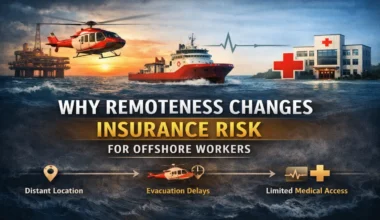
Work offshore
-
Handle explosives, chemicals, or electrical systems
-
Perform physically repetitive tasks
The more physical exposure, environmental danger, or safety-critical responsibility involved, the more restrictive disability coverage becomes.
This affects:
-
Whether coverage is offered
-
What exclusions apply
-
How long benefits can last
-
What definition of disability is used
The insurance system treats hazardous duties as fundamentally different from low-risk work, even when income and job titles appear similar.
As occupational exposure and physical strain increase, insurers often rely on additional exclusions and narrower disability definitions to manage long-duration claim exposure.
Why High-Risk Policies Include More Exclusions
High-risk disability insurance policies often include exclusions that are rare in standard policies.
Common restricted areas include:
-
Back, spine, and joint injuries
-
Repetitive strain
-
Mental health and stress-related claims
-
Substance-related conditions
-
Certain occupational diseases
These exclusions exist because high-risk work produces a higher probability of:
-
Chronic pain
-
Degenerative injury
-
Partial impairment
-
Long-term disability claims
From the insurer’s perspective, excluding or limiting these categories reduces exposure to claims that are difficult to verify, slow to resolve, and expensive to support long term.
These exclusions are not arbitrary, they are structural risk controls.
A broader explanation of why hazardous occupations face more policy exclusions is explored in our article on why high-risk insurance policies contain more exclusions.
Why Benefit Periods Are Often Shorter for Physical Jobs
Physically demanding jobs have higher injury severity and longer recovery timelines. However, insurers also assume that many high-risk workers will eventually be able to perform some form of work, even if not their original job.
As a result, high-risk disability policies often:
-
Cap benefit durations
-
End benefits once partial work becomes possible
-
Transition workers into “any occupation” definitions
These benefit structures are closely connected to how disability insurance waiting periods, income replacement rules, and payment durations are designed for hazardous occupations.
A construction worker may no longer be able to climb or lift but could theoretically perform light supervisory or administrative tasks. Insurers use this possibility to limit long-term benefit payments.
This structure shifts financial responsibility away from permanent income replacement and toward career transition.
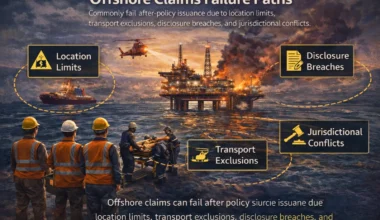
Common Failure Paths in Disability Insurance for High-Risk Jobs
Disability disputes in hazardous occupations often arise from policy structure rather than from disagreement about the existence of injury.
Common failure paths include:
– Workers being classified as capable of lighter or alternative work
– Transition from own-occupation to any-occupation disability definitions
– Benefit periods ending before full physical recovery occurs
– Exclusions related to repetitive strain, chronic pain, or occupational injury patterns
– Medical evidence disputes involving functional work capacity
– Partial recovery that still prevents safe performance of hazardous duties
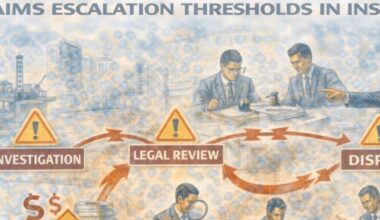
For high-risk workers, claim disputes frequently occur because medical improvement does not always restore the physical reliability required for safe occupational performance.
In many cases, the core dispute is not whether a worker has medically improved, but whether enough functional reliability has returned to safely resume hazardous occupational duties.
Why Underwriting Is Stricter for High-Risk Workers
Disability insurance underwriting is designed to predict how likely a worker is to become disabled and how long that disability might last.
For high-risk workers, insurers place greater weight on:
-
Prior injuries
-
Chronic pain
-
Joint, back, or nerve conditions
-
Body weight
-
Smoking
-
Substance use
-
Mental health history
The same medical condition that might be acceptable for a desk worker can be disqualifying for a roofer, diver, or heavy-equipment operator.
This is because physical jobs leave less margin for functional loss.
As occupational recovery uncertainty increases, insurers often respond by narrowing coverage structures, tightening definitions, and limiting long-duration claim exposure.
Why Disability Insurance for High-Risk Jobs Is Structured Differently
High-risk disability insurance is not simply more expensive. It is built on a different risk model.
Understanding how disability insurance functions as a broader income-protection system for hazardous occupations makes these underwriting differences easier to interpret realistically.
In hazardous work:
-
Injuries are more frequent
-
Recovery is more uncertain
-
Partial disability is more common
-
Return-to-work options are limited
Insurance systems respond by:
-
Narrowing disability definitions
-
Adding exclusions
-
Shortening benefit periods
-
Tightening underwriting
These rules exist to keep the system financially viable while still providing income protection during serious periods of incapacity.
Frequently Asked Questions
Why are disability insurance rules stricter for hazardous jobs?
High-risk occupations involve greater injury exposure, longer recovery timelines, and fewer return-to-work alternatives, leading insurers to apply stricter underwriting controls and narrower disability definitions.
What is the difference between own-occupation and any-occupation disability?
Own-occupation coverage focuses on whether a worker can perform their specific job, while any-occupation coverage evaluates whether they can perform other suitable work at all.
Why do high-risk disability policies contain more exclusions?
Hazardous occupations create higher probabilities of chronic pain, repetitive strain, and long-duration disability claims, prompting insurers to limit exposure through exclusions and coverage restrictions.
Can disability benefits stop even if someone cannot return to their original job?
Yes. Benefits may end when insurers determine that a worker can perform lighter or alternative work under the policy definition.
Why are benefit periods shorter for physically demanding jobs?
Insurers often assume that some workers may eventually transition into lower-risk work, leading policies to limit long-term benefit durations for hazardous occupations.
Conclusion
Disability insurance for high-risk jobs is governed by rules designed around physical exposure, injury probability, and recovery uncertainty. Understanding these rules explains why coverage looks different for construction workers, offshore crews, industrial operators, pilots, and other hazardous occupations.
Readers seeking a broader explanation of waiting periods, income replacement structures, and benefit duration rules should also review our guide to how disability insurance works for high-risk workers.
Final underwriting insight:
Disability insurance systems for hazardous occupations are fundamentally designed around long-duration income interruption risk, functional work-capacity uncertainty, and the financial exposure created by physically demanding labor.
Understanding these structural rules allows high-risk workers to interpret disability definitions, exclusions, waiting periods, underwriting decisions, and long-term claim outcomes more realistically before evaluating coverage options.