Reviewed for underwriting accuracy by the RJI Institutional Review Team | Published: July 2026 | Updated: July 2026
————————————————————————————————————–
Executive Summary
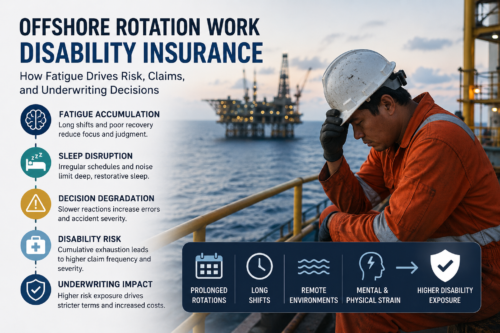
Offshore rotation work disability insurance evaluates a different question than standard occupational disability coverage. Instead of asking only whether a job involves physical hazard, underwriters ask whether prolonged deployment in a remote marine environment degrades the human reliability a crew depends on to work and to respond to emergencies safely.
Because rotation length, recovery infrastructure, and shift design determine how far that degradation progresses before a hitch ends, these operational variables translate directly into pricing, eligibility, and claims exposure. This article traces that translation mechanism end to end: from the operational reality of accumulating fatigue, through the institutional basis for treating it as an insurable risk factor, to the specific underwriting decisions it produces.
What Offshore Rotation Fatigue Means for Disability Underwriting
Traditional disability underwriting asks whether a job’s physical duties expose a worker to strain, impact, or repetitive-motion injury. Offshore rotation underwriting asks a broader question: whether the deployment itself, independent of any single task, erodes the cognitive and physical reliability a worker needs to perform safely through the final days of a hitch.
Traditional Disability Underwriting: evaluates task-level physical hazard
↓
Offshore Rotation Disability Underwriting: evaluates cumulative human reliability across the full deployment
This distinction exists because remote marine deployments remove the recovery options that make onshore fatigue self-correcting. An onshore worker can rest for a weekend before fatigue reaches a critical threshold. An offshore worker remains inside the same operational and environmental pressures for the full length of the hitch, so fatigue that would resolve onshore instead accumulates.
Underwriting interpretation: when recovery options are structurally unavailable rather than merely inconvenient, insurers treat rotation length itself as a rated variable, not just the occupation performed during it. Foundational guidance on how remote deployment affects overall risk classification is set out in Offshore Risk Underwriting: How Insurers Evaluate Marine & Remote Workers.
Micro-Fatigue Accumulation and Cognitive Reliability Degradation
Fatigue-related occupational research tracked by the National Institute for Occupational Safety and Health (NIOSH) and incident reviews conducted by the Bureau of Safety and Environmental Enforcement (BSEE) both describe a pattern in which small, repeated sleep deficits compound across a rotation rather than resolving between shifts. A worker can feel subjectively fine while measurable reaction time and judgment have already slowed.
Small daily sleep deficits
↓
Micro-fatigue accumulation
↓
Cognitive reliability decline
↓
Emergency-response slowing
Field Example
A crane operator on day 23 of a 28-day hitch feels normal at shift start. Three weeks of shortened sleep cycles have slowed his processing speed by a margin too small for him to notice. Lifting a subsea assembly during a sea swell, the delay is enough that the load strikes a deck crew member.
Underwriting interpretation: carriers do not price micro-fatigue as a subjective complaint; they price it as a measurable, time-dependent decline that BSEE incident analysis links to late-hitch error rates. An injury on day twenty-three of a hitch carries a different causation profile than an identical injury on day two, and the later in a rotation an incident occurs, the more underwriting review treats accumulated fatigue as a contributing factor rather than a coincidental one.
That shift in causation framing has practical consequences for the worker as well as the carrier. A late-hitch injury is more likely to draw a fatigue-related causation review, which can slow how quickly a claim moves toward acceptance, and adjusters increasingly request hitch-day data, sleep logs, and shift history alongside the incident report itself, extending investigation timelines for claims that fall late in a long rotation.
Circadian Rhythm Instability and Neurological Recovery Failure
The International Maritime Organization (IMO) has published guidance emphasizing that shift-pattern management materially affects crew fatigue and must be actively controlled rather than left to individual tolerance. Rotating and night-shift schedules disrupt the body’s circadian rhythm, and without deep uninterrupted sleep the brain does not fully clear metabolic waste between shifts.
Intensive shift rotation
↓
Circadian rhythm instability
↓
Neurological recovery deterioration
↓
Underwriting risk escalation
Underwriters pay particular attention to forward-rotation transitions, where a worker moves from day shifts to night shifts within the same hitch. IMO guidance associates these mid-deployment transitions with sharper reductions in sleep quality than steady rotating schedules, because the body has less time to re-entrain before the hitch ends.
Underwriting interpretation: a schedule design that produces predictable neurological recovery failure is treated as a structural underwriting variable. No amount of individual discipline offsets a shift design that never allows deep recovery, so review focuses on the schedule itself rather than the worker.
That focus carries through to both submission review and pricing. Operations that minimize forward-rotation transitions and hold to stable shift patterns present a materially different risk profile than those that reverse direction mid-hitch, and shift-transition frequency functions as a rating input alongside hitch length for exactly that reason, since both determine how much recovery deficit accumulates before rotation end.
Isolation, Psychological Survivability and Cognitive Narrowing
Occupational stress research recognizes a pattern sometimes called the third-quarter phenomenon, in which mental fatigue, emotional strain, and concentration difficulty intensify after a rotation passes its midpoint. Prolonged separation from family and support networks compounds the physical fatigue already accumulating from shift work.
Prolonged offshore isolation
↓
Psychological fatigue and stress accumulation
↓
Isolation-induced cognitive narrowing
↓
Reduced peripheral awareness
Under sustained psychological strain, the brain conserves capacity by narrowing attention to immediate, familiar tasks and screening out peripheral information. This narrowing is adaptive under acute stress but becomes a liability offshore, where peripheral cues such as an unusual pressure reading or an irregular engine sound often provide the first warning of developing failure.
Underwriting interpretation: modern underwriting review treats psychological strain as a physical safety variable rather than a separate wellbeing consideration, because cognitive narrowing directly reduces a worker’s ability to detect early warning signs.
That framing carries through to claims and to submission review alike. A claim involving a missed warning sign late in a long, isolating rotation is more likely to be examined for psychological fatigue contribution than the same miss occurring early in a shorter one, and operations without structured contact schedules, rest breaks, or rotation-length limits built around psychological recovery face closer scrutiny of both frequency and severity assumptions.
Why Fatigue Turns Minor Offshore Incidents Into Major Disability Claims
Fatigue does not only slow a worker down; it changes the category of outcome an incident produces. An exhausted worker facing a sudden emergency experiences delayed reaction, narrowed situational awareness, and degraded communication at exactly the moment coordination matters most, which is the pattern BSEE and OSHA incident reviews associate with escalation from a contained event into a catastrophic one.
The same exhaustion that slows judgment also slows the body. Muscles, joints, and reflexes respond less precisely to sudden forces, raising the likelihood of severe traumatic injury from swinging loads, sudden sea swells, or slips during balance-dependent tasks. Once an injury occurs, chronic exhaustion impairs immune function and slows tissue repair, extending recovery time for an identical injury compared to a well-rested worker.
Carriers treat fatigue as more than another workplace hazard. It increases how often serious incidents occur, how severe those injuries become, and how long recovery takes. Together, those factors raise the expected cost of disability claims.
Policy language matters here as much as medical outcome. Where a policy defines disability using an “any occupation” standard rather than an “own occupation” standard, an insurer may argue a worker can still perform lower-risk onshore duties even after losing the reliability needed to work offshore safely, which can reduce or deny long-term benefits despite a genuine occupational disability. Severity disputes in this category frequently turn on whether exhaustion is treated as a contributing cause of the underlying incident or only of its outcome, a distinction that shapes both liability allocation and benefit calculation.
Transport Exposure and Remote Emergency Access
Two operational realities compound fatigue risk without constituting a separate primary mechanism: the transport chain that moves crews to and from the facility, and the remote medical access available once an incident occurs. Both interact with fatigue but are governed as dedicated mechanisms in their own right.
Repeated helicopter transfers, particularly at night after a full shift, introduce airborne cognitive degradation at the exact moment a worker would need full alertness to execute emergency escape procedures. The full institutional and underwriting treatment of this exposure, including how carriers evaluate night-transfer frequency and transit safety, is addressed in Helicopter Transport Risk in Offshore Insurance.
Separately, the distance between an offshore facility and definitive medical care means an exhausted, already-injured worker faces delayed stabilization on top of reduced physiological resilience. Carrier treatment of evacuation logistics and coverage limitations tied to remote medical access is addressed in Offshore Evacuation Risk and Insurance and Remote Medical Access and Occupational Coverage.
In practice, carriers may evaluate both mechanisms together. Where fatigue compounds transport or remote medical exposure, underwriters often review both files rather than treating either in isolation.
How Rotation Length Changes Disability Insurance Risk
Rotation length is one of the clearest structural variables underwriters review, because BSEE and NIOSH fatigue research both associate longer continuous deployment with a steeper decline in measurable human performance. Underwriters group submissions into risk tiers based on hitch length rather than treating all rotational work as equivalent.
| Rotation Type | Underwriting Risk Profile | Key Fatigue Drivers |
| 14/14 (2 weeks on / 2 weeks off) | Standard baseline | Manageable fatigue where shifts are regular and rest environments are controlled. |
| 21/21 (3 weeks on / 3 weeks off) | Elevated risk | Measurable performance decline typically visible by week three; requires active monitoring. |
| 28/28 (4 weeks on / 4 weeks off) | High underwriting severity | Significant micro-fatigue accumulation with elevated risk of cognitive narrowing and slow post-hitch recovery. |
Figure 1. Rotation length as an underwriting risk variable. Longer continuous deployment is associated with steeper measurable decline in human performance and higher underwriting severity.
Underwriters also review how compensation and time worked are tracked against the approved schedule. Overtime, hazard pay, and day-rate income are common in offshore rotations, and disability calculations that exclude these amounts can leave injured workers underpaid relative to actual earnings. Hitch length itself functions as a rating variable independent of occupation, so two otherwise identical submissions can receive different terms based solely on rotation structure.
Underwriting interpretation: an operation that regularly extends workers past their approved hitch length without notifying the carrier introduces undisclosed exposure that can affect coverage validity at claim stage, separate from the fatigue risk itself.
Why Recovery Systems and Staffing Levels Matter to Insurers
A standard rest period does not guarantee recovery. Workers can log twelve hours off-shift and still experience incomplete neurological recovery if the sleeping environment is noisy, poorly climate-controlled, or if consecutive shifts never allow deep sleep to occur, a pattern sometimes referred to as inter-shift recovery failure.
Chronic multi-week stress
↓
Recovery infrastructure quality
↓
Complete or incomplete neurological recovery
The American Petroleum Institute’s Recommended Practice 75 (API RP 75) sets out how Safety and Environmental Management Systems should account for human factors and staffing redundancy, including whether an operation can absorb a sudden staffing gap without overloading the remaining crew.
Underwriting credit mechanism: operations that can document active fatigue-monitoring systems, stable non-rotating shift patterns, upgraded acoustic and climate-controlled sleeping quarters, and demonstrated staffing redundancy under API RP 75 principles present verifiable evidence, not general safety assurances, that supports improved classification and terms. Sharing that documentation with underwriters at renewal, rather than only at initial submission, is typically what moves a file from standard monitoring to credit-eligible status.
Why Fatigue Leads to Higher Premiums and Coverage Restrictions
The accumulated risk described in the preceding sections resolves into a small set of concrete underwriting actions. Carriers do not treat fatigue as a temporary discomfort; they model it as a severity multiplier affecting frequency, injury outcome, and recovery cost at once, which raises reserve exposure across the book.
High fatigue risk profile
↓
Elevated claims reserve exposure
↓
Reduced underwriter appetite
↓
Higher premium or restricted terms
One direct consequence is the elimination period, the waiting interval before disability benefits begin. Carriers may lengthen elimination periods where a submission shows elevated fatigue exposure, weak recovery controls, or repeated long-hitch deployment, since these factors are associated with more protracted claims investigation. Combined with a long rotational schedule, an extended elimination period can leave an injured worker without income for a materially longer stretch than the same injury would produce under a standard schedule, a detail that matters most precisely when a worker can least absorb it.
Underwriting interpretation: where deployment duration, recovery controls, and staffing redundancy fall outside acceptable ranges simultaneously, insurers may respond with any combination of added exclusions, reduced coverage limits, mandatory fatigue-management requirements, operational audits, or declination. Carrier treatment of these compounding restrictions is addressed further in Why Offshore Workers Face Insurance Restrictions.
Coverage Gaps in Employer Disability Plans
Employer-provided group long-term and short-term disability plans frequently contain limitations specific to offshore assignments, international waters, contractor status, or high-risk occupational classification that workers assume are covered by default. Some plans also calculate benefits from base salary alone, excluding overtime, hazard pay, or day-rate income that forms a significant share of offshore earnings. For a worker whose income is heavily weighted toward offshore premiums, that gap can produce a substantial income shortfall during a long-term disability period even where the underlying claim is accepted without dispute, which is why supplemental coverage designed specifically for rotational offshore exposure is common in this workforce.
Claims Complexity and Common Failure Paths
Fatigue-related claims trigger expanded review because proving that exhaustion materially contributed to an incident requires more than the incident report itself. Offshore work also typically involves multiple operators, contractors, and service providers, which complicates establishing responsibility, and rapid crew turnover can degrade the evidentiary record before an investigation begins.
Weak fatigue controls
↓
Degraded cognitive reliability
↓
Emergency-response instability
↓
Catastrophic severity escalation
↓
Complex claim dispute
Operational Failure Points Underwriters Review
Undisclosed overtime that masks true exhaustion levels; hitch-length violations that keep crew deployed past their approved window; noncompliance with mandated alertness checks or cognitive-monitoring alerts; unapproved extended assignments not reported to the carrier; corner-cutting on emergency protocols under time pressure; and undisclosed changes in job duties that shift a worker into higher-risk exposure without updating the policy.
Claims consequence: when investigators find these operational failures, it typically indicates the employer had visibility into fatigue risk and did not act on it, a finding that frequently supports a denied or reduced claim rather than the reverse.
What Offshore Workers Should Review Before Buying Coverage
Coverage Review Checklist
● Whether the policy uses an “own occupation” or “any occupation” definition of disability
● How the elimination period interacts with the actual rotation schedule
● Whether overtime, hazard pay, and day-rate income are included in benefit calculations
● Whether offshore locations or international waters are excluded
● How evacuation and remote medical transport are handled under the policy
● Whether contractor status affects eligibility
● Whether fatigue-management noncompliance can be used to dispute a claim.
Key Takeaways
● Underwriting focus: offshore rotation disability insurance evaluates whether a worker can sustain reliable cognitive and physical performance across an entire multi-week deployment, not only whether the job itself is physically hazardous.
● Hidden driver: micro-fatigue accumulates below a worker’s own awareness, meaning measurable performance decline typically precedes any subjective sense of exhaustion.
● Structural variable: rotation length, shift-transition frequency, and recovery infrastructure function as rating inputs independent of occupation performed.
● Credit mechanism: documented fatigue-monitoring systems, stable shift design, and verified staffing redundancy under API RP 75 principles are what move a submission toward improved terms, not general safety assurances.
● Financial exposure: unmanaged fatigue risk raises reserve exposure across frequency, severity, and recovery cost simultaneously, which is reflected in premium, elimination periods, and coverage restrictions
Final Underwriting Insight
Offshore rotation work disability insurance is not only a question of whether a worker can physically continue offshore duties. It evaluates whether prolonged deployment gradually erodes the decision-making and emergency-response reliability a crew depends on before a serious incident occurs. Managing this exposure requires verifiable fatigue controls, recovery infrastructure, and staffing redundancy, translated into documentation an underwriter can actually rate against.
—————————————————————————————————————————
Institutional & Underwriting Reference
This article was developed using institutional offshore safety guidance, occupational fatigue research, marine operational risk frameworks, and disability underwriting principles related to prolonged offshore deployment and human performance. Key references consulted include guidance and operational frameworks from:
- Bureau of Safety and Environmental Enforcement (BSEE)
- International Maritime Organization (IMO)
- American Petroleum Institute Recommended Practice 75 (API RP 75)
- Center for Offshore Safety (COS)
- National Institute for Occupational Safety and Health (NIOSH)
- Occupational Safety and Health Administration (OSHA)
Research & Underwriting Methodology
This article applies the RJI Underwriting Translation Framework to a single primary mechanism: how prolonged offshore rotation deployment degrades human reliability and how that degradation resolves into disability underwriting decisions involving pricing, eligibility, coverage, and claims. Related mechanisms—including transport exposure, remote medical access, and jurisdiction-specific coverage restrictions—are covered in dedicated RJI articles and are referenced here where they materially influence disability underwriting decisions.
—————————————————————————————————————————
Disclaimer: Risk Job Insurance (RJI) provides educational resources and institutional underwriting analysis for hazardous industries. Insurance policy terms, underwriting practices, and regulatory requirements vary by insurer, jurisdiction, and operational circumstances. Readers should review their specific policy wording and seek professional advice where appropriate before making coverage decisions.