Reviewed for Underwriting Accuracy by the RJI Institutional Review Team | Published: June, 2026 | Updated: June, 2026
An Underwriting Reference for Marine Operators, Risk Managers, and the Offshore Workforce
————————————————————————————————————–
Executive Summary
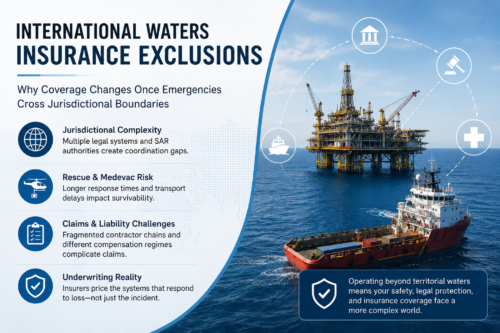
Most offshore employers assume insurance coverage changes because work becomes more dangerous farther from shore. In reality, insurers are evaluating something completely different: whether rescue, command, evacuation, and legal systems remain controllable once operations cross multiple jurisdictions simultaneously.
International waters insurance exclusions restrict or suspend coverage once an asset operates beyond territorial seas, assessing whether an operator’s safety structures can withstand the transition into unmanaged operating spaces. They evaluate how deep-sea work impacts emergency response and liability exposure under two foundational maritime frameworks: the United Nations Convention on the Law of the Sea (UNCLOS) and the Maritime Labour Convention (MLC 2006).
What Is International Waters Insurance Exclusions
An international waters insurance exclusion is a binding policy provision that limits, conditions, or suspends hull, liability, P&I (Protection and Indemnity), and workers’ compensation coverage the moment a vessel, mobile rig, or personnel group crosses past territorial waters. Under international maritime law, territorial waters typically extend up to 12 nautical miles (NM) from a coastal state’s baseline.
| Territorial Waters 0–12 NM
Sovereign law / unified SAR access |
→ | Contiguous Zone 12–24 NM
Customs enforcement / fragmenting rescue |
→ | EEZ 24–200 NM
Resource rights / treaty-based SAR |
→ | High Seas 200+ NM
Flag-state regime / maximum exclusion risk |
| Operational Change | Underwriting Interpretation | Insurance Consequence |
| Crosses territorial waters | Jurisdiction fragments | Territorial exclusions begin |
| Medevac depends on foreign SAR | Treatment timing less predictable | Higher severity loading |
| Multi-national contractor chain | Liability uncertainty increases | Coverage restrictions |
| Cross-border medical evacuation | Claims administration slows | Premium adjustment |
| Offshore fatality | Long-tail reserve exposure | Claims remain open longer |
Table 1. Operational Change → Insurance Change. Each row traces one operational shift through to its underwriting outcome.
| Operating Zone | Operational Reality | Underwriting View |
| Territorial Waters | Single legal authority | Lower uncertainty |
| Contiguous Zone | Shared enforcement | Moderate uncertainty |
| EEZ | Resource rights + treaties | Elevated uncertainty |
| High Seas | Flag-state governance | Highest uncertainty |
Table 2. Jurisdiction Comparison. Underwriting uncertainty tracks the same zone progression shown in Figure 1.
For underwriters, this exclusion serves as an operational-controllability threshold. It differentiates between predictable, domestic legal regimes and multi-jurisdictional operating spaces where regulatory authority fragments across flag states, coastal states, and international treaties. This assessment sits at the very heart of Offshore Risk Underwriting: How Insurers Evaluate Marine & Remote Workers, as underwriters look past simple company safety policies to analyze how an entire commercial operation maintains physical command and structural stability when standard municipal legal protections no longer apply.
Underwriting interpretation: Workers and business owners often assume coverage lapses purely because deep-sea work is physically dangerous. From a carrier perspective, however, the real concern is whether your command system, rescue network, and contractor chain can still function reliably once domestic legal frameworks stop uniform enforcement.
Jurisdictional Fragmentation and Claims Complexity
1. Institutional Basis
Under UNCLOS Article 97, jurisdiction over incidents occurring on the high seas lies primarily with the flag state of the vessel involved. However, this statutory allocation does not prevent cross-border conflicts when an incident involves a vessel registered under a Liberian flag, a drilling operator incorporated in the United Kingdom, a marine contractor registered in Nigeria, and a multi-national crew covered under separate national labor frameworks. While the MLC 2006 sets minimum standards for seafarer compensation, medical care, and repatriation, its enforcement depends on individual flag-state and port-state implementation, which varies significantly across international basins.
2. Underwriting Interpretation
Insurers evaluate this legal fragmentation as an inflation vector for legal defense costs and open-reserve volatility. When an emergency crosses borders, it triggers concurrent investigations by multiple foreign regulatory bodies. Underwriters cannot easily determine which statutory compensation scheme or liability limitation act will take precedence during a lawsuit. This legal ambiguity prevents accurate actuarial modeling of worst-case exposure.
3. Stakeholder Translation
-
Business impact: If an accident triggers multi-system claims fragmentation, separate components of the same incident may be litigated in different countries simultaneously. Employers face massive administrative gridlock and competing discovery requests while separate countries argue over who has the right to enforce their specific safety standards.
-
Worker impact: Jurisdictional gridlock directly translates to prolonged anxiety following a severe workplace incident. While separate international courts or corporate legal teams argue over which country’s compensation rates apply, an injured worker’s medical benefits and family survivor payments can be delayed for months.
4. Insurance Consequence
Eligibility consequence: Once jurisdictional fragmentation introduces unmodeled legal liabilities, insurers typically suspend standard policy forms and impose strict territorial exclusions. To reinstate coverage, operators must secure specific cross-border endorsements that carry heavily restricted policy limits, higher deductibles, and narrow jurisdictional venue warranties.
Severity Modeling: Conditional Dependencies and Systemic Lags
1. Institutional Basis
Search and rescue (SAR) operations in international waters are governed by the International Convention on Maritime Search and Rescue (Hamburg, 1979), which divides global waters into distinct rescue zones managed by localized Maritime Rescue Coordination Centres (MRCCs). In territorial waters, SAR operations follow a unified domestic command. In international zones, however, response mobilization relies on treaty-based voluntary cooperation and cross-border data sharing between neighboring countries.
2. Underwriting Interpretation
Underwriters use this framework to build conditional dependency models that track how separate operational failures compound into high-severity losses under duress. Insurers translate these international coordination gaps into Remote Rescue Delays in Offshore Claims, analyzing how boundary-line response friction expands the claims timeline. Underwriters treat treaty-dependent SAR access as an unpredictable variable that amplifies casualty severity.
3. Stakeholder Translation
-
From the employer’s perspective: Insurers are evaluating whether an operation’s emergency response plan relies on uncontracted, public coast guard assets. If an incident occurs near a boundary between two national SAR zones, rescue centers can spend critical hours negotiating territorial responsibility before launching assets, compounding the owner’s operational interruption exposure.
-
What this means for workers: Administrative rescue delays directly erode physical survivability windows. In high-exposure scenarios, such as cold-water exposure, severe trauma, or major structural blowouts, a two-hour delay caused by cross-border coordination gaps converts a manageable injury into a fatal event before help arrives.
4. Insurance Consequence
Premium consequence: Because delayed survivor detection and rescue fragmentation alter the expected severity of a marine accident, insurers apply steep risk loadings to the primary liability premium. If an operator cannot demonstrate a seamless air-bridge or surface recovery framework, carrier appetite may decline to the point where standard-market coverage is no longer available.
Medevac Routing, Port Access, and Evacuation Complexity
1. Institutional Basis
UNCLOS establishes that while coastal states must cooperate in safety matters, they retain the sovereign right to control entry into their ports and territorial waters for health, national security, or custom enforcement reasons. When a medical extraction occurs past the 12-NM boundary, the transport aircraft or support vessel must secure explicit clearances from the receiving coastal state before bringing foreign nationals or un-vetted equipment across domestic borders.
2. Underwriting Interpretation
Underwriters analyze these logistical handoffs to measure what specialists call treatment-timing reliability, the statistical probability that an injured worker reaches advanced trauma care before structural stabilization collapses. These international transport barriers directly mirror the air-bridge liabilities scrutinized in Helicopter Transport Risk in Offshore Insurance, where fuel-range boundaries, open-water ditching survival windows, and weather groundings compound cross-border clearance delays.
3. Stakeholder Translation
-
Business impact: Employers often discover that operational planning assumes an open medical corridor that does not exist in law. A helicopter crew may be forced to hold in mid-air or divert to a distant alternate port while corporate officers scramble to satisfy local immigration rules, custom clearances, or emergency port-access mandates.
-
Worker impact: For the crew member inside the aircraft, these delays interrupt treatment continuity. These treatment-continuity risks closely overlap with the survivability issues discussed in Remote Medical Access and Occupational Coverage, where delayed specialist access and offshore medical limitations turn a treatable trauma case into a catastrophic life-altering disability.
4. Insurance Consequence
At claim stage: If a claim investigation reveals that a medical condition worsened dramatically due to unmitigated cross-border transport barriers, insurers may dispute the escalating costs under the policy’s mitigation-of-loss clauses. The resulting premium adjustments will reflect the heightened risk of long-tail permanent disability payments.
Marine Fatality Exposure and Recoverability Uncertainty
1. Institutional Basis
UNCLOS Article 98 mandates that every flag state require masters of vessels to render assistance to persons in danger of being lost at sea. However, once a fatal event occurs in international waters, the regulatory process for body recovery, formal death verification, and forensic scene preservation fragments across competing coroner and maritime authority jurisdictions.
2. Underwriting Interpretation
Many of these survivability and recoverability concerns are further explored in Marine Fatality Exposure in Insurance Underwriting, particularly where delayed recovery operations increase offshore severity uncertainty. Underwriters model high-seas fatalities as long-tail financial liabilities. The lack of an immediate, unified coroner jurisdiction prevents the timely issuance of death certificates, extending the window of open-reserve volatility for the insurer.
3. Stakeholder Translation
-
From the employer’s perspective: An offshore fatality in international waters does not close when the physical recovery operation ends. Corporate owners face years of multi-system forensic investigations and competing legal inquiries that defer contract awards and disrupt operational focus.
-
What this means for workers: For families, this jurisdictional ambiguity results in prolonged legal processing. The delay in death certification defers the distribution of survivor benefits, halts estate processing, and creates multi-year compensation disputes across conflicting national insurance layers.
4. Insurance Consequence
Coverage implication: To limit their exposure to long-term legal and investigation costs, underwriters place strict passenger concentration limits and aggregate caps on aviation and marine transport exposures. This operational restriction directly explains Why Offshore Workers Face Insurance Restrictions, as insurers contract their policy capacity to avoid catastrophic accumulation events in unmanaged basins.
| Deepwater Fatality Event | → | Delayed Body Recovery | → | Deferred Death Certification |
| Multi-System Litigation | → | Competing Jurisdictions | → | Open Reserve Volatility |
Figure 2. The fatality-to-litigation chain. Each stage compounds reserve uncertainty for the underwriter before a claim can close.
Rotational Fatigue and Contractor Chain Integrity
1. Institutional Basis
The MLC 2006 establishes strict minimum limits for seafarer rest hours and maximum deployment cycles to prevent human performance degradation. However, modern offshore projects depend on layered contractor structures, including primary operators, drilling contractors, marine logistics vendors, and third-party catering firms, where enforcement of these rest records fragments across separate corporate policies.
2. Underwriting Interpretation
Underwriters view contractor-chain fragmentation and offshore operational fatigue as primary drivers of human reliability failure. This operational risk connects directly to Offshore Rotation Work and Disability Insurance, as cognitive degradation during long-duration transport or high-stress crane operations frequently leads to severe accidents. Insurers look for contractor-chain opacity, where hidden subcontractor tiers bypass primary fatigue-management controls.
3. Stakeholder Translation
-
Business impact: When an incident occurs under a fragmented contractor chain, each subcontractor’s insurer attempts to transfer responsibility, leading to years of disputed indemnity obligations. If the primary operator cannot produce audited rest-period records for all personnel, they face a severe erosion of their claim defensibility.
-
Worker impact: Subcontracted crews operating under un-audited scheduling systems face heightened exposure to physical injury. If an accident occurs, the worker faces a complex maze of competing policies, where separate insurance carriers argue over who holds primary employers’ liability for the injured person.
4. Insurance Consequence
Underwriting impact: Once contractor-chain transparency or scheduling discipline deteriorates, underwriters respond by implementing strict territorial endorsements and higher premium loadings. If the operator cannot prove comprehensive oversight of all subcontracted tiers, carrier appetite may become so limited that only specialist or surplus markets remain willing to insure the exposure.
| Operational Event | Underwriting Response | Coverage Result |
| Rescue delay | Higher severity assumption | Premium increase |
| Border conflict | Claims uncertainty | Restricted wording |
| Fatality offshore | Long-tail reserve | Reduced appetite |
| Contractor opacity | Liability uncertainty | Higher deductibles |
Table 3. Mechanism Chain. A cross-section view of how the five mechanisms above each resolve into a distinct coverage outcome.
Operational Controls: Underwriting Credit Mechanisms
To overcome international waters exclusions and secure standard-market coverage, operators must implement specific, verifiable operational controls that function as underwriting credit mechanisms:
-
Automated Geofencing and Tracking: Deploy real-time asset tracking paired with automated alerts when any vessel approaches an unapproved zone.
Operational impact: This control prevents an accidental boundary breach from triggering an automatic policy suspension right before a casualty event occurs.
-
Contractual Indemnity Alignment: Audit all subcontracts to ensure indemnity clauses match primary policy terms, verifying that MLC 2006 financial security duties are fulfilled across all tiers.
Underwriting impact: Providing pre-audited contractor documentation removes liability ambiguity, unlocking broader capacity and lower retention requirements during renewal.
-
Pre-Cleared SAR and Medevac Partnerships: Establish private, contracted agreements with regional all-weather rescue providers, including pre-authorized medical flight paths and designated emergency port-access clearances.
Why this changes coverage: Documenting a guaranteed extraction window allows underwriters to compress their severity models, moving the risk out of high-surcharge categories.
-
Unified Command Protocols: Implement and routinely test an emergency response matrix that explicitly documents the boundaries of final authority between the Vessel Master and the OIM during joint marine and industrial crises.
Insurance interpretation: Documented command clarity removes the unmitigable risk of administrative bottlenecks, supporting competitive premium terms.
Sanctions and Compliance Auditing: Integrate rigorous compliance screening for all salvage and emergency maintenance vendors under U.S. Treasury OFAC Sanctions Programs guidelines.
Practical consequence: Vetting vendors prevents a scenario where an emergency salvage payment made to an unapproved entity voids the entire marine policy and triggers regulatory fines.
| Underwriting Evidence | Underwriting Benefit |
| SAR agreement | Better rescue controllability |
| Geofencing | Territory compliance |
| Contractor register | Better liability visibility |
| Unified command | Reduced operational uncertainty |
| Fatigue documentation | Better severity modeling |
Table 4. Underwriting Credits. Each control above resolves into a specific, named underwriting benefit — evidence, not generic safety practices.
Real-World Underwriting Scenarios
Scenario A: The Multi-Jurisdictional Blowout
A drillship operating 180 miles offshore experiences a severe well-control emergency. The vessel flies a Panamanian flag, the operating company is based in Houston, the drilling contractor is British, and the crew comprises six different nationalities. Because the operator lacked pre-cleared SAR partnerships or cross-border routing plans, evacuation teams faced severe administrative delays at the nearest coastal state line. The resulting treatment-timing failure escalated two injury claims into long-tail fatality lawsuits, illustrating how easily rescue fragmentation amplifies claim severity.
Scenario B: The Unsanctioned Emergency Salvage
A supply vessel operating in international waters near a disputed maritime boundary suffers a catastrophic propulsion failure during a storm. The captain engages a regional salvage tug to stabilize the vessel. During the claims audit, the insurer discovers the salvage provider is owned by an entity on the OFAC Specially Designated Nationals (SDN) list. Because the operator had no pre-screened emergency vendor list, the insurer was legally required to suspend policy indemnification, leaving the operator directly liable for all salvage costs and structural hull damages.
The Institutional Framework
The underwriting principles and regulatory expectations outlined in this analysis align directly with global frameworks managed by the leading authorities in maritime safety and commercial insurance markets:
-
IOGP (International Association of Oil & Gas Producers): Establishes global benchmarks for offshore safety performance, helideck operations, and corporate emergency response guidance used throughout the international energy industry.
-
ICAO (International Civil Aviation Organization): Defines international standards for all-weather operations and mandates strict fatigue management systems under Annex 6.
-
CAA (Civil Aviation Authority, UK): Sets stringent guidelines for helicopter underwater escape protocols (CAP 1036) and offshore landing safety standards (CAP 437).
-
BSEE (Bureau of Safety and Environmental Enforcement, US): Enforces offshore workplace safety, well-control boundaries, and emergency evacuation planning under 30 CFR Part 250.
-
OEUK (Offshore Energies UK): Delivers annual industry performance analytics, maritime safety guidance, and standardized survival equipment compliance reviews.
-
IS-BAO (International Standard for Business Aircraft Operations): Serves as the premier independent safety audit and operational accreditation standard for premium offshore aviation providers.
Operators and workers should consult these sources directly, as standards are updated periodically and jurisdictional variations apply.
Final Underwriting Insight
In international operations, underwriters are not simply gambling on whether an accident will happen; they are betting on whether your operational system can maintain continuity when domestic legal frameworks disappear.
The more evidence you provide that your command, rescue, and compliance networks can hold together under cross-border stress, through documented command protocols, pre-arranged SAR partnerships, disclosed contractor chains, and automated evidence preservation, the better positioned you are for sustainable, fairly-priced coverage at renewal.
————————————————————————————————————–
Disclaimer: This article is an educational reference for underwriting concepts in offshore marine and energy risk. It does not constitute formal insurance or legal advice. Specific coverage terms, premium outcomes, and regulatory requirements vary substantially by jurisdiction, underwriter, and operational profile. Operators must consult qualified marine insurance brokers and maritime counsel for guidance specific to their circumstances.