Executive Summary
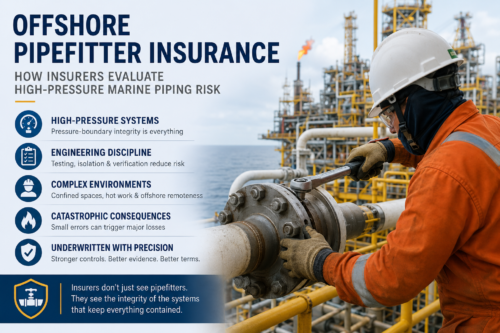
An offshore pipefitter installs, aligns, tests, maintains and repairs the pressurised piping systems that move hydrocarbons, chemicals, steam and utility fluids across production platforms, FPSOs, drilling rigs, and offshore wind installations. The work looks routine when it goes well: pipe spools are fitted, flanges are torqued, systems are pressure tested, and production continues. Offshore Pipefitter Insurance is priced high not because this routine work is dangerous in the way a fall or a strike injury is dangerous, but because a single fitting error, an incomplete isolation, or a missed pressure test can release hydrocarbons into a confined, ignition-prone offshore environment where fire, explosion, environmental contamination and prolonged business interruption become simultaneous possibilities rather than isolated risks.
Insurers evaluate offshore pipefitters primarily through the lens of pressure-boundary reliability: how reliably a contractor’s work keeps pressurised hydrocarbons inside the boundary they were engineered to occupy. Testing discipline, isolation procedures, hot work coordination, confined-space competency and system age all feed into whether a contractor is eligible for coverage, and at what price.
The exposures that most influence Offshore Pipefitter Insurance are pressure boundary failure, incomplete valve isolation before line-opening work, hot work near live hydrocarbon systems, confined-space entry, and offshore remoteness, which delays both evacuation and emergency response. Insurability improves when contractors can document engineering-verified testing, competent isolation practice, low leak-history frequency and disciplined permit compliance, since each reduces the probability that a routine task becomes a catastrophic loss.
| Underwriting insight: Offshore Pipefitter Insurance is not priced on how often pipefitters are injured. It is priced on how reliably pressurised hydrocarbon systems are kept intact, isolated and verified before, during and after piping work, because containment failure is the mechanism that converts routine maintenance into catastrophic loss. |
| Pipefitting Activity
↓ Pressure Boundary ↓ Containment Integrity ↓ Underwriting Confidence ↓ Insurance Outcome |
Figure: The central thesis of this article in one sequence. Everything that follows explains how insurers evaluate each link in this chain.
Who Needs Offshore Pipefitter Insurance?
The coverage described in this article is rarely bought directly by an individual pipefitter. It is purchased by the organisations that employ or engage them, and those organisations fall into a fairly consistent set of buyer categories across the offshore energy sector.
- Offshore mechanical and piping contractors providing pipefitting crews directly to platform and vessel operators
- EPC (engineering, procurement and construction) contractors delivering new-build offshore piping systems and process modules
- Shutdown and turnaround maintenance firms mobilising fitters for scheduled production outages
- Fabrication companies building pipe spools and modules for later offshore installation
- Brownfield maintenance contractors performing ongoing repair and modification work on existing assets
- Offshore engineering companies whose scope includes piping design verification, commissioning support, or field engineering
Each buyer category presents a different mix of the exposures discussed throughout this article: an EPC contractor’s exposure concentrates around construction-phase testing and commissioning, while a shutdown specialist’s concentrates around compressed-schedule maintenance on live, ageing systems.
What Does an Offshore Pipefitter Do?
Offshore pipefitters spend their working hours inside process modules, on open decks exposed to marine weather, and inside confined vessels and tanks where visibility and movement are restricted. The core of the trade is process piping: fabricating and installing the spools, flanges, valves and supports that carry hydrocarbons, produced water, chemicals and utility fluids between wellheads, separators, compressors and export systems. Work ranges from new construction to shutdown maintenance on an ageing FPSO where entire piping runs are cut out under a compressed schedule, to emergency repair when a flange begins weeping under pressure.
Flange assembly and valve installation are deceptively simple descriptions for work that carries outsized underwriting weight. A flange joint that is under-torqued, misaligned, or fitted with the wrong gasket does not fail immediately; it fails later, under a pressure or temperature excursion the original fitter never observed. Bolted joint practice is governed by recognised guidance such as ASME PCC-1, and for insurers, documented adherence to calibrated torque procedures reduces uncertainty by demonstrating that pressure-boundary integrity is verified systematically rather than left to individual judgement. Hydrostatic and pneumatic testing exist precisely to catch these failures before a system is commissioned.
Shutdown maintenance compresses this exposure: offshore shutdowns bring contract labour onto a platform for a fixed window, often two to four weeks, during which entire piping systems are isolated, opened, modified and re-commissioned in sequence. The pressure to return systems to service on schedule sits in direct tension with the discipline required to verify each joint and test before startup. Insurers read shutdown volume and discipline as a combined signal: high activity is not itself a red flag, but high activity without documented verification is.
Confined-space work compounds the exposure, since pipefitters frequently work inside separator vessels, tanks and compressor modules where atmosphere and egress are constrained. Elevated work adds fall exposure to an already pressurised risk profile, and ageing infrastructure adds a final layer: pipefitters on older platforms and FPSOs frequently repair systems where corrosion and fatigue have already reduced the margin between operating and failure pressure.
Common Offshore Pipefitter Injuries That Influence Insurance Risk
The injuries associated with offshore pipefitting read, on a claims log, as a familiar list: burns, crush injuries, falls, chemical exposure, musculoskeletal strain from manual handling in confined spaces, and hearing or respiratory effects from prolonged exposure to compressor and process module environments. What distinguishes this occupation from a general industrial trade is not this list itself but the tail risk sitting behind it. A high-pressure hydrocarbon release does not produce a moderate burn injury in isolation; it produces a fire or explosion event that can injure or kill multiple workers simultaneously, damage adjacent process equipment, and trigger a production shutdown lasting weeks or months.
This is why underwriters focus on claim severity rather than claim frequency. A contractor with low injury frequency but a documented history of near-miss pressure releases represents a materially different risk than one with slightly higher minor-strain frequency and no containment incidents. Frequency-based rating understates the exposure because the loss distribution is bimodal: many quiet years followed by an occasional event whose severity dwarfs the cumulative cost of every minor claim before it. NIOSH’s surveillance work on high-pressure fluid injection and marine industrial injury reinforces this skew, distinguishing it from the more evenly distributed patterns typical of general construction trades.
| Hazard Exposure | Physical Mechanism | Underwriting Severity Read |
| High-pressure release | Stored energy failure at a flange or fitting | Potential for multi-casualty, high-severity claim |
| Hydrocarbon exposure | Uncontained gas release or vapour inhalation | Respiratory and toxic exposure claims, often delayed onset |
| Thermal or flash burn | Ignition of released process gas | Prolonged specialist burn treatment, high reserve development |
| Confined-space incident | Oxygen displacement or toxic gas accumulation | Rescue-dependent, high fatality potential |
| Crush or impact injury | Pipe spool handling or structural collapse | Permanent disability, extended rehabilitation |
| Fall from height | Scaffolding or grating failure during pipe work | Traumatic injury, frequently catastrophic |
Figure: How individual hazard exposures translate into the severity signal underwriters read from a claims file.
Why Offshore Pipefitter Insurance Claims Become Complex
When an offshore pipefitter is injured in a containment-failure event, the claim path is rarely straightforward. Evacuation depends on helicopter or vessel transport, both weather-constrained, a dynamic examined in more detail in Helicopter Transport Risk in Offshore Insurance. Rehabilitation from burn or crush injuries is frequently prolonged, and disability determinations can be complicated by which compensation scheme applies and whether the incident implicates the platform operator, a fabrication contractor, or both.
Contractor disputes are common because offshore piping work is rarely performed by a single, vertically integrated employer: a pipefitter may work under a specialist contractor, under a platform operator’s operational control, alongside welders and riggers employed elsewhere. When a containment failure occurs, allocating liability across workers’ compensation, general liability and marine liability becomes a multi-party exercise that can take months. Clear scope-of-work documentation and unambiguous supervisory chains present a cleaner claims picture than loosely defined multi-contractor arrangements.
How Insurers Classify Offshore Pipefitters
Insurers evaluating insurance for offshore pipefitters draw on several classification systems, and it is a common misunderstanding, including among brokers, that these systems can be reduced to a single lookup code. Each system classifies a different dimension of the risk, and offshore pipefitting sits at an awkward intersection of several of them.
SOC: What the Worker Does
The Standard Occupational Classification system places pipefitters under SOC code 47-2152, Plumbers, Pipefitters, and Steamfitters, built around onshore construction and industrial trades. SOC describes the task performed, fitting, aligning, and joining piping systems, without reference to the pressure, hydrocarbon content, or offshore location of the work. It is useful for labour statistics and injury benchmarking through datasets such as the Bureau of Labor Statistics’ Census of Fatal Occupational Injuries, but it does not, by itself, tell an underwriter anything about containment risk.
NAICS: What the Business Does
The North American Industry Classification System typically places the employer, not the individual worker, under a code such as 213112, Support Activities for Oil and Gas Operations, when the work serves offshore production or drilling clients, or under a construction contractor code where the work is new-build fabrication rather than maintenance. NAICS informs underwriters about industry exposure and client concentration, but it does not distinguish a fitter maintaining low-pressure utility lines from one maintaining high-pressure export piping.
NCCI and Workers’ Compensation: A Jurisdictional Complication
This is where offshore pipefitting departs most sharply from onshore trades. Onshore pipefitters are typically rated under a state classification analogous to NCCI code 5183, Plumbing NOC, while offshore pipefitters on fixed platforms, floating production units, and drilling rigs frequently fall instead under federal maritime schemes: the Longshore and Harbor Workers’ Compensation Act for non-seaman maritime workers, or the Jones Act where a worker qualifies as vessel crew. Which scheme applies depends on the worker’s role, the structure, and the jurisdiction, and this is itself a significant source of underwriting uncertainty. A misclassification between state compensation, USL&H, and Jones Act coverage is one of the most consequential gaps in offshore contracting, since each carries different benefits, liability standards, and exclusions.
ISO: What Liability Exposure Looks Like
Insurance Services Office general liability classifications group offshore contractors by the nature of their operations, distinguishing fabrication and installation work from ongoing maintenance, and inform how a carrier prices third-party bodily injury and property damage exposure, a distinct question from the workers’ compensation and NAICS questions above. A contractor whose classification does not reflect its actual service pressures is likely underpriced relative to true exposure, one reason underwriters request scope-of-work documentation rather than relying on codes alone.
| Four classification systems, four different questions: SOC asks what the worker does. NAICS asks what industry the employer serves. Workers’ compensation classification, complicated offshore by USL&H and Jones Act jurisdiction, asks which compensation scheme and benefit structure applies. ISO asks what third-party liability exposure the operation creates. No single code answers all four, and treating one as a substitute for the others is a recurring source of coverage gaps. |
Why Classification Matters
Insurers distinguish offshore pipefitters from offshore welders, industrial plumbers, mechanical fitters and maintenance mechanics on one governing distinction: process piping under pressure, carrying hydrocarbons, versus general installation carrying water or low-pressure utility fluids. A plumber’s profile is built around systems where a joint failure produces a leak, not a hydrocarbon release, and an industrial pipefitter onshore with fixed emergency response infrastructure faces a materially different profile than one on an isolated platform. Offshore Welder Insurance addresses the adjacent but distinct exposure created when an ignition source is introduced directly into the piping work; pipefitting risk is defined by the pressure boundary, welding risk by the ignition source applied to it.
This distinction matters because offshore pipefitters routinely perform duties that blur these boundaries: a fitter may tack-weld a support bracket, assist in rigging a pipe spool, or perform testing without a dedicated test technician’s certification. Where mixed duties are a small proportion of scope, insurers generally rate the position under the dominant classification. Where they become a persistent, material share, particularly involving welding by workers who are not welding-certified, classification drift becomes a genuine underwriting concern rather than a technicality.
Classification Drift
Transitional drift describes the gradual expansion of an offshore pipefitter’s actual duties beyond the scope originally declared for classification and premium purposes. A contractor initially classified for maintenance piping work may, over a shutdown season, find its fitters performing rigging, fabrication welding, pressure testing sign-off, and mechanical repairs that were never part of the original scope disclosure. Each of these additional duties carries its own severity profile, and none of them is automatically captured by a classification set at the start of a policy period.
Insurers manage this exposure through audit rather than assumption. A payroll and duty audit conducted mid-contract or at renewal is the primary mechanism for detecting drift, and it is why underwriters increasingly request scope-of-work documentation at a level of specificity that many brokers find unfamiliar: not just job titles, but the proportion of hours spent on pressure testing, hot work, confined-space entry and rigging, broken out separately from routine pipe installation.
Payroll Audits
Shutdown projects create the sharpest payroll audit exposure because they concentrate contract labour and subcontracting into a short, intense window. A platform operator may engage a primary contractor, which subcontracts specialist testing and NDT services while supplying its own fitters for the bulk of the work. Each subcontracting layer raises the question of whose payroll a worker sits on, which policy responds if injured, and whether declared scope matches actual work performed during the shutdown.
Underwriters translate audit findings directly into renewal terms. A contractor whose audit reveals accurate, granular payroll allocation across duty types typically retains favourable terms. A contractor whose audit reveals systematic under-declaration of hazardous duty hours, whether through inattention or through an incentive to minimise declared premium, faces retroactive premium adjustment at minimum, and in more serious cases a reduction in offered capacity or a non-renewal, because the audit finding itself signals a broader weakness in operational reporting discipline.
Underwriting Severity Comparison Across Piping-Adjacent Occupations
The table below situates offshore pipefitters against related trades that underwriters frequently confuse or bundle together at the point of submission. Positioning is illustrative of underwriting tendency rather than a fixed rating scale, since actual terms depend on scope, location, and contractor history.
| Occupation | Primary Exposure Driver | Relative Severity Weight | Key Underwriting Signal |
| Offshore Pipefitter | Pressure boundary and containment integrity | High | Pressure test and isolation documentation |
| Offshore Welder | Ignition source applied to hydrocarbon systems | High | Hot work permit and fire watch discipline |
| Industrial Plumber (Onshore) | Water and drainage systems | Low to Moderate | Standard trade injury history |
| Mechanical Fitter | Rotating equipment and mechanical assembly | Moderate | Lockout/tagout compliance |
| Maintenance Mechanic | General equipment upkeep, mixed systems | Moderate | Scope breadth and duty mix |
| Offshore Rigger | Load handling and lifting operations | Moderate to High | Lift plan and crane coordination |
Figure: Relative underwriting severity weighting across occupations commonly bundled with offshore pipefitting in submissions.
How Insurers Evaluate Offshore Pipefitter Insurance
Why Offshore Pipefitters Start with Higher Base Rates
Insurers evaluate Offshore Pipefitter Insurance by starting from an elevated base rate relative to onshore piping trades, reflecting the combined weight of hydrocarbon service pressure, offshore remoteness, and confined-space exposure before any contractor-specific adjustment is applied. From that starting point, underwriting translation proceeds through modifiers, claims interpretation and eligibility filters that move an individual contractor’s terms away from the base assumption in either direction.
Rating Modifiers That Change Offshore Pipefitter Insurance Premiums
The Experience Modification Rate remains the primary quantitative signal underwriters use to adjust base rates, but it is read alongside qualitative indicators of operational maturity that a bare EMR number does not capture. A low EMR does not, by itself, indicate genuinely strong discipline versus a short claims history that has not yet encountered a severe event. Underwriters read the trend as much as the level: an EMR drifting upward over several consecutive years, even below 1.0, generally signals eroding operational discipline, while a stable or improving trend supports confidence independent of the absolute figure. Underwriters increasingly pair EMR review with direct evidence of maintenance quality and project complexity, since these predict future severity more reliably than a historical loss ratio alone for an occupation with a bimodal loss distribution.
How Claims History Affects Offshore Pipefitter Insurance
When reviewing loss history, underwriters distinguish loss-of-containment events, hydrocarbon leaks and flange failures from more generic injury claims, since these carry a materially different reserve development pattern: a fire or explosion claim frequently opens with a reserve that increases substantially as investigation and business-interruption quantification proceed. Underwriters therefore weight a single containment-related claim far more heavily than years of clean frequency data, scrutinising reserve development for evidence that past incidents were fully investigated and remediated rather than closed prematurely.
Eligibility Requirements for Offshore Pipefitter Insurance
Before terms are quoted at all, most specialist offshore markets apply eligibility filters that function as a gate rather than a rating adjustment: documented test procedures, functioning permit-to-work systems, formal isolation procedures, verified competency programmes, and a credible rescue plan for the locations involved. Underwriters increasingly frame these expectations against recognised benchmarks, including OSHA’s process safety management standard at 29 CFR 1910.119 and the API RP 75 framework, treating alignment as evidence of a functioning management system rather than a checklist exercise. Absence of any one is not simply priced as a modifier; it frequently results in outright ineligibility for standard offshore capacity, pushing the contractor toward excess and surplus lines markets at materially higher cost.
Underwriter Red Flags That Increase Offshore Pipefitter Insurance Risk
- A pattern of repeated hydrocarbon leaks, even where individually classified as minor incidents
- Flange failures without a documented root-cause investigation or corrective action
- Pressure testing records that are incomplete, inconsistent, or absent from submission materials
- Isolation procedures that rely on verbal confirmation rather than documented tag-out and verification
- Operation on ageing infrastructure without a corresponding inspection and integrity management programme
The Underwriting Decision Process
Everything described above, base rates, EMR, claims interpretation, eligibility filters, red flags, resolves into a single repeatable decision sequence that underwriters apply whether or not they name it explicitly.
| Operational Exposure
↓ Engineering Controls ↓ Engineering Evidence ↓ Underwriter Confidence ↓ Pricing ↓ Coverage Conditions ↓ Renewal |
Figure: The underwriting decision logic connecting operational exposure to renewal outcome for offshore pipefitting contractors.
A contractor cannot argue its way to underwriter confidence directly; it has to pass through engineering controls that are actually in place, and evidence that those controls were followed, before confidence and favourable pricing follow. Contractors that try to shortcut this sequence, presenting confidence without evidence, are the ones underwriters learn to discount most heavily over time.
Operational Realism: Where the Risk Actually Concentrates
Underwriting terms shift materially depending on the asset involved. Production platforms with mature, steady-state operations generally present a more predictable risk than FPSOs, where storage, processing and marine motion combine on a single hull. Drilling rigs introduce well-control considerations distinct from production assets, with mud circulation and choke-and-kill piping feeding blowout preventer systems rated well above 10,000 psi. Offshore wind projects, free of hydrocarbon content, introduce their own high-voltage and structural exposures. Gas compression and export systems carry some of the highest service pressures on an installation, and decommissioning projects introduce a distinct profile in which dismantled piping may retain residual hydrocarbon content under uncertain pressure on infrastructure whose original documentation is incomplete.
Offshore Asset Types
Four elements form the engineering backbone of containment: pressure, the containment system holding it, the testing that verifies it before service, and the isolation that makes maintenance on it safe. Insurers evaluate these as a connected system before turning to the operational amplifiers that can make any weakness worse.
Pressurised Systems as the Defining Severity Amplifier
If a single mechanism explains why offshore pipefitting insurance commands elevated rates, it is the direct causal chain running from pressure to catastrophic loss. This chain does not depend on unusual or exotic failure modes; it describes the ordinary consequence of an ordinary piping failure occurring in a hydrocarbon-pressurised, confined, ignition-prone environment.
| Pressure
↓ Loss of Containment ↓ Hydrocarbon Release ↓ Fire / Explosion ↓ Catastrophic Insurance Loss |
Figure: The governing severity mechanism underwriters apply when evaluating offshore pipefitter exposure.
Every other exposure discussed in this article, confined space, hot work, isolation, ageing infrastructure, functions as a factor that either increases or decreases the probability of the first step in this chain occurring, or the consequence severity once it does. This is why pressure-boundary reliability sits at the centre of how insurers price the occupation, rather than at the periphery.
Containment Integrity Underwriting
Containment integrity underwriting evaluates flange management, valve reliability and pressure boundary condition as a connected system rather than separate line items, since failure tends to occur at the weakest point in a system, not its average condition. Engineering verification, third-party inspection, non-destructive testing and documented corrosion monitoring together build the evidentiary picture an underwriter uses to assess whether a system will hold its boundary under normal and abnormal conditions. Inspection intervals consistent with recognised practice, such as API 570, give underwriters a reference point for judging whether a contractor’s programme is merely present or genuinely adequate.
Pressure Testing
Hydrostatic and Pneumatic Discipline
Hydrostatic testing, pneumatic testing, commissioning leak testing and periodic re-testing after modification verify a piping system before it returns to service, in line with practice such as ASME B31.3. Insurers evaluate not merely whether testing occurred but the quality of the regime: whether pressures and durations followed recognised practice, whether results were independently verified, and whether failures triggered genuine remediation rather than a repeat test until a pass. Pneumatic testing carries its own concern, since a compressed gas column stores far more recoverable energy than test water, and insurers look for defined exclusion zones and engineered pressure relief accordingly. This is one of the few pre-loss indicators an underwriter can inspect directly, which makes it disproportionately influential in eligibility and pricing.
Isolation Integrity: Lockout, Line Blanking and Valve Isolation
Incomplete isolation is among the most consequential failure modes in offshore piping work, converting a controlled maintenance task into an uncontrolled release scenario. Lockout/Tagout, physical line blanking and valve isolation verification exist to guarantee a system is genuinely de-pressurised and disconnected, not merely assumed to be. A single closed valve is generally not adequate isolation for line-breaking work; insurers look for a double block and bleed arrangement or a physical blind installed at the point of work, since a single valve can leak past its seat without visible warning. Underwriters treat isolation maturity as a threshold issue: excellent test records with weak isolation discipline still present a severe concern, because isolation failure bypasses the entire integrity programme built around the system.
Operational Risks That Increase Offshore Pipefitter Insurance Costs
Beyond the engineering system itself, a set of operational conditions determines how much worse a containment weakness becomes if triggered, and how likely triggering is. Insurers evaluate these amplifiers both individually and in combination, since they rarely occur in isolation on an active piping job.
Hot Work in Piping Operations
Offshore pipefitters routinely work in proximity to hot work, whether performing tack welds themselves or coordinating with dedicated welders cutting and joining adjacent piping sections. Hot Work Risk in Offshore Insurance Underwriting addresses the ignition-source mechanism in detail; for pipefitting purposes, the relevant point is that hot work performed on or near a piping system that has not been fully verified as isolated and gas-freed converts a manageable maintenance task into a potential ignition event, which is why permit-to-work systems require explicit sign-off connecting isolation status to hot work authorisation.
Confined Space Operations
Vessel and tank entry for internal piping inspection or repair introduces the atmospheric and egress exposures addressed in Confined Space Underwriting. For pipefitters specifically, confined-space work frequently coincides with the highest-consequence piping tasks, internal inspection of separators and pressure vessels, because these are the locations where corrosion and fatigue are hardest to detect from the outside and most consequential if missed.
Remote offshore Location: Medical Access, Rescue and Helicopter Dependency
Offshore location is a severity amplifier independent of the piping work performed. Remote Medical Access and Occupational Coverage addresses how the absence of on-site definitive care shapes the consequence of any injury event, with particular force for burn and blast injuries where time to treatment materially affects outcome. A containment event injuring multiple workers simultaneously also tests an installation’s evacuation capacity in a way isolated injuries do not, and Remote Rescue Delays in Offshore Claims and Helicopter Transport Risk in Offshore Insurance address how weather, vessel and aircraft availability shape the interval between injury and definitive care, an interval underwriters treat as a direct input into expected claim severity for any catastrophic piping event.
Ageing Infrastructure
Corrosion, fatigue and erosion progressively erode the margin between a piping system’s designed operating pressure and its actual failure pressure. Deferred maintenance compounds this, and legacy systems approaching or exceeding original design life require a materially more rigorous inspection and integrity programme to sustain the same underwriting confidence as newer infrastructure. Underwriters treat asset age not as an automatic disqualifier but as a factor that raises the evidentiary bar: the older the system, the more current the integrity documentation needs to be.
Temporary Repairs Versus Permanent Repairs
Temporary repairs, clamps, composite wraps and similar interim measures are sometimes operationally necessary to maintain production while a permanent repair is engineered and scheduled. Underwriters distinguish sharply between temporary repairs that are documented, time-bound and tracked toward a permanent resolution, and temporary repairs that become de facto permanent through deferral. The latter signals declining underwriting confidence, because it indicates operational pressure is consistently overriding engineering judgment about system integrity.
Exposure Interaction and Accumulation
Pressure, hydrocarbons, confined spaces, hot work and remote rescue capacity do not operate as independent risk factors; they interact. A pressure release inside a confined space is more severe than the same release in open air, and a hot work ignition source near an incompletely isolated system is more consequential than one near a verified-isolated system. Exposure Stacking describes this interaction, and underwriters price offshore pipefitters with explicit attention to how many amplifying factors are present simultaneously, rather than evaluating each in isolation.
Accumulation risk extends this logic from the individual worker to the installation as a whole: a single piping failure can simultaneously injure pipefitters, welders, and electricians nearby, damage equipment operated by other contractors, and halt output across the entire asset, the mechanism by which a piping-specific incident becomes a catastrophic, multi-party insurance event.
Seasonal Variability
Offshore maintenance scheduling is weather-dependent. Storm seasons compress available weather windows for shutdown work, concentrating high-hazard piping activity into shorter periods and increasing schedule pressure. Underwriters take note of scheduling patterns that consistently push piping work into narrow windows, because compressed schedules are one of the more reliable predictors of shortcuts in testing and isolation discipline.
Hot Work Endorsements and Policy Conditions
Because pipefitting work is frequently performed alongside hot work, most policies covering offshore piping contractors carry specific hot work endorsements rather than relying on general liability language alone. These typically require a documented permit system with named authorising personnel, continuous fire watch following hot work, gas testing before and during work in any location with hydrocarbon potential, and explicit restriction of coverage where hot work proceeds without a valid permit. Carriers increasingly require evidence that permit systems are audited, not merely documented, since one that exists on paper but is routinely bypassed under schedule pressure provides limited genuine risk reduction.
| Policy condition note: A hot work permit requirement is frequently drafted as a condition precedent to coverage for fire or explosion losses connected to hot work activity, meaning that a claim arising from unpermitted hot work can face a coverage challenge independent of the underlying facts of the incident. Contractors should treat permit compliance as a coverage-preserving obligation, not only a safety practice. |
Insurance Programmes Commonly Associated with Offshore Pipefitter Insurance
- Workers’ Compensation / USL&H / Jones Act coverage for employee injury under the applicable jurisdictional scheme
- General Liability for third-party bodily injury and property damage
- Marine Employer’s Liability and Marine Liability for operational offshore liability distinct from standard general liability
- Environmental / Pollution Liability for hydrocarbon release and contamination consequences
- Inland Marine / Contractor’s Equipment for pipefitting tools and mobile assets in transit
- Builders Risk where pipefitting occurs within new-construction or major capital projects
- Excess / Umbrella Liability layered above primary programmes given the catastrophic severity potential in containment failure
These programmes are frequently underwritten by different specialist markets even when purchased by a single contractor, and a piping failure of any significance tends to activate several simultaneously, addressed in more detail below.
How Offshore Pipefitter Insurance Claims Develop
Common Failure Paths
Claim failures in offshore pipefitting frequently trace back to a small number of root causes: a pressure release from a joint that was not tested to the standard the system required, a documentation gap that leaves an investigation unable to establish what testing or isolation work actually occurred, or a supervisory failure at the moment of the task.
Coverage Gaps
Coverage gaps compound these failures: subcontractor assumptions about undeclared testing or isolation scope, excluded work not disclosed at binding, and temporary repairs that blur declared versus actual scope. Coverage reliability failures go further, into the documentation the policy depends on: isolation records that do not match a system’s actual state, permits issued without valid authorisation, and engineering verification claimed but not substantiated by underlying records.
| Engineering Defect
↓ Containment Failure ↓ Hydrocarbon Release ↓ Fire / Explosion ↓ Multiple Casualties ↓ Property Damage ↓ Production Shutdown ↓ Environmental Claim ↓ Long-Tail Insurance Claim |
Figure: The claim breakpoint sequence underwriters model when pricing catastrophic piping failure exposure.
Each stage in this sequence translates into a distinct underwriting consequence. Containment failure itself triggers the workers’ compensation and general liability response for injured personnel. Business interruption losses accrue to the platform operator and can extend into contractual liability if the piping contractor bears responsibility under its service agreement. Environmental damage introduces pollution liability exposure that can persist for years after the initial event through remediation and regulatory enforcement. Underwriters price offshore pipefitters with this full sequence in view, not merely the initial injury component.
What Insurance Covers Offshore Pipefitters?
Offshore pipefitters are unusual because one operational failure frequently activates several insurance policies simultaneously. A single offshore piping failure rarely stays contained to one line of insurance, and the sections below describe how each relevant policy interprets the same underlying event.
Workers’ Compensation
Employee injury from a piping failure is evaluated under whichever compensation scheme, state workers’ compensation, USL&H, or Jones Act, applies to the specific worker and vessel or structure involved. The jurisdictional determination itself can become contested where a worker’s role sits ambiguously between maritime and non-maritime classification, which is why clear documentation of a worker’s actual duties and work location carries direct claims consequence.
General Liability
Third-party injury exposure arises when a piping failure injures workers employed by other contractors, or visitors and inspectors present on the installation at the time of the event. General liability responds to these third-party claims, and coverage terms typically hinge on the contractor’s contractual risk transfer arrangements with the platform operator and other contractors on site.
Marine Liability
Operational offshore liability, distinct from standard onshore general liability, addresses exposures specific to marine and offshore operations, including liability arising from work performed from or in connection with a vessel. Where pipefitting work touches a mobile offshore unit or support vessel, structural fire protection and pressure system requirements under the International Maritime Organization’s SOLAS convention inform how a marine underwriter reads the adequacy of onboard containment and firefighting arrangements, alongside the jurisdictional questions raised in the workers’ compensation context above.
Environmental Liability
Hydrocarbon release and pollution consequences flowing from a containment failure are addressed under environmental or pollution liability coverage, which typically responds to cleanup costs, third-party contamination claims and regulatory enforcement actions that can persist well beyond the immediate incident response.
Inland Marine
Pipefitting equipment, pressure testing apparatus and mobile assets moved to and from offshore locations fall under inland marine or contractor’s equipment coverage, which is evaluated separately from the liability and compensation exposures above but can still be affected where equipment is damaged or lost as a consequence of the same incident.
Builders Risk
Where pipefitting work occurs within a new-construction or major capital project, builders risk coverage responds to physical damage to the project itself. A containment failure during construction or commissioning phase piping work can implicate builders risk alongside the liability and compensation lines discussed above, particularly where the failure damages adjacent construction work or delays project completion.
| A single flange failure during a shutdown can simultaneously trigger a workers’ compensation claim for an injured fitter, a general liability claim from a third-party contractor injured nearby, an environmental liability claim for hydrocarbon release, a business interruption claim from the platform operator, and an equipment claim for damaged test apparatus. Underwriters price offshore pipefitters with this multi-line activation pattern in view from the outset. |
Why Offshore Pipefitter Insurance Premiums Change
Capacity and Availability Constraints
Offshore energy insurance capacity for piping-related contractor risk is concentrated among a relatively small number of specialist markets with the technical underwriting expertise to evaluate mechanical integrity, test documentation quality, and isolation discipline. This concentration means that a contractor’s standing with a small number of key markets carries outsized influence on the terms available across the broader market, and a significant loss or a pattern of poor submissions can meaningfully constrain available capacity even where alternative markets technically exist.
Portfolio Underwriting
An individual underwriting decision is rarely made in isolation. An insurer is deciding whether adding a given contractor improves or worsens the expected performance of its existing offshore energy portfolio: a contractor with strong discipline can be attractive even at a competitive rate because it improves the portfolio’s aggregate loss profile, while one with marginal documentation can be declined even at a price that looks profitable in isolation, because it concentrates uncertainty the insurer already carries elsewhere. This lens explains why two superficially similar contractors can receive sharply different terms depending on what else a given carrier is already holding.
Regulatory and Litigation Surges
Major offshore explosions and hydrocarbon release incidents historically trigger intensified regulatory enforcement and litigation extending beyond the specific operator or contractor involved. Bodies such as BSEE have used major incident findings to tighten safety expectations across the sector, and bodies such as IOGP and IADC typically follow with revised guidance that carriers fold into their own underwriting checklists, producing a market-wide tightening of terms that persists for years after the triggering event.
Carrier Appetite Trends
Carrier appetite for offshore pipefitting risk continues to concentrate around demonstrated pressure-system reliability, clean leak history, disciplined maintenance programmes, engineering quality and broader operational maturity. Contractors that can evidence these factors through structured documentation increasingly access more favourable terms even in a constrained capacity environment, while contractors relying on generic safety assurances without supporting documentation face growing difficulty securing standard market terms regardless of overall market conditions.
| Underwriting Indicator | Preferred Appetite Signal | Restricted Appetite Signal |
| Torque and tensioning control | Calibrated equipment with logged records | Manual tools, no recorded procedure |
| Pressure testing | Engineered test packages, independent verification | Undocumented or inconsistently recorded tests |
| Permit-to-work system | Auditable, cross-referenced across crews | Paper-based with limited enforcement |
| EMR trend | Stable or improving | Rising, even if still below 1.0 |
| Leak and containment history | Clean or fully investigated and remediated | Recurring, without documented corrective action |
Figure: Indicative signals separating preferred from restricted carrier appetite for offshore pipefitting contractors; actual terms depend on the full underwriting picture.
How Offshore Pipefitters Can Improve Insurance Eligibility
Immediate Underwriting Improvements
Contractors seeking to improve insurability typically focus first on closing the most visible gaps: tightening test procedures, implementing leak detection where absent, formalising isolation verification, and demonstrating permit-to-work compliance through auditable records rather than informal practice.
Structural Data Compliance
Beyond immediate fixes, underwriters look for structural compliance: pressure test reports maintained in a retrievable format, inspection records that track condition over time rather than one-off snapshots, maintenance logs connected to specific piping systems, competency records for hot work and confined-space personnel, and engineering verification documentation producible on request rather than reconstructed after the fact.
System-Compliant Account Presentation
Contractors that present their operations to underwriters as a coherent system, engineering integrity, process safety programme, operational maturity, contractor management discipline, and documentation quality presented together rather than as disconnected compliance items, consistently achieve stronger underwriting outcomes than those presenting the same underlying practices piecemeal. Underwriters read a well-organised submission as itself a signal of operational discipline, because the same rigor required to assemble coherent documentation tends to correlate with the rigor applied to the underlying piping work.
| Every mitigation step described above translates into the same underwriting currency: reduced uncertainty about whether a contractor’s piping systems will hold their pressure boundary under normal and abnormal conditions. Contractors that understand this translation, rather than treating documentation as a compliance formality, consistently negotiate from a stronger position at renewal. |
Real-World Offshore Pipefitter Insurance Examples
Scenario One: Hydrostatic Testing Before Commissioning
A pipefitting crew completes installation of a new export line ahead of platform commissioning. The contractor follows a documented hydrostatic testing sequence, holding the line at test pressure for the full duration specified by engineering, with results independently verified and logged before the line is released to service.
| Operational Situation: Full hydrostatic test completed and documented
↓ Underwriting Interpretation: Engineering-verified containment confidence ↓ Insurance Consequence: Favourable eligibility for standard offshore terms ↓ Operational Improvement: Testing discipline reinforced as a renewal asset |
Scenario Two: Emergency Flange Replacement on an Ageing Platform
A flange on a decades-old production line begins weeping under pressure during normal operations. The crew performs an emergency isolation, replaces the flange under permit, and re-tests the joint before returning the line to service, but the platform’s broader integrity management documentation for that line is incomplete.
| Operational Situation: Reactive repair on ageing, under-documented infrastructure
↓ Underwriting Interpretation: Isolated competent response inside a weak documentation environment ↓ Insurance Consequence: Conditional terms pending broader integrity management evidence ↓ Operational Improvement: Commission an asset-wide inspection programme to close the documentation gap |
Scenario Three: Confined-Space Piping Repair
A fitter enters a separator vessel to repair an internal piping connection identified during inspection. Atmospheric testing, standby personnel and a documented rescue plan are in place before entry begins.
| Operational Situation: Verified confined-space entry protocol for internal piping repair
↓ Underwriting Interpretation: Demonstrated competency in the highest-consequence work category ↓ Insurance Consequence: Positive weight toward favourable renewal terms ↓ Operational Improvement: Documented protocol becomes a template for future internal inspection work |
Scenario Four: Pressure Testing Identifies a Critical Defect Before Startup
Pre-commissioning pressure testing on a newly fabricated piping section reveals a weld defect that would likely have failed under service pressure. The line is rejected, repaired, and re-tested before commissioning proceeds.
| Operational Situation: Testing catches a defect before the system enters service
↓ Underwriting Interpretation: Testing programme functioning exactly as engineered ↓ Insurance Consequence: Strong evidence of engineering discipline ↓ Operational Improvement: Defect data feeds back into fabrication quality control for future projects |
Scenario Five: Hydrocarbon Leak Caused by Inadequate Isolation
A fitter begins work on a line believed to be isolated, but a valve isolation was not independently verified before work commenced. A small hydrocarbon release occurs before the error is identified and the line is fully isolated.
| Operational Situation: Isolation assumed rather than independently verified
↓ Underwriting Interpretation: A threshold-level containment discipline failure ↓ Insurance Consequence: Significant negative weight regardless of injury severity in the incident ↓ Operational Improvement: Mandatory independent isolation verification before any line-opening work |
Final Underwriting Insight
Offshore Pipefitter Insurance is shaped by more than pipe installation. Insurers evaluate pressure-boundary reliability, engineering verification, hydrocarbon control, emergency response capability and operational discipline because failures in pressurised offshore systems can escalate into catastrophic human, environmental and financial losses. Contractors who consistently demonstrate engineering quality, documented process safety and operational maturity strengthen underwriting confidence, improve eligibility and create more favourable insurance outcomes.
The occupation sits at the centre of the broader Offshore Risk Underwriting: How Insurers Evaluate Marine and Remote Workers cluster precisely because pressurised piping connects nearly every other exposure category in offshore operations, hot work, confined space, rescue capacity, and ageing infrastructure, into a single governing mechanism: whether the pressure boundary holds. Understanding offshore pipefitting risk through this lens is what separates institutional underwriting analysis from a generic occupational safety overview, and it is the standard against which every article in this cluster, including Why Offshore Workers Face Insurance Restrictions and International Waters Insurance Exclusions, is written.
| Offshore pipefitters are not insured because they install piping. They are insured because insurers believe they can preserve the integrity of pressurised systems whose failure could produce catastrophic human, environmental and financial consequences. |
—————————————————————————————————————————
Sources & Underwriting References
- S. Bureau of Labor Statistics, Census of Fatal Occupational Injuries
- National Institute for Occupational Safety and Health (NIOSH), occupational injury surveillance
- Occupational Safety and Health Administration (OSHA), 29 CFR 1910.119, Process Safety Management of Highly Hazardous Chemicals
- American Petroleum Institute, API RP 75, Safety and Environmental Management Systems for Offshore Operations
- American Petroleum Institute, API 570, Piping Inspection Code
- American Society of Mechanical Engineers, ASME PCC-1, Guidelines for Pressure Boundary Bolted Flange Joint Assembly
- American Society of Mechanical Engineers, ASME B31.3, Process Piping
- International Association of Oil & Gas Producers (IOGP), fatal-risk and process safety guidance
- International Association of Drilling Contractors (IADC), well-control and equipment integrity standards
- International Maritime Organization (IMO), SOLAS convention, structural fire protection and pressure system requirements
- S. Bureau of Safety and Environmental Enforcement (BSEE), offshore safety management system enforcement
- Longshore and Harbor Workers’ Compensation Act (USL&H) and Jones Act, maritime compensation jurisdiction
This article synthesises offshore energy underwriting principles, occupational classification systems, engineering integrity standards, process safety guidance, workers’ compensation frameworks, and specialist offshore insurance market practices to explain how insurers evaluate offshore pipefitting risk. It is intended as an educational analysis of underwriting methodology rather than legal, engineering, or insurance advice, and does not represent the position of any specific insurer, carrier, or regulator named or referenced within it.