Executive Summary
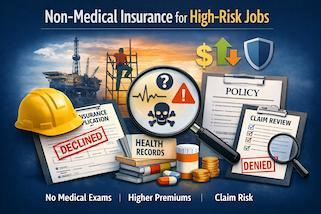
Non-medical insurance for high-risk jobs allows workers to secure coverage without undergoing medical exams, using occupational classification, disclosures, and database checks instead. While approval is faster, insurers offset the uncertainty with higher premiums, lower coverage limits, and stricter exclusions. Critically, underwriting shifts from pre-approval verification to post-claim investigation, increasing the risk of denial if disclosures are incomplete or inconsistent. For a full breakdown of how insurers evaluate these risks, see how underwriting works for high-risk jobs. Insurance regulators require full disclosure regardless of underwriting method, meaning non-medical policies are still subject to post-claim verification, as outlined in NAIC consumer guidance. This structure makes non-medical insurance suitable for speed and accessibility, but less reliable for claim certainty in high-risk occupations.
What Is Non-Medical Insurance for High-Risk Jobs?
Non-medical insurance refers to life or disability policies issued without a physical medical examination or lab testing. Instead of verifying health risk upfront, insurers rely on indirect data sources and statistical models.
For high-risk workers, this creates a fundamentally different insurance structure. This difference is rooted in occupational risk classification systems used by insurers.
Core Definition
Non-medical insurance =
Coverage issued based on declared information + risk modeling, not clinical verification.
How It Differs from Fully Underwritten Policies
| Factor | Fully Underwritten | Non-Medical |
|---|---|---|
| Medical exam | Required | Not required |
| Risk validation | Verified upfront | Deferred |
| Approval speed | Slow | Fast |
| Claim certainty | Higher | Lower |
Classification logic
From an underwriting perspective, non-medical insurance introduces a classification problem: insurers must assign applicants into risk categories without verified medical data. For high-risk occupations, this forces underwriters to rely more heavily on occupational risk classification systems, effectively increasing the weight of job-related hazard in pricing and eligibility decisions.
How Non-Medical Underwriting Works (System Breakdown)
This is where real underwriting logic matters.
1. Data Sources Used Instead of Medical Exams
Insurers substitute clinical testing with:
- Occupational classification systems
(e.g., offshore worker vs warehouse staff) - Self-reported disclosures
(health, lifestyle, job duties) - Prescription databases
(flags chronic conditions) - Insurance history databases
(past claims, prior applications)
In contrast, fully verified policies rely on medical exams for high-risk insurance underwriting decisions.
Insurers often rely on third-party data sources and prescription databases to validate risk signals in the absence of medical exams, as outlined by the Insurance Information Institute.
2. Risk Scoring Without Verification
Instead of confirming your health, insurers:
- Assign probability scores
- Compare against population risk models
- Adjust for occupation risk multipliers
For high-risk jobs, this creates a key issue:
You are being priced as both medically uncertain and occupationally hazardous.
In practice, underwriters apply structured filters to control the uncertainty created by the absence of medical verification. These filters act as operational substitutes for clinical validation and determine whether a non-medical application can proceed to approval.
Key underwriting filters include:
Maximum coverage thresholds allowed without medical evidence
Occupation-specific acceptance classes based on hazard exposure
Disclosure consistency checks across application data and third-party databases
Automatic decline triggers for high-risk combinations (e.g., hazardous occupation combined with flagged medical indicators)
Together, these filters reduce underwriting uncertainty by narrowing the acceptable risk range before policy issuance.
Underwriting filter model (non-medical policies): When medical verification is removed, insurers rely on predefined thresholds, occupational classification systems, and data consistency checks to control risk exposure before approval.
3. Pricing and Structural Adjustments
Because uncertainty is higher, insurers compensate by:
- Increasing premiums
- Limiting coverage amounts
- Embedding exclusions
- Tightening claim review rules
Why High-Risk Workers Choose Non-Medical Insurance
Despite the risks, demand is high for structural reasons.
1. Speed of Approval
- Non-medical: 24–72 hours
- Fully underwritten: 2–8 weeks
For workers starting contracts (offshore, oil rigs, remote sites), timing matters.
2. Avoiding Medical Disqualification
High-risk workers often face:
- Hypertension
- Fatigue-related conditions
- Prior injuries
These can trigger:
- Declines
- Premium loadings
- Policy exclusions
3. Logistical Constraints
- Offshore workers cannot easily attend medical exams
- Remote locations limit access to approved exam centers
4. Strategic Use (Last-Resort Coverage)
Many applicants use non-medical policies when:
- Fully underwritten coverage fails
- Urgent coverage is required
The Tradeoffs: What You Gain vs What You Risk
This is the most important section for decision-making.
What You Gain
✔ Faster Access to Coverage
- Immediate financial protection
- Useful for contract-based workers
✔ Simplified Application Process
- No blood tests or medical visits
- Less documentation
✔ Accessibility for Borderline Applicants
- Individuals who might fail medical exams can still qualify
What You Lose
❌ Higher Premiums
- You pay for uncertainty
- Insurers price for worst-case scenarios
❌ Lower Coverage Limits
- Policies often capped below fully underwritten equivalents
❌ Narrower Coverage Scope
- Occupational exclusions
- Hazard-specific limitations
❌ Increased Claim Risk
- Greater likelihood of:
- Claim delays
- Claim denials
- Policy rescission
These tradeoffs are not arbitrary; they reflect how insurers price uncertainty. Without medical verification, underwriters assume a wider risk range, leading to conservative pricing, reduced exposure limits, and stricter contractual protections.
Underwriting Translation: What Insurers Are Actually Doing
Let’s break this down into real decision logic.
Approval Conditions
Insurers typically approve non-medical policies when:
- Coverage amount is below threshold
- Occupation falls within acceptable high-risk categories
- Applicant disclosures appear consistent
In many underwriting frameworks, non-medical approvals are limited to predefined bands, such as:
- Low-to-mid coverage amounts below internal risk thresholds
- Occupations within insurable hazard classes
- Applicants without conflicting third-party data signals
Once these thresholds are exceeded, full medical underwriting is typically required. These thresholds are defined by eligibility requirements insurers apply to high-risk workers.
Decision breakpoint (non-medical underwriting):
Non-medical approval typically fails when risk crosses combined thresholds, such as:
– High-risk occupation + elevated undisclosed medical probability
– Coverage amount exceeding simplified issue limits
– Conflicting data between application disclosures and third-party databases
At this point, insurers either:
– Require full medical underwriting, or
– Decline coverage entirely
Risk Flags That Trigger Restrictions
- Hazardous occupation + no medical data
- Incomplete or vague disclosures
- History of prior claims
- Prescription database inconsistencies
Common Policy Adjustments
- Premium loading: Increased cost per unit of risk
- Exclusions: Job-specific risks removed from coverage
- Coverage caps: Lower payout ceilings
Simplified issue and non-medical policies are typically priced higher due to reduced risk verification, a pattern consistently noted in industry underwriting frameworks.
Key Insight
Insurers are not reducing risk; they are shifting it into policy structure and claim conditions.
Structural Exclusions in Non-Medical Policies
High-risk workers often miss this completely.
Common exclusions include:
- Offshore accident exclusions
- Hazardous duty exclusions
- Pre-existing condition clauses
- High-risk activity limitations
These exclusions are often broader in non-medical policies.
These exclusions are not incidental; they are deliberate underwriting tools used to isolate risks that cannot be confidently priced without medical verification.
Structural exclusion model (non-medical policies):
Exclusions are used to isolate high-uncertainty risks that cannot be priced accurately without medical verification, reducing insurer exposure at claim stage.
Failure Paths: How Claims Get Denied
This is where non-medical insurance introduces elevated claim risk.
1. Misrepresentation of Health
- Undisclosed conditions
- Incomplete medical history
2. Occupational Misclassification
- Job duties not accurately described
- Hazard level understated
3. Contestability Period Claims
- Claims within first 1–2 years trigger deep audits
4. Data Mismatch
- Application vs prescription records
- Application vs employment records
5. Exclusion Triggers
- Death or injury falls under excluded category
Critical Reality
Non-medical underwriting delays verification, it does not eliminate it.
These failure patterns reflect the broader system explained in risk job insurance explained.
In non-medical policies, the claim stage effectively becomes a secondary underwriting phase, where insurers validate the accuracy of initial disclosures before releasing payment.
During the contestability period, insurers can investigate and deny claims based on misrepresentation or non-disclosure, a standard practice explained in regulatory guidance.
Claim Breakpoints: When Insurers Investigate
These investigation triggers follow the same underwriting logic outlined in how underwriting works for high-risk jobs, where insurers reassess risk when financial exposure or uncertainty increases.
Certain events trigger deeper review:
High-Risk Triggers
- Early death (within contestability period)
- Large payout claims
- Work-related incidents
- Suspicious inconsistencies
What Insurers Do at This Stage
- Retrieve medical history
- Audit employment records
- Cross-check databases
- Validate disclosures
Real-World Scenarios
Scenario 1: Offshore Worker (Claim Denied)
- Applies for non-medical insurance
- No exam required → fast approval
- Dies within 14 months offshore
Post-claim findings:
- Undisclosed hypertension
- Prescription history detected
Outcome: Claim denied
Scenario 2: Construction Worker (Partial Payout)
- Approved quickly
- Policy includes occupational exclusion
Incident:
- Fatal site accident
Outcome:
- Claim reduced due to exclusion clause
Scenario 3: Mining Worker (Delayed Claim)
- Non-medical policy issued
- Claim occurs within contestability period
Outcome:
- Extended investigation
- Payment delayed for months
These breakpoints exist because they represent scenarios where the financial exposure is high or the probability of misrepresentation is statistically elevated.
Evidence Block (Regulatory + Industry Logic)
Insurance regulators and industry data confirm the structural risks in non-medical underwriting:
- Disclosure requirements apply regardless of underwriting method, with insurers permitted to deny claims for misrepresentation under contestability rules (NAIC)
- Simplified issue policies consistently carry higher premiums and lower coverage thresholds due to reduced risk verification (Insurance Information Institute)
- Occupational risk remains a primary pricing driver, with fatality and hazard data from OSHA and NIOSH influencing underwriting classification models
These factors explain why non-medical insurance carries both accessibility advantages and elevated claim risk, with simplified issue policies consistently priced higher and issued at lower coverage limits compared to fully underwritten equivalents.
This pricing and coverage gap reflects the higher uncertainty associated with non-medical underwriting, where the absence of clinical verification increases variability in expected claim outcomes.
When Non-Medical Insurance Becomes a Bad Choice
Non-medical insurance becomes structurally risky when:
- The applicant has known but undisclosed medical conditions
- The occupation involves extreme hazard exposure (e.g., offshore drilling, mining)
- The policy is intended for high-value coverage beyond simplified issue thresholds
In these cases, the probability of claim denial or reduced payout increases significantly, making fully underwritten policies a more reliable option despite longer approval timelines.
In contrast, fully underwritten policies reduce claim-stage uncertainty by verifying medical risk upfront, resulting in more stable pricing, fewer exclusions, and higher claim reliability.
Key Takeaways
- Non-medical insurance for high-risk jobs trades speed for certainty; approval is faster, but underwriting risk is shifted to the claim stage.
- Underwriting moves from pre-approval verification to post-claim validation, meaning insurers may investigate disclosures only after a claim is filed.
- High-risk occupations amplify pricing and restriction mechanisms, including higher premiums, lower coverage limits, and broader exclusions.
- Underwriting filters (coverage thresholds, occupational classes, and data checks) replace medical exams but do not eliminate risk; they redistribute it.
- Most claim denials occur due to disclosure issues or exclusion triggers, especially within the contestability period.
- Non-medical policies are best suited for speed or accessibility, not for maximizing payout certainty in high-risk environments.
Decision summary (non-medical underwriting): Faster access to coverage comes at the cost of higher uncertainty, stricter policy structure, and increased reliance on post-claim verification.
Final underwriting insight:
Non-medical insurance does not eliminate risk, it shifts the timing of risk evaluation from policy issuance to claim settlement, fundamentally changing how coverage reliability should be assessed by high-risk workers.