Editorial notice: Reviewed for underwriting accuracy by the RJI Underwriting Research Team | Published: June, 2026 | Last reviewed: June, 2026.
————————————————————————————————————–
Executive Summary
Structural steel erectors assemble the load-bearing framework of modern infrastructure, hoisting multi-ton I-beams, girders, and columns via cranes and securing them at extreme elevations. While the trade is physically defined by iron, welding torches, and high-strength bolts, commercial insurance carriers define it by two catastrophic financial exposures: high-risk construction fall hazards and structural collapse risk. Because a single operational failure in this sector can trigger multi-million-dollar losses across workers’ compensation, general liability, and commercial auto lines, Structural Steel Erector Insurance is evaluated through a strict institutional framework rather than a general contracting underwriting lens. Underwriters do not merely price the manual labor performed; they calculate the statistical probability that an employer’s site engineering, rigging plans, and fall-arrest programs will fail. Pricing and coverage eligibility are ultimately dictated by an insured’s ability to demonstrate total systemic control over these catastrophic severity variables. This evaluation follows the broader framework explained in Height Exposure Underwriting.
Underwriting Insight: In structural steel erection, insurers do not price the job title; they price the engineering systems designed to control catastrophic kinetic energy. An underwriter evaluates the interaction between occupational exposure, operational controls, historical loss development, and capacity availability. A business that views safety as a regulatory administrative obligation will face compounding premiums and restricted market access, whereas an organization that structures its operations around verifiable hazard mitigation controls converts its risk profile into a preferred underwriting asset.
The Physical Weight of the Loss Pathway
To an ironworker or steel contracting foreman, the daily work reality consists of wind shear, heavy iron, taglines, impact wrenches, and the constant psychological awareness of the drop. To an insurance carrier, this human reality is a complex data engine that converts physical friction into financial loss development. Understanding how a worker’s physical movements cross the threshold into an insurance claim requires looking past generic job descriptions to analyze the exact mechanics of workplace risk measurement.
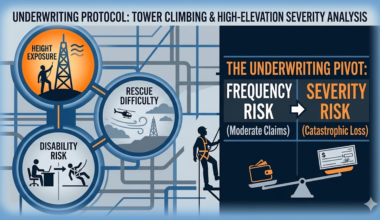
Because structural steel erection combines extreme working heights with heavy suspended loads, even a single fall can produce life-altering injuries. Insurers evaluate these events primarily through their catastrophic financial consequences rather than their frequency, a principle explored further in Catastrophic Fall Risk Insurance.
Daily Work Conditions That Drive Insurance Risk
The operational environment of a structural steel erector is inherently unstable and highly exposed to ambient variables. Workers operate at significant elevations, frequently exceeding 100 feet on commercial, industrial, or high-rise projects, where wind speeds are amplified, and surfaces are vulnerable to frost, moisture, and oil film. The equipment utilized includes heavy mobile cranes, tower cranes, aerial lifts, and structural connecting tools.
Connecting ironworkers must straddle unbraced beams to guide multi-ton structural members into place while fighting the pendulum motion of a crane load. The physical demands require continuous climbing, balancing, and heavy lifting under extreme cognitive stress. Environmental hazards are not limited to gravity; they include intense thermal radiation from welding operations, high-decibel acoustic environments that disrupt critical communication between the crane operator and signalmen, and concurrent operations (simo-ops) where other trades operate directly below or beside the steel framework.
The Injury Patterns That Shape Insurance Costs
This physical environment generates an occupational hazard profile dominated by extreme claim severity. While minor injuries such as lacerations from handling sharp metal or flash burns from welding torches occur with moderate claims frequency, underwriting models focus heavily on the trailing indicators of severe injuries and long-term impairment risks:
-
Traumatic Trajectory Falls: Falls from elevated steel structures introduce catastrophic claim uncertainty, almost always resulting in traumatic brain injuries (TBIs), spinal cord transections resulting in permanent quadriplegia, or immediate fatalities.
-
Crush and Impact Injuries: When a multi-ton beam shifts due to an improper rigging configuration or a premature tagline release, the kinetic energy transferred to a worker results in traumatic amputations, internal organ pulverization, or pelvic crush syndromes.
-
Occupational Disease and Long-Term Impairment: Beyond acute trauma, long-term exposure to hexavalent chromium during stainless steel welding, lead paint disturbance during structural retrofits, and chronic musculoskeletal degradation from manipulating heavy impact tools create substantial latent workers’ compensation exposures.
To an insurer, these injuries represent massive financial reserve uncertainty. A permanent total disability (PTD) claim for a young connector can easily require carriers to establish initial claims reserves exceeding millions of dollars to cover lifetime indemnity payments and escalating specialized medical care.
Why Structural Steel Injury Claims Become Complex
When an ironworker is severely injured, the subsequent claim process highlights the structural tension between the physical event and the insurance system. Claims frequently stall or become highly contested due to documentation challenges and structural validation requirements:
-
The Reporting Lag: In the chaotic aftermath of a site accident, employers frequently delay formal claim reporting while managing OSHA investigations and project shutdowns. Underwriters know that a multi-day delay in reporting a severe spinal injury increases ultimate loss costs due to unmanaged medical networks and early attorney involvement.
-
The Evidence Void: Because steel erection occurs dynamically at height, establishing whether an ironworker was properly tied off at the exact millisecond of a fall requires rigorous forensic documentation. If pre-shift fall protection inspection logs, daily job hazard analyses (JHAs), and anchor-point certifications are missing or incomplete, the claim is pushed into litigation, expanding the defense costs borne by the policy.
-
Return-to-Work Impediments: The highly demanding physical nature of steel erection makes temporary transitional duties or “light-duty” accommodations exceptionally difficult to execute. An ironworker with a modified lifting restriction cannot safely return to an active connecting deck. This structural reality extends the duration of temporary total disability (TTD) benefits, driving up the total cost of the claim and directly inflating the employer’s long-term loss history. When injuries progress from temporary disability to permanent impairment, insurers fundamentally reassess the lifetime financial exposure of the claim, a transition explored further in Permanent Disability Risk Insurance.
Claim Breakpoint Threshold: Approval commonly shifts toward intensive claims review and legal contestation when an elevated fall injury lacks immediate, contemporaneous digital log validation of anchor-point certification. Without verifiable pre-shift documentation, the system experiences a structural breakdown. This makes the claim harder to verify, increases expected claim costs, and reduces the insurer’s willingness to offer favorable terms on upcoming renewals.
What Happens After an Elevation Injury?
-
Worker Directive: File an injury notice immediately, even if a fall was partially arrested and you believe you are unhurt. Because internal spine, joint, or suspension trauma injuries often take days to manifest, an unlogged incident creates an evidence void that can cause claims adjusters to contest medical necessity or delay wage replacements later.
-
Foreman Takeaway: If a crew member experiences a fall or heavy impact, protect your team and your policy by freezing the immediate gear configuration. Take digital photos of the harnesses, lanyards, and anchorage components instantly. Delayed reporting or missing field logs strip away the carrier’s managed medical network advantages, dragging out the claim’s financial duration and ultimate settlement cost.
How Insurers Classify Structural Steel Risk
Before a carrier applies a single premium dollar to a risk, they must map the physical reality of the ironworker into a rigid regulatory framework. Insurers rely on standardized coding structures to maintain statistical consistency across hundreds of thousands of data points, drawing an absolute underwriting classification boundary around the business operations.
+----------------------------------------+
|          HUMAN SITE REALITY            |
| Connecting multi-ton steel at 150 ft   |
+-------------------+--------------------+
                    |
                    v
+-------------------+--------------------+
|       CLASSIFICATION VALIDATION        |
| Mapped to NCCI 5040 / NAICS 238120     |
+-------------------+--------------------+
                    |
                    v
+-------------------+--------------------+
|        UNDERWRITING TRANSLATION        |
| Manual Rate applied + EMR Multiplier   |
+----------------------------------------+
Figure 1: Visual mapping of field structural activities into regulatory insurance codes, defining the precise parameters where premium calculations begin.
Primary Regulatory Codes
In the United States, occupational classification is governed by several interconnected regulatory systems, each serving a unique function in the risk pricing architecture:
- NCCI Class Codes: The National Council on Compensation Insurance assigns four-digit codes to categorize workers’ compensation exposures. For structural steel erectors, the foundational code is NCCI Class Code 5040 (Iron or Steel: Erection – Structural). This code commands some of the highest manual rates in the construction industry due to its intrinsic severity profile. The classification itself establishes only the starting point for pricing. Final premiums also depend on payroll distribution, experience modification, and historical loss performance, relationships explored further in NCCI Class Codes and EMR for High-Risk Occupations. The underlying classification rules, payroll assignment requirements, and audit procedures are established in the NCCI Scopes® Manual, which serves as the primary reference for workers’ compensation classification.
-
ISO Classification: The Insurance Services Office provides classification codes for commercial general liability (CGL) policies. Structural steel erection is typically classified under ISO Code 99165 (Steel Erection – Structural), which segregates this severe structural collapse and third-party property damage risk from lighter non-structural operations.
-
NAICS Codes: The North American Industry Classification System uses NAICS Code 238120 (Structural Steel and Precast Concrete Contractors) to track macro-economic data and industry-level safety trends.
These classification systems exist to prevent data contamination. By isolating structural steel exposure from general carpentry or interior fit-outs, actuarial models can accurately project future loss trends based purely on the historical performance of high-risk structural operations.
Occupational Classification Logic
A common point of operational friction occurs when a business owner assumes all metalworking activities are evaluated identically. Underwriters enforce strict boundaries between NCCI Class Code 5040 and adjacent codes based on the structural function of the iron and the height at which it is installed:
| NCCI Code | Description | Risk Profile | Underwriting Verdict |
| 5040 | Iron/Steel: Erection – Structural | Heavy load-bearing framing, multi-story hoisting, crane dependence. | High Manual Rate; strict eligibility requirements. |
| 5057 | Iron/Steel: Erection – N.O.C. | Miscellaneous ironwork, stairways, fire escapes, and non-bearing elements. | Moderate Manual Rate; intermediate hazard profile. |
| 5059 | Iron/Steel: Erection – Frame Buildings | Light-gauge steel framing, low-rise structures, residential scale. | Lower Manual Rate; lower kinetic energy exposure. |
If an employer utilizes workers classified under Code 5057 to perform structural column splicing or main girder connections on a commercial project, they are operating outside their underwriting classification boundary. This mismatch distorts the predictive accuracy of the pricing model, increases uncertainty about future losses, and can lead to immediate policy cancellation or severe retroactive audit penalties.
These classification systems exist to prevent data contamination. By isolating structural steel exposure from general carpentry or interior fit-outs, actuarial models can accurately project future loss trends based purely on the historical performance of high-risk structural operations. Within the broader occupational insurance system, structural steel erection consistently ranks among the highest-rated construction classifications because of its combination of extreme elevation, suspended loads, and catastrophic injury potential. This comparative underwriting framework is explored further in the Occupational Class Ratings Guide, which explains how insurers rank different occupations according to expected claim frequency, severity, and long-term loss development.
When Contractors Move Into Higher-Risk Work
Occupational profiles are rarely static. A contractor may begin a fiscal year specializing in low-rise ornamental ironwork (Class 5057), but secure a mid-year contract requiring the erection of a structural steel clear-span warehouse (Class 5040). This phenomenon is known as transitional drift.
When operations shift without proactive underwriter notification, a severe classification mismatch risk emerges. If an ironworker falls while executing a structural connection under an ornamental classification, the carrier’s claims department will instantly flag the operational variance. While the workers’ compensation claim must be paid by law, the carrier will trigger a comprehensive re-underwriting audit, recalculate premiums retroactively using the higher-rated structural class code, and frequently non-renew the account due to material misrepresentation of exposure variables.
How Payroll Audits Increase Insurance Costs
The annual commercial insurance audit is the ultimate validation mechanism for occupational classification. For structural steel erectors, payroll allocation during an audit represents a high-stakes financial evaluation:
-
The Division of Payroll: NCCI rules require that, unless explicit, contemporaneous time-card documentation is maintained down to the exact hour, an employee’s entire payroll for that reporting period will be allocated to the highest-rated applicable classification. If an ironworker spends 39 hours doing light ornamental welding and 1 hour connecting a structural I-beam, the entire 40-hour payroll is swept into Code 5040 if distinct records are absent. This represents a critical audit threshold where a single hour of missing data converts a lower-rated payroll segment into a high-premium structural classification.
-
Subcontractor Payroll Contamination: Underwriters strictly evaluate the use of uninsured or underinsured subcontractors. If a steel erector hires independent weld crews or rigging labor who do not carry valid workers’ compensation certificates, the auditor will legally pull those subcontractor payments into the primary insured’s payroll basis, generating massive, unexpected premium adjustments at the end of the policy term.
-
The Impact of Premium Overtime: Actuarial models recognize that while overtime hours increase payroll totals, they do not necessarily scale the underlying exposure linearly. Auditors allow for the exclusion of the premium portion of overtime pay (e.g., the “half-time” in time-and-a-half), provided the employer’s payroll records are structured to clearly break out regular hourly rates versus premium overtime differentials.
What Is the Most Common Contractor Classification Mistake?
-
Estimator Warning: Never assume you can cross-mix worker hours arbitrarily on an active commercial estimate. If field supervisors fail to split hours meticulously via daily timecards down to the exact clock hours, the auditor will automatically apply the structural rate (5040) to 100% of that employee’s annual payroll, blowing past your projected project budget overhead.
-
Worker Directive: If your duties change significantly during a project, such as moving from ground assembly to tying into structural columns, make sure this change is communicated to the office, so your work records accurately reflect the specific tasks you performed. This precision protects the business’s bidding capacity and ensures audit transparency.
How Insurers Financially Model Structural Steel Risk
Once the occupational exposure is classified, the file moves into active financial translation. Underwriters analyze an asset through a series of formulas, modifiers, and filters to answer one primary question: Is the premium collected sufficient to offset the ultimate cost of the claims this risk will generate over a ten-year development horizon?
How Insurers Calculate Base Premiums
Every structural steel risk starts its journey at the manual base rate level. The base rate for NCCI Class Code 5040 is determined by the historical loss data of the state in which the work is performed. This base rate reflects the structural volatility of the trade. Actuarial pricing models assume that steel erection will exhibit low claims frequency but exceptionally high claims severity. Because the expected losses per $100 of payroll are structurally elevated, the baseline premium is intentionally designed to absorb massive, shock-loss occurrences. The carrier builds a long-term capital reserve around the account, assuming that a single major loss will require decades of premium accumulation to amortize.
How EMR and Schedule Rating Change Premiums
The manual base rate is merely a generic starting point. The unique operational quality of an individual contractor is calculated using mathematical rating modifiers:
-
Experience Modification Rate (EMR): The experience modification rate construction system is a rolling three-year empirical calculation that compares an employer’s actual historical losses against the expected losses calculated for their specific payroll volume and classification. The formula uses a credibility weighting factor that heavily penalizes claim frequency over claim severity. A single large shock loss from a crane collapse hurts an EMR less than multiple separate smaller fall-protection or rigging injury claims over the same experience rating period. Frequency indicates a systemic failure of operational controls, which predictive underwriting models view as an absolute precursor to a catastrophic event. An EMR above the standard baseline of 1.00 brands the contractor as a debit risk, instantly crossing a critical pricing threshold that raises insurance costs and can lock them out of institutional project bidding.
-
Schedule Rating Modifiers: Separate from the mathematical calculation of the EMR, the underwriter possesses discretionary authority to adjust premiums via schedule rating factors. These adjustments are based on qualitative operational controls: the stability of executive leadership, the presence of an in-house crane inspector, or the longevity of the field crew. A high-quality account can offset a high base rate by securing maximum schedule credits through verified management excellence.
How Underwriters Read Your Claims History
An underwriter interprets loss runs through a lens of long-term financial erosion. When evaluating a steel erector’s loss runs, several critical metrics are analyzed:
-
Incurred vs. Paid Losses: Paid losses represent cash already disbursed. Incurred losses represent paid cash plus the claims adjuster’s financial reserves for future payouts. Underwriters price accounts based on total incurred losses, evaluating whether the carrier’s financial reserves are developing positively or negatively over time.
-
Reserve Development: If an older worker’s compensation claim has developed steadily upward due to latent orthopedic complications or neurological failure, this negative reserve development signals that the employer’s operations generate long-tail, unpredictable exposures.
-
Trend Analysis: A steady upward trajectory in claims frequency, even for minor medical-only events, indicates to an underwriter that site discipline is decaying. Actuarial hazard modeling shows that an unmanaged spike in minor rigging incidents increases claim uncertainty, making the company significantly harder to insure and serving as a warning that operations may intersect with a catastrophic failure pathway if left uncorrected.
Why Contractors Fail Underwriting Review
Carriers maintain rigid internal guidelines that function as immediate eligibility filters. If an account hits a single underwriter red flag, it is frequently declined automatically, regardless of the premium size:
[ACCOUNTS SUBMITTED]
         │
         ▼
┌─────────────────────────────────┐
│     ELIGIBILITY FILTERS        │
│  - EMR Threshold Baseline       │  ──> [FAILED]  ──> Declined
│  - No Structural Claims > Limit │
└────────────────┬────────────────┘
                 │ [PASSED]
                 ▼
┌─────────────────────────────────┐
│     UNDERWRITER RED FLAGS       │
│  - Active OSHA Citations        │  ──> [TRIGGERED] ──> Open Audit /
│  - Rapid Payroll Growth (> 30%) │                      Premium Escalation
└────────────────┬────────────────┘
                 │ [CLEARED]
                 ▼
     [BINDABLE COVERAGE ASSET]
Figure 2: Institutional review gates where accounts are automatically routed based on data thresholds and operational compliance indicators.
-
EMR Thresholds: Many standard-market carriers refuse to evaluate any structural steel erector whose EMR breaches strict internal limits, representing a hard approval threshold where the risk transitions from standard markets to non-admitted surplus lines.
-
OSHA General Duty Clause Citations: Active or uncorrected citations under the OSHA fall protection insurance implications framework act as an immediate underwriting veto.
-
Operational Instability and Rapid Growth: A steel erector whose payroll expands excessively in a single twelve-month cycle flags a severe warning. Rapid growth implies the hiring of unvetted, green ironworkers who lack institutional safety training, directly escalating the probability of an operational breakdown.
-
Subcontractor Risk Exposure: If a contractor passes too high a percentage of their core structural steel volume down to third-party sub-erectors, standard underwriters view the firm as a paper contractor with zero direct control over field operations, driving immediate exclusion from standard market pricing.
Why Did My Premium Increase After Several Minor Injuries?
-
Risk Buyer Reality: If three separate workers suffer minor hand lacerations or field strains during a routine bolt-up sequence, underwriters view this frequency pattern as clear proof that site-level supervision is failing. Actuarial data indicates that an unmanaged accumulation of minor injuries is a highly accurate predictor of a future catastrophic fall, forcing the insurer to scale up your EMR rate rapidly.
-
Worker Directive: Participate actively in daily safety updates and log all protective gear checks. Your personal adherence to minor site protocols, like keeping cut-resistant gloves on and using tool tethers, directly suppresses the claim frequency spikes that can restrict your employer’s market access, safeguarding the pipeline of projects that keeps your crew employed.
The Field Variables That Re-Shape Premiums
The abstract calculations performed in an underwriting department must eventually confront the messy reality of the active job site. Certain field variables possess massive leverage; they can instantly reduce coverage predictability or, conversely, build systemic underwriting confidence that drives down the cost of commercial insurance.
How Project Size and Height Affect Insurance
The physical dimensions of a contractor’s typical project portfolio dictate their structural exposure model. A steel erector assembling single-story pre-engineered metal buildings faces a fundamentally different risk profile than an enterprise erecting a multi-story commercial office tower or a heavy industrial petrochemical refinery module. As verticality increases, the complexity of crane configurations, wind vector modeling, and multi-tier falling object protection scales significantly. Underwriters evaluate the maximum height exposure of past and projected operations, forcing high-rise erectors into specialized surplus lines markets while routing low-rise builders through standard commercial programs. For many insurers, project height itself becomes an underwriting threshold, with increasing elevations triggering stricter eligibility requirements, reduced market appetite, or additional coverage restrictions. How insurers establish these height-based underwriting limits is explored further in Height Restrictions in Occupational Insurance Policies.
Operational Factors That Increase Claim Severity
Occupational hazard modeling identifies specific field conditions that function as operational severity amplifiers. The presence of any of the following elements reduces the insurer’s willingness to offer favorable terms and changes the valuation framework:
-
Extreme Elevation: At significant vertical heights, the biological survival rate of a worker trailing a fall-arrest line drops dramatically if suspension trauma controls are absent.
-
Confined Space Intersections: Executing structural steel modifications inside active industrial boilers, subterranean shafts, or transit tunnels creates severe extraction restrictions. If a worker is injured, emergency extraction is delayed, turning minor trauma into major medical loss.
-
Over-Water and Infrastructure Operations: Erecting steel bridges over navigable waterways or active multi-lane highways introduces marine liability or immense third-party public interaction exposures. A single dropped spud wrench or miscalculated crane radius can shut down a transportation artery, triggering catastrophic general liability property and business interruption claims.
Operational Controls That Improve Insurability
To counter these severity amplifiers, an employer must demonstrate that their site safety architecture relies on engineering controls rather than passive human behavior. Underwriters look for specific operational protocols to justify applying schedule rating credits:
-
Engineering Controls over PPE: A contractor who designs out the hazard, for example, by utilizing ground-level pre-assembly of steel trusses so that modules can be hoisted as a single pre-fabricated unit, proves they have reduced the total worker-hours exposed to height.
-
Administrative Safety Systems: Carriers scrutinize whether the firm utilizes written, non-negotiable Daily Rigging Plans, mandatory Pre-Lift Crane Inspections, and an absolute “100% Tie-Off Policy” enforced via third-party site safety audits.
-
The Rescue Infrastructure: Standard fall protection plans often stop at preventing the worker from hitting the ground. Advanced underwriting evaluates the active rescue infrastructure. If a worker hangs suspended in a harness, they face life-threatening orthostatic intolerance (suspension trauma). An underwriter rewards contractors who maintain dedicated aerial rescue teams, high-angle extraction kits, and documented rescue drill logs because the ability to rescue an injured worker quickly is itself an underwriting variable. Delayed extraction frequently increases claim severity, making rescue capability a measurable component of insurance pricing rather than simply a safety consideration. This relationship is explored further in Rescue Difficulty in Insurance Underwriting.
       [HAZARD CONTROL HIERARCHY]
  ┌────────────────────────────────────────┐
  │ 1. PRE-ASSEMBLY (Engineering Credit)    │  <-- Eliminates height exposure
  ├────────────────────────────────────────┤
  │ 2. DAILY RIGGING PLANS (Admin Credit)   │  <-- Structures critical lifts
  ├────────────────────────────────────────┤
  │ 3. ACTIVE RESCUE TEAMS (Severity Loss) │  <-- Prevents suspension trauma
  └────────────────────────────────────────┘
Figure 3: Hierarchy of operational risk controls used by underwriters to calculate schedule rating credits and rate reductions.
How Seasonal Operations and Crew Size Increase Risk
The calendar year introduces systemic risk patterns that impact financial performance. Winter operations introduce ice loading on uninsulated steel beams, reducing friction coefficients and increasing slip-and-fall frequency. Conversely, peak summer project cycles introduce severe thermal stress, inducing cognitive fatigue among ironworkers executing precision connections at height, which reduces coverage predictability.
Furthermore, underwriters evaluate accumulation risk. If an employer places a large number of ironworkers onto a single elevated decking platform under a single supervisor, they have created a concentration of exposure. A localized structural collapse or a major rigging failure at that node will simultaneously injure or kill the entire crew. This represents a definitive market threshold where the accumulation risk breaches a carrier’s net retention limits, forcing them to either decline the risk completely or split the placement across a panel of multiple insurance entities to buffer their balance sheet.
Why Wasn’t Our Written Safety Program Enough?
-
Operations Manager Insight: Underwriters do not grant premium discounts for a standard safety manual sitting on a shelf. To unlock better rates, you must prove that your field supervisors actively eliminate height exposure by pre-assembling structural steel trusses on the ground before making critical crane lifts. Shifting worker hours down to grade level is what moves the needle on an institutional risk profile.
-
Worker Directive: Keep your safety certifications current and provide updated copies whenever your employer requests them. Understanding and practicing your site’s suspension trauma rescue plan, such as deploying integrated harness relief straps immediately to relieve femoral vein pressure, proves that severe outcomes can be controlled, directly reinforcing your team’s insurability.
Where the Insurance System Breaks Down
Despite meticulous underwriting and robust premium collection, the intersection of legal language, site operations, and structural accidents frequently results in a construction insurance system breakdown. When an operational event occurs, coverage can disintegrate along highly predictable fault lines, leaving contractors exposed to crippling uninsured liabilities.
Why Claims Fail After Structural Steel Accidents
The primary failure mode in structural steel insurance centers on the immediate collection of empirical site evidence. When a crane drops an integrated steel package, the physical site changes instantly as crews rush to clear debris and secure the structure. If the corporate office fails to execute an established post-incident protocol, critical data evaporates:
-
Rigging Material Disappearance: Slings, shackles, and synthetic straps that failed are frequently thrown into scrap bins or misplaced during site remediation. Without forensic preservation of the failed rigging component, the insurer cannot execute subrogation actions against the manufacturer, forcing the entire financial burden of the loss to permanently sit on the contractor’s internal loss history.
-
The Unsigned JHA: If a workers’ compensation claim involves an injured ironworker whose signature is missing from that morning’s Job Hazard Analysis or fall-protection sign-in sheet, plaintiff attorneys can easily argue that the employer failed to communicate site-specific hazards. This converts a standard administrative claim into a high-risk employer liability lawsuit or a willful OSHA violation defense action.
Coverage Gaps and Structural Exclusions
Commercial general liability and clauses for high-risk construction trades are intentionally written with narrow operational scopes. Steel erectors routinely fall victim to catastrophic coverage gaps buried within policy endorsements:
-
The Crane & Rigging “Care, Custody, or Control” Exclusion: A standard CGL policy excludes damage to property owned, rented, or controlled by the insured. If a steel erector elevates an expensive custom HVAC structural chassis, and the rigging fails, the CGL policy will explicitly deny coverage for the destroyed equipment under the Care, Custody, or Control exclusion. Without a specialized Rigger’s Liability Endorsement attached to an Inland Marine policy, the contractor is entirely self-insured for the physical asset being lifted.
-
The Action Over Exclusion: In many jurisdictions, injured workers cannot sue their employer directly due to the exclusive remedy of workers’ compensation law. However, the worker can sue the project’s General Contractor or Project Owner for failing to maintain a safe job site. The General Contractor then turns around and sues the Steel Erector for contractual indemnification based on the contract’s hold-harmless clauses. If the steel erector’s CGL policy contains an Employee Indemnification / Action Over Exclusion, the insurer will refuse to defend or indemnify the contractor against this third-party lawsuit, triggering immediate corporate insolvency.
When Insurance Response Changes After a Major Loss
Every commercial policy operates under definite structural thresholds where the response mechanics fundamentally alter. In steel erection, these breakpoints are defined by the physical severity of the event:
[OPERATIONAL INCIDENT OCCURS]
             │
             ├─> Medical Only Claim ─────────> Paid via Workers' Comp Reserve
             │
             ├─> Severed Rigging Line ───────> Exceeds Deductible Boundary
             │                                 (Triggers Rigger's Marine Policy)
             │
             └─> Catastrophic Site Collapse ──> Breaches CGL Primary Limit ($1M)
                                               (Triggers Umbrella/Excess Layers)
Figure 4: Algorithmic progression of insurance lines responding to varying degrees of site structural failure.
When an event crosses from a localized asset loss into a systemic structural collapse, it instantly breaches the primary CGL limit (typically capped at $1,000,000 per occurrence). At this claim threshold, the primary carrier relinquishes control of the defense panel, and specialized Umbrella and Excess Liability underwriters step in to manage the exposure. If the contractor failed to maintain absolute continuity of underwriting definitions between their primary and excess policy layers, they face a devastating structural gap where the excess policy refuses to drop down and cover the loss due to an unaligned exclusion framework.
Why Was This Commercial Claim Denied?
-
Risk Manager Alert: Check your policy exclusions list right now for an Action Over endorsement. If an injured ironworker files a third-party injury claim against the project general contractor, and the contractor uses the contract’s indemnity language to redirect that multi-million dollar liability back to you, this exclusion permits your insurer to completely walk away from the defense panel.
-
Worker Directive: Always read and verify your involvement in the job-site safety briefing before stepping onto a connecting deck. If you are hurt and your confirmation is missing from that day’s safety briefing log, defense lawyers will weaponize the documentation gap during upcoming workers’ compensation hearings to assert you ignored explicit, documented site safety commands.
How One Accident Triggers Multiple Policies
Actuarial hazard modeling emphasizes that a single physical failure on a structural steel project does not restrict itself to one type of insurance. Because ironwork manipulates immense mass at extreme elevation, an operational breakdown triggers an immediate cascading response across multiple distinct lines of coverage, each interpreting the same occupational mechanics through a unique legal lens.
To illustrate this systemic interaction, consider a realistic operational scenario: A mobile crane, overloaded while attempting to swing a structural steel truss into position on a multi-story building site, suffers an outrigger structural failure, causing the crane to tip forward. The falling steel truss crushes a passing commercial delivery vehicle on an adjacent municipal street, while the collapsing crane boom cuts through active scaffolding, severely injuring two connecting ironworkers and causing a partial collapse of the building’s concrete masonry core.
                   +----------------------------------+
                   |  CATASTROPHE EVENT: CRANE UPSET  |
                   +----------------+-----------------+
                                    |
     +------------------------------+------------------------------+
     |                              |                              |
     v                              v                              v
+----+---------------------+  +-----+--------------------+  +------+-------------------+
|  WORKERS' COMPENSATION  |  |  GENERAL LIABILITY       |  |  INLAND MARINE /         |
|                          |  |                          |  |  RIGGER'S LIABILITY      |
| Covers medical/indemnity |  | Covers third-party auto/ |  | Covers physical crane/   |
| for injured ironworkers. |  | structural building core.|  | shattered steel asset.   |
+--------------------------+  +--------------------------+  +--------------------------+
Figure 5: Cross-line policy collision resulting from a single point of failure on an active rigging deck.
Here is how different insurance lines independently interpret and respond to this single operational catastrophe:
Workers’ Compensation
The workers’ compensation policy operates on a statutory, no-fault basis. It completely ignores whether the crane operator misread the load chart or if the ironworkers were improperly positioned. The policy immediately activates to cover 100% of the medical treatments, emergency surgeries, and long-term rehabilitation costs for the two injured ironworkers. Simultaneously, it provides indemnity benefits to replace lost wages during their temporary or permanent total disability periods. The underwriter’s primary concern here is the long-tail medical inflation and the massive reserve required to support the injured workers over a potentially multi-decade horizon, which will directly inflate the firm’s EMR for the subsequent three years.
Commercial General Liability (CGL)
The CGL policy is designed strictly to defend the insured against third-party bodily injury and property damage claims. The CGL underwriter views this accident through the lens of legal liability and tort exposure. The policy responds to the property damage claim filed by the owner of the crushed delivery vehicle and covers any bodily injury claims filed by members of the public or other non-employee site personnel.
However, the CGL policy contains a structural wall: the Care, Custody, or Control exclusion and the Your Work exclusion. The CGL will flatly refuse to pay for the replacement of the structural steel truss itself, nor will it pay to rebuild the concrete masonry core that was damaged by the steel erector’s own operations, as standard liability lines do not function as a performance bond for faulty workmanship or operational errors.
Inland Marine / Contractor’s Equipment & Rigger’s Liability
While the crane is a vehicle, it is classified as mobile construction machinery, which isolates its physical damage coverage away from Commercial Auto lines and places it directly onto an Inland Marine floaters policy. The Inland Marine underwriter evaluates the physical loss of the crane asset itself based on depreciated cash value or scheduled replacement cost. Concurrently, if a specialized Rigger’s Liability Endorsement was executed, this specific policy layer drops down to cover the financial cost of the ruined structural steel truss that was actively suspended in the air at the moment of the rigging failure, clearing the exclusion boundary that paralyzed the primary CGL policy.
Excess / Umbrella Liability
Because of the concurrent financial losses, combining third-party auto destruction, structural building damage, and catastrophic bodily injury exposures, will rapidly exhaust the primary $1,000,000 CGL limit, the excess liability policy is immediately triggered. The excess underwriter takes control of the defense strategy, deploying specialized legal counsel to structure global settlement agreements designed to protect the steel erector from direct corporate asset seizure. The availability of this line depends entirely on whether the primary insurance lines were structured with concurrent, uninterrupted coverage boundaries that align perfectly with the excess layer’s attachment points.
One Accident. Four Policies.
-
Equipment Manager Impact: A single rigging drop instantly triggers four different claims adjusters simultaneously. You must ensure absolute crossover consistency. If your broker failed to link your Inland Marine property definitions with your primary general liability lines, your policy may pay out for the crane damage but reject the multi-tier building cleanup expenses.
-
Worker Directive: Understand that workers’ compensation and third-party liability investigations often have different objectives. If you are asked to provide statements beyond your workers’ compensation claim, make sure you understand who is requesting the information and why. Your core medical care is protected under workers’ compensation, but separate liability lines prioritize mapping fault across the project structure.
Why Structural Steel Insurance Becomes More Expensive
The aggregate financial performance of high-risk trades like structural steel erection dictates how insurance carriers deploy their underwriting capital globally. Contractors do not operate in an isolated vacuum; they are highly vulnerable to macro-economic market currents and systemic carrier appetite shifts.
Why Insurance Capacity Is Limited
In commercial insurance, capacity is the maximum amount of capital an insurance company is willing to risk on a specific industry sector or individual policy. Because structural steel insurance exposes a carrier to severe catastrophic shock losses, total market capacity is permanently constrained. Standard admitted insurance carriers (such as those providing standard business owner policies) almost completely avoid this trade. Instead, the market is heavily dominated by a highly restricted number of domestic surplus lines carriers and specialized Lloyd’s of London syndicates. When global reinsurance capital contracts due to unrelated worldwide property catastrophes, the capacity for high-risk domestic construction lines drops instantly, forcing carriers to raise minimum premiums, restrict policy limits, and enforce stricter eligibility criteria for steel contractors. This relationship between global reinsurance conditions and underwriting capacity is regularly analyzed in Lloyd’s market reports, which provide insight into how catastrophic losses influence commercial insurance availability and pricing.
How Regulation, Litigation, and Reinsurance Affect Pricing
The structural steel insurance market is hyper-sensitive to changes in the legal and regulatory environment. Several external factors drive sharp contractions in underwriting appetite:
-
The Nuclear Verdict Phenomenon: Social inflation—driven by a growing public anti-corporate sentiment and sophisticated plaintiff attorney tactics—has led to an explosion of jury awards exceeding millions of dollars for construction accidents. When a jury awards an extreme verdict for a single ironworker fall claim, the entire actuarial pricing matrix for NCCI Class Code 5040 is disrupted, causing carriers to immediately execute widespread pricing cycles that contract their underwriting appetite and drive premium rates up across the board.
-
The Regulatory Squeeze: Enhanced enforcement initiatives by organizations such as the National Institute for Occupational Safety and Health (NIOSH) and OSHA’s National Emphasis Program on falls directly influence underwriting models. A sharp increase in regional OSHA inspections and associated willful citations alerts carriers to a rising probability of systemic industry non-compliance, prompting immediate contractions in carrier risk appetites for specific geographic territories and creating a more restrictive insurance environment. NIOSH research on construction fall prevention and OSHA enforcement priorities provide insurers with important indicators of emerging operational risks and industry safety trends.
How Does Legal Inflation Affect My Bidding Cost?
-
CFO Strategy: Do not utilize generic historical overhead multipliers when projecting multi-year structural bids. When major liability jury awards explode nationally, reinsurers restrict secondary market capacity. Your standard general liability premium can climb mid-project, shrinking your projected bottom-line profit margins.
-
Project Engineer Impact: High-stakes vertical contracts now require you to demonstrate rigorous regulatory compliance data up front. If your target region experiences a surge in OSHA emphasis enforcement actions, standard premium carriers will refuse to back your project unless you can supply multi-year clean inspection histories.
How Structural Steel Exposure Moves Through the Insurance System
To visualize how physical job-site activity converts into long-term corporate survivability, the entire institutional chain must be viewed as an interconnected data pipeline. An operational event or choice at the site level echoes through every layer of the underwriting machine, ultimately determining the commercial viability of the contracting enterprise.
+------------------------------------------------------------------------+
| 1. OPERATIONAL EXPOSURE                                                |
| Ironworkers connect heavy beams at a height of 120 feet.               |
+--------------------------------───┬────────────────────────────────----+
                                    │
                                    v
+--------------------------------───┴────────────────────────────────----+
| 2. CLASSIFICATION                                                      |
| Regulators segregate the risk into NCCI 5040 and ISO 99165.            |
+--------------------------------───┬────────────────────────────────----+
                                    │
                                    v
+--------------------------------───┴────────────────────────────────----+
| 3. EXPECTED LOSSES                                                     |
| Actuarial tables price the manual rate assuming catastrophic severity. |
+--------------------------------───┬────────────────────────────────----+
                                    │
                                    v
+--------------------------------───┴────────────────────────────────----+
| 4. ELIGIBILITY                                                         |
| Underwriters screen the file for red flags, growth spikes, and EMR.    |
+--------------------------------───┬────────────────────────────────----+
                                    │
                                    v
+--------------------------------───┴────────────────────────────────----+
| 5. PRICING                                                             |
| Schedule credits are applied based on verifiable engineering controls. |
+--------------------------------───┬────────────────────────────────----+
                                    │
                                    v
+--------------------------------───┴────────────────────────────────----+
| 6. CLAIMS                                                              |
| Post-incident digital documentation dictates reserve development.      |
+--------------------------------───┬────────────────────────────────----+
                                    │
                                    v
+--------------------------------───┴────────────────────────────────----+
| 7. MARKET CAPACITY                                                     |
| Social inflation and nuclear verdicts expand or contract market options.|
+--------------------------------───┬────────────────────────────────----+
                                    │
                                    v
+--------------------------------───┴────────────────────────────────----+
| 8. RENEWAL OUTCOME                                                     |
| The company receives either a preferred rate or a non-renewal notice.  |
+------------------------------------------------------------------------+
-
Operational Exposure: The physical reality of multi-ton steel elements being manipulated via rigging lines over active public spaces establishes the high-severity baseline of the risk profile.
-
Classification: The business operations cross the underwriting classification boundary, assigning all field payroll to NCCI Class Code 5040 and eliminating the option to use lower-rated ornamental codes.
-
Expected Losses: Actuarial tables establish high pure premium rates per $100 of payroll to account for potential lifetime indemnity payouts stemming from traumatic trajectory falls.
-
Eligibility: The contractor passes through underwriting filtration systems, where active OSHA General Duty Clause citations or excessive subcontractor utilization can trigger automatic declinations.
-
Pricing: The basic manual rate is multiplied by the firm’s EMR and modified by discretionary schedule rating credits that reward advanced engineering controls like pre-assembly modules.
-
Claims: An incident occurs, and the presence or complete absence of an immediate, forensic evidence trail dictates whether claims adjusters build massive financial reserves or successfully subrogate the loss.
-
Market Capacity: Specialized non-admitted surplus lines carriers adjust their corporate risk appetites based on macro-economic cycles, social inflation trends, and regional nuclear verdict patterns.
-
Renewal Outcome: The accumulated data engine outputs a final underwriting judgment, yielding either premium reduction rewards for structural data compliance or an institutional non-renewal that restricts commercial viability.
Reversing the Risk Profile
When a structural steel contractor experiences a series of adverse claims, a high EMR projection, or an OSHA citation sequence, they are rapidly pushed toward the brink of uninsurability. To survive, management must execute an aggressive underwriting eligibility recovery strategy designed to systematically rebuild underwriter confidence.
Immediate Actions That Improve Underwriting Eligibility
An employer can signal a profound, immediate cultural shift to potential underwriters by executing decisive operational modifications within a short validation window:
-
Inventory Stand-Down and Audit: Halt all field operations for a full shift to execute a comprehensive, third-party inspection of every piece of fall-arrest equipment, hoisting shackle, and rigging line in corporate inventory. Permanently destroy and dispose of any component exhibiting wear, documenting the entire process via photographic destruction logs.
-
Transition to Advanced Head Protection: Mandate the immediate retirement of standard Type 1 traditional hard hats, replacing them with modern ANSI/ISEA Certified Type II Construction Safety Helmets featuring integrated chin straps. Actuarial data show that traditional hard hats regularly fall off a worker’s head during the initial millisecond of a fall or tip, leaving the brain completely unprotected during subsequent impacts. Implementing chin-strap helmets directly reduces expected claim costs by preventing mild falls from converting into high-severity brain injury claims, stabilizing long-term coverage predictability.
-
Deploy Smart Crane Systems: Integrate hook-mounted load cell telemetry and automated crane wind anemometer recording systems across all active lifting assets. By removing human guesswork from load-radius calculations and environmental lift boundaries, management establishes immediate, verifiable control over critical hoisting hazards.
Building Verifiable Operational Data
Underwriters operate strictly on verifiable data compliance. To secure preferred pricing, a steel erector must convert its safety program into a structured data asset:
-
The Digitized Safety Architecture: Transition away from paper logs stuffed into field trucks. Implement cloud-based safety management platforms where every single pre-shift JHA, daily crane inspection log, and weekly toolbox talk is programmatically time-stamped, geotagged, and archived.
-
Contemporaneous Payroll Auditing: Establish an internal accounting protocol that tracks labor allocation dynamically via digital time-cards linked to project blueprints. By producing clear, hour-by-hour payroll tracking that cleanly separates Class 5040 structural work from Class 5057 ornamental installations, the firm eliminates the risk of an aggressive insurance audit sweep, proving total transparency to the carrier’s underwriting team.
Presenting a Better Insurance Risk
The ultimate step in eligibility recovery is the formal underwriting submission. The presentation must read like an institutional risk assessment rather than a generic broker marketing application:
-
The Verified EMR Narrative: If the firm has an adverse loss history, provide an explicit, formal “Letter of Corrective Action.” Explain precisely why the failure occurred, document the immediate termination of any non-compliant personnel involved, and show the exact operational controls installed to guarantee that the specific failure path is closed permanently.
-
The Subcontractor Verification Manual: Submit a formalized Corporate Subcontractor Standard Operating Procedure. Prove to the underwriter that the firm mandates strict CGL and Excess limits for all sub-erectors, enforces mandatory Waiver of Subrogation endorsements, and verifies certificates of insurance (COIs) regularly via automated tracking platforms.
-
Proactive Exposure Transparency: Provide complete engineering lift plans for the upcoming project horizon, demonstrating that the firm’s executive team actively designs out hazards long before field crews arrive on a deck. This level of granular, data-driven transparency instantly differentiates the enterprise from unmanaged commodity contractors, forcing competitive underwriters to unlock maximum schedule credits and offer institutional-grade market pricing.
How Do Contractors Regain Insurer Confidence?
-
Operations Manager Action: If a serious injury sequence has forced your company into high-premium surplus lines pools, do not deploy standard brokerage files. You must provide a structured operational recovery brief that presents verified photo-logs of retired gear, cloud-linked daily JHA records, and advanced pre-engineered lift plans.
-
Worker Directive: Maintain strict accountability regarding your personal credentials. Ensure your specialty certifications and trade training documentation are signed and submitted to the safety manager as soon as they are completed. Clean, verifiable qualification tracking helps the company exit debit rating tiers, protecting long-term job security for the entire crew.
Real-World Examples: The Three Operational Pathways
To firmly connect abstract insurance logic to the physical mechanics of ironwork, the following scenarios illustrate the absolute trajectory from a field event to an underwriting conclusion.
Scenario 1: The Undocumented Height Transition
-
Operational Event: A steel contracting firm is insured under the assumption that they specialize strictly in low-rise pre-engineered metal warehouse frames under 30 feet. Mid-term, the contractor accepts an emergency contract to connect structural heavy steel framing for a five-story municipal building addition. An ironworker operating at an elevated height slips on a wet top flange. While his fall-arrest harness successfully stops his descent, the crew lacks an active rescue plan. The worker hangs suspended for over half an hour before local municipal emergency services can execute an extraction, inducing profound orthostatic shock that results in permanent lower-limb neurological degradation.
-
Underwriting Interpretation: The carrier’s claims division immediately references the initial underwriting submission, noting that the contractor explicitly stated they executed zero work exceeding 30 feet. The carrier recognizes that the employer intentionally expanded into a high-severity environment without implementing the requisite high-angle rescue infrastructure or notifying the company of the material change in operational exposure, fundamentally reducing coverage predictability.
-
Insurance Consequence: The statutory workers’ compensation claim is fully funded, resulting in a severe multi-million-dollar permanent total disability reserve configuration. However, the underwriter issues an immediate notice of policy cancellation due to material misrepresentation of exposure variables. The firm’s EMR projects a significant multi-point surge, and the contractor is forced into the state-assigned risk pool at an escalated premium rate, rendering them financially incapable of bidding on subsequent commercial projects.
Scenario 2: The Unsigned Subcontractor Collapse
-
Operational Event: A structural steel erector hires an independent welding crew to complete critical beam field splicing on an industrial commercial complex. The steel erector fails to collect a current Certificate of Insurance from the weld crew, accepting a verbal assurance that their policy is active. During erection, an unbraced structural column, improperly tacked by the subcontractor, buckles under a dead-load transfer, causing a localized structural collapse of two floor bays. No workers are injured, but extensive structural concrete and metal decking installed by other trades is destroyed.
-
Underwriting Interpretation: The primary CGL underwriter reviews the loss run through the lens of contract enforcement and subcontractor control. Upon discovering that the subcontractor was operating without verified, active general liability coverage and that the primary insured failed to execute a formal hold-harmless indemnification agreement before site mobilization, the underwriter flags the account as a severe risk control failure that reduces the carrier’s willingness to offer standard pricing.
-
Insurance Consequence: The primary carrier funds the third-party property damage claim to settle the dispute with the project owner. However, because the steel erector failed to maintain subrogation avenues against the negligent subcontractor, the carrier absorbs 100% of the loss cost. At the subsequent annual audit, the auditor sweeps the entire monetary payment made to the subcontractor crew directly into the steel erector’s primary payroll basis under NCCI Class Code 5040, generating an immediate retroactive audit premium assessment and triggering an automatic non-renewal notice from the underwriting department.
Scenario 3: The Systemic Control Victory
-
Operational Event: A large-scale industrial steel erector bids on a complex infrastructure project requiring heavy crane operations over an active railway corridor. During underwriting renewal, the employer submits a digitized safety portfolio showing that all personnel are outfitted with Type II chin-strap safety helmets, every critical lift is engineered via advanced 3D crane positioning software, and all field sites utilize cloud-managed digital JHA sign-ins. Two months into the policy cycle, a passing freight locomotive generates unexpected track harmonic vibrations that cause a crane outrigger cribbing block to crack during a minor lift. The crane operator’s automated load-moment indicator instantly locks out the crane controls, preventing an overturn, while the suspended structural element is safely controlled via dual synthetic taglines managed by an ironwork crew working under a 100% tie-off mandate. Zero injuries occur, and zero assets are damaged.
-
Underwriting Interpretation: The carrier’s risk engineering team conducts an unannounced site audit after the incident. They review the digital crane computer logs, inspect the photographic record of the destroyed cribbing block, and verify that the crew executed a perfect emergency pause sequence according to documented standard operating procedures. The underwriter views this non-event as empirical validation of the firm’s predictive underwriting model.
-
Insurance Consequence: At the subsequent policy renewal, despite a macro-market contraction in high-risk construction capacity, the underwriter applies maximum schedule credits across the workers’ compensation and general liability lines. The account is retained within the carrier’s preferred tier program, dropping their net insurance overhead cost below the regional industry average and giving the contractor a decisive pricing advantage on subsequent structural bids.
Key Takeaways
-
Actuarial Reality Over Job Titles: Insurers enforce a rigid underwriting classification boundary (NCCI Code 5040 / ISO Code 99165) because structural steel erection involves low-frequency but catastrophic-severity risk profiles. Actuarial models analyze how a contractor manages physical kinetic energy and gravity, completely ignoring generic business descriptions.
-
Frequency Invites Catastrophe: In the experience rating modification formula, minor claim frequency is penalized far more severely than an isolated shock loss. Spikes in minor medical incidents signal a systemic collapse of operational controls, which predictive models interpret as an absolute indicator of a future multi-million-dollar disaster.
-
The Documentation Imperative: Insurance coverage fails not from lack of intent, but from a failure of contemporaneous site data collection. If pre-shift inspections, signed daily JHAs, and subcontractor certificates are absent or unverified, claims transition into expensive, losing litigation battles that permanently damage market access.
-
Systemic Reversal is Verifiable: Elevating an account out of underwriting restrictions requires shifting from passive compliance to engineering-first hazard management. By replacing traditional hard hats with Type II safety helmets, digitizing payroll and safety metrics, and proving absolute contractual control over subcontractors, an employer forces carriers to apply maximum premium credits.
Final Underwriting Insight
Commercial insurance carriers do not evaluate a structural steel enterprise by the title on the side of a field truck; they evaluate the system-level interaction between intense physical exposure, executive risk control infrastructure, historical reserve development, and fluctuating global capital capacity. In the specialized world of Structural Steel Erector Insurance, a business owner must recognize that every single daily workplace movement, from the torque applied to a structural connection bolt to the signature captured on a pre-lift crane checklist, is translated directly into a long-term financial decision inside an underwriting manual. True operational safety is never an administrative box to be checked to appease an inspector; it is an active financial strategy that dictates whether an organization maintains preferred market access at sustainable premiums, or slowly self-destructs under the compounding weight of unmanaged operational liabilities.
—————————————————————————————————————————
Institutional & Underwriting Reference
- National Council on Compensation Insurance (NCCI) — Scopes® Manual and Experience Rating Plan Manual
- Occupational Safety and Health Administration (OSHA) — 29 CFR 1926 Construction Standards and Fall Protection Requirements
- National Institute for Occupational Safety and Health (NIOSH) — Construction Safety and Fall Injury Research
- Insurance Services Office (ISO) — Commercial General Liability Classification Framework
- American National Standards Institute (ANSI) / International Safety Equipment Association (ISEA) — Industrial Head Protection Standards (ANSI/ISEA Z89.1)
- National Association of Insurance Commissioners (NAIC) — Commercial Insurance Regulatory Framework
- International Risk Management Institute (IRMI) — Construction Risk Management and Commercial Insurance Guidance
- Lloyd’s of London — Specialty Construction Insurance and Reinsurance Market Research
Reviewed for Underwriting Accuracy
This article was reviewed for underwriting realism involving:
- structural steel erection exposure analysis
- catastrophic fall severity modeling
- workers’ compensation classification methodology
- EMR and experience rating interpretation
- payroll allocation and audit exposure
- commercial liability risk evaluation
- rescue capability and claim severity assessment
- construction underwriting eligibility analysis
- commercial insurance market capacity assessment
- operational control and schedule rating evaluation