Editorial notice: Reviewed for underwriting accuracy by the RJI Institutional Review Team | Published: June 2026 | Last reviewed: June 2026.
————————————————————————————————————–
Executive Summary
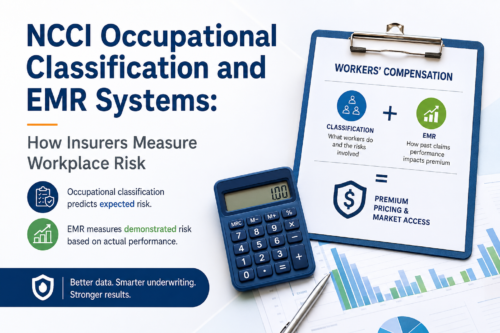
Workers’ compensation pricing does not operate on intuition or guesswork. It is built on two interlocking systems: occupational classification and the experience modification rate (EMR). Together, these systems convert observable workplace behavior, what workers do, how often they are injured, and how much those injuries cost, into measurable insurance risk that directly determines premium pricing and market access. NCCI occupational classification and EMR systems form the foundation of workers’ compensation underwriting in the United States.
The National Council on Compensation Insurance (NCCI) administers the classification and experience rating frameworks used by insurers across most U.S. jurisdictions. Occupational classifications estimate expected workplace hazards based on job type and historical industry loss patterns. The EMR translates an employer’s actual claims history into a numeric modifier applied against base premium rates.
Primary Underwriting Thesis: Occupational classification predicts expected risk, while EMR measures demonstrated risk. Underwriters combine both to evaluate whether future losses are likely to improve, remain stable, or deteriorate.
Together, these systems transform workplace activity into measurable insurance risk. Classification establishes the expected loss profile of an occupation, while EMR reflects how an individual employer performs against that expectation. The resulting analysis influences premium pricing, underwriting decisions, and long-term market access.
This article explains how both systems function, how underwriters interpret them, and why employers in high-risk occupations must understand these mechanisms to manage their insurance costs and maintain market access.
What Is NCCI?
The National Council on Compensation Insurance (NCCI) is a private, nonprofit organization that serves as the central data repository and rating bureau for workers’ compensation insurance across approximately 38 U.S. states and the District of Columbia. Founded in 1923, NCCI collects claims data from insurers, develops actuarially credible loss costs, manages occupational classification systems, and administers experience rating programs.
Insurers operating in NCCI-affiliated states rely on NCCI’s published loss costs and classification rules as the pricing foundation for workers’ compensation policies. NCCI does not set final premium rates, those are filed by individual carriers subject to state regulatory approval, but it establishes the statistical baseline from which carrier rates are derived.
NCCI’s core functions include:
-
Data collection: Aggregating claims, payroll, and exposure data submitted by member carriers across jurisdictions.
-
Experience rating: Calculating individual employer EMRs based on actual versus expected loss performance.
-
Classification management: Maintaining and updating the Scopes® Manual, the definitive reference governing how employees are assigned to occupational class codes.
-
Loss-cost development: Publishing advisory loss costs by class code, the actuarial cost of projected losses per $100 of payroll, which carriers use to derive premium rates.
The standardization NCCI provides allows insurers to price risk consistently across employers and states, compare loss histories across industries, and develop actuarially sound rate structures. Without a centralized classification and data system, meaningful premium differentiation between low-hazard and high-hazard employers would be statistically unreliable.
For employers, particularly those in How Underwriting Works for High-Risk Jobs, understanding that NCCI is the technical infrastructure behind premium pricing, not simply an administrative registry, is essential to understanding why classification decisions carry significant financial consequences.
How Occupational Classification Works
The baseline financial calculation of a workers’ compensation policy relies on a rigid, step-by-step progression:
Insurers evaluate jobs based on their inherent physical and environmental exposures rather than job titles alone. NCCI synthesizes these exposures into four-digit workers’ compensation classification codes. Each code represents a distinct risk pool characterized by specific hazard exposures, injury frequencies, and injury severities.
-
Hazard Exposure: The environmental or situational probability of an adverse event occurring (e.g., working at heights versus an office environment).
-
Injury Frequency: How often a specific type of worker suffers an injury within a given exposure timeframe.
-
Injury Severity: The financial and medical magnitude of an injury when it does occur, reflecting the likelihood of temporary disability, permanent disability, or fatality.
Consider the baseline differentiation between diverse occupational risk profiles:
-
Office Worker / Clerical (Code 8810): Characterized by minimal hazard exposure, low injury frequency, and negligible injury severity. Expected losses are minimal, translating to nominal rates per $100 of payroll.
-
Electrician (Code 5190): Moderate hazard exposure involving localized low-voltage or medium-voltage systems, with moderate frequency but heightened potential severity due to electrical shock or arc flash hazards.
-
Roofer (Code 5551): High-severity and high-frequency risk profile dominated by gravity-related hazards. Falls from heights elevate both medical losses and long-term indemnity reserves.
-
Tower Climber (Code 7600): Extreme hazard exposure characterized by severe height risks, environmental isolation, and low-frequency but catastrophic severity outcomes.
-
Ironworker (Code 5040): High physical hazard profile driven by heavy structural steel manipulation, constant high-elevation exposure, and severe crushing or structural collapse risks.
By segregating operations into these specific pools, the underwriting system establishes an actuarial baseline. This baseline ensures that an employer’s premium accurately reflects the objective historical loss patterns of their industry before accounting for the employer’s individual performance.
How NCCI Class Codes Affect Premiums
Class codes are pricing infrastructure, not simple administrative labels. Each NCCI class code carries an advisory loss cost, expressed as a dollar amount per $100 of insured payroll, that represents the actuarially expected cost of workers’ compensation losses for that job category. Carriers apply their own loss cost multipliers (LCMs) to these advisory rates to derive final premium rates, subject to state regulatory approval.
The basic workers’ compensation premium calculation follows this structure:
Several variables within this calculation are directly controlled or influenced by NCCI classification:
-
Payroll allocation: Payroll must be correctly allocated to the applicable class code. Assigning higher-hazard work to a lower-rated code, whether intentionally or through classification error, constitutes a material misrepresentation subject to audit correction and retroactive premium adjustment.
-
Loss costs: NCCI publishes advisory loss costs for each class code. A roofer’s loss cost rate may be ten to twenty times higher per $100 of payroll than an office worker’s, reflecting the actuarial difference in expected injury frequency and severity.
-
State adjustments: Individual states may approve carrier rates that deviate from NCCI advisory loss costs based on state-specific claims experience. Employers operating across multiple states may therefore face different effective rates for the same occupational classification.
For employers seeking to understand How Workers’ Compensation Premiums Are Calculated, the key takeaway is that class code assignment is the single most significant structural variable in premium determination, even before claims history is applied through the EMR. An incorrect or disputed classification can produce premium discrepancies of tens or hundreds of thousands of dollars on large payrolls.
Classification Boundary Problems and Mixed Operations
Many employers do not operate within a single, unambiguous occupational category. Construction contractors, specialty trades, and service businesses frequently employ workers whose duties span multiple job functions, creating classification boundary challenges that have direct underwriting consequences.
NCCI’s Scopes Manual establishes rules for payroll separation, the process of allocating individual employee payroll to the appropriate class code when workers perform duties that qualify for classification under two or more codes. Proper payroll separation is mandatory and must be supported by documented time records or equivalent evidence. Absent adequate documentation, insurers and auditors may apply the higher-rated classification to the entire payroll.
Common classification boundary scenarios include:
-
Roofers installing solar panels: Workers trained in roofing may perform solar photovoltaic installation, which is typically classified differently. Misclassifying the solar work under the roofing code, or vice versa, can distort premium calculations.
-
Tower climbers performing telecom maintenance: Tower climbers may also perform ground-level equipment configuration or cable splicing, which carries a different risk profile than elevated structural work. Correctly separating elevated from non-elevated duties is critical to accurate classification.
-
Ironworkers performing welding: Structural ironwork and welding operations may qualify under separate codes depending on whether the welding is incidental to structural assembly or constitutes a primary trade function.
-
Contractors performing multiple trades: General contractors or multi-trade specialty contractors routinely employ workers across carpentry, electrical, plumbing, masonry, and other classifications. Each trade carries its own loss cost rate, making payroll allocation a material audit concern.
Classification boundary underwriting is the practice by which underwriters evaluate whether an employer’s stated classification structure accurately reflects actual operations. Discrepancies between policy classifications and audited operations frequently generate retroactive premium adjustments, classification disputes, and heightened underwriting scrutiny at renewal. Insurers conducting insurance audits are specifically trained to identify misaligned payroll allocation.
Employers who experience classification disputes should consult resources on Workers’ Compensation Audits Explained to understand the audit process and their rights to contest classification determinations.
What Is an Experience Modification Rate (EMR)?
The experience modification rate (EMR) is a numeric multiplier applied to a workers’ compensation base premium that reflects an individual employer’s actual claims performance relative to the expected claims performance for employers in the same occupational classification and size category. The EMR is calculated annually by NCCI (or the applicable state rating bureau) using three years of loss history, excluding the most recently completed policy year.
The EMR functions on a simple comparative principle:
-
EMR below 1.00: The employer’s actual losses are lower than expected for its industry and size. This produces a credit modifier, reducing the base premium. An EMR of 0.85, for example, indicates that actual losses are approximately 15 percent below industry expectations.
-
EMR equal to 1.00: The employer’s actual losses match industry expectations. No modification is applied; the employer pays the base rate for its class code.
-
EMR above 1.00: The employer’s actual losses exceed expectations. This produces a debit modifier that increases the base premium. An EMR of 1.25 means the employer’s losses are approximately 25 percent above the expected level for its industry peer group.
The EMR thus serves as the mechanism by which individual employer claims behavior is translated into premium pricing. For Workers’ Compensation for High-Risk Occupations, where base loss costs are already elevated, a debit EMR compounds the premium impact significantly.
How EMR Is Calculated
The EMR calculation compares an employer’s actual losses against statistically expected losses for a business of similar size operating under the same classification codes. While the conceptual formula is straightforward, the actual computation involves several actuarial adjustments that temper the raw loss comparison.
Note: Actual calculations are significantly more complex and involve credibility weighting, loss limitations, and payroll normalization. The formula above is a conceptual approximation only.
The principal components of the EMR calculation include:
-
Actual losses: The dollar amount of workers’ compensation claims, both paid and reserved, generated by the employer during the experience rating period. Both claim frequency (how many claims occurred) and claim severity (how much each claim cost) factor into actual losses.
-
Expected losses: The projected losses for an employer of equivalent payroll size operating under the same class codes. Expected losses are derived from NCCI’s published expected loss rates, which are updated periodically as industry-wide loss experience develops.
-
Payroll normalization: Because employer payroll fluctuates over time, the calculation normalizes payroll to produce a stable comparison baseline across the three-year experience period.
-
Historical claims period: NCCI uses three completed policy years, excluding the most recently completed year. This structure means an employer’s current year claims will not directly affect the EMR until approximately two years later.
-
Loss limitations: Individual catastrophic claims are capped at a maximum value for EMR calculation purposes. This prevents a single catastrophic event from disproportionately distorting an employer’s modifier, though catastrophic losses still influence underwriting judgment through separate channels.
The technical complexity of EMR computation is explained further in resources covering Experience Modification Rate (EMR) Explained, but employers should understand that the modifier reflects a multi-year weighted average of loss performance, not a snapshot of any single year’s claims.
EMR Decision Thresholds
Underwriters apply informal thresholds to EMR values that influence their underwriting disposition, pricing flexibility, and willingness to offer coverage. The following table reflects general market conventions; specific thresholds vary by carrier, state, and industry:
| EMR Range | Underwriting Interpretation | Strategic & Operational Impacts |
| Below 0.80 | Exceptional claims history | Strong safety performance; preferred underwriting position. |
| 0.80 – 1.00 | Better than expected | Favored position; eligible for schedule credits. |
| 1.00 | Industry average | Neutral baseline for pricing. |
| 1.01 – 1.25 | Elevated risk | Additional underwriting scrutiny likely; premium surcharges. |
| Above 1.25 | High-risk underwriting exposure | Increased underwriting scrutiny and potential market access restrictions. |
Disclaimer: EMR thresholds are not universally standardized. Carrier appetite, state market conditions, occupation type, and underwriting judgment all influence how individual EMR values are interpreted. An EMR of 1.20 may be acceptable in a low-hazard classification, but disqualifying in a high-hazard occupation such as Tower Climber Insurance or Roofing Insurance.
How Underwriters Interpret EMR Beyond the Number
The EMR is the beginning of the underwriting analysis, not the conclusion. Experienced underwriters examine the composition of the claims experience underlying the modifier to assess whether the number accurately reflects current operational risk or obscures important trends.
Two employers with identical EMRs may receive substantially different underwriting outcomes based on qualitative analysis of their claims history:
-
Claim recency: Claims concentrated in the most recent experience year carry greater underwriting concern than claims distributed across an older period. A worsening trajectory signals deteriorating safety performance.
-
Claim frequency: A high volume of small claims often indicates systemic operational problems, inadequate training, poor housekeeping, or deficient safety culture, rather than random statistical variation.
-
Claim severity: Single high-cost claims, particularly those involving permanent disability or litigation, represent tail risk that may indicate exposure to catastrophic future losses even if overall frequency is low.
-
Reserve development: Open claims with growing reserves suggest that ultimate loss costs are still developing. Underwriters account for reserve uncertainty when projecting future loss potential from historical EMR data.
-
Catastrophic losses: Falls from elevation, traumatic amputations, and fatalities represent a loss pattern that underwriters weigh heavily regardless of EMR impact, particularly in occupations such as Ironworker Insurance and Wind Turbine Technician Insurance.
-
Recurring injury patterns: The same type of injury occurring repeatedly, for example, repetitive back strain from manual lifting, or recurring fall incidents in a roofing operation, indicates that the operational root cause has not been addressed.
Predictive underwriting is the analytical framework that transforms this retrospective EMR data into a forward-looking risk assessment. Underwriters are not evaluating what has already happened; they are estimating the probability and cost of future losses based on patterns in historical experience. The primary question is: given this employer’s demonstrated risk profile, are future losses likely to improve, remain stable, or deteriorate?
Loss Frequency vs. Loss Severity
Underwriters differentiate between two dimensions of claims performance that both influence the EMR and underwriting judgment: loss frequency and loss severity.
Loss frequency refers to the number of claims generated over a given period relative to payroll exposure. High-frequency employers, those with numerous small claims, often present an underwriting concern that their EMR alone may understate. Repeated small claims indicate that workers are being injured at an above-average rate, suggesting operational deficiencies in safety culture, supervision, or hazard control.
Loss severity refers to the average cost of individual claims. A single catastrophic claim, a permanent disability resulting from a tower fall, or a wrongful death claim arising from structural ironwork, can produce an EMR spike that persists for three years and significantly constrains market access.
The interplay between frequency and severity carries different implications:
-
Frequent small claims: Often interpreted as indicators of systemic safety problems. Underwriters may apply schedule rating debits for inadequate operational controls even if the EMR remains manageable.
-
Catastrophic single claims: May be partially isolated in EMR calculations through loss limitations, but they trigger heightened underwriting scrutiny and frequently result in coverage exclusions, elevated deductibles, or non-renewal.
-
Operational instability: Fluctuating claim patterns, years of low losses followed by sudden spikes, may suggest inconsistent safety management or project-specific exposure rather than stable underlying risk.
For high-hazard occupations tracked by Occupational Risk Assessment frameworks, the distinction between frequency and severity is particularly significant because both dimensions are elevated compared to low-hazard industries. A roofer or tower climber does not need a high-frequency claims history to generate a damaging EMR; a single severe injury can be sufficient.
Why High-Risk Occupations Are More Sensitive to EMR
In elevated-hazard occupations, the relationship between EMR and premium is amplified because the baseline loss costs against which the modifier is applied are already significantly higher than standard industry rates. A debit EMR of 1.25 applied against a low-hazard clerical class code produces a modest premium increase. The same modifier applied against the loss cost rate for structural ironwork or tower climbing produces a premium that may render operations financially unviable.
The following occupational categories illustrate this amplification dynamic:
-
Roofing Insurance: Roofing consistently ranks among the highest workers’ compensation loss cost classifications. OSHA data reports fall-related fatality rates in roofing that far exceed the construction industry average. A debit EMR in this classification compounds already elevated base rates, rapidly escalating premium costs.
-
Tower Climber Insurance: Telecommunications tower work involves extreme height exposure, often at 500 to 1,500 feet. The combination of extreme hazard classification and catastrophic injury potential means that even a single disabling fall can shift an EMR into debit territory for multiple subsequent years.
-
Ironworker Insurance: Structural ironworkers face simultaneous exposure to falls, struck-by incidents, and welding hazards. BLS fatal injury data consistently place structural metal workers among the most hazardous occupational categories in construction.
-
Wind Turbine Technician Insurance: Wind energy technicians perform maintenance on nacelles and blades at heights of 200 to 400 feet. As the sector expands, actuarial loss data continues to develop, but initial loss patterns reflect the same high-severity profile as other elevated trade occupations.
For any of these occupations, claims performance has a direct and disproportionate effect on EMR, premium pricing, and market access. This is discussed further in Why Elevated Workers Pay More for Insurance, and Catastrophic Fall Risk in Occupational Insurance.
Claims Development and Reserve Uncertainty
Workers’ compensation claims do not close at a fixed point in time. Medical treatment for serious injuries, spinal cord damage, traumatic brain injuries, severe burns, and permanent orthopedic conditions may continue for years or decades. The total cost of a claim is often unknown at the time of the initial incident and continues to develop as medical expenses accumulate, litigation proceeds, and disability permanency is established.
Claims reserves are the estimated future costs that insurers set aside for open claims. Reserves reflect the insurer’s actuarial judgment about the ultimate cost of pending liabilities, but they are inherently uncertain. Medical inflation, changes in treatment protocols, litigation outcomes, and claimant life expectancy all affect how reserves develop over time.
Reserve uncertainty underwriting is the analytical practice of accounting for this open-claims risk in the underwriting evaluation. An employer whose loss run contains multiple large, open claims with growing reserves presents greater forward-looking risk than an employer whose claims are closed at stable values, even if both employers have identical EMRs at the time of underwriting.
The implications for EMR are significant: because the EMR is calculated using both paid losses and case reserves, an employer’s modifier may continue changing for years after the original incident occurred. A claim reserved at $50,000 at policy inception may develop to $250,000 or more as medical costs accumulate and legal proceedings resolve. Each reserve increase flows through to subsequent EMR calculations.
For offshore and offshore-adjacent occupations such as those covered under Offshore Worker Insurance, long-tail medical claims are a particular underwriting concern due to the severity of maritime injuries and the complex regulatory environment governing maritime workers’ compensation.
Experience Rating Credibility and Employer Size
Not all EMRs carry equal statistical weight. NCCI’s experience rating formula incorporates a concept known as credibility weighting, a statistical adjustment that determines how much an individual employer’s loss history should influence the modifier versus how much the industry-wide expected loss baseline should control.
Credibility weighting operates on a fundamental actuarial principle: larger data sets produce more statistically reliable conclusions. As applied to experience rating:
Employer Size → Data Credibility → EMR Weighting → Premium Volatility
-
Large employers: Those with substantial payroll generating significant expected losses receive higher credibility weights. Their actual loss experience is considered statistically meaningful, and their EMRs more accurately reflect their individual risk profile rather than random variation.
-
Small employers: Those with limited payroll and fewer expected losses receive lower credibility weights. Because their data volume is small, a single claim can substantially distort their EMR in either direction. NCCI assigns a larger portion of the modifier to the expected loss benchmark rather than actual losses for these employers.
This structure means that small employers in high-hazard occupations face EMR volatility that may not accurately represent their true risk management performance. A single severe claim can push a small contractor’s EMR to levels that trigger adverse underwriting appetite responses, increased pricing, restricted coverage terms, or carrier non-renewal, even when the incident was an isolated event rather than a systemic safety failure.
Underwriters account for credibility weighting when interpreting EMRs, particularly for small employers in high-hazard trades where statistical volatility is inherent in the experience rating structure.
Schedule Rating and Underwriting Judgment
The EMR is a retrospective measure: it reflects what has already occurred. Schedule rating is a prospective adjustment mechanism that allows underwriters to modify premiums based on their assessment of an employer’s current operational quality, independent of historical claims performance.
Schedule rating permits carriers to apply credits or debits, typically within a range of plus or minus 25 percent, though this varies by state, based on factors that indicate the employer’s future loss potential:
-
Schedule credits may be applied for: documented safety training programs, formal return-to-work programs, robust incident reporting systems, management engagement with safety oversight, and clean facilities with effective housekeeping.
-
Schedule debits may be applied for: inadequate safety management systems, failure to address prior OSHA citations, poor housekeeping, absence of formal training protocols, or high employee turnover in hazardous roles.
The conceptual distinction is important: EMR measures historical performance, while schedule rating evaluates present operational quality. An employer with a modestly elevated EMR, perhaps driven by a single prior catastrophic claim, may receive favorable schedule credits if the underwriter is satisfied that current operational controls are robust and the prior incident was addressed. Conversely, an employer with an average EMR but demonstrably poor safety management may receive schedule debits that increase the premium above what the modifier alone would produce.
For contractors pursuing large project bids that require favorable EMR and overall pricing metrics, investing in demonstrable operational improvements that support schedule credits is a practical risk management strategy that produces measurable premium benefit.
Contractor and Subcontractor Exposure
The use of subcontractors introduces classification and experience rating complications that extend beyond the primary employer’s workforce. Workers’ compensation exposure follows the employment relationship, but that relationship is frequently ambiguous in contractor-subcontractor structures, creating audit and classification risks that can affect the general contractor’s EMR and premium.
Key contractor exposure scenarios with direct underwriting consequences include:
-
Uninsured subcontractors: When a subcontractor cannot demonstrate valid workers’ compensation coverage through a certificate of insurance, the general contractor’s policy may be required to extend coverage to those workers. Their payroll is then allocated to the applicable classification codes under the GC’s policy and included in the premium and experience rating calculation.
-
Labor leasing and PEO arrangements: Workers provided through professional employer organizations (PEOs) or labor leasing arrangements may have separate workers’ compensation coverage, but the classification and experience rating implications must be traced to the actual employer of record for EMR purposes.
-
Independent contractor misclassification: Workers classified as independent contractors but functionally operating as employees are a persistent source of audit findings. If reclassified at audit, their payroll and any associated claims are added to the employer’s experience rating history retroactively.
-
Certificate-of-insurance failures: Failure to collect and verify certificates of insurance from all subcontractors before work commences is one of the most common sources of retroactive premium assessments at workers’ compensation audits.
These issues connect directly to the topics covered in Employee Misclassification and Insurance Risk. The financial consequences of subcontractor exposure are not limited to a single policy period; retroactive premium adjustments and EMR effects from improperly classified subcontractor claims can persist for three or more years in the experience rating system.
States That Do Not Use NCCI
While NCCI administers workers’ compensation rating systems in the majority of U.S. states, a number of significant jurisdictions maintain independent state rating bureaus that operate their own classification systems and experience rating programs. Employers with multi-state operations must understand that classification rules and EMR calculations may vary between NCCI and non-NCCI jurisdictions.
The principal independent state bureaus include:
-
California: The Workers’ Compensation Insurance Rating Bureau of California (WCIRB) administers classification and experience rating under a separate system. California’s classification codes, expected loss rates, and EMR calculations differ from NCCI standards.
-
New York: The New York Compensation Insurance Rating Board (NYCIRB) maintains its own rating and classification system. New York’s workers’ compensation market is among the largest in the country, with distinct classification rules and premium structures.
-
New Jersey: The Compensation Rating and Inspection Bureau (CRIB) of New Jersey administers workers’ compensation classification and rating independently of NCCI.
Other independent states include Delaware, Indiana, Massachusetts, Michigan, Minnesota, North Carolina, Pennsylvania, Texas, and Wisconsin, among others. The degree of divergence from NCCI standards varies; some independent bureaus maintain close alignment with NCCI methodology, while others have developed substantially different classification and rating frameworks.
For multi-state contractors, including those operating in the bridge construction, offshore energy, and heavy industrial sectors, the classification and EMR implications of operating across both NCCI and independent jurisdictions require careful underwriting coordination.
How Insurers Use NCCI and EMR Together
The complete underwriting framework for workers’ compensation risk assessment integrates occupational classification, experience rating, and underwriting judgment into a unified evaluation of current and future risk:
| Component | Function |
|---|---|
| Classification | Establishes expected risk |
| EMR | Measures demonstrated risk |
| Underwriting Judgment | Evaluates current operational quality |
| Premium | Reflects projected future losses |
Underwriting judgment completes the framework by incorporating qualitative factors, operational controls, management engagement, subcontractor risk, and claims management practices that the quantitative systems cannot fully capture. This is predictive underwriting: the synthesis of expected risk, demonstrated risk, and current operational indicators into a forward-looking probability estimate for future losses.
The practical output of this integrated framework is a premium that reflects not just historical averages, but an actuarially and judgmentally informed estimate of what future losses will cost. For employers in high-hazard classifications, this framework means that underwriting outcomes are particularly sensitive to both the class code assigned and the claims history demonstrated within that code.
Common Classification Errors
Classification errors are among the most consequential and common sources of premium disputes in workers’ compensation. They occur at policy inception, during mid-term operations, and at audit, and their financial effects can be substantial.
Frequent classification error categories include:
-
Employee misclassification: Assigning a worker to a lower-rated class code than their actual job duties warrant. Whether intentional or inadvertent, this constitutes a material misrepresentation that will be corrected at audit, often with a retroactive premium adjustment.
-
Incorrect payroll allocation: Failing to properly allocate payroll between applicable class codes when employees perform duties that span multiple classifications.
-
Multiple job duties: Using a single class code for an employee who performs both high-hazard and low-hazard work without maintaining the time records necessary to support payroll separation.
-
Contractor versus employee errors: Classifying workers as independent contractors to avoid workers’ compensation obligations, then failing to collect certificates of insurance, exposing the employer to inclusion of those workers’ payroll and claims in the policy audit.
The consequences of classification errors cascade through the underwriting relationship:
-
Retroactive premium adjustments at audit, sometimes covering multiple policy years.
-
Reclassification of payroll to higher-rated codes with immediate premium impact.
-
Potential EMR effects if uninsured subcontractor claims are incorporated into the experience rating record.
-
Elevated underwriting scrutiny at renewal following audit findings.
Employers who have experienced premium disputes, audit findings, or classification corrections should consult resources on Workers’ Compensation Audits Explained and Employee Misclassification and Insurance Risk for guidance on managing these processes.
Can Employers Improve Their EMR?
The EMR is a lagging indicator; it reflects claims that have already occurred, but the operational behaviors that produce future claims are within the employer’s control. Improving EMR requires sustained operational investment in safety systems and claims management over the three-year experience rating horizon.
Effective EMR improvement strategies include:
-
Safety programs and training: Documented safety training programs, particularly for high-hazard tasks such as fall protection, lockout/tagout, and equipment operation, reduce injury frequency. OSHA-compliant safety programs provide both injury prevention value and schedule rating credit potential.
-
Return-to-work programs: Structured modified-duty programs that return injured workers to productive employment reduce indemnity claim costs. Because indemnity payments are a significant driver of claim cost, effective return-to-work management directly reduces the losses flowing into the EMR calculation.
-
Claims management: Active involvement in the claims process, prompt reporting, coordination with treating physicians, and engagement with insurers on claim disposition helps prevent claims from developing unnecessarily high reserves or extended open periods.
-
Incident prevention: Root cause analysis of near-misses and minor incidents prevents the operational conditions that produce severe claims. The National Safety Council (NSC) and OSHA both provide frameworks for systematic incident prevention that employers can adapt to their specific operational environments.
It is important to understand that EMR improvement is not immediate. Operational changes made today will not fully appear in the EMR for two to three years, reflecting the lag structure of the experience rating period. However, demonstrated operational improvements, documented through training records, safety program audits, and declining incident rates, can support favorable schedule rating credits that produce near-term premium benefit even before the EMR fully reflects the improvement.
Carrier Appetite and Market Access
Market access underwriting refers to the process by which an employer’s risk profile determines which carriers are willing to offer coverage and on what terms. EMR is one of the most significant factors governing market access in workers’ compensation.
As EMR increases, market access constricts in predictable patterns:
-
Coverage availability: Some admitted market carriers decline to quote accounts with EMRs above specified thresholds, regardless of pricing. As fewer standard market options remain, employers may be forced to the surplus lines market, where pricing is less regulated, and coverage terms may be less favorable.
-
Deductible requirements: Carriers may impose mandatory deductibles, requiring the employer to self-fund a portion of each claim, as a condition of offering coverage to elevated-EMR accounts. This shifts financial risk back to the employer and increases the effective cost of claims beyond the premium impact.
-
Coverage exclusions: Underwriters may exclude specific operation types, locations, or employee categories from coverage terms, creating uninsured gaps that expose the employer to direct liability.
-
Coverage limits: High-EMR accounts may face restrictions on policy limits or endorsement availability that constrain their ability to meet contractual insurance requirements.
-
Pricing flexibility: Standard market carriers with competitive pricing typically reserve capacity for accounts with EMRs below 1.00. Above that threshold, carrier competition decreases progressively, reducing the employer’s ability to negotiate favorable terms.
For occupations such as Offshore Worker Insurance and Bridge Worker Insurance, where placement is already challenging due to hazard classification, an elevated EMR can effectively close the standard admitted market entirely, leaving surplus lines as the only available option.
Decision breakpoint: When elevated occupational hazards combine with deteriorating claims experience, underwriters may impose deductibles, restrict coverage terms, or reduce market availability even before formal EMR thresholds are breached.
Contract Bidding and EMR Thresholds
In construction, specialty contracting, and infrastructure sectors, the EMR functions not only as an insurance pricing tool but as a prequalification credential. Project owners, general contractors, and public agencies routinely require contractors to demonstrate acceptable EMR performance before they may bid on or perform work.
Common EMR prequalification thresholds include:
-
EMR below 1.00: Standard prequalification threshold for many commercial and industrial projects. Contractors exceeding 1.00 may be disqualified from bidding regardless of technical qualification or competitive pricing.
-
EMR below 0.90: Required by many large public infrastructure projects and safety-conscious private owners. This threshold reflects a demonstrable above-average safety performance standard.
-
EMR below 0.80: Required by some federal projects, utility companies, and major energy sector owners. Achieving and maintaining this level of EMR performance requires sustained, systematic safety management investment.
The financial consequences of EMR prequalification failure extend well beyond premium cost. A contractor disqualified from a major project bid due to EMR may lose contract revenue that dwarfs the premium savings that would have been achievable through safety investment. This dynamic makes EMR management a direct business performance issue for contractors operating in bid-competitive markets.
Thresholds vary by project owner, project type, sector, and geographic market. Contractors operating in safety-sensitive sectors, transportation infrastructure, energy, petrochemical, and public works should monitor EMR continuously rather than responding reactively at renewal.
Why This Matters Beyond Workers’ Compensation
The effects of NCCI classification and EMR extend beyond workers’ compensation premium pricing into broader business operations and financial relationships. Risk metrics originally developed for insurance pricing have become proxy measures of operational quality that influence multiple business dimensions:
-
Commercial insurance: General liability and commercial umbrella underwriters increasingly review workers’ compensation loss history when evaluating contractors and employers. A deteriorating workers’ compensation record often signals operational conditions that create general liability exposure as well.
-
Business reputation: In industries where safety performance is publicly visible, through OSHA inspection records, incident reporting, and contractor prequalification databases, EMR functions as a reputational credential that affects relationships with clients, partners, and prospective employees.
-
Market access: As discussed above, high EMRs restrict the insurance market options available to employers, increasing cost and reducing coverage quality at precisely the time when risk management resources are most needed.
-
Contract bidding: EMR prequalification requirements prevent contractors from accessing revenue opportunities directly. The loss of a single major contract due to EMR disqualification may represent a financial impact several times larger than the insurance cost difference between good and poor EMR performance.
-
Lender requirements: Some commercial lenders and bonding companies review workers’ compensation risk metrics as part of credit and surety underwriting. A deteriorating EMR may affect borrowing capacity or surety bond availability for contractors dependent on bonded project access.
The Workers Compensation Research Institute (WCRI) publishes periodic research on the economic effects of workers’ compensation costs on employer competitiveness and market access that provides a broader context for these dynamics. The conclusion across sectors is consistent: NCCI classification and EMR are not merely insurance administrative details; they are operational performance metrics with direct financial and strategic consequences for employers in all industries, and particularly severe consequences for those in high-hazard occupational categories.
Comprehensive Risk Framework Matrix
The following matrix maps out the primary risk components across high-risk industries, linking their standard operational exposures to insurance outcomes and long-term business impacts:
| Focus Area | Core NCCI Classification | Baseline Risk Profile | Primary Underwriting Focus | Critical Claims Breakpoint | Long-Term Business Impact |
| Roofing Operations | Code 5551 | Elevated gravity hazards; high frequency of falls; severe medical severity. | Height Exposure Underwriting | Falls from roofs leading to high indemnity and permanent disability reserves. | High EMR eliminates access to standard markets, increasing why Elevated Workers Pay More for Insurance. |
| Telecom & Tower Sites | Code 7600 | Extreme high-altitude exposure; environmental isolation; catastrophic severity. | Catastrophic Fall Risk | Low-frequency, high-severity fatal incidents require massive reserve allocation. | Restricts access to standard carriers, forcing placement into non-standard markets. |
| Structural Ironwork | Code 5040 | Heavy structural steel fabrication; crushing hazards; high physical strain. | Permanent Disability Risk | Crushing injuries and severe fractures are causing extended loss of work and high claims frequency. | High frequency of small claims inflates the EMR, disqualifying the firm from major commercial projects. |
| Wind Energy Sites | Code 5120 / 8726 | Confined spaces at high altitude; mechanical and high-voltage electrical hazards. | Occupational Risk Assessment | Arc flash burns or fall injuries inside the nacelle create complex medical claims. | Drives up specialized general liability costs and limits participation in green infrastructure projects. |
| Marine & Bridge Projects | Code 6003 / 5040 | Over-water structural environments, complex transport, drowning, and fall hazards. | Workers’ Compensation for High-Risk Occupations | Marine or high-altitude falls result in complex jurisdictional coverage claims. | Triggers extensive audit scrutiny and increases collateral requirements for commercial bonds. |
| Subsea & Offshore Work | Code 7394 / 7395 | Deepwater environments, decompression risks, and heavy machinery hazards. | How Underwriting Works for High-Risk Jobs | Diver decompression sickness or equipment failures leading to severe medical and liability claims. | Restricts access to specialized offshore liability markets and complicates contract prequalification. |
Final Underwriting Insight
NCCI classification predicts occupational exposure, while EMR reflects real-world performance. Together, these systems transform workplace risk into measurable insurance pricing. Underwriters use these systems not only to evaluate past performance, but to assess whether future losses are likely to improve, remain stable, or deteriorate. Occupational classifications estimate expected workplace hazards, while EMR measures actual claims performance. Together, these systems convert workplace behavior into measurable insurance risk.
For employers, whether in general commercial operations or high-hazard occupations such as Roofing Insurance, or Tower Climber Insurance, understanding the mechanics of NCCI classification and the experience modification rate is foundational to managing insurance costs and maintaining access to the insurance markets necessary to operate.
The path from workplace behavior to insurance premium follows a defined chain:
Each link in that chain represents an opportunity for employers to influence outcomes through operational discipline, accurate classification practices, proactive claims management, and sustained investment in safety infrastructure. The underwriting conclusion, whether favorable or adverse, flows directly from the operational behaviors that generate the data these systems measure.
Employers who treat NCCI classification and EMR management as strategic business functions rather than passive insurance administrative processes consistently achieve better pricing, broader market access, and stronger contract qualification outcomes. Those who do not typically discover the financial consequences of that omission at renewal, or, in the most adverse cases, when coverage becomes unavailable entirely. For further guidance on Occupational Risk Assessment and related topics, consult the additional resources linked throughout this article.
—————————————————————————————————————————
Institutional & Underwriting References
This article references workers’ compensation classification systems, occupational safety frameworks, and underwriting concepts commonly used across commercial insurance markets.
Institutional References
- National Council on Compensation Insurance (NCCI) — Occupational classification systems, experience rating methodologies, loss cost development, and Scopes® Manual guidance.
- Occupational Safety and Health Administration (OSHA) — Workplace safety regulations, fall protection standards, and employer compliance requirements.
- National Institute for Occupational Safety and Health (NIOSH) — Occupational injury research, exposure assessment, and prevention frameworks.
- U.S. Bureau of Labor Statistics (BLS) — Occupational injury rates, fatality statistics, and labor market data.
- Workers Compensation Research Institute (WCRI) — Research on claim development, medical costs, and workers’ compensation system performance.
- National Safety Council (NSC) — Workplace safety management practices and injury prevention research.
Reviewed for Underwriting Accuracy
This article was reviewed for:
- Occupational classification analysis
- Experience Modification Rate (EMR) interpretation
- Claims frequency and severity evaluation
- Payroll allocation and audit principles
- Workers’ compensation underwriting concepts
- Carrier appetite and market access factors
- High-risk occupational exposure assessment
- Reserve uncertainty and claims development considerations