Editorial notice: Reviewed for underwriting accuracy by the RJI Institutional Review Team | Published: June, 2026
—————————————————————————————————————————
Executive Summary
General liability roofing insurance protects roofing contractors against third-party bodily injury, property damage, legal defense costs, and completed operations claims arising from roofing work. Premiums are typically higher than those of other contractor classes because roofing combines elevated property damage exposure, water intrusion risk, and long-tail liability that can emerge years after project completion.
What Is General Liability Roofing Insurance?
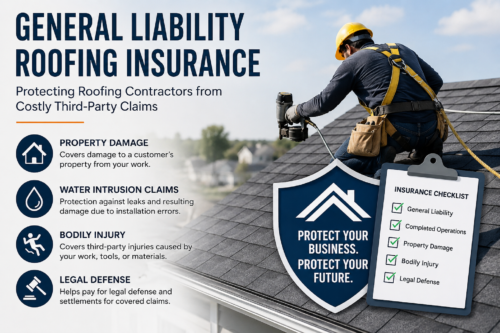
General liability roofing insurance is a commercial insurance policy designed to protect roofing contractors against third-party bodily injury, property damage, and completed operations claims arising from roofing work.
For roofing businesses, general liability coverage commonly responds to events such as accidental damage to a customer’s property, water intrusion caused by installation errors, damage resulting from falling tools or materials, and legal defense costs associated with covered liability claims.
However, general liability insurance does not cover employee injuries, company-owned equipment, commercial vehicles, or professional design errors. Those exposures typically require separate policies such as workers’ compensation, inland marine, commercial auto, or professional liability insurance.
Most roofing contractors pair general liability insurance with workers’ compensation, commercial auto, inland marine, and excess liability coverage because general liability alone does not address every operational exposure.
Because roofing combines elevated property damage exposure, completed operations liability, and severe loss potential, it is frequently one of the most heavily scrutinized contractor classifications during underwriting.
Why Does General Liability Roofing Insurance Cost So Much?
You just opened your commercial general liability (GL) renewal quote, and the number staring back at you looks more like a monthly commercial mortgage payment than a standard operational expense. It’s an immediate, sharp sticker shock. Your immediate reaction might be to blame market inflation or an overzealous insurance agent, leading to the obvious question: why is general liability roofing insurance so radically different from standard artisan contractor rates?
To understand the price, you have to look past the daily routine of your crew and focus on the cold operational reality. An underwriter evaluating a standard carpentry or drywall contractor sees localized, manageable risk. If a drywaller drops a hammer, a sheet of sheetrock cracks.
If a roofing contractor makes a mistake, the entire structural integrity of a commercial building is compromised.
[Minor Installation Oversight]
       │
       ▼
[Water Ingress/Structural Leak]
       │
       ▼
[Destroyed Building Interior, Inventory, & Electrical Infrastructure]
When you price roofing risk, you aren’t paying for the statistical probability of a dropped tool or a twisted ankle; you are paying for catastrophic property damage and systemic water ingress liability.
Why roofing insurance costs more than many contractor classifications: Roofing liability insurance is generally more expensive than many artisan contractor classifications because a single installation error can create extensive property damage, water intrusion losses, business interruption exposure, and long-tail completed operations liability. Unlike many contractor trades, roofing failures often affect the structural envelope of a building, increasing both claim severity and litigation potential.
How Roofers Are Classified for Liability Insurance
When a commercial insurance carrier receives an application from a roofing contractor, the system does not look at the business as a generic entity. Instead, it processes the business through an automated classification filter designed to isolate and price specific types of risk. Understanding this structural classification logic is essential; it is the exact mechanism that dictates whether an application is routed to a preferred market or rejected entirely.
The ISO Classification Framework: Code 98686 vs. Code 98684
The commercial insurance industry relies on standardized classifications managed by the Insurance Services Office (ISO). These codes act as the primary operational definitions that insurers use to determine baseline risk and calculate premiums. In the roofing sector, operations are divided into two primary classification codes.
Underwriting Translation: Roofing classifications are not administrative labels. They function as pricing instructions that determine how carriers model claim severity, property damage exposure, completed operations liability, and eligibility for preferred insurance markets. A contractor’s classification often influences premium cost, available coverage options, deductible requirements, and whether the account remains eligible for standard admitted carriers.
-
Code 98686 (Roofing – Residential): This code applies strictly to roofing operations executed on residential structures, typically including single-family homes, townhouses, and smaller multi-family complexes. Underwriters classify this work as lower-severity risk because residential buildings generally feature sloped roofs that utilize standard asphalt shingles, slate, or tile. These installations do not require open-flame applications, involve lower concentrations of property value under one roof, and carry a lower statistical probability of widespread structural water ingress claims.
-
Code 98684 (Roofing – Commercial): This code captures all commercial, industrial, institutional, and low-slope specialty roofing operations. If a contractor works on strip malls, manufacturing facilities, warehouses, or high-density office complexes, the carrier forces placement under Code 98684. Underwriters view this code through a high-severity lens because commercial systems are dominated by massive, flat structural expanses where a single membrane installation oversight can trap millions of gallons of water, destroying expensive commercial inventory and specialized building infrastructure.
Here is where the digital disconnect catches contractors in a costly trap. Let’s say your agent submits your application under Code 98686 (Residential Shingles) to secure a lower, more competitive baseline premium. However, during automated triage, the carrier’s system scrapes your website, social media profiles, or past local permits and finds references to “structural steel coordination,” “high-rise waterproofing,” or “commercial hot-tar applications.”
The validation filter instantly flags a mismatch. The system doesn’t just ask for clarification; it halts the application entirely or forces an automated downgrade to a high-premium specialty tier, locking you out of standard preferred pricing. Misrepresenting your scope to bypass these filters is a primary reason Why Roofers Face Strict Insurance Underwriting across the entire commercial market.
This automated validation process functions as an underwriting gatekeeper, determining whether a roofing contractor remains eligible for preferred pricing, standard-market placement, or specialty-market review.
Residential vs. Commercial Risk Differentiation
The division between residential and commercial classification is driven by how actuarial models calculate potential loss severity. While a residential claim under Code 98686 typically tops out at the value of a single-family dwelling, a commercial failure under Code 98684 triggers complex, multi-layered financial exposures:
-
Business Interruption Liability: If a commercial roof leaks over a data center or a manufacturing floor, the insurer is liable for more than just physical property damage; they must pay for the business’s lost revenue while the facility is shut down for repairs.
-
Structural Load Constraints: Commercial systems require deep technical evaluation of structural load limits, deck anchoring, and complex wind-uplift pressures, expanding the long-tail liability window.
High-Risk Placement Drivers: High-Rise Operations and Hot Work
Even within standard commercial classifications, certain operational characteristics act as immediate underwriting landmines, moving an account from a standard tier into specialized high-risk placement.
High-Rise Operations
When roofing operations exceed standard residential or low-rise commercial heights, insurers often apply additional underwriting scrutiny. This correlation between physical elevation and severe underwriting penalties is a central focus of specialized height exposure underwriting protocols. As working height increases, the insurer’s exposure shifts from frequency risk to severity risk, requiring additional underwriting review, premium surcharges, and stricter eligibility standards. Many carriers apply informal working-height thresholds when evaluating elevated-risk contractors, making height restrictions and insurance eligibility an important underwriting consideration.
Hot Work Operations
Any operational use of open flames, torches, or high-heat application systems, such as modified bitumen torch-down systems or traditional asphalt kettles, instantly reclassifies the risk profile.
[Open-Flame Torch Operation] ──► [Hidden Sub-Roof Smolder] ──► [Catastrophic Total-Loss Fire]
Underwriters view hot work as a high-severity fire hazard where a single spark can smolder undetected in a structural roof deck for hours before erupting into a total-loss blaze. Consequently, hot work operations are routinely rejected by standard admitted carriers and pushed entirely into the specialty surplus lines market.
The Severe Consequences of Misclassification
Many contractors fall into the trap of allowing an inexperienced agent to misclassify their business under the lower-premium residential code (98686) while secretly executing profitable commercial contracts (98684). This misclassification carries catastrophic financial and legal consequences:
The Real Cost of Misclassification
The Post-Audit Premium True-Up: Commercial general liability policies are auditable contracts. At the close of the policy year, the carrier performs a formal audit of your payroll records, project contracts, and billing invoices. If the auditor discovers your business derived 30% of its revenue from commercial low-slope projects while paying residential premiums, the carrier will issue a retroactive premium bill for the financial difference, often totaling tens of thousands of dollars, due immediately.
Total Denial of Claims: If your crew causes a severe water ingress event or an operational fire on a commercial jobsite, and the carrier discovers you are classified strictly as a residential contractor, the insurer can deny defense and indemnity based on material misrepresentation of risk. Your cheap policy is completely voided, leaving your corporate and personal assets directly exposed to the loss.
Policy Cancellation and Blacklisting: Discovery of intentional classification manipulation results in mid-term policy cancellation. A forced cancellation for material misrepresentation is noted on your commercial insurance score, making it incredibly difficult and expensive to secure coverage from any reputable carrier for years to come.
Underwriting Decision Matrix
| Preferred Risk | Standard Risk | High-Risk Placement |
|
• Residential roofing
• Limited subcontractors
• Clean claims history
• Formal safety program |
• Mixed residential and commercial operations
• Moderate subcontractor usage
• Occasional claims activity |
• High-rise roofing operations
• Hot-work applications
• Repeated claims activity
• Significant OSHA violations
• Extensive subcontractor dependency |
As operational characteristics move toward the high-risk category, underwriters frequently apply premium surcharges, restrictive endorsements, larger deductibles, or surplus-lines placement.
The Long-Tail Reality of Completed Operations
To successfully negotiate your premium, you must look at your business through an actuary’s eyes. Underwriters don’t model their risk based on what happens while your crew is physically on the roof today. They evaluate risk through the lens of Completed Operations Liability.
┌─────────────────────────────────────────────────────────────┐
│                THE STATUTE OF REPOSE WINDOW                 │
├──────────────────────────────┬──────────────────────────────┤
│      Active Policy Year      │   Tail Risk Exposure Period  │
│ (Crew physically on the roof)│       (2 to 10+ Years)       │
├──────────────────────────────┼──────────────────────────────┤
│  • Actual installation       │  • Latent structural defects │
│  • Immediate site safety     │  • Slow-leak water damage    │
│  • Open-roof weather risk    │  • Mold & toxic exposure     │
└──────────────────────────────┴──────────────────────────────┘
When you finish a job and pack up the trucks, the underwriter’s exposure is just beginning. Depending on your state’s strict statute of repose guidelines, your business faces legal vulnerability for latent design, structural, or installation defects for anywhere from 2 to 10 years after project completion. A minor flashing oversight on a commercial building might take three winters of freezing and thawing to manifest as a structural failure. Because the financial tail of these claims is so incredibly long, the baseline cost of transferring that risk into the future remains high.
Typical Roofing Liability Limits and Premium Ranges
Many roofing contractors carry liability limits of $1,000,000 per occurrence and $2,000,000 aggregate because these limits are commonly required by general contractors, commercial project owners, property managers, and municipal bid specifications.
On larger commercial projects, contractors may also be required to carry umbrella or excess liability coverage, increasing total liability protection to $5 million, $10 million, or more depending on contractual requirements.
Premium Benchmarks
Commercial insurance benchmark data in 2026 commonly places small residential roofing contractors with clean claims histories in the range of approximately $2,800 to $3,200 annually ($230 to $270 per month). Larger commercial roofing operations often face substantially higher premiums because of increased completed operations exposure, working-height risk, subcontractor usage, specialty classifications, and surplus-lines market placement.
The 1M/2M Liability Standard
General contractors, property managers, and commercial project owners frequently require roofing contractors to carry at least $1,000,000 per occurrence and $2,000,000 aggregate in general liability coverage before permitting them to work on a project.
Per Occurrence Limit ($1,000,000): The maximum amount the insurance carrier will pay for a single covered bodily injury or property damage claim arising from one occurrence.
Aggregate Limit ($2,000,000): The maximum total amount the carrier will pay for all covered claims combined during the policy period.
Underwriting Translation: Premium benchmarks should be viewed as starting points rather than guarantees. Roofing liability insurance is ultimately priced according to classification, completed operations exposure, working height, claims history, subcontractor controls, project type, and overall loss severity potential.
Why Roofing Liability Insurance Rates Vary Between Contractors
Roofing liability premiums are not determined by a single factor. Underwriters evaluate multiple operational characteristics to estimate both the probability of a claim and the potential severity of a loss.
Revenue and Payroll
Revenue and payroll remain two of the most important exposure measurements in roofing insurance. Larger operations generally complete more projects, employ more workers, and create more opportunities for property damage or liability events. As operational volume increases, the insurer’s overall exposure increases as well.
Residential vs. Commercial Roofing Operations
Commercial roofing operations often attract greater underwriting scrutiny than residential work because losses can involve larger structures, more expensive building systems, greater business interruption exposure, and significantly higher repair costs. Commercial flat-roof systems, industrial facilities, and large-scale waterproofing projects frequently generate higher severity projections than standard residential installations.
Working Height and Fall Severity Exposure
Working height exposure significantly increases claim severity and consistently attracts underwriting scrutiny. As operational elevation increases, insurers shift from modeling frequency risk to catastrophic severity risk, including major injury claims, prolonged disability exposure, and long-tail financial losses.
Because higher elevations increase potential claim costs, contractors performing elevated work often face premium surcharges, stricter underwriting requirements, and additional safety verification procedures. This relationship between working height and claim severity is a major factor in roofing insurance pricing.
Open Roof Exposure
Leaving thousands of square feet of a structural deck exposed overnight during volatile storm seasons dramatically inflates your risk profile. When underwriters assess this, they look at a contractor’s comprehensive history, noting how closely they manage field safety, including how past OSHA Fall Violations and Insurance Costs directly correlate with higher baseline premium rates.
Claims History
Past losses provide underwriters with insight into future risk. Frequent water intrusion claims, repeated property damage incidents, or patterns of operational deficiencies may indicate elevated future exposure. A clean claims history, by contrast, can improve underwriting outcomes and increase access to preferred markets.
Subcontractor Usage
Heavy reliance on subcontractors introduces additional uncertainty into the underwriting process. Carriers often examine subcontractor agreements, certificate-of-insurance procedures, and quality-control systems because liability arising from subcontracted work can ultimately return to the primary contractor.
Years in Business and Operational Controls
Experience matters because long-established contractors often have more mature safety programs, documented quality-control procedures, and stronger risk-management systems. Underwriters generally view operational discipline as a positive indicator because it reduces the likelihood of preventable losses and improves claim defensibility when disputes arise.
How Roofing Liability Claims Develop
Water Intrusion Claims
A flashing failure, membrane defect, or installation error can allow water to enter a building months or years after project completion. These claims often involve interior damage, electrical systems, inventory losses, mold remediation, and business interruption expenses.
Falling Material Claims
Dropped tools, roofing debris, or unsecured materials can damage vehicles, structures, or adjacent property. General liability insurance is designed to respond to covered third-party property damage claims arising from these incidents.
Open-Roof Weather Claims
Temporary exposure during roof replacement creates a unique liability scenario. Sudden weather events can generate extensive interior property damage and frequently trigger disputes regarding policy exclusions and contractor negligence.
The Dangerous Exclusions Hidden in Cheap Paper
When a quote arrives that is 40% cheaper than the market average, it is rarely because that carrier discovered a magic formula for cheaper claims. It is almost always because they have gutted the policy’s utility by inserting aggressive exclusion landmines. For an uncovered claim, a cheap policy quickly reveals itself as an existential financial trap.
Critical Exclusion Checklist
The “Open Roof” Exclusion: This clause completely voids coverage if a water damage claim occurs while a roof is open and unsealed, unless the contractor can prove adherence to strict, pre-approved temporary tarping and weather-monitoring protocols. If a sudden microburst rips through your temporary tarps overnight, you are entirely on your own.
The Absolute Subcontractor Exclusion: This endorsement denies any defense or indemnity for claims arising out of work executed by 1099 subcontractors, unless those subcontractors are explicitly scheduled on your policy and carry identical liability limits. If your sub causes a major structural fire and lacks adequate insurance, the financial liability bounces directly back to your business asset sheet, completely exposed.
Coverage Coordination for Roofing Contractors
General Liability is the foundation of your risk management program, but it is not a catch-all. To prevent catastrophic coverage gaps, you need to understand how GL interacts with the rest of your commercial coverage stack.
| Coverage Type | Primary Risk Protected | What It Covers on the Jobsite | What It Specifically Excludes |
| Commercial General Liability | Third-party bodily injury and property damage caused by operations. | Damage to a building’s interior caused by a roof leak during or after installation. | Damage to your own tools, uninstalled materials, or pure design/engineering errors. |
| Inland Marine (Equipment/Cargo) | First-party physical loss or damage to mobile property and materials. | Expensive commercial rigging equipment, safety systems, and TPO rolls sitting in the truck or staging area. | Third-party liability claims or damage to the permanent structure itself. |
| Professional Liability (E&O) | Financial loss caused by errors, omissions, or negligence in professional advice. | Faulty engineering calculations or structural load-bearing specs your firm provided directly to a client. | Direct physical installation errors or physical property damage (handled by GL). |
Navigating these distinct layers is especially critical because roofers encounter unique risks when operating at heights. While standard GL covers the property damage from a falling tool, bodily injuries to your crew fall under entirely different underwriting metrics.
Furthermore, because a severe injury on a commercial roof frequently involves specialized emergency response, underwriters heavily penalize teams operating without a clear plan that addresses the Rescue Difficulty in High-Elevation Underwriting.
Why Some Roofing Contractors End Up in Surplus Lines Insurance Markets
Because the severity of roofing claims is so high, standard “admitted” carriers routinely reject roofing risks entirely. Consequently, most successful roofing operations must secure coverage within the non-admitted, surplus lines market, where carriers have the freedom to customize pricing and exclusions based entirely on the specific risk presented.
To secure competitive rates in this environment, your underwriting package must demonstrate an institutional grade of operational discipline. You can fundamentally change how a carrier views your operation by presenting a structured risk framework that speaks directly to an underwriter’s primary financial fears.
How Roofing Contractors Can Improve Insurance Eligibility
To effectively force surplus lines underwriters to award you discretionary premium credits, your formal renewal submission must contain three actionable pillars:
-
A Formal Corporate Safety Manual: A comprehensive ledger documenting mandatory tie-off protocols, regular field safety audits, and strict compliance with the latest OSHA Fall Protection Standards.
-
An Active Quality Control (QC) Program: Including written checklists for daily jobsite closures, documented open-roof tarping procedures, and clear, verify-and-sign management protocols for 1099 subcontractors.
-
Long-Tail Liability Mitigation: Documented jobsite protocols that systematically minimize structural exposures and reduce the long-term Permanent Disability Risk from Elevated Work.
-
Third-Party Material Specs: Exclusively installing certified, manufacturer-backed single-ply membrane systems (such as TPO or PVC) that feature documented wind-uplift testing tells the underwriter that the materials used have a lower baseline statistical failure rate.
-
Digital Site Documentation Protocols: Implementing a mandatory company policy where crews use time-stamped, geofenced photo logs to document structural deck integrity before laying down underlayments provides an airtight audit trail. This documentation proves your crew didn’t cover up pre-existing rot or structural deficits, significantly reducing the insurer’s exposure to historical structural damage claims.
When you shift the underwriter’s perception of your business from a volatile statistical gamble to a tightly managed, professional enterprise, you gain significant market leverage. This professional presentation is what ultimately transforms a standard, mortgage-sized premium quote into a highly competitive, defensible operational asset.
The Underwriting Reality Behind Roofing Liability Insurance
General liability roofing insurance is expensive because insurers are not pricing the roofing project itself; they are pricing the possibility that a single installation error could create years of property damage, legal liability, and completed operations exposure. The further a roofing operation moves toward high-severity risk factors, the more underwriting scrutiny, pricing pressure, and coverage restrictions it is likely to face.
Institutional & Underwriting Reference
This article references underwriting concepts, contractor classification frameworks, workplace safety standards, and roofing operational risk factors commonly used throughout the commercial insurance industry.
Referenced Institutions
• Occupational Safety and Health Administration (OSHA) – Fall protection standards, construction safety requirements, and enforcement guidance relevant to roofing operations.
• National Institute for Occupational Safety and Health (NIOSH) – Research relating to construction injuries, fall hazards, occupational fatalities, and worker safety exposures.
• Insurance Services Office (ISO) – Commercial liability classification systems and contractor operational classifications used throughout insurance underwriting.
• National Roofing Contractors Association (NRCA) – Roofing industry operational practices, installation guidance, and roofing risk-management considerations.
Reviewed for Underwriting Accuracy
This article was reviewed for:
• Roofing contractor classification analysis
• Completed operations liability exposure
• Water intrusion and property damage severity modeling
• Roofing underwriting risk factors
• Subcontractor liability exposure
• Commercial general liability coverage structure
• Excess and surplus-lines market considerations
• Roofing operational risk management practices
Research & Underwriting Methodology
This article evaluates general liability roofing insurance through the lens of occupational classification, completed operations exposure, claim severity analysis, underwriting filters, pricing factors, exclusion structures, and surplus-lines market placement.
The analysis focuses on how insurers evaluate roofing contractors, how liability exposure develops throughout the project lifecycle, which operational characteristics influence premium outcomes, and where coverage limitations most commonly affect claim results.
Published: June 2026
Last Updated: June 2026