Editorial notice: Reviewed for underwriting accuracy by the RJI Institutional Review Team | Published: Jan, 2026 | Last reviewed: Jan, 2026.
————————————————————————————————————–
Introduction
Construction insurance often appears straightforward on paper. An injury occurs on a job site. Equipment is damaged during work. A loss is clearly connected to employment. From a worker’s perspective, coverage should follow naturally.
In practice, it often does not.
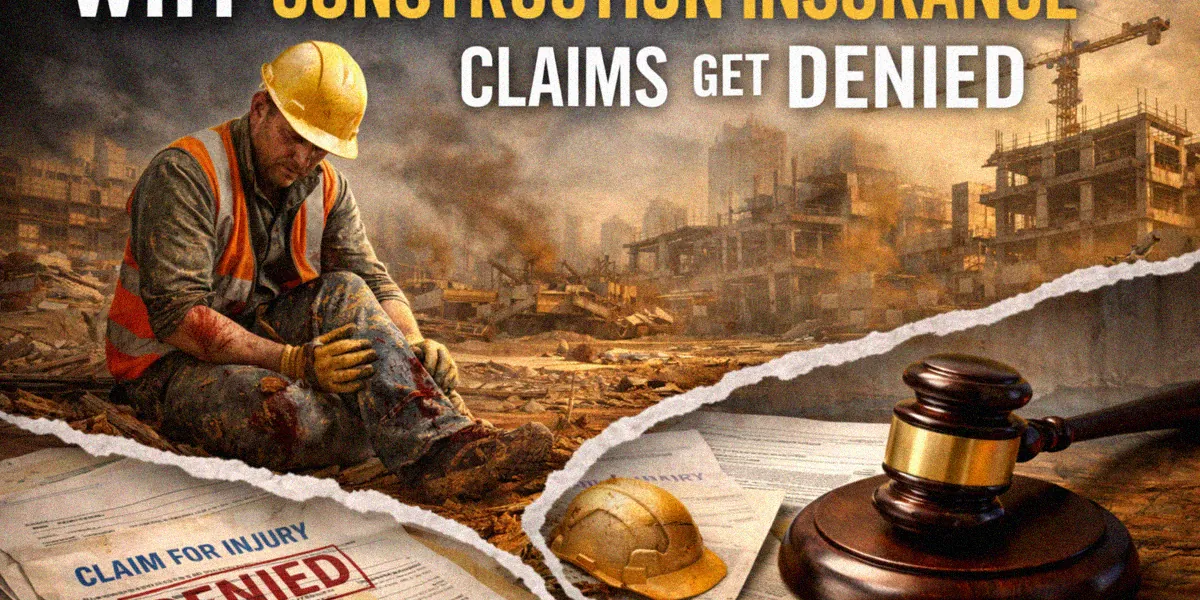
Construction insurance “breakdowns” are not usually the result of missing paperwork, bad faith, or isolated administrative mistakes. They are the predictable outcome of how construction risk is translated, simplified, and constrained inside insurance systems long before any worker steps onto a site.
This page explains why insurance outcomes in construction so often diverge from job-site expectations, even when losses are real and work-related. It does not explain how to dispute claims, appeal decisions, or select coverage. Its purpose is structural: to show how insurance systems are designed, and why those designs regularly fail to map cleanly onto real construction work.
This system-level breakdown should be read alongside the broader overview of how Construction workers insurance is structured, which explains the foundational coverage models and limits that shape these outcomes.
Why Construction Insurance claims Fails Predictably
Insurance systems are built to manage risk at scale. To do that, they rely on abstraction: standardized job classifications, assumed work conditions, fixed roles, and simplified timelines. These abstractions are necessary for underwriting, pricing, and regulatory compliance, but they are also the source of many breakdowns.
Why construction insurance claims fails in real life, it is usually because:
-
The job site behaves differently from the model assumed
-
The worker’s role is more fluid than the policy allows
-
The sequence of events is harder to isolate than the claims system requires
-
Responsibility is spread across multiple parties, not one insured entity
None of these conditions is unusual in construction. They are normal. The problem is that insurance systems are not designed around what is normal on active job sites; they are designed around what is manageable on paper.
Insurance systems are designed to manage risk at scale through abstraction and pooling, a principle reflected throughout guidance from the National Association of Insurance Commissioners (NAIC) and the Insurance Information Institute (Triple-I) on risk classification, insurance regulation, and loss modeling.
The Gap Between Job-Site Reality and Policy Assumptions
Construction work is dynamic. Tasks shift hourly. Workers move between roles. Hazards overlap. Job sites change as projects progress.
Insurance policies, by contrast, are static. They assume:
-
Stable job descriptions
-
Predictable work environments
-
Clear employer–employee relationships
-
Isolated incidents with identifiable causes
When real work drifts outside those assumptions, even slightly, coverage outcomes begin to fracture. This is not because the work is improper, but because the system evaluating it was never designed to track that level of complexity.
This gap between lived work conditions and policy assumptions is the foundation of most construction insurance failures.
Construction work environments routinely exceed the standardized risk assumptions reflected in many insurance models, as evidenced by the evolving hazard profiles documented by OSHA’s construction-industry safety resources.
How Classification Systems Create Construction Insurance Gaps
Before underwriting can price construction risk, insurers must convert real-world work into standardized classifications. This process is necessary because insurance systems cannot evaluate every worker, task, and project individually.
Workers’ compensation classification systems maintained by organizations such as the National Council on Compensation Insurance (NCCI) were created to standardize risk evaluation and pricing across thousands of employers, but they necessarily simplify complex job-site realities.
The challenge is that real construction work rarely remains inside a single classification.
A worker hired for one role may perform multiple tasks during a project. A subcontractor may take on duties outside the scope originally described during underwriting. Job-site responsibilities often evolve as projects progress.
Insurance systems, however, generally rely on the classifications assigned before losses occur.
This creates one of the earliest structural failure paths in construction insurance. When actual work drifts beyond the assumptions built into a classification, coverage interpretation becomes more complicated because the loss may no longer align perfectly with the exposure profile used to issue and price the policy.
In many construction insurance disputes, the disagreement is not whether work occurred, but whether the work performed matches the classification assumptions on which coverage was based.
How Underwriting Simplifies Construction Risk
Underwriting requires simplification. Insurance underwriting frameworks are built around exposure categorization, risk selection, and loss prediction methodologies commonly discussed throughout professional risk-management resources such as the International Risk Management Institute (IRMI).
In that process:
-
Complex job functions are reduced to single classifications.
-
Multi-hazard environments are averaged into expected loss profiles.
-
Temporary or transitional work is treated as a fixed activity
These simplifications work reasonably well for pricing large portfolios of risk. They work poorly when applied to individual workers or specific incidents.
When an injury or loss occurs outside the narrow assumptions tied to a classification, the policy may technically still be in force, but the event may no longer align with how that policy defines covered risk.
What the Insurance System Is Actually Trying to Do
From a worker’s perspective, underwriting often appears disconnected from how construction work is actually performed.
The underwriting objective, however, is not to describe every detail of a project. Its purpose is to convert unpredictable field activity into predictable pricing categories.
To accomplish this, underwriters must estimate:
- Expected injury frequency
- Expected claim severity
- Operational hazards
- Worker exposure levels
- Liability potential
- Project complexity
Every simplification improves pricing consistency across thousands of policies. At the same time, every simplification increases the possibility that real job-site conditions will differ from the assumptions used to issue coverage.
This tradeoff sits at the center of many construction insurance breakdowns. The system is designed to produce predictable insurance outcomes at a portfolio scale, not to capture every operational detail of individual projects.
Construction Insurance Eligibility Rules & Worker Exclusions
Coverage does not begin at the moment an injury happens. It begins only after eligibility conditions are satisfied.
In construction, eligibility failures often occur because:
-
Employment status is unclear or contested.
-
The worker is classified differently than their actual duties suggest
-
The timing of work does not align with policy periods.
-
Multiple entities appear to share control over the work
Worker classification disputes remain a recurring issue throughout the construction industry and are frequently addressed through employment-classification guidance published by the U.S. Department of Labor.
From a worker’s perspective, these distinctions feel artificial. From a system perspective, they are necessary gates that determine whether responsibility attaches at all.
Many legitimate workers discover eligibility limits only after a claim is evaluated, when it is already too late to adjust how the system sees their role.
Common Eligibility Failure Paths
Eligibility disputes frequently emerge from ordinary construction arrangements rather than unusual circumstances.
Common failure paths include:
- Independent contractor versus employee classification disputes
- Undeclared subcontractor relationships
- Payroll classifications that differ from actual work performed
- Temporary workers operating across multiple employers
- Shared supervision between contractors and subcontractors
- Work performed outside the insured operational scope
In many cases, the injury itself is not disputed. The dispute centers on whether the worker fits the eligibility framework required for coverage to respond.
This distinction explains why a loss can appear unquestionably work-related while still triggering coverage uncertainty.
How Normal Construction Activities Trigger Exclusions
Exclusions are often misunderstood as rare or extreme limitations. In construction, many exclusions are triggered by ordinary job-site conditions, not exceptional behavior.
Common exclusion triggers include:
-
Work at height or depth beyond defined thresholds.
-
Use of specific tools or machinery
-
Work performed outside declared scopes
-
Activities considered “incidental” but not explicitly included
Because exclusions operate mechanically, intent and necessity often do not matter. If an activity falls outside the policy’s defined risk envelope, coverage can fail even when the activity is standard for the trade.
Why Claims Systems Struggle With Causation and Timing
Construction injuries and losses rarely occur as clean, isolated events. They often involve:
-
Repetitive exposure over time
-
Multiple contributing conditions
-
Delayed symptoms or reporting
-
Overlapping work responsibilities
Occupational injury research published by the National Institute for Occupational Safety and Health (NIOSH) has long documented that many workplace conditions develop through cumulative exposure rather than a single identifiable event.
Claims systems, however, are designed to evaluate discrete incidents with clear causal chains. When causation is diffuse or timing is ambiguous, the system may default toward denial, not because harm is doubted but because responsibility cannot be cleanly assigned within system rules.
This mismatch between how construction harm develops and how claims systems evaluate events is a central failure point.
Common Claims Failure Paths
Construction claims become increasingly difficult when events do not fit the clean timelines preferred by insurance systems.
Examples include:
- Repetitive-use injuries that develop gradually
- Exposure-related conditions with delayed symptoms
- Multiple incidents contributing to a single injury
- Delayed reporting after project completion
- Multiple employers potentially sharing responsibility.
- Losses involving overlapping operational hazards
Claims systems function most efficiently when a specific event, date, and responsible party can be identified. Construction losses frequently develop under conditions where those boundaries are less clear.
As uncertainty increases, the difficulty of assigning responsibility increases as well.
Layered Contracting and Fragmented Responsibility
Modern construction relies on layered contracting: owners, general contractors, subcontractors, labor providers, and independent operators working simultaneously.
This multi-employer project structure is a defining characteristic of the construction industry and is widely recognized throughout the Associated General Contractors of America (AGC) industry guidance and project-delivery resources.
Insurance policies, however, are typically written around single insured entities with defined responsibilities.
When a loss occurs, the system must determine:
-
Who controlled the work?
-
Who employed the worker?
-
Whose policy should respond
-
Whether contractual risk transfer applies
These determinations are often contested internally, even when the injury itself is undisputed. As responsibility fragments, coverage can stall or collapse entirely.
Why Insurance Works Better on Paper Than on Active Job Sites
On paper, construction insurance is orderly. Risks are categorized. Roles are clear. Coverage is bounded.
On job sites, none of that is true.
Insurance systems are optimized for predictability, not adaptability. They perform best when reality resembles their assumptions, and break down when it does not. In construction, reality rarely cooperates.
Understanding this does not resolve any single denial or failure. But it explains why so many construction workers, supervisors, and contractors encounter outcomes that feel confusing, inconsistent, or unfair.
Construction Insurance Breakdown Model
Most construction insurance failures can be traced to one of five system layers:
- Classification Layer — how work is categorized before coverage is issued.
- Eligibility Layer — who qualifies for coverage when a loss occurs.
- Exclusion Layer — which activities fall outside the policy’s defined risk envelope.
- Claims Layer — how causation, timing, and responsibility are evaluated.
- Responsibility Layer — which party’s insurance is expected to respond.
Understanding these layers helps explain why construction insurance outcomes often differ from job-site expectations, even when losses are genuine and work-related.
Where This Explanation Leads Next
Each breakdown described above is a structural failure path, not an isolated problem. This page serves as the parent framework for deeper explainers that examine how these mechanisms operate in detail, including:
-
Where coverage eligibility most commonly fails
-
How exclusions are applied in real job-site scenarios
-
Why contractor and subcontractor risk gaps persist
-
How employer responsibility fragments across projects
-
Why “work-related” alone is often insufficient for coverage
Together, these explainers map the internal logic of construction insurance systems, showing not how to fight them, but how they function.
Evidence and Operational Consequences
Construction insurance systems depend on standardization because insurers must evaluate and price large numbers of risks consistently.
The underlying principles can be seen across OSHA construction safety guidance, NIOSH occupational injury research, NCCI classification systems, and NAIC insurance regulatory frameworks, all of which rely on standardized methods for evaluating, categorizing, and managing risk.
This approach is reflected throughout the industry:
- Occupational safety regulators document constantly changing construction hazards.
- Workers’ compensation systems rely on classification structures to group similar risks.
- Underwriting frameworks depend on exposure categories rather than individual task-by-task analysis.
- Claims systems require defined rules for assigning responsibility and determining coverage.
These systems are efficient for administering large insurance portfolios, but they inevitably create gaps between administrative models and real-world construction activity.
For workers, this can mean an injury is clearly connected to employment while still becoming difficult to evaluate within insurance rules.
For contractors, it can mean coverage disputes arise even when work was legitimate, expected, and operationally necessary.
For project owners, it can create uncertainty regarding which party’s insurance is expected to respond after a loss.
The result is not necessarily insurance failure. Rather, it is a predictable consequence of applying standardized insurance systems to highly dynamic construction environments.
Core Takeaway
Construction insurance does not fail randomly.
It fails predictably, because it was never designed to fully mirror the complexity of real construction work.
Once that design reality is understood, the outcomes, no matter how frustrating, become easier to interpret.
Institutional & Underwriting Reference
This article was developed using construction risk management frameworks, occupational classification systems, insurance underwriting principles, and regulatory guidance from the following organizations:
Occupational Safety and Health Administration (OSHA)
Construction industry hazard identification, multi-employer worksite guidance, and construction safety standards.
https://www.osha.gov/construction
National Institute for Occupational Safety and Health (NIOSH)
Construction injury research, occupational exposure studies, cumulative injury development, and workplace risk analysis.
https://www.cdc.gov/niosh/construction
National Council on Compensation Insurance (NCCI)
Workers’ compensation classification systems, occupational risk categorization, experience rating methodologies, and construction exposure classifications.
https://www.ncci.com
National Association of Insurance Commissioners (NAIC)
Insurance regulatory frameworks, risk classification principles, underwriting oversight, and insurance system governance.
https://content.naic.org
International Risk Management Institute (IRMI)
Insurance underwriting methodology, construction risk management, contractual risk transfer, and commercial insurance coverage analysis.
https://www.irmi.com
Associated General Contractors of America (AGC)
Construction project delivery structures, subcontracting relationships, contractor responsibilities, and industry operational practices.
https://www.agc.org
Reviewed for Underwriting Accuracy
This article was reviewed for underwriting accuracy with emphasis on:
- Construction occupational classification systems
- Risk classification and exposure modeling
- Construction underwriting methodology
- Coverage eligibility determination
- Construction exclusion analysis
- Claims causation evaluation
- Multi-employer worksite responsibility allocation
- Contractor and subcontractor risk transfer structures
- Construction insurance failure-path analysis
Research & Underwriting Methodology
This article analyzes construction insurance as a risk-management system rather than as an individual insurance product.
Research focused on:
- How construction work is translated into underwriting classifications
- How insurance systems simplify complex construction operations
- How eligibility requirements determine coverage attachment
- How exclusions create structural coverage limitations
- How claims systems evaluate causation and responsibility
- How layered contracting environments fragment insurance obligations
- How underwriting assumptions diverge from active job-site conditions
The analysis incorporates construction safety guidance, insurance regulatory frameworks, occupational classification methodologies, workers’ compensation risk structures, commercial underwriting principles, and construction industry operational practices.
Published: January, 2026.
Last reviewed: June, 2026.