Editorial notice: Reviewed for underwriting accuracy by the RJI Institutional Review Team | Published: June, 2026 | Last reviewed: June, 2026.
————————————————————————————————————–
Executive Summary
Evacuation-Only Gaps in High-Risk Commercial Insurance occur when a policy covers medical treatment but excludes the emergency extraction needed to remove injured workers from remote, offshore, or elevated job sites. These underwriting gaps can significantly increase catastrophic claim exposure, rescue-related liability, uninsured operational costs, and accumulation risk in industries involving towers, rope access, offshore operations, and remote infrastructure work.
Evacuation-only gaps become particularly severe when multiple workers depend on the same rescue infrastructure during catastrophic incidents, creating concentration risk and increasing the potential for simultaneous claims.
Most high-risk business owners assume standard Workers’ Compensation and Commercial General Liability (CGL) policies fully protect workers during severe incidents. However, many commercial insurance structures contain evacuation and transport limitations that only become visible during complex rescue events involving offshore platforms, wind turbines, telecom towers, or other high-elevation environments.
What is an Evacuation-Only Gap?
Evacuation-Only Gaps in High-Risk Commercial Insurance often emerge when emergency extraction logistics fall outside the assumptions built into standard commercial underwriting structures.
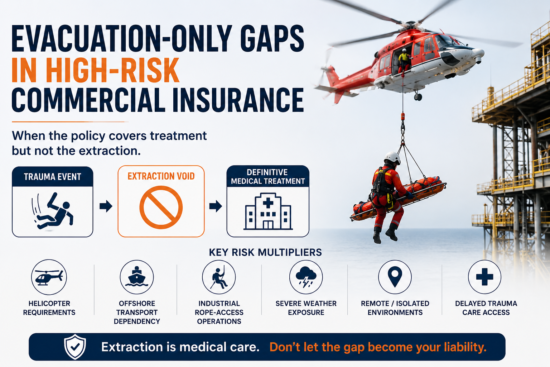
An Evacuation-Only Gap occurs when a commercial insurance policy covers the ultimate medical treatment of an injured worker (the hospital stay, surgery, and rehabilitation) but completely excludes the physical logistics and transit assets required to extract and transport that worker from a high-elevation or remote job site.
[ Trauma Event ]
        │
        ▼
[ Extraction Void ]  <-- Employer Pays Out-of-Pocket
        │
        ▼
[ Definitive Treatment ] <-- Policy Triggers & Pays
In simpler terms, A policy may cover definitive medical treatment while excluding the extraction logistics required to access that treatment. This fundamental disconnect is a direct consequence of Rescue Difficulty in High-Elevation Underwriting, where insurers scale your premiums not just by how high you climb, but by how long it takes to safely get you back down.
Why Standard Policies Fall Short
Standard commercial underwriting logic operates on “urban baseline accessibility.” It assumes a municipal ambulance can drive up to the curb, or a local fire department can manage basic extraction. When operations shift to complex high-elevation, or offshore environments, that baseline logic breaks down completely.
How Underwriters Evaluate Evacuation Exposure
Underwriters evaluate evacuation exposure by analyzing how difficult, expensive, and time-sensitive emergency extraction may become during a catastrophic injury event.
Key Risk Multipliers
Several underwriting factors increase evacuation-risk concern:
- distance from municipal emergency services
- offshore transport dependency
- helicopter rescue requirements
- industrial rope-access operations
- severe weather exposure
- isolated terrain or offshore blocks
- lack of nearby trauma infrastructure
- dependence on private rescue contractors
These evacuation concerns are closely connected to Offshore Risk Underwriting, where insurers evaluate helicopter dependency, weather-related extraction delays, and offshore rescue infrastructure limitations.
As evacuation complexity increases, insurers may apply stricter underwriting reviews, rescue-related exclusions, specialized endorsement requirements, higher liability pricing, carrier restrictions, or elevated occupational classifications.
The Severity Multiplier: For insurers, difficult extraction environments create a severity multiplier because delays between injury and definitive medical treatment significantly increase catastrophic claim exposure.
The 5 Hidden Coverage Traps
1. The Workers’ Comp “Reasonable & Necessary” Trap
“Workers’ Compensation guidelines dictate that insurers must cover ‘reasonable and necessary medical transportation.’ However, under the OSHA Fall Protection Standards (Code 1926.502), employers are strictly mandated to provide a clear, functional plan for prompt rescue. If your current coverage triggers at the hospital door rather than the point of suspension, your business may retain substantial uninsured extraction exposure during that rescue window.
2. The Method-of-Access Rope Exclusion
Just as consumer adventure plans exclude technical mountaineering, commercial general liability policies regularly feature strict Method of Access Restrictions. If your crew utilizes industrial rope access (IRATA/SPRAT) rather than standard scaffolding, your baseline policy may exclude any liability or rescue expenses incurred while workers are suspended under tension.
3. The “Point of Suspension” Liability
When a worker remains suspended following a fall-arrest event, underwriters recognize that rescue delays may rapidly increase medical severity exposure due to suspension trauma and prolonged circulation restriction.
In technical rope-access environments operating under IRATA or SPRAT frameworks, insurers may evaluate whether existing Method-of-Access exclusions significantly limit rescue-related liability exposure during prolonged extraction events.
For insurers, extended suspension duration creates a significant claim-severity concern because delays in extraction may increase catastrophic injury exposure, long-term impairment risk, and downstream liability complexity.
4. The Emergency First-Party Transport Limitation
If an employee suffers an acute medical emergency (such as a heart attack or heat stroke) while working on an isolated offshore structure or remote cell tower, standard commercial liability lines do not trigger because there is no third-party negligence. Without a dedicated medical evacuation endorsement, the logistics of extraction fall squarely on direct business expense.
5. The First-Party vs. Third-Party Coverage Disconnect
Underwriters also evaluate whether emergency evacuation exposure originates from a workplace injury event or from an acute medical emergency occurring in a remote operational environment.
For example, if a supervisor or technician experiences a stroke, aneurysm, cardiac event, or other sudden medical emergency on an offshore platform or remote elevated structure, standard liability coverage may not respond in the same manner as a traditional occupational injury claim.
Without dedicated medical evacuation endorsements or emergency transport provisions, businesses may retain immediate operational and financial responsibility for extraction logistics and emergency transport coordination.
The Financial Reality of Remote Extraction
When an accident occurs in an environment with high rescue difficulty, the costs can escalate rapidly. Because municipal services cannot service specialized structures or deep offshore blocks, employers must rely on private contract infrastructure.
| Rescue Asset | Operational Scope | Out-of-Pocket Cost Est. |
| High-Angle Technical Team | Specialized rigging & structural extraction | $15,000 – $40,000 |
| Private Marine Transport | Offshore platform to coastal transit hub | $30,000 – $75,000 |
| Rotary-Wing Airlift (Helicopter) | Remote terrain / Deepwater medevac | $50,000 – $150,000+ |
| Fixed-Wing Air Ambulance | Inter-facility trauma center jet transport | $100,000 – $300,000 |
Estimated costs vary by geography, weather conditions, rescue complexity, aircraft availability, and jurisdiction. Figures shown are illustrative industry ranges compiled from public emergency transport resources and commercial evacuation providers.
Actuarial Note on Transport Logistics: The baseline pricing detailed above reflects public emergency medical transport cost estimates. According to emergency transit metrics managed by the U.S. Department of State and the CDC, remote or high-altitude medical air evacuations consistently range from $100,000 to over $300,000, depending on structural complexity and geographic isolation.
Underwriting Takeaway: For insurers, the time gap between the trauma event and definitive care is a major severity driver. Extended extraction delays may significantly increase long-term disability exposure, rehabilitation costs, and catastrophic claim severity. This is one reason insurers closely connect prolonged rescue delays with Permanent Disability Risk from Elevated Work in elevated-risk occupations.
How Evacuation-Only Gaps in High-Risk Commercial Insurance Affect Underwriting
When insurers identify significant evacuation exposure during underwriting review, commercial policies may become more restrictive.
Evacuation exposure frequently increases when operations rely on offshore transport, helicopter rescue, industrial rope access, severe-weather operations, isolated terrain, or remote infrastructure lacking nearby trauma facilities.
Insurers may also require businesses to demonstrate formal evacuation planning, dedicated rescue infrastructure, and documented emergency-response partnerships before offering broader coverage terms.
At certain evacuation-risk thresholds, insurers may decline coverage entirely unless dedicated rescue-response endorsements and emergency transport provisions are formally documented during underwriting review.
These underwriting concerns become significantly more severe in industries involving towers, offshore platforms, wind-energy operations, industrial rope access, and remote elevated infrastructure.
How Employers Can Identify and Close Evacuation Coverage Gaps
To protect your business from catastrophic out-of-pocket exposure, business owners, safety directors, and risk managers must move past general policy assurances and audit the precise policy language.
Underwriting Conclusion
An insurance policy that only protects your workers after they reach a hospital bed is structurally incomplete for high-risk, high-elevation industries. For operations on towers, turbines, and offshore platforms, extraction is medical care. Bridging the evacuation-only gap is the difference between a managed operational incident and significant unplanned financial exposure.
Key Takeaways
- Evacuation-only gaps occur when extraction logistics are excluded while medical treatment remains covered.
- Rescue difficulty can materially increase catastrophic claim severity.
- Offshore and elevated operations often require specialized evacuation endorsements.
- Delayed extraction may increase disability exposure and operational costs.
- Businesses should verify whether coverage begins at the point of injury or only after hospital admission.
Institutional & Underwriting Reference
Institutional References
- Occupational Safety and Health Administration (OSHA) Fall Protection Standards — Federal fall-protection and prompt-rescue standards relevant to emergency extraction obligations, suspension trauma exposure, and elevated-work rescue planning.
- Industrial Rope Access Trade Association (IRATA) — International rope-access operational and rescue frameworks commonly referenced in offshore, wind-energy, tower, and industrial elevated-access operations.
- Society of Professional Rope Access Technicians (SPRAT) — Technical rope-access certification and rescue standards used in high-angle industrial access and extraction environments.
- Centers for Disease Control and Prevention (CDC) Emergency Medical Transport Resources — Public emergency medical transport and trauma-response resources relevant to evacuation logistics and catastrophic injury response systems.
- Federal Aviation Administration (FAA) Air Ambulance Guidance — Aviation operational guidance relevant to emergency medical transport, helicopter extraction logistics, and remote evacuation operations.
Reviewed for Underwriting Accuracy
This article was reviewed for underwriting relevance using the following commercial-risk and evacuation-exposure evaluation frameworks:
- Emergency extraction severity modeling
- Commercial evacuation exposure assessment
- Rope-access liability evaluation
- Offshore evacuation dependency analysis
- Remote infrastructure rescue-risk modeling
- Suspension trauma severity exposure review
- Medical transport delay escalation analysis
- Catastrophic injury severity underwriting
- Contractor operational transfer-risk analysis
- Commercial endorsement and exclusion review systems
Research & Underwriting Methodology
This article applies Risk Job Insurance’s commercial evacuation-risk underwriting framework by analyzing how insurers evaluate emergency extraction exposure, transport limitations, rope-access operations, offshore rescue dependency, and catastrophic injury severity in high-risk industries.
The underwriting methodology used in this article includes:
- Commercial liability exclusion analysis
- Emergency extraction exposure modeling
- Rope-access operational risk assessment
- Offshore evacuation dependency evaluation
- Catastrophic disability severity escalation analysis
- Medical transportation trigger analysis
- Rescue-delay claim severity review
- Contractor transfer-risk evaluation
- Commercial endorsement structure assessment
- Remote infrastructure emergency-response modeling
The article also incorporates operational underwriting concerns commonly evaluated in offshore energy, telecommunications tower work, industrial rope access, remote infrastructure maintenance, marine operations, and elevated industrial rescue environments where extraction delays may materially affect catastrophic claim severity and uninsured financial exposure.