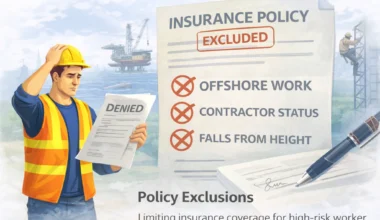
Why offshore work is harder for insurers becomes clear when examining how loss containment systems break down in remote marine environments.
Within the broader structure of Offshore Workers Insurance, underwriting behavior is shaped less by the danger of the job itself and more by the insurer’s ability to contain loss after an incident occurs.
Offshore roles often mirror onshore equivalents: welders weld, electricians repair systems, and crane operators lift loads. Yet insurers treat offshore placements differently. The structural driver is not simply the hazard level. It is a containment difficulty.
Offshore work is harder for insurers to contain because response time, evacuation logistics, jurisdictional coordination, and infrastructure limits make severity harder to predict and cap. When severity becomes unstable, underwriting tightens.
This article isolates containment difficulty as a systemic driver of offshore eligibility restrictions, pricing shifts, and policy limitations.
What “Containment” Means in Insurance Systems
In insurance modeling, containment refers to the system’s ability to stabilize and cap loss severity after an incident occurs. Containment modeling exists primarily to protect insurer capital from severity volatility, not to evaluate fairness of occupational risk.
Containment is achieved when insurers can rely on:
-
Predictable severity limits
-
Rapid medical stabilization capability
-
Reliable escalation pathways (ambulance → hospital → specialist)
-
Controlled claims verification processes
-
Defined jurisdictional authority
Insurance systems are not built to eliminate accidents. They are built to limit unpredictability.
Onshore environments typically support containment through:
-
Proximity to trauma centers
-
Established emergency transport networks
-
Clear legal jurisdiction
-
Standardized billing frameworks
-
Stable medical documentation systems
Offshore environments weaken these containment controls. When post-incident variables become unstable, insurers face loss containment constraints that increase capital exposure.
Why Remoteness Disrupts Containment
Distance alone does not create underwriting concern. Instability of response does.
Offshore environments introduce remoteness risk, the uncertainty created when access to definitive care depends on variables outside immediate control.
Key destabilizing factors include:
Time to Definitive Care
Advanced trauma care may require hours of transport rather than minutes. In severe injuries, delay directly influences outcome severity.
Medevac Feasibility
Helicopter or vessel evacuation is not guaranteed. It depends on weather, daylight conditions, equipment availability, and contractual arrangements.
Weather-Dependent Transport
Storm conditions can suspend evacuation capability entirely, extending stabilization timelines.
Equipment Constraints
Offshore platforms may have limited medical facilities designed for stabilization, not advanced intervention.
Communication Gaps
Signal reliability, coordination delays, and cross-agency communication introduce verification complexity.
Infrastructure Dependency
Transport often requires coordinated sequencing: platform stabilization → vessel transfer → helicopter transport → coastal hospital intake.
Remoteness risk functions as a severity amplifier because escalation pathways are conditional, not automatic. Insurers cannot assume rapid stabilization. That instability increases projected worst-case loss exposure.
Offshore emergency coordination often depends on maritime rescue frameworks such as those outlined by the International Maritime Organization’s Search and Rescue (SAR) Convention, where response capability varies by region and resource allocation.
How Severity Becomes Harder to Cap
Offshore underwriting is influenced less by accident frequency and more by claim severity amplification. In high-remoteness cases, projected losses may approach reinsurance attachment points, further tightening underwriting parameters.
Severity becomes harder to cap offshore due to:
Delayed Advanced Medical Care
Complications increase when trauma treatment is deferred.
Transport Complications
Air evacuation itself carries risk. Deterioration during transport increases claim complexity.
Extended Hospitalization
Delayed stabilization may lengthen ICU stays and rehabilitation timelines.
Cross-Border Billing
Medical evacuation coverage may involve treatment in foreign jurisdictions with variable billing structures.
Legal Ambiguity in International Waters
Jurisdictional complexity affects liability assignment, benefit coordination, and dispute resolution.
Insurers price for worst-case severity bands, not average injury scenarios. When containment variables are unstable, the projected severity band widens. Capital modeling must reflect that upper boundary.
Offshore work expands the severity ceiling even if the occupation itself is unchanged.
Legal ambiguity in international waters introduces jurisdictional complexity, particularly in areas governed under the United Nations Convention on the Law of the Sea (UNCLOS), where liability and enforcement authority may depend on vessel flag state, coastal state rights, and maritime zone classification.
Why Offshore Work Is Harder for Insurers in Underwriting Models
Insurers respond structurally when loss containment constraints exceed predictable thresholds.
Common responses include:
Offshore Eligibility Restrictions
Eligibility may shift from occupation-based assessment to location-based gating once remoteness risk crosses predefined parameters.
Sub-Limits or Capped Benefits
Policies may include maximum benefit ceilings for evacuation, hospitalization, or specific injury categories.
Geographic Exclusions
Coverage may exclude work performed beyond certain nautical distances or outside specified territorial waters.
Mandatory Medical Evacuation Coverage
Medical evacuation coverage may be required as a rider or embedded component before primary coverage is issued.
Premium Loading
Pricing may shift from occupational rating to severity-band loading when remoteness risk drives upper-limit volatility.
Employer Evacuation Contract Dependence
Underwriting may require confirmation that the employer maintains active evacuation contracts before approving coverage.
These mechanisms are containment responses. They are not punitive measures. They are structural adjustments to protect capital when severity modeling exceeds tolerance thresholds.
Structural Containment Failure Paths
Containment breaks at identifiable underwriting thresholds.
Threshold 1: Remoteness Risk Trigger
When projected evacuation time exceeds actuarial stabilization thresholds embedded in severity models, offshore eligibility restrictions may activate.
Threshold 2: Severity-Band Shift
When worst-case severity projections exceed occupational baselines, pricing shifts from job classification to location-driven loading.
Threshold 3: Coverage Cap Introduction
If upper-band loss projections surpass reinsurance comfort levels, benefit caps or sub-limits are introduced.
Threshold 4: Geographic Override
In certain maritime zones or international waters, geographic exclusions may override occupation-based eligibility.
Threshold 5: Evacuation Dependency Requirement
When evacuation logistics determine survival probability, medical evacuation coverage becomes a precondition for policy issuance.
These breakpoints reflect containment modeling exceeding capital tolerance. Insurers restrict coverage when predictability deteriorates beyond acceptable variance levels.
Addressing Common Worker Misconceptions
Several recurring assumptions conflict with underwriting logic:
“The job is the same as onshore.”
Containment modeling evaluates post-incident escalation, not task similarity.
“We have strong safety compliance.”
Compliance reduces frequency but does not eliminate remoteness risk or claim severity amplification.
“My employer handles emergencies.”
Employer emergency response improves outcomes, but insurers must independently model evacuation feasibility, jurisdictional complexity, and billing exposure.
Location can change eligibility, pricing, and policy structure even when occupational duties remain identical.
Containment modeling overrides job equivalence.
Effects on Claims Outcomes
Containment instability also affects claims administration. Offshore claims often require layered review across carriers, jurisdictions, and evacuation providers, extending settlement timelines beyond standard occupational benchmarks.
Offshore incidents may involve:
-
Extended claims verification timelines
-
Additional documentation requirements
-
Jurisdictional review across maritime or international frameworks
-
Coordination between multiple insurers or carriers
-
Increased dispute probability due to cross-border interpretation
These are systemic consequences of jurisdictional complexity and loss containment constraints, not arbitrary administrative barriers.
This systemic instability explains why offshore work is harder for insurers, even when the occupational tasks mirror onshore equivalents.
Structural Context Within Offshore Insurance
This containment analysis functions as a structural component within Offshore Workers Insurance. It explains why offshore workers are treated differently by insurance systems even when their occupational tasks mirror onshore roles.
Offshore underwriting behavior is driven by severity uncertainty, not moral judgment or occupational bias.
When response pathways are unstable, severity becomes harder to cap.
When severity becomes harder to cap, underwriting restricts.
That is the systemic logic behind offshore eligibility restrictions and pricing behavior.