Introduction
Offshore workers often discover, sometimes only after applying for coverage or filing a claim, that insurance behaves differently once work moves beyond land-based environments. Coverage becomes narrower, premiums increase, exclusions appear, and claims take longer to resolve. These outcomes can feel arbitrary, especially when job duties closely resemble onshore roles and safety records are strong.
These differences are easier to understand when viewed within the broader framework of how offshore workers insurance actually works, including where coverage commonly narrows, fails, or breaks down altogether.
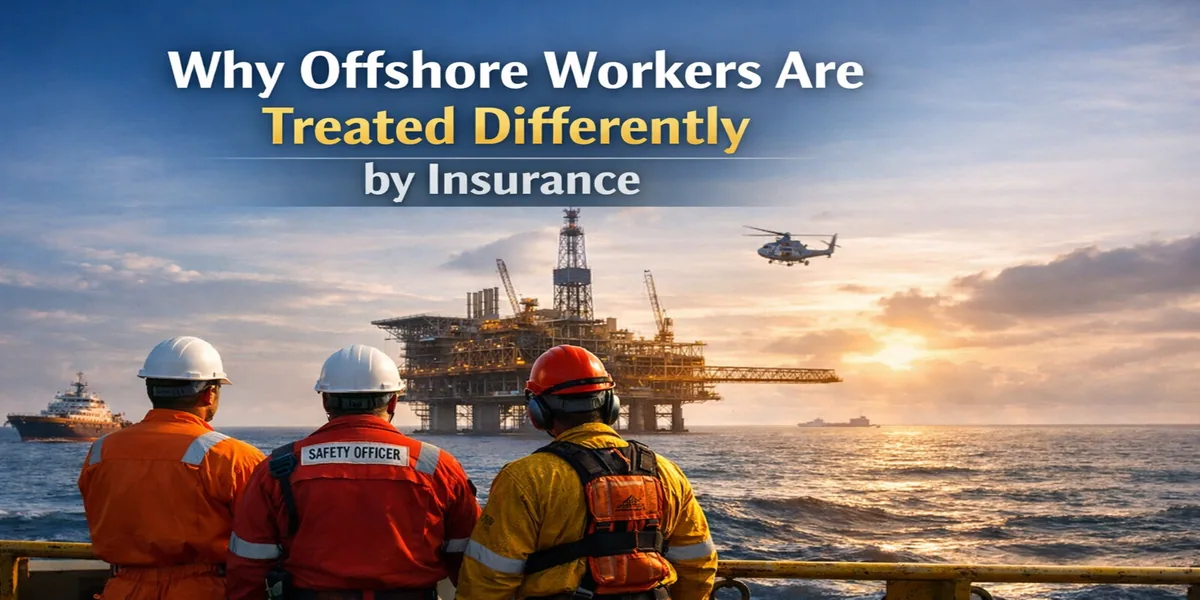
In reality, offshore workers are not treated differently because insurers view them as reckless or uninsurable. They are treated differently because offshore work is classified as a distinct insurance environment, one that disrupts many of the assumptions underwriting and claims systems rely on to function predictably.
To understand why offshore insurance outcomes diverge so sharply from onshore work, it is necessary to examine how insurers model risk at a structural level.
Offshore Work Is Treated as a Separate Insurance Environment
Insurance systems do not assess risk based solely on job titles or individual behavior. They evaluate environments, the conditions under which work is performed, and the constraints those conditions impose once something goes wrong.
Insurance systems do not assess risk based solely on job titles or individual behavior; they rely on formal risk classification to group work environments with similar loss characteristics and constraints.
Offshore environments are structurally different from onshore workplaces due to a combination of factors that cannot be easily mitigated after an incident begins:
-
Physical separation from shore-based infrastructure
-
Exposure to open water, weather volatility, and confined platforms
-
Limited on-site medical capability
-
Dependence on vessels or aircraft for routine transport and emergency evacuation
These conditions are widely recognized as defining characteristics of offshore working environments, which introduce constraints that differ fundamentally from land-based industrial work.
Even when the work itself is similar, inspection, maintenance, supervision, the offshore setting introduces risks that cannot be isolated or corrected quickly. For insurers, this distinction matters more than the task being performed.
Across insurance markets, offshore work is generally treated as a separate risk category because its loss characteristics differ from land-based employment.
As a result, offshore work is reclassified not as “more dangerous,” but as less controllable.
Why Remoteness Changes Insurance Risk Offshore
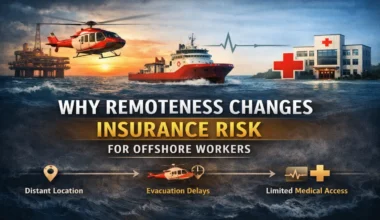
Remoteness is one of the most misunderstood drivers of offshore insurance decisions. From a worker’s perspective, distance may feel like a logistical inconvenience. From an insurer’s perspective, it is a severity multiplier.
Most insurance models assume that injuries and illnesses can be stabilized quickly. They rely on predictable access to emergency services, hospitals, and specialists. Offshore environments break those assumptions.
When an incident occurs offshore:
-
Emergency response times are longer.
-
Medical treatment options are limited at the point of injury.
-
Evacuation depends on weather, visibility, and equipment availability.
Delays compound risk. An injury that might be manageable onshore can escalate offshore due to time, exposure, and transport constraints. Insurers, therefore model offshore incidents not by how they start, but by how badly they can deteriorate before intervention is possible.
Offshore incident response is constrained by distance, weather, and transport availability, as outlined in international guidance on emergency response and evacuation offshore.
This is why remoteness consistently leads to higher premiums, narrower coverage, and stricter eligibility, even when incident frequency appears low.
Why Offshore Work Is Harder for Insurers to Contain
Containment is a core concept in insurance. Insurers prefer risks that can be isolated, capped, and resolved without spreading across systems or timeframes.
Offshore incidents resist containment.
A single offshore event can trigger multiple layers of exposure:
-
The initial worksite incident
-
Secondary risk during evacuation or transfer
-
Environmental exposure to water or weather
-
Involvement of transport crews and third parties
-
Operational shutdowns extending beyond the injured worker
From an insurance perspective, offshore incidents often involve exposure stacking, where a single event triggers multiple layers of loss across worksite, transport, environment, and third-party involvement.
Because offshore operations are interconnected, insurers model these incidents as compound loss scenarios, not isolated claims. Losses are harder to cap, timelines are harder to predict, and responsibility is often shared across multiple entities.
From an underwriting standpoint, lack of containment introduces uncertainty that must be priced, restricted, or excluded.
Jurisdiction and Flag State Complicate Offshore Insurance
Insurance depends on enforceable legal frameworks. Claims require clarity about which laws apply, which courts have authority, and which entity is responsible for payment.
Offshore work frequently exists outside these clean boundaries.
Offshore work frequently introduces jurisdictional ambiguity, where it is unclear which laws, courts, or enforcement mechanisms ultimately govern an insurance claim.
Common complications include:
-
Flag state law differing from employer jurisdiction
-
Workers employed by onshore entities but operating offshore
-
Multiple nationalities involved in a single incident
-
Contracts governed by different legal systems
From an insurer’s perspective, jurisdictional ambiguity increases claims risk, not because claims are illegitimate, but because enforcement pathways are uncertain. When insurers cannot reliably predict how a claim will be adjudicated or enforced, they respond by tightening coverage terms.
This is why offshore insurance often includes exclusions, limitations, or additional requirements that do not apply to onshore workers. Jurisdiction is not a technicality; it is a claims reliability problem.
Why Offshore Risk Is Priced by Severity, Not Frequency
Offshore insurance decisions are driven by severity-based underwriting, where maximum plausible loss matters more than how often incidents occur.
One of the most common frustrations offshore workers face is that strong safety records and low incident rates do not significantly improve insurance terms.
This is because offshore underwriting prioritizes severity over frequency.
Even if incidents are rare, offshore events carry the potential for catastrophic loss:
-
Severe injury combined with delayed treatment
-
Multi-party incidents during evacuation
-
Environmental damage tied to industrial operations
-
Prolonged operational shutdowns
Insurers therefore model offshore risk using worst-case assumptions. Pricing and eligibility are driven by maximum plausible loss rather than average outcomes.
This explains why:
-
Long claim-free periods do not materially reduce premiums
-
Employer safety investments offer limited underwriting relief
-
Coverage remains restrictive even in well-managed operations.
Insurance systems are designed to survive catastrophic scenarios, not to reward low-frequency exposure.
Why Individual Safety Records Rarely Change Offshore Outcomes
Many offshore workers maintain excellent safety records and expect those records to influence insurance decisions. In practice, individual behavior has limited impact on offshore underwriting.
This is because insurance systems underwrite exposure profiles, not people.
Offshore insurance decisions are driven by:
-
The role being performed.
-
The environment in which it occurs.
-
The system-level exposure created by that environment.
Individual safety records matter operationally for employers and regulators. They may influence hiring, rotation length, or task assignment. But underwriting aggregates risk across environments, not individuals.
As a result, even the safest offshore workers are evaluated within the same structural risk class as others performing similar roles in similar environments.
Where Offshore Coverage Commonly Breaks Down
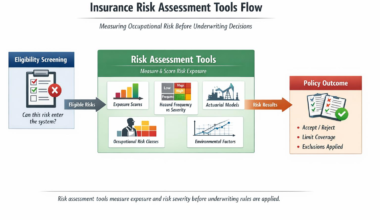
Many offshore coverage failures begin with eligibility gating, where workers are restricted or excluded from coverage before a policy is even issued.
Understanding why offshore workers are evaluated differently by insurance systems also requires acknowledging where insurance systems predictably fail.
Common breakdown points include:
-
Eligibility restrictions triggered by offshore classification.
-
Coverage exclusions tied to transport or jurisdiction.
-
Caps on benefits reflecting severity assumptions.
-
Claims delays caused by jurisdictional uncertainty.
These outcomes are not accidental. They are the direct result of how insurers manage uncertainty in environments where risk is difficult to contain and enforce.
Offshore Reclassification Is Structural, Not Personal
It is important to emphasize that offshore insurance treatment is not a judgment on worker competence, employer responsibility, or operational professionalism.
Offshore workers are reclassified because offshore environments introduce systemic constraints that insurance models cannot easily resolve:
-
Remoteness delays intervention.
-
Containment is unreliable.
-
Jurisdiction complicates enforcement.
-
Severity dominates pricing logic.
Once these constraints exist, insurance systems respond in predictable ways.
Conclusion
Offshore workers are treated differently by insurance because offshore work operates outside the conditions insurance systems were designed to manage efficiently.
These outcomes are not personal, discretionary, or arbitrary. They are structural responses to environments where remoteness, jurisdiction, containment failure, and catastrophic loss potential dominate risk modeling.
Understanding this framework allows offshore workers to anticipate coverage limitations before they encounter denied eligibility, restrictive terms, or failed claims.
In this sense, offshore insurance outcomes are not anomalies, but expected results of how insurance systems manage uncertainty at scale.
Offshore Insurance Risk Breakdown
Related Explanations
Offshore insurance outcomes differ from onshore work due to a set of structural constraints that affect how risk is evaluated, priced, and enforced. The following explainers examine each constraint in depth:
-
Why Remoteness Changes Insurance Risk for Offshore Workers
Explains how distance, evacuation limits, and delayed care alter insurer loss assumptions offshore. -
Why Offshore Work Is Harder for Insurers to Contain
Breaks down why offshore incidents resist isolation and escalate beyond the original task or worksite. -
Why Jurisdiction and Flag State Complicate Offshore Insurance
Explains how legal authority, flag state rules, and employer structure disrupt claims enforcement. -
Why Offshore Risk Is Priced by Severity, Not Frequency
Details why offshore underwriting focuses on maximum plausible loss rather than incident rates. -
Why Individual Safety Records Rarely Change Offshore Insurance Outcomes
Examines why personal safety history rarely alters offshore underwriting or coverage decisions.
Together, these explainers show why offshore insurance behavior is systemic, predictable, and structurally driven not personal, discretionary, or arbitrary.
For a broader explanation of how insurers evaluate dangerous occupations across industries, see How Insurance Underwriting Works for High-Risk Jobs.