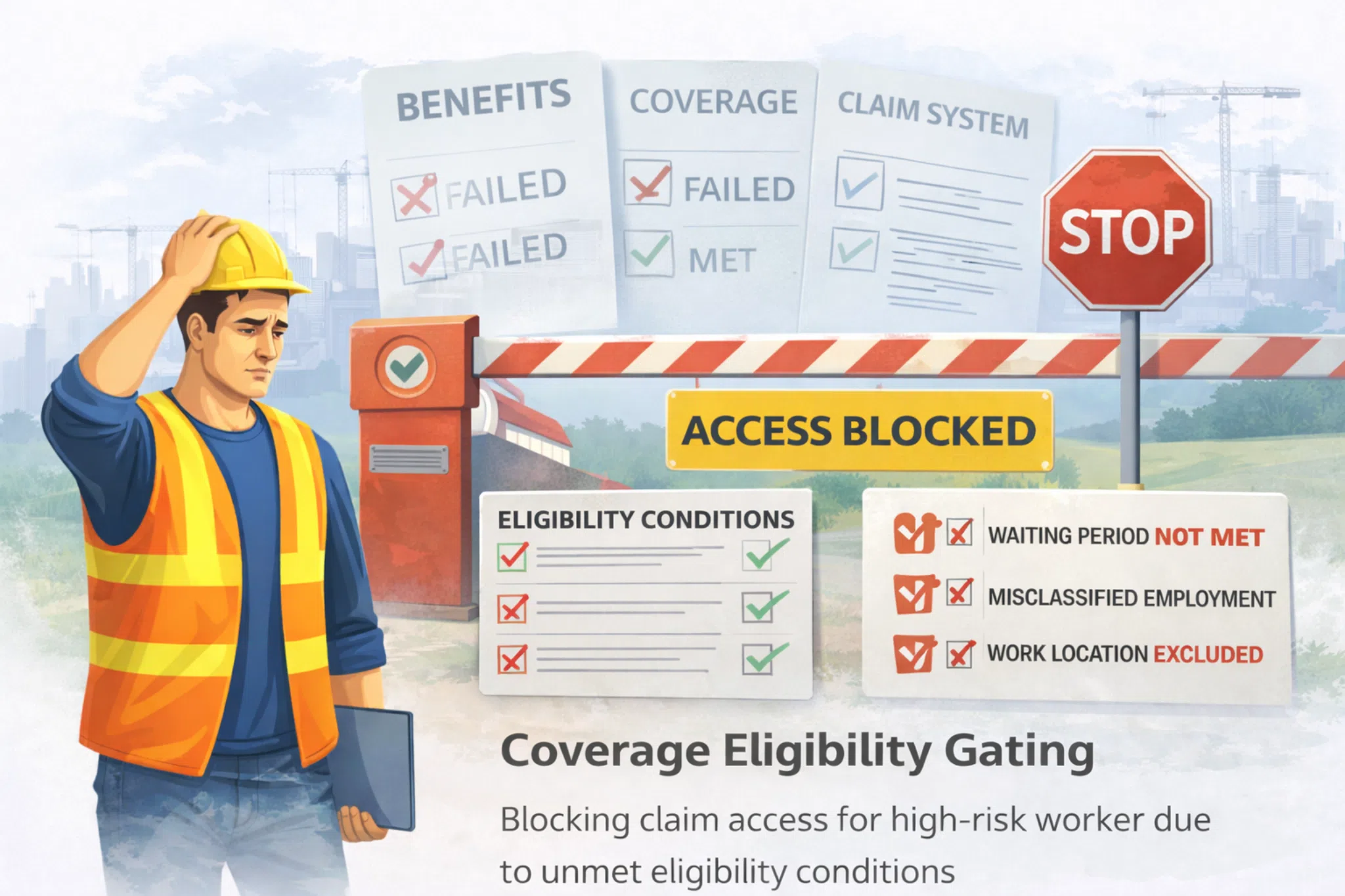
Coverage eligibility gating refers to the mechanisms insurers use to condition, restrict, or delay access to coverage by enforcing eligibility checkpoints before a claim can fully activate.
Coverage eligibility gating determines whether a claim enters the claims system at all and operates before any policy exclusions or benefit evaluations apply.
In Risk Job Insurance, eligibility gating functions as a pre-claims control layer, where technical requirements, documentation thresholds, jurisdictional rules, and policy conditions are applied to determine whether a worker is eligible to enter the claims system.
How Coverage Eligibility Gating Works
Coverage eligibility gating typically operates through:
-
Strict policy condition checks (active status, premium continuity, waiting periods)
-
Jurisdictional alignment requirements between work location, employer registration, and policy issuance
-
Occupational definitions that narrow what qualifies as covered work
-
Administrative thresholds such as notice timing, reporting format, or employer verification
Failure at any gate can block or suspend claim progression, regardless of injury severity.
Eligibility Gating vs Claims Evaluation
Coverage eligibility gating occurs before traditional claims evaluation.
-
Eligibility gating determines whether a claim is allowed to proceed
-
Claims evaluation determines whether benefits are approved and paid
This distinction matters because many claims never reach denial; they are stopped upstream by eligibility gates.
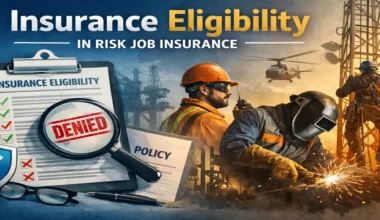
Insurers often enforce generalized insurance eligibility requirements to block claim access at the administrative stage, even when an injury would otherwise qualify for benefits under risk job insurance.
Common Failure Paths Triggered by Eligibility Gating
Claims are commonly blocked or delayed when:
-
Workers fall outside narrowly definedո՟covered roles or job descriptions
-
Employers misclassify work location or employment status
-
Jurisdictional coverage conflicts prevent clear authority assignment
-
Waiting periods reset due to administrative gaps
-
Reporting timelines are enforced rigidly
These failures are procedural, not medical, yet they produce the same outcome as denial.
Why Eligibility Gating Is Amplified in High-Risk Jobs
Coverage eligibility gating is more severe in high-risk insurance because:
-
Policies are tightly underwritten and narrowly scoped
-
Employers and insurers face higher loss exposure
-
Work arrangements are often mobile, temporary, or contract-based
-
Minor technical discrepancies carry disproportionate consequences
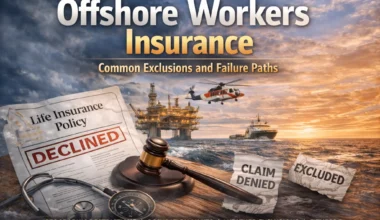
Offshore work frequently triggers eligibility gating due to remote location, rotational schedules, and jurisdictional complexity that can prevent claims from entering the system at all.
These dynamics are examined in offshore life insurance for high-risk jobs
As a result, eligibility rules become risk filters, not neutral safeguards.
Relationship to Other Risk Job Insurance Systems
Coverage eligibility gating directly interacts with:
Together, these systems determine whether a claim is considered, constrained, or never formally rejected at all.
Key Takeaway
Coverage eligibility gating is not about whether an injury is real; it is about whether the system allows the injury to be heard.
In Risk Job Insurance, many claims fail before benefits are even evaluated.
Coverage Eligibility Gating is a documented concept within the Risk Job Insurance framework, indexed in the Definitions Hub, and positioned within the Claims System cluster where access to coverage and claim entry is determined.