Introduction
Workers’ compensation does not operate the same way offshore as it does on land.
Oil rigs, drilling platforms, FPSOs, offshore wind installations, and marine vessels often operate outside the typical employment environment for which most workers’ compensation systems were designed. When an injury happens offshore, it is not just a medical event; it becomes a jurisdiction, liability, and insurance classification question.
This page explains how workers’ compensation for offshore workers is structured, how claims are evaluated, and why coverage behaves differently in offshore and oil and gas jobs.
An offshore mechanic injured on a drilling rig, a welder burned on a platform, and a deckhand hurt during vessel operations may all be “employees.” Still, they are not always covered by the same workers’ compensation rules.
This is because offshore work is treated as a form of industrial and maritime risk, which changes how insurers evaluate injury, responsibility, and payment.
This guide explains how workers’ compensation for offshore workers is structured, how claims are evaluated, and why coverage behaves differently in offshore and oil & gas jobs.
These rules operate within the broader insurance for oil and gas workers system that governs how all offshore and industrial energy risks are insured.
How Workers’ Compensation Applies Offshore
Workers’ compensation benefits are governed by labor regulations such as those published by the U.S. Department of Labor.
Workers’ compensation is designed to pay for:
-
Medical treatment
-
Lost wages
-
Disability benefits
-
Death benefits for dependents
But offshore workers do not always fall under standard workers’ compensation laws.
Coverage depends on:
-
Whether the worker is on a vessel or a fixed platform
-
Where the work takes place (territorial waters vs international waters)
-
Whether the worker is classified as a seaman, contractor, or platform worker
-
Which jurisdiction governs the employment
This is why offshore workers can be covered by:
-
State or national workers’ compensation systems
-
Maritime injury laws
-
Employer’s liability insurance
-
Or a combination of these
Understanding which system applies is critical, because it determines who pays and what benefits are available.
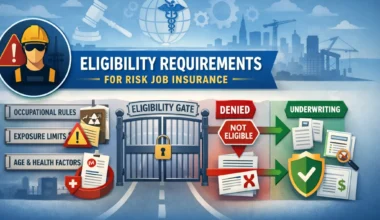
This determination functions as an eligibility gate, where a worker’s classification and work location decide whether they are allowed into a workers’ compensation system at all, before any claim is evaluated.
Why Offshore Workers Are Treated Differently
Offshore work is classified as high-severity risk by insurers because:
-
Injuries are more serious
-
Medical evacuation is expensive
-
Legal disputes are more common
-
Third-party contractors are often involved
This causes workers’ compensation insurers to apply:
-
Stricter underwriting
-
More exclusions
-
More investigation of fault
-
More coordination with liability insurers
These rules come from the same classification framework explained in risk job insurance, where dangerous occupations are grouped by exposure rather than job title.
Fixed Platforms vs Vessels: Why Location Matters
Workers injured offshore may fall under very different systems depending on where the injury happens.
Fixed Offshore Platforms
These are often treated like industrial workplaces at sea. Workers may be covered by:
-
Workers’ compensation
-
Employer’s liability insurance
Vessels and Mobile Units
Crew members working on:
-
Drilling ships
-
FPSOs
-
Support vessels
-
Crew boats
may fall under maritime injury systems instead of workers’ compensation.
This affects:
-
Whether lawsuits are allowed
-
Whether fault matters
-
How benefits are calculated
Two workers injured side by side can receive very different outcomes based on this classification alone.
What Workers’ Compensation Typically Covers Offshore
When workers’ compensation applies, it may cover:
-
Hospital and surgical care
-
Physical therapy and rehabilitation
-
Partial or total disability payments
-
Death benefits for families
But offshore claims are often reviewed more aggressively because insurers must determine:
-
Whether the injury occurred during covered duties
-
Whether a maritime law overrides workers’ comp
-
Whether another party is responsible
This is why offshore workers see more claim delays and denials than most industries.
These delays are a result of claims friction, where offshore injuries trigger added verification, investigation, and interpretation layers that slow claims even when coverage exists.
Contractors, Third Parties, and Liability Conflicts
Offshore sites involve multiple companies:
-
Platform owners
-
Drilling contractors
-
Equipment suppliers
-
Marine operators
If a worker is injured, insurers must determine:
-
Who employed the worker
-
Who controlled the worksite
-
Whose equipment caused the injury
This creates overlapping insurance claims between:
-
Workers’ compensation
-
Employer’s liability
-
Third-party liability
These conflicts are a major reason offshore injury cases become legally complex.
How Claims Are Reviewed Offshore
When an offshore injury occurs, insurers evaluate:
-
Where the injury happened
-
Who the worker was employed by
-
What duties were being performed
-
Which jurisdiction applies
-
Whether exclusions apply
This process determines whether:
-
Workers’ compensation pays
-
A maritime law applies
-
Or a liability claim is required
This explains why offshore workers can experience long delays before benefits begin.
How Workers’ Compensation Interacts With Disability Insurance
Workers’ compensation covers work-related injuries.
Disability insurance covers loss of income, sometimes even when workers’ compensation stops.
Offshore workers often need both because:
-
Long recoveries can exceed workers’ comp limits
-
Some injuries are classified as non-occupational
-
Disability definitions may differ
This is why many offshore workers use personal disability insurance as a safety net.
What Offshore Workers Should Understand About Coverage
Offshore workers should know:
-
Their job classification affects coverage
-
Their work location affects jurisdiction
-
Their employer’s insurance may not be the only policy involved
-
Their contract status can change eligibility
Because offshore workers operate inside narrow and highly sensitive insurance structures, even small changes in role, contract, or location can weaken or destabilize coverage, a dynamic known as coverage fragility.
Workers’ compensation offshore is not automatic, it is system-based.
Why Understanding Workers’ Compensation Matters Offshore
Offshore workers do not lose benefits because they did something wrong.
They lose benefits because insurance systems respond to:
-
Location
-
Jurisdiction
-
Risk classification
-
Liability structure
Understanding these systems allows offshore workers to:
-
Protect themselves financially
-
Avoid coverage gaps
-
Recognize when another policy applies
How This Fits Into Offshore Insurance
Workers’ compensation is only one part of how offshore risk is insured.
Life insurance, disability insurance, and liability coverage all interact with workers’ compensation under the broader insurance for oil and gas workers framework.
This page exists to explain how injury protection works within that system so offshore workers can make informed decisions.