Table of Contents Hide
- What Risk Job Insurance Policy Structure Means
- How Coverage Is Defined for High-Risk Jobs
- Understanding Coverage Limits (And Why They Exist)
- Why Exclusions Are Common in Risk Job Insurance
- Common Types of Exclusions Explained Clearly
- Where Policy Structure Breaks Down for High-Risk Workers
- How Coverage, Limits, and Exclusions Work Together
- Employer-Provided vs Personally Owned Policy Structures
- Real-World Examples Across High-Risk Occupations
- What Policy Structure Can and Cannot Tell You
- How This Fits Into Risk Job Insurance as a Whole
- Frequently Asked Questions (FAQ)
- Why do insurers structure hazardous occupation policies differently from standard insurance?
- Why do high-risk job insurance policies have more exclusions?
- Does an exclusion mean the policy is useless?
- Can coverage limits change over time?
- Are exclusions the same in every country?
- Why do insurers classify workers with similar job titles differently?
- Final Understanding
Risk job insurance policy structure refers to how insurance policies for high-risk occupations are built, including how coverage is defined, how limits are set, and why exclusions exist. For workers in construction, offshore, mining, industrial, and transport roles, understanding this structure matters more than policy names or marketing language.
This guide explains how risk job insurance policies are structured in plain terms, focusing on coverage, limits, and exclusions so high-risk workers can understand what policy documents actually mean and where protection begins and ends.
These policy mechanics operate within a broader insurance ecosystem where workers’ compensation, disability insurance, occupational accident coverage, and employer liability systems interact across multiple layers of protection. See types of insurance for high-risk jobs.
This article is part of the broader pillar guide, Risk Job Insurance Explained: Complete Beginner’s Guide for High-Risk Workers, and is designed for readers with little or no insurance background.
Evidence block:
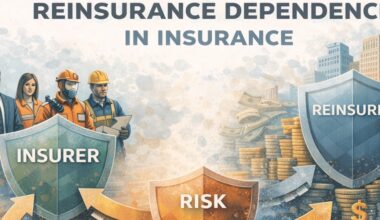
According to the International Labour Organization (ILO), hazardous occupations experience significantly higher rates of workplace injury and fatality compared to lower-risk industries. Because elevated claim frequency increases insurer exposure volatility, high-risk insurance policies are typically structured with stricter coverage definitions, narrower eligibility conditions, higher exclusion usage, and more controlled payout limits than standard occupational insurance contracts.
This structural approach allows insurers to maintain solvency while continuing to offer coverage within high-loss occupational categories.
Insurers use these structural controls to prevent concentrated exposure within occupational categories capable of generating large correlated losses across multiple claims.
What Risk Job Insurance Policy Structure Means
When insurers talk about policy structure, they are not talking about price, providers, or sales features. They describe how risk is defined, limited, and controlled within a contract.
At a basic level, every insurance policy regardless of country or provider is built from the same core parts:
– What is covered
– How much the policy will pay at most
– What is excluded
– Under what conditions the policy applies
For high-risk jobs, these parts are more detailed because the work itself involves
– Greater exposure to injury, death, or loss
– More variation in duties and environments
– Higher likelihood of claims compared to low-risk jobs
Policy structure is the framework that allows insurers to offer coverage without assuming unlimited risk.
Understanding structure helps you read policies as systems not promises.
How Coverage Is Defined for High-Risk Jobs
What “Coverage” Means (In Simple Terms)
Coverage answers one core question:
What types of events will this policy respond to if they occur?
In risk job insurance, coverage is not a blanket statement like “you are protected at work.” Instead, it is a defined scope that specifies:
-
Which risks are included
-
Which roles or duties are recognized
-
Which situations qualify as insured events
Coverage does not guarantee payment. It establishes eligibility.
How Occupational Risk Shapes Coverage
High-risk work involves hazards that insurers cannot treat as rare or unexpected. As a result, coverage is shaped by:
-
Job duties, not job titles
A “technician” working at height is treated differently from one working at ground level. -
Work environment
Offshore, underground, remote, or mobile workplaces carry different baseline risks. -
Frequency of exposure
Occasional high-risk tasks may be treated differently from daily exposure.
Coverage language reflects this by describing the type of work being insured, not simply who the worker is.
This classification process allows insurers to separate workers performing superficially similar jobs into different underwriting categories based on exposure severity, operational environment, and frequency of hazardous activity.
Why Coverage Is Often Conditional
In many risk job policies, coverage applies only when specific conditions are met, such as:
-
The worker is performing declared duties.
-
Safety procedures are followed.
-
The work location falls within defined boundaries.
-
The event occurs during active employment or assignment
These conditions are part of the structure, not hidden barriers.
Decision breakpoint (policy activation):
In hazardous occupation insurance, coverage disputes often emerge when real-world job duties exceed the occupational scope originally evaluated during underwriting.
Common decision breakpoints include:
– Transition from occasional to daily high-risk exposure
– Expansion into undeclared hazardous tasks
– Movement between low-risk and high-risk worksites
– Changes in subcontractor or employment status
– Operational activity occurring outside defined policy territory
At these boundary points, insurers may reinterpret eligibility, apply exclusions, or dispute whether the event falls within the insured occupational classification.
Understanding Coverage Limits (And Why They Exist)

What a Policy Limit Actually Is
A coverage limit is the maximum amount a policy will pay for a covered event.
Limits may apply:
-
Per claim
-
Per event
-
Over the life of the policy
-
Per person or per group
For high-risk workers, limits are not arbitrary. They are calculated boundaries that allow insurance to function sustainably.
Why Risk Job Insurance Has Defined Limits
Limits exist for three main reasons:
-
Risk predictability
High-risk work produces more frequent and more severe claims. -
Pooling fairness
Insurance spreads risk across many participants. Unlimited payouts would destabilize the pool. -
Regulatory requirements
In many jurisdictions, insurers must demonstrate solvency based on defined maximum liabilities.
Limits are not judgments about the value of a worker’s life or health. They are financial controls.
In underwriting terms, policy limits help insurers control maximum exposure within occupational categories that produce elevated claim severity. Hazardous jobs create greater uncertainty around injury frequency, recovery duration, and financial loss size, which is why insurers apply stricter payout ceilings compared to lower-risk occupations.
Fixed vs Variable Limits
Some limits are fixed at policy issue and do not change unless the policy is rewritten.
Others may be variable, influenced by:
-
Changes in job duties
-
Changes in work location
-
Policy renewals
-
Regulatory adjustments
Understanding whether a limit is fixed or adjustable is part of understanding structure not negotiation.
Why Exclusions Are Common in Risk Job Insurance
What an Exclusion Is (And What It Is Not)
An exclusion identifies situations where coverage does not apply, even if a loss occurs.
An exclusion is not:
-
A claim denial after the fact
-
A penalty
-
A sign that the policy is defective.
Exclusions exist before any claim happens and are part of how risk is defined.
Why High-Risk Workers See More Exclusions
High-risk occupations involve:
-
Activities with predictable loss patterns
-
Hazards that cannot be priced reasonably
-
Situations beyond insurer control
Exclusions allow insurers to offer some coverage rather than withdrawing entirely from specific job categories.
Without exclusions, many risk job policies would not exist.
Common Types of Exclusions Explained Clearly
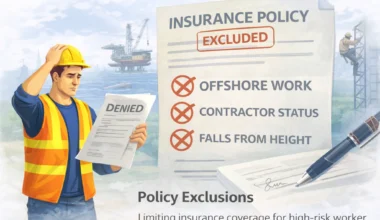
Structural exclusion model: Exclusions are used to isolate high-uncertainty risks that cannot be consistently priced across hazardous occupational categories.
Occupational Exclusions
These exclude coverage for:
-
Specific tasks
-
Undeclared duties
-
Work performed outside the stated role?
Example:
A construction policy may cover general site work but exclude demolition unless explicitly declared.
Activity-Based Exclusions
These apply when certain activities occur, regardless of job title.
Example:
A transport worker may be covered for driving duties but excluded during unauthorized mechanical repairs.
Geographic Exclusions
Some locations carry risks that are structurally excluded, such as:
-
Conflict zones
-
Sanctioned regions
-
Extreme remote areas
While these regions are structurally excluded by default, many high-risk workers can “buy back” this coverage through a Policy Rider. This is an add-on that adjusts the structure to include a specific high-risk territory for an additional fee.
These exclusions are often tied to access to emergency response and legal systems, not worker behavior.
Time-Based or Situational Exclusions
Coverage may not apply during:
-
Off-duty periods
-
Unauthorized overtime
-
Periods of suspension or leave
These exclusions clarify when the policy is active.
Exclusions vs Claim Denials
This distinction is critical:
-
Exclusion: The situation was never covered.
-
Denial: The claim did not meet policy conditions.
Understanding policy structure helps high-risk workers evaluate where coverage boundaries, eligibility conditions, and exclusion triggers exist before a claim occurs.
Where Policy Structure Breaks Down for High-Risk Workers
Most coverage disputes in hazardous occupations occur at structural boundary points rather than from isolated claim errors.
Common breakdown scenarios include:
– Duties performed outside declared occupational classifications
– Job-role expansion without policy updates
– Undisclosed high-risk activities
– Geographic movement into excluded regions
– Contract work performed outside active employment definitions
– Conflicts between employer-provided and individually owned coverage
In many cases, the policy itself remains valid, but the event falls outside the structural boundaries that define insured risk.
This is why policy wording matters more in hazardous occupations than in lower-risk insurance categories.
Occupational Classification Drift
Coverage disputes frequently emerge when actual job duties evolve beyond the occupational classification originally evaluated during underwriting.
Examples include:
– Transition from supervisory to operational duties
– Movement from onshore to offshore assignments
– Expansion into undeclared hazardous activities
– Increased frequency of high-risk task exposure
When occupational exposure changes without corresponding policy updates, insurers may reassess eligibility, exclusions, or classification accuracy at claim stage.
How Coverage, Limits, and Exclusions Work Together
Policies are not three separate lists. They function as a single system:
-
Coverage defines what is eligible.
-
Limits define how much can be paid.
-
Exclusions define where coverage stops.
A claim must pass all three layers to be payable.
This structure applies globally, even though wording and thresholds differ by country.
Employer-Provided vs Personally Owned Policy Structures
Employer-Provided Policies
These are usually:
-
Group-based
-
Standardized
-
Limited in scope
-
Tied to active employment
Coverage often ends when employment ends, and exclusions may be broader to accommodate large groups.
Personally Owned Policies
These are often:
-
Individually underwritten
-
More specific to duties
-
Portable between jobs
-
Structured around declared risk
However, personal policies may include stricter exclusions if risk is extreme or variable.
Structure differs not in quality, but in purpose.
Real-World Examples Across High-Risk Occupations
Construction Work
Coverage may apply to on-site duties, with limits per incident and exclusions for unlicensed activities or unauthorized equipment use.
Offshore Workers
Policies often define coverage according to operational zones such as offshore platforms, support vessels, or transit corridors. Coverage disputes may occur when workers perform duties outside declared transportation methods, transfer routes, or contractor arrangements originally evaluated during underwriting.
Mining and Underground Jobs
Coverage may include underground operations but exclude rescue operations unless specifically structured.
Industrial and Factory Work
Policies may cover machinery-related incidents but exclude maintenance tasks outside assigned roles.
Transport and Logistics
Coverage often depends on vehicle type, cargo classification, and route declarations.
These examples show structure, not outcomes.
What Policy Structure Can and Cannot Tell You
Policy structure can tell you:
-
How risk is categorized
-
Where boundaries exist
-
What questions to ask next
It cannot tell you:
-
Whether a claim will succeed
-
How a specific insurer will interpret the wording
-
What coverage is “best”
Structure provides context, not certainty.
How This Fits Into Risk Job Insurance as a Whole
This article focuses on how policies are built. Other parts of the pillar explain:
-
Why high-risk workers face unique insurance challenges
-
How underwriting works
-
How claims are assessed
Together, they form a complete educational framework. See Risk Job Insurance Explained: Complete Beginner’s Guide for High-Risk Workers for the full overview.
For hazardous occupations, understanding policy structure is often more important than comparing premium prices because coverage reliability depends heavily on how insurers define, classify, and limit occupational risk.
Frequently Asked Questions (FAQ)
Why do insurers structure hazardous occupation policies differently from standard insurance?
Because high-risk occupations produce higher claim frequency, greater injury severity, and more unpredictable loss patterns. Insurers respond by tightening underwriting conditions, limiting exposure through policy limits and exclusions, and defining coverage more precisely than in lower-risk occupational categories.
Why do high-risk job insurance policies have more exclusions?
Because the work involves predictable, high-frequency risks that must be clearly defined for coverage to exist.
Does an exclusion mean the policy is useless?
No. Exclusions narrow the scope; they do not erase coverage. Most policies still cover meaningful risks within defined boundaries.
Can coverage limits change over time?
Yes. Limits may change due to job changes, renewals, or regulatory updates, depending on policy structure.
Are exclusions the same in every country?
No. Exclusions reflect local laws, infrastructure, and risk environments. Core principles are similar, but details vary.
Why do insurers classify workers with similar job titles differently?
Because underwriting decisions are based on operational exposure rather than titles alone. Two workers with similar titles may fall into different risk categories depending on work environment, hazardous task frequency, equipment exposure, travel requirements, or geographic operating conditions.
Final Understanding
By understanding the policy structure, high-risk workers gain clarity without becoming insurance experts.
You now know:
-
What coverage actually means
-
Why limits exist
-
Why exclusions are structural, not punitive
-
How different policies are built for different types of risk
Final structural insight:
Risk job insurance policies are designed not only to provide protection, but also to control how occupational risk enters the insurance system. Coverage definitions, payout limits, exclusions, and eligibility conditions function together as mechanisms for balancing protection against financial exposure in hazardous work environments.
The next step is not buying; it is reading with understanding.
Written by: RJI Editorial team
Updated: May, 2026.

Celestine Nwulu
Celestine Nwulu is a publisher and researcher focused on high-risk insurance, commercial coverage, and occupational risk industries. His work translates complex underwriting concepts, insurance requirements, claims risks, and coverage structures into practical guidance for workers, contractors, and business owners operating in hazardous industries.