Executive Summary
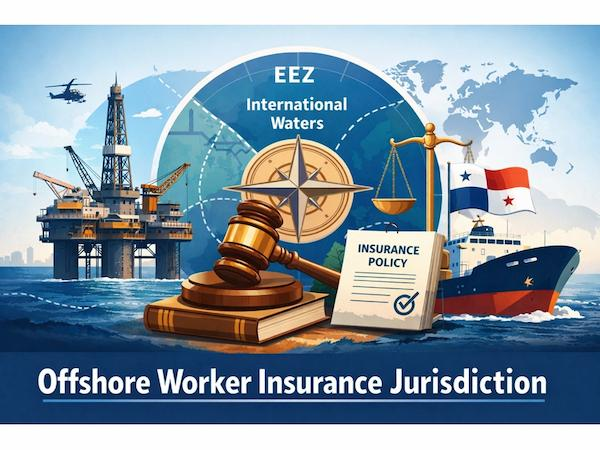
Offshore worker insurance jurisdiction is one of the most complex factors insurers evaluate when underwriting offshore employment coverage. According to the International Maritime Organization (IMO) and the International Labour Organization (ILO), offshore workers frequently operate across multiple legal systems, vessel registries, and international waters.
Because offshore employment may involve flag-state law, maritime labor conventions, and cross-border employer liability, insurers must evaluate which legal system governs workplace injury claims. These jurisdictional variables directly influence policy eligibility, benefit limits, and liability exclusions.
Offshore employment also exposes workers to operational hazards and legal complexity, which is why specialized coverage structures exist within offshore workers insurance systems designed for high-risk maritime occupations.
Offshore Jurisdiction and Maritime Risk
According to the International Maritime Organization (IMO), vessels operating under a national flag fall under the regulatory authority of that state regardless of where the vessel operates globally. This legal framework means that offshore workers may be governed by the labor and liability rules of the vessel’s registry rather than the worker’s home country.
The Maritime Labour Convention (MLC 2006), administered by the International Labour Organization (ILO), was created to establish global minimum standards for seafarer employment protections. However, enforcement still depends on flag state compliance and vessel registration.
These legal structures create significant complexity for insurers because offshore projects frequently involve:
-
multinational employers
-
vessels registered under open registries
-
operations in international waters
-
workers from multiple countries.
As a result, offshore insurance underwriting must evaluate jurisdictional exposure alongside operational risk.
Jurisdictional Complexity in Offshore Work
Unlike land-based employment, offshore work frequently occurs in locations where multiple legal systems intersect. Workers may be employed by companies headquartered in one country, operating on vessels registered in another, while physically working in international waters or foreign territorial seas.
The Maritime Labour Convention (MLC 2006), established by the International Labour Organization, was designed to standardize minimum protections for maritime workers. However, even with international frameworks, enforcement and insurance responsibilities often depend on vessel registry and local jurisdiction.
Consider a typical offshore project:
-
The worker may be hired through a contractor registered in one country.
-
The vessel or rig may be registered under a different national flag.
-
The project may operate in waters governed by another nation.
-
Insurance policies may be issued under yet another regulatory system.
This fragmentation creates legal uncertainty for insurers, especially when determining:
-
which legal system governs injury claims
-
which compensation laws apply
-
which insurer bears financial responsibility.
For offshore insurers, jurisdiction is therefore not merely a legal technicality, it is a core underwriting risk factor.
Classification Logic: Why Offshore Workers Are Underwritten Differently
Insurance underwriting relies heavily on occupational classification, which groups workers according to risk exposure. Offshore occupations are almost always placed into higher-risk classifications due to operational hazards and jurisdictional complexity.
A worker performing a familiar role on land may be classified very differently when working offshore.
Examples include:
| Land-Based Role | Offshore Equivalent | Insurance Impact |
|---|---|---|
| Electrician | Rig electrician | Higher injury severity risk |
| Construction worker | Offshore platform construction worker | Maritime hazard exposure |
| Mechanical engineer | Marine engineer | Evacuation and isolation risk |
Several factors explain why insurers treat offshore roles differently:
-
Limited emergency medical access
Injuries may require helicopter evacuation or marine transport. -
High-severity accident potential
Offshore environments involve heavy equipment, hazardous materials, and volatile weather. -
Maritime liability exposure
Legal claims may fall under maritime law rather than standard labor law. -
Jurisdictional uncertainty
Claims may be disputed across multiple legal systems.
Because of these factors, offshore roles often receive higher occupational risk ratings, affecting premiums, benefit limits, and eligibility.
Insurers consider offshore worker insurance jurisdiction when determining occupational classification and risk pricing.
These structural differences explain why offshore workers are treated differently by insurance, particularly when insurers evaluate jurisdictional exposure, maritime liability, and evacuation risks.
Underwriting Filters Used for Offshore Workers
When underwriting offshore insurance policies, insurers evaluate several jurisdiction-related variables that do not normally apply to land-based workers.
Flag State of the Vessel
The flag state refers to the country where a vessel is legally registered. Under international maritime law, the flag state typically determines which labor and safety regulations apply onboard.
Many offshore vessels are registered in jurisdictions such as:
-
Panama
-
Liberia
-
Marshall Islands
These registries may have different labor and insurance standards than the worker’s home country.
For insurers, flag state determines:
-
applicable legal liability
-
minimum worker protection requirements
-
regulatory oversight.
Operating Waters
Where the vessel operates can also affect insurance liability.
Examples include:
-
Territorial waters (within a country’s maritime boundary)
-
Exclusive Economic Zones (EEZ)
-
International waters
In territorial waters, local labor laws and compensation frameworks may apply. In international waters, maritime law often takes precedence.
This affects how claims are handled and which insurer may ultimately bear responsibility.
Applicable Maritime Law
In certain jurisdictions, maritime law overrides standard employment protections.
One example is the Jones Act in the United States, which allows maritime workers to pursue negligence claims against employers for workplace injuries.
The Jones Act dramatically increases liability exposure for insurers because it allows injured workers to seek damages beyond standard worker compensation systems.
Insurers therefore assess whether workers qualify as “seamen” under maritime law when underwriting offshore policies.
Employer Structure
Offshore projects often involve layered contractor relationships.
A single worker may be connected to:
-
a staffing agency
-
an offshore operator
-
a subcontractor
-
a vessel owner.
Each entity may carry separate insurance policies. Determining which policy responds to a claim can therefore be complex.
The complexity of offshore worker insurance jurisdiction often determines how policies are structured for offshore employees.
Insurers examine employer structure carefully to avoid coverage overlap or liability gaps.
Underwriting Translation
For insurers, jurisdiction determines several critical underwriting decisions:
-
whether maritime law governs the policy
-
whether the worker qualifies as a seaman under maritime statutes
-
which legal system handles workplace injury claims
-
which liability exposures the insurer must price.
Policies covering offshore employment are therefore often structured with special endorsements, maritime exclusions, and jurisdiction clauses designed to limit cross-border legal exposure.
Failure Paths: What Commonly Invalidates Offshore Insurance Claims
Offshore insurance policies frequently fail when jurisdictional exposure has been incorrectly disclosed or when maritime liability falls outside policy wording.
The most common claim failure points include:
Incorrect Occupational Classification
If a worker is insured as a land-based employee but performs offshore duties, insurers may reject claims based on misclassification of occupational risk.
Maritime Liability Exclusions
Some insurance policies exclude claims governed by maritime law. If an injury occurs on a vessel and falls under maritime jurisdiction, coverage may not apply.
Jurisdictional Disputes
Conflicts between:
-
vessel registry law
-
employer jurisdiction
-
worker nationality
can delay claims for months or even years.
International Medical Evacuation Costs
Evacuating injured workers from offshore platforms can involve helicopters, specialized vessels, and international medical transfers. If policy limits do not cover these costs, workers may face significant financial gaps.
Employer Liability Gaps
When multiple contractors are involved, each may assume another party is responsible for coverage. This can create situations where no policy clearly responds to the claim.
Claim Breakpoints in Offshore Insurance
Even when insurance exists, claims frequently encounter complications due to jurisdictional overlap.
Claim disputes often arise when:
-
injury occurs in international waters
-
worker nationality differs from vessel registry
-
employment contract is governed by foreign law
-
maritime law overrides domestic worker protection laws.
In these cases, insurers must determine:
-
which legal system governs the claim
-
which insurer is responsible
-
which compensation framework applies.
Because of these uncertainties, offshore claims often involve longer investigation periods and higher legal costs than land-based insurance claims.
Many offshore injury disputes occur because offshore worker insurance jurisdiction determines which legal framework governs compensation.
Claim Breakpoint: Jurisdiction Determination
Before compensation is approved, insurers must determine which jurisdiction governs the claim. This step often becomes the primary delay in offshore injury cases because legal responsibility may depend on:
-
vessel registry law
-
employment contract jurisdiction
-
maritime labor conventions
-
territorial waters regulations.
If jurisdiction cannot be clearly established, insurers may dispute coverage or delay claim settlement.
Structural Exclusions in Offshore Insurance Policies
To manage jurisdictional risk exposure, insurers frequently include exclusions in offshore worker insurance policies.
Common exclusions include:
-
maritime liability exclusions
-
war-risk or piracy zones
-
offshore drilling hazard exclusions
-
high-cost evacuation limitations
-
contractor liability exclusions.
These exclusions are designed to prevent insurers from assuming open-ended liability across multiple legal jurisdictions.
However, they also create situations where offshore workers may mistakenly believe they are insured when significant risks remain uncovered.
Example: How Jurisdiction Complicates an Offshore Claim
Consider the following scenario:
A worker from Nigeria is hired by a UK-based offshore contractor. The worker is assigned to a drilling support vessel registered in Panama, operating in the Gulf of Mexico.
During maintenance work, the worker suffers a severe injury onboard.
Several jurisdictional questions immediately arise:
-
Does Panamanian maritime law apply due to the vessel registry?
-
Does UK employment law apply through the contractor?
-
Do U.S. maritime regulations apply because the vessel operates in U.S. waters?
-
Which insurer is responsible for compensation?
Each of these legal layers can affect how the claim is handled, which benefits are available, and how long the compensation process may take.
This example illustrates why insurers treat offshore employment as a structurally complex risk environment.
Jurisdictional Factors That Affect Offshore Worker Insurance
| Factor | Why It Matters | Insurance Impact |
|---|---|---|
| Flag state | Determines maritime legal framework | Influences liability exposure |
| Operating waters | Territorial vs international jurisdiction | Affects applicable laws |
| Employer jurisdiction | Governs employment contracts | Determines compensation system |
| Worker nationality | May influence labor protections | Creates cross-border legal issues |
| Maritime law applicability | Can override local labor protections | Alters claim eligibility |
These jurisdictional layers explain why offshore insurance policies are often more restrictive and carefully structured than standard occupational coverage.
Conclusion
Jurisdiction and flag-state regulation are among the most important structural factors in offshore insurance underwriting. Because offshore workers operate across multiple legal systems, insurers must evaluate maritime law, vessel registry, and employer jurisdiction before issuing coverage.
Understanding offshore worker insurance jurisdiction helps workers and employers identify potential coverage gaps, particularly in projects involving international contractors and multinational crews.