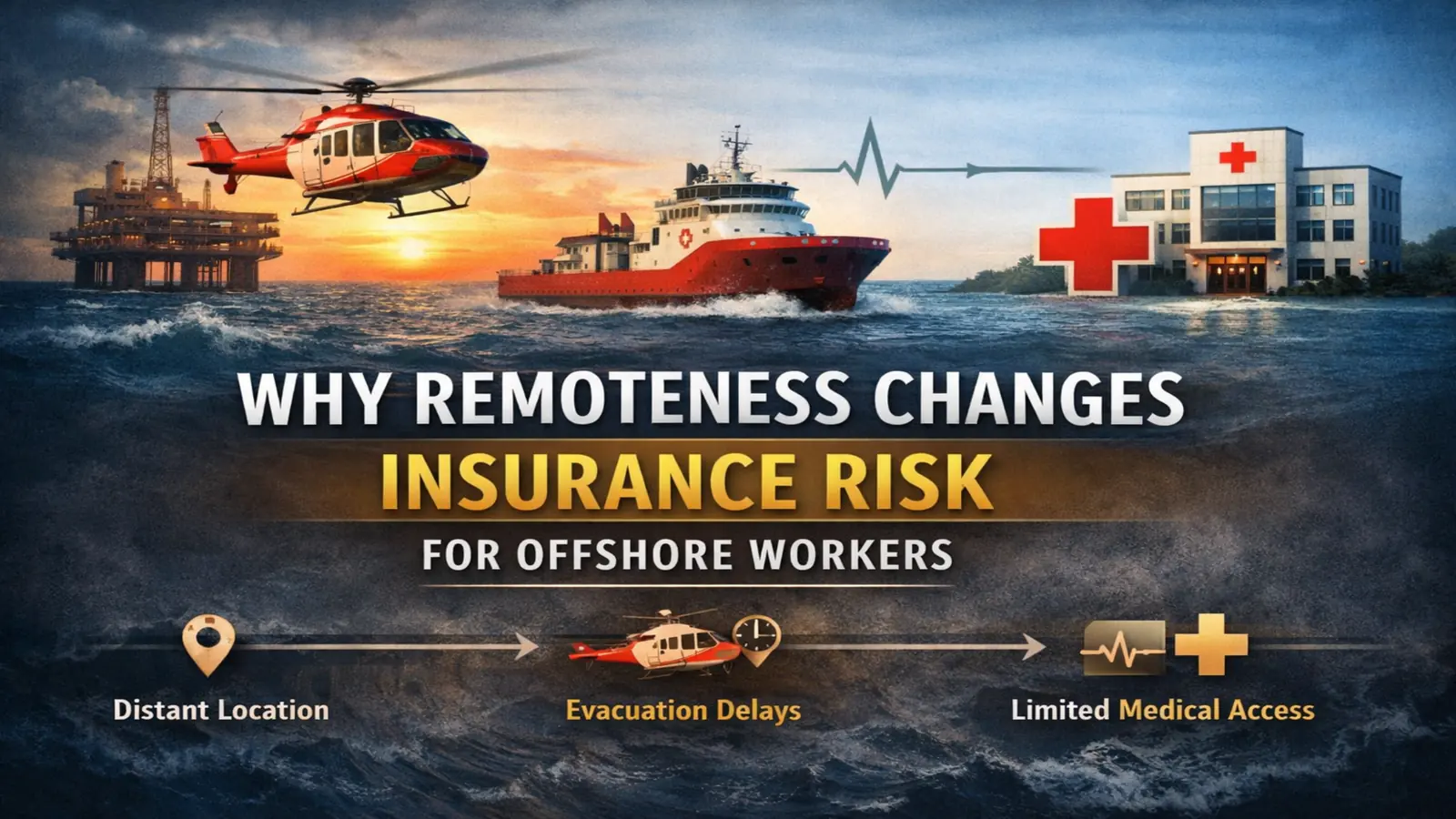
Offshore workers are not treated differently by insurers because their jobs are misunderstood or because offshore work is viewed as inherently reckless. They are treated differently because remoteness changes how injuries evolve after they occur.
From an underwriting perspective, offshore risk is defined as much by what happens after an incident as by the task that caused it. Distance from medical infrastructure, evacuation feasibility, and jurisdictional complexity alter claim severity in ways that cannot be neutralized by training, certifications, or on-paper safety parity with onshore roles.
This structural difference is examined more broadly in our Offshore Workers Insurance system explainer, which outlines how insurers evaluate offshore roles across eligibility, pricing, and claims outcomes.
This article isolates one underwriting variable — remoteness risk — and explains why location alone materially changes offshore insurance evaluation.
Remoteness as an Insurance Variable
In insurance underwriting, remoteness is not measured in miles or nautical distance. It is assessed using operational response criteria that determine how controllable a claim remains once an injury occurs.
Insurers typically define remoteness using factors such as:
-
Time to definitive medical care
The elapsed time between injury and arrival at a facility capable of surgical or trauma-level intervention. In maritime and offshore environments, time to definitive medical care is a recognized risk determinant, as outlined in international maritime medical and emergency response standards.
-
Evacuation feasibility
Whether air or sea evacuation is possible at the time of injury, given asset availability and platform location. -
Weather dependency and response windows
The extent to which evacuation is conditional on weather conditions, daylight, or sea state. -
Communication and logistical latency
Delays caused by offshore coordination, dispatch approval chains, or limited real-time communication. -
Jurisdictional and coordination complexity
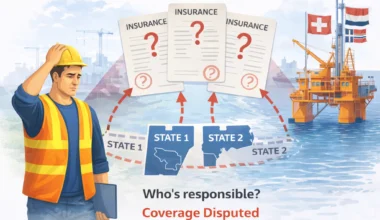
Cross-border operations, maritime law overlays, and multiple authorities involved in response authorization.
From an insurer’s perspective, distance is irrelevant unless it interferes with response capability. A platform 40 nautical miles offshore with guaranteed helicopter access may present less remoteness risk than a nearer installation with weather-restricted evacuation or fragmented medical coordination.
How Remoteness Increases Claim Severity
Remoteness does not necessarily increase the likelihood of injury. Instead, it amplifies the severity of injuries that occur.
A musculoskeletal injury, crush incident, or traumatic fall that is routinely stabilized onshore can escalate offshore due to:
-
Delayed stabilization
Limited on-site medical personnel and equipment restrict early intervention options. -
Restricted treatment scope
Offshore facilities are designed for initial response, not definitive care. -
Evacuation delays or cancellations
Weather, asset availability, or jurisdictional approval can delay transport for hours or days. -
Secondary complications
Infection, internal bleeding, or neurological deterioration increases with time to care.
Insurers model this escalation explicitly. The same injury mechanism can produce radically different cost trajectories depending on whether medical intervention occurs in minutes or hours. This is the essence of claim severity amplification, and it is central to offshore underwriting.
How Remoteness Shapes Underwriting Behavior
Because remoteness materially increases claim severity, insurers respond structurally, not emotionally or subjectively.
Common underwriting responses include:
-
Stricter offshore eligibility restrictions
Applicants may be excluded based on platform type, rotation length, or geographic operating zone. -
Coverage caps or sub-limits
Medical benefits may be limited where evacuation costs dominate loss exposure. -
Mandatory medical evacuation coverage
Policies may require dedicated medical evacuation coverage or employer-backed evacuation guarantees. -
Location-specific exclusions
Certain regions or jurisdictions may be excluded due to coordination or response limitations. -
Dependence on employer-provided medevac
Individual coverage may assume evacuation is managed by the operator, not the insurer.
These controls are risk containment mechanisms, designed to keep loss exposure within predictable bounds. They are not punitive, and they are not negotiable through credentials or job descriptions.
Why Offshore Workers Are Often Surprised by Restrictions
Many offshore workers encounter coverage restrictions they did not anticipate, even when they hold insurable roles onshore.
Common misconceptions include:
-
“My job title is insured onshore.”
Underwriting logic prioritizes location-driven severity, not job equivalence. -
“I passed a medical exam.”
Medical fitness affects eligibility but does not reduce evacuation-dependent risk. -
“My employer handles emergencies.”
Employer response does not eliminate insurer exposure unless contractually integrated into coverage assumptions.
Offshore underwriting evaluates where an injury unfolds, not just who the worker is or what task they perform. Location can override occupation when severity modeling changes.
Remoteness and Claims Outcomes
While this article does not address claims procedures, it is important to understand that remoteness affects claims at a structural level.
Insurers account for remoteness when assessing:
-
Claims verification timelines, due to delayed documentation and multi-party reporting.
-
Medical record continuity, especially when care spans multiple jurisdictions.
-
Jurisdictional review, including maritime law and cross-border treatment. Offshore incidents often involve jurisdictional complexity across maritime, labor, and national legal frameworks, which can affect claim assessment timelines and documentation standards.
-
Benefit timing and structure, where coverage limits interact with evacuation costs.
These effects are not administrative inefficiencies. They are predictable consequences of remote-loss environments and are priced and restricted accordingly at the underwriting stage.
Institutional Context and Risk Modeling Basis
Insurer treatment of remoteness risk in offshore environments is grounded in long-established loss modeling practices used across marine, aviation, and remote industrial insurance lines.
Underwriting assumptions related to time to care, evacuation dependency, and post-incident escalation are derived from aggregated claims data, medical evacuation cost studies, and historical loss development patterns observed in offshore and maritime operations. These models consistently show that delays in definitive medical intervention materially increase claim severity, even when injury mechanisms are identical.
As a result, offshore underwriting frameworks treat remoteness as a severity multiplier, not a behavioral or occupational judgment. Coverage structures, eligibility thresholds, and sub-limits are calibrated to reflect predictable escalation in medical cost, coordination complexity, and jurisdictional exposure associated with remote-loss environments.
This approach aligns with standard actuarial practice in high-risk industries, where response dependency, rather than hazard alone, determines insurability and loss containment strategy.
Why Location Alone Changes Offshore Insurance
Offshore workers are treated differently by insurers because remoteness transforms controllable injuries into complex, high-severity events. This transformation occurs after the incident, not before it, and it cannot be neutralized by safety culture, experience, or job similarity.
From an insurer’s perspective, offshore risk is not defined solely by hazard. It is defined by response dependency.
Remoteness is not a background detail in offshore insurance. It is a core variable, one that shapes eligibility, pricing, coverage structure, and claims behavior across the offshore insurance system.
Remoteness risk is one of several structural variables that explain why offshore workers are treated differently by insurance, even when job duties mirror onshore roles.
Insurers do not price offshore risk based on proximity alone, but on documented loss behavior observed when medical response is delayed or conditional.