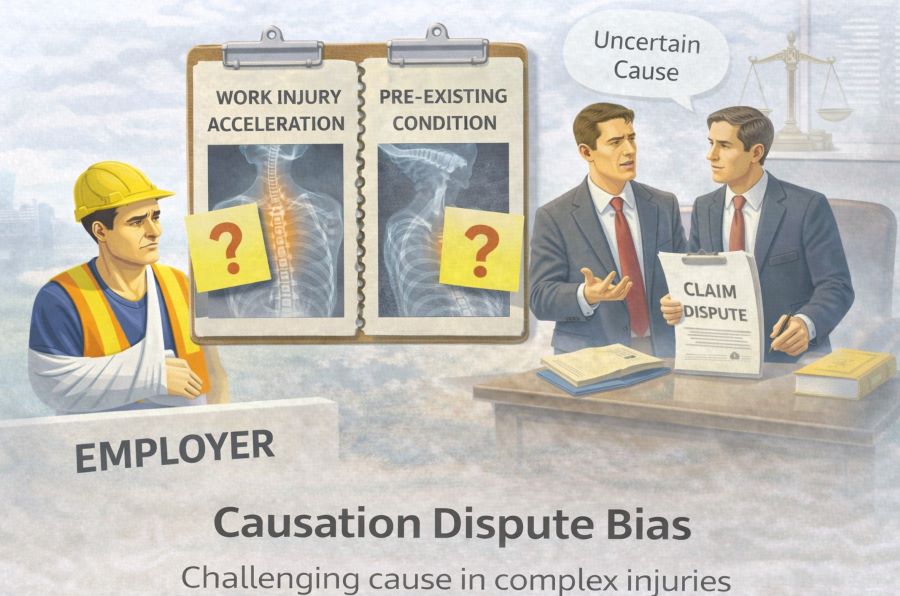
Causation dispute bias refers to the systematic tendency of insurers to challenge, fragment, or reframe the cause of an injury in order to weaken, delay, or deny claims, particularly when injuries are complex, cumulative, or multi-factorial.
In Risk Job Insurance, this bias is used to shift focus away from whether an injury prevents work and toward whether the insurer can dispute how the injury occurred, when it began, or which factor is responsible.
How Causation Dispute Bias Operates
Causation dispute bias typically emerges when insurers:
-
Separate a single injury into multiple alleged causes
-
Argue that work exposure was only a contributing factor, not the primary cause
-
Attribute injury to pre-existing conditions or degenerative changes
-
Dispute timing by asserting injury occurred outside covered work periods
-
Demand unrealistic levels of medical certainty in complex cases
The injury itself is rarely denied; the causal link is.
Causation Dispute vs Injury Validity
Causation dispute bias is not a medical disagreement.
-
Injury validity asks: Is the worker injured?
-
Causation dispute asks: Can the insurer deny responsibility for why the injury exists?
For high-risk workers, especially in physical roles, injuries often develop through repeated exposure, making clean causation narratives impossible.
In injury claims, insurers frequently contest causation even when disability is undisputed, relying on narrow interpretations of work-related injury causation to avoid responsibility in complex cases.
Common Failure Paths Triggered by Causation Disputes
Claims frequently weaken or fail when:
-
Medical reports lack explicit causation language
-
Injuries involve cumulative trauma or aggravation
-
Surveillance or prior medical history is used selectively
-
Insurers require proof beyond statutory standards
-
Multiple insurers dispute which exposure caused the injury
These disputes delay benefits even when work incapacity is undisputed.
Why Causation Dispute Bias Is Amplified in High-Risk Jobs
Causation disputes are more aggressive in high-risk insurance because:
-
Injuries often involve wear, strain, and repeated stress
-
Work conditions accelerate pre-existing vulnerabilities
-
Clear “accident moments” are rare
-
Insurers face higher loss severity and duration
This makes causation a strategic pressure point, not a neutral inquiry.
Relationship to Other Risk Job Insurance Systems
Causation dispute bias directly interacts with:
Together, these mechanisms determine whether responsibility is accepted or contested.
Causation dispute bias operates inside the claims system and should be read alongside other claims evaluation mechanisms documented in the Claims Evaluation Biases & Failure Paths cluster.
Key Takeaway
Causation dispute bias is not about truth; it is about uncertainty.
In Risk Job Insurance, insurers often exploit complexity to challenge responsibility even when injury and work incapacity are clear.
Causation Dispute Bias is a documented concept within the Risk Job Insurance framework, indexed in the Definitions Hub, and positioned within the Claims System cluster where injury attribution and responsibility are contested.
Related Definitions (lateral)