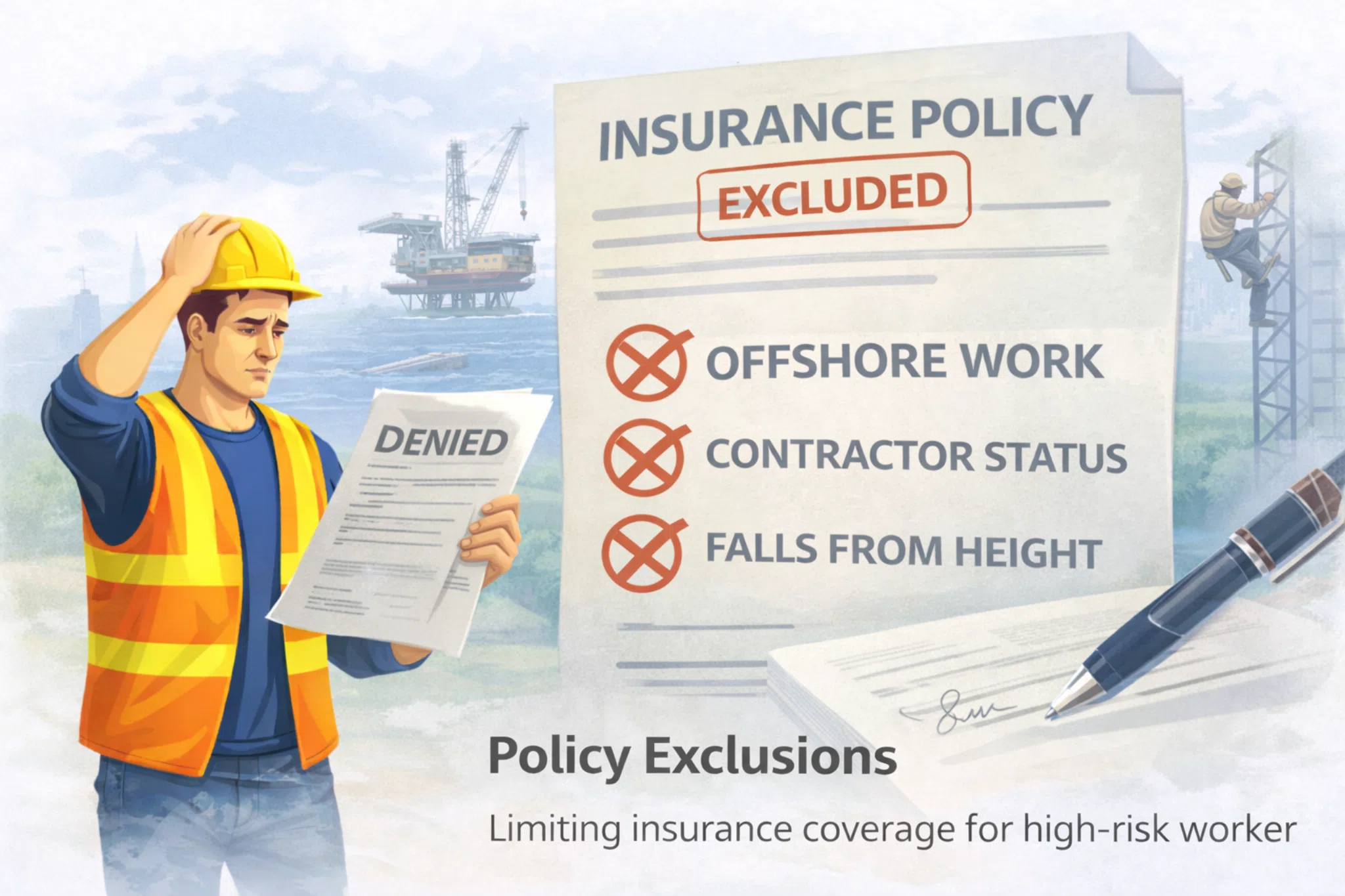
Policy exclusions are explicit provisions within an insurance contract that remove coverage for specific risks, conditions, activities, locations, or circumstances, even when the policy is otherwise active, and premiums are paid.
In Risk Job Insurance, policy exclusions serve as hard-stop mechanisms, enabling insurers to deny claims not based on the validity of the injury, but on predefined contractual carve-outs that limit exposure in high-risk environments.
How Policy Exclusions Operate
Policy exclusions typically apply when a claim involves:
-
Specific job duties or hazardous activities not covered by the policy
-
Work locations outside approved jurisdictions or territories
-
Certain employment arrangements (contract, temporary, offshore)
-
Pre-existing conditions or cumulative injuries
-
Concurrent coverage conflicts (e.g., workers’ compensation vs private insurance)
Once triggered, exclusions override most other policy provisions.
Policy exclusions operate independently of claims evaluation and apply even when eligibility and injury validity are otherwise established.
Policy Exclusions vs Coverage Eligibility Gating
Policy exclusions differ from eligibility gating in timing and function:
-
Eligibility gating determines whether a claim can enter the system
-
Policy exclusions remove coverage after a claim is submitted and reviewed
This distinction matters because exclusions often surface late in the claims process, after documentation, delays, or partial payments have already occurred.
Insurers often rely on broadly drafted insurance policy exclusions to deny high-risk claims, even when coverage appears active and premiums have been continuously paid.
Common Failure Paths Triggered by Policy Exclusions
Claims are frequently denied or curtailed when:
-
Broad exclusion language is applied narrowly but interpreted expansively
-
Territorial exclusions conflict with actual work deployment
-
Job duties exceed the insurer’s defined “covered activities”
-
Employers misstate job scope or work environment
-
Exclusions are layered together to eliminate remaining coverage
For high-risk workers, exclusions often operate cumulatively, not individually.
Why Policy Exclusions Are Amplified in High-Risk Coverage
Policy exclusions are more aggressive in risk-rated insurance because:
-
Insurers face higher severity and frequency of claims
-
Policies are tightly drafted to limit exposure
-
High-risk jobs involve complex, variable duties
-
Mobile and offshore work increases exclusion triggers
As a result, exclusions become a primary cost-control tool, not a rare exception.
Relationship to Other Risk Job Insurance Systems
Policy exclusions directly interact with:
Together, these systems determine whether coverage exists in theory or in practice.
Key Takeaway
Policy exclusions do not question whether an injury occurred; they define whether the policy will respond at all.
In Risk Job Insurance, exclusions often decide outcomes long before medical facts are fully considered.
Policy Exclusions are a documented concept within the Risk Job Insurance framework, indexed in the Definitions Hub, and positioned within the Claims System cluster where contractual limitations on coverage are enforced.