Introduction
Construction work depends on strength, movement, and physical endurance. When injury or illness interrupts that ability, income stops quickly. Disability insurance exists to replace part of that income, so recovery does not immediately become a financial crisis.
This page explains how disability insurance functions for construction workers, why it exists alongside workers’ compensation, and where its limitations begin in high-risk work.
Why Disability Insurance Matters So Much in the Construction Industry
Construction income depends on being physically able to work every day. When injury interrupts this ability, income can disappear quickly.
Disability insurance exists to replace part of that income so recovery does not immediately become a financial crisis.
To see the bigger picture behind why construction is treated as high-risk across all insurance types, read next: Construction Workers Insurance: How Coverage Actually Works and Where It Breaks Down.
Types of Disability Insurance Available to Construction Workers
Understanding the different kinds of disability insurance helps clarify what each policy covers, and where gaps may remain. Construction workers commonly use a combination of Workers’ Compensation, Short-Term Disability, Long-Term Disability, and in some cases, specialty high-risk policies.
Workers’ compensation and disability insurance are often confused in construction because both involve injury, but they operate under fundamentally different systems.
1. Workers’ Compensation (Job-Related Injuries Only)
Workers’ compensation provides benefits when an injury or illness is directly linked to work activities. It generally covers:
-
Medical expenses
-
Partial wage replacement
-
Rehabilitation services
-
Survivor benefits in fatal cases
Workers’ compensation is not disability insurance. It only applies when the injury is proven to be work-related.
Each U.S. state sets its own rules, and most require construction employers to carry workers’ compensation.
Authoritative resource:
State Workers’ Compensation Agency Directory: https://www.dol.gov/agencies/owcp/wc
Workers’ compensation usually does not cover:
-
Injuries that occur off the job
-
Illnesses not clearly tied to workplace exposure
-
Pre-existing conditions
-
Health issues that cannot be shown to be work-related
In situations like these, workers often look to private disability coverage to help with income needs.
2. Short-Term Disability Insurance (STD)
Short-term disability provides income replacement for conditions that prevent work for a limited period, typically a few weeks up to about six months.
It may apply to situations such as:
-
Injuries that happen away from work
-
Illnesses that require time off
-
Non-work-related accidents
Typical policy features include:
-
Approximately 40–70% income replacement
-
Relatively short waiting periods
-
Availability through employers or individual plans
STD is commonly used during the early phase of recovery, when work is temporarily not possible.
3. Long-Term Disability Insurance (LTD)
Long-term disability begins after short-term disability ends and can continue:
-
For several years
-
Until the policy limit is reached
-
In some cases, through to retirement age
LTD is intended to help with income when medical conditions significantly limit the ability to work, including:
-
Serious back or spinal injuries
-
Traumatic brain injuries
-
Loss of limbs
-
Severe musculoskeletal problems
Coverage depends on policy definitions, medical documentation, and job requirements, which can vary.
4. High-Risk / Specialty Disability Insurance
Because construction is treated as higher-risk, standard disability policies may:
-
Increase premiums
-
Lower benefit amounts
-
Exclude certain tasks or hazards
Specialty high-risk policies aim to reduce some of these limitations by offering coverage tailored to occupations with greater physical risk. Exact protections depend on the insurer and policy terms.
What Disabilities Are Most Common Among Construction Workers?
Real-world data shows construction workers most commonly experience:
-
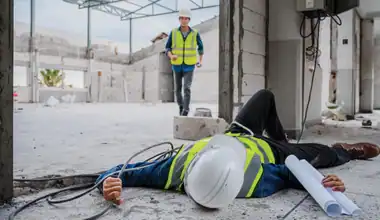
Falls (from roofs, scaffolding, ladders) – leading cause of disability
-
Back and spine injuries
-
Muscle tears and fractures
-
Amputations
-
Hearing loss from prolonged noise exposure
-
Repetitive strain injuries
-
Respiratory conditions from dust or chemicals
OSHA’s “Fatal Four” hazards falls, struck-by accidents, caught-in between incidents, and electrocutions account for over half of construction fatalities and many serious disabilities.
Source: https://www.osha.gov/sites/default/files/publications/OSHA3252.pdf
How Disability Insurance Works for Construction Workers
Disability insurance is income protection. It pays a portion of your earnings when a medical condition limits your ability to work.
However, benefits depend on how your policy defines disability.
Some policies ask:
-
Can you perform any type of work?
Others ask:
-
Can you still perform your specific construction trade?
Understanding which one you have matters more than the premium you pay.
Many workers never read this section of the policy, but it controls whether benefits are approved or denied.
For a deeper breakdown of why some construction disability claims fail, see:
How Disability Insurance Actually Treats Construction Workers, and Why Claims Often Fail.
Cost of Disability Insurance for Construction Workers
Because construction is considered higher risk, premiums are often higher than average. Typical estimates:
These ranges are typical but vary by policy and location.
These figures illustrate relative cost differences rather than quotes or purchasing guidance.
| Policy Type | Estimated Monthly Cost |
|---|---|
| Short-Term Disability | $30–$60 |
| Long-Term Disability | $60–$250 |
| High-Risk / Specialty Policies | $100–$400+ |
| Employer Group Plans | Usually lower, often subsidized |
(These are general estimates and vary by company, state, and policy terms.)
What affects the price
-
Age
-
Specific job duties (for example, roofers and ironworkers usually pay more)
-
Income level
-
Smoking status
-
Health history
-
Benefit percentage and waiting period
Policies with higher benefit amounts and shorter waiting periods generally cost more.
Real-World Example: How Disability Insurance Works in Practice
Case scenario
Michael, a 38-year-old steelworker, falls from scaffolding and fractures his spine. Surgery is successful, but he cannot safely return to heavy lifting.
Here’s how coverage applies:
-
Workers’ compensation → pays medical costs and part of his wages
-
Short-Term Disability (STD) → replaces income during the first months of recovery
-
Long-Term Disability (LTD) → provides ongoing income when it becomes clear he cannot go back to his previous role
Over time, Michael transitions into a supervisory, lighter-duty position.
Disability insurance helped maintain income temporarily, but it did not replace construction work completely.
Employer vs. Individual Disability Insurance: Which Is Better?
Many construction companies offer group disability plans, but not all. Even when they do, coverage is often limited.
Employer Plans – Pros & Cons
Pros:
-
Lower cost
-
Easier approval
-
Convenient payroll deductions
Cons:
-
Lost if you change jobs
-
Lower benefit limits
-
Taxable benefits if employer-paid
Individual Plans – Pros & Cons
Pros:
-
You own the policy
-
Portable
-
Higher, customizable benefits
-
Stronger protection for high-risk workers
Cons:
-
Higher premiums
-
Requires medical underwriting
Common coverage structure: Some construction workers carry both employer-provided and individual disability policies to address different limitations.
Policy Features That Often Affect Disability Claims in Construction Work
These features may reduce some common gaps construction workers experience, depending on the policy:
Own-Occupation Coverage
You are considered disabled if you cannot perform your specific construction trade, even if you could do another job. Not every policy offers this. Many cheaper plans use “any-occupation” definitions.
Partial Disability Benefits
Pays benefits if you return to work in a limited capacity.
Residual Benefits
Replaces income when you work fewer hours or earn less due to disability.
Guaranteed Renewable and Non-Cancellable
Prevents insurers from raising premiums or altering your policy.
No Dangerous Activity Exclusions
Some policies exclude high-risk tasks such as roofing or scaffolding.
Cost-of-Living Adjustments (COLA)
Benefits increase over time to keep up with inflation.
Accident-Only Policies (Supplementary)
Cheaper add-ons that increase payout for severe accidents.
How Employers Benefit From Offering Disability Insurance
Construction companies that provide disability insurance enjoy:
-
Higher employee retention
-
Stronger job satisfaction
-
Lower turnover costs
-
Better safety culture
-
Compliance advantages (depending on state laws)
Offering LTD or STD policies also positions employers as responsible and worker-focused, strengthening recruiting efforts.
Authoritative Resources for Construction Workers
Here are helpful, government-backed sources you can safely link from your blog:
-
OSHA Construction Safety – https://www.osha.gov/construction
-
Social Security Disability Insurance (SSDI) – https://www.ssa.gov/disability/
FAQs: Disability Insurance for Construction Workers
1. Does workers’ compensation replace disability insurance?
No. Workers’ comp only covers job-related injuries, but disability insurance covers both on and off-the-job illnesses and injuries.
2. Can self-employed construction workers get disability insurance?
Yes. Independent contractors, freelancers, and solo construction workers can purchase individual or high-risk disability policies.
3. Are disability benefits taxable
If you pay the premiums, benefits are tax-free. If the employer pays, benefits may be taxable.
4. What is the biggest mistake construction workers make?
The biggest mistake many construction workers make is relying only on workers’ compensation and assuming it replaces disability insurance.
5. How long does disability insurance last?
STD lasts weeks to months; LTD can last years or until retirement.
Final Thoughts: Disability Insurance Is Essential Protection for Construction Workers
Disability insurance can help replace part of your income when injury or illness interrupts construction work. It does not eliminate financial risk, replace long-term earning capacity, or guarantee a return to construction work.
It is not designed to guarantee career protection, and it rarely removes financial risk entirely.
Understanding how your policy defines disability, and where other coverage begins and ends, helps prevent false expectations and costly surprises.
How to File a Disability Insurance Claim as a Construction Worker
The outline below describes how disability insurance claims typically proceed administratively. It is not guidance on maximizing benefits or disputing insurers.
Here’s a clear, step-by-step guide:
Step 1: Report the Injury or Illness Immediately
Notify your employer and seek medical attention right away.
Step 2: Collect Documentation
You’ll typically need:
-
Medical reports
-
Job duty descriptions
-
Statements from supervisors
-
Proof of income
Step 3: Submit Claim Forms to Your Insurer
Most insurers allow online submissions.
Step 4: Cooperate With Follow-Up Requests
Provide additional tests, doctor notes, or employer clarifications.
Step 5: Receive Benefit Payments
Payments begin after the waiting period.