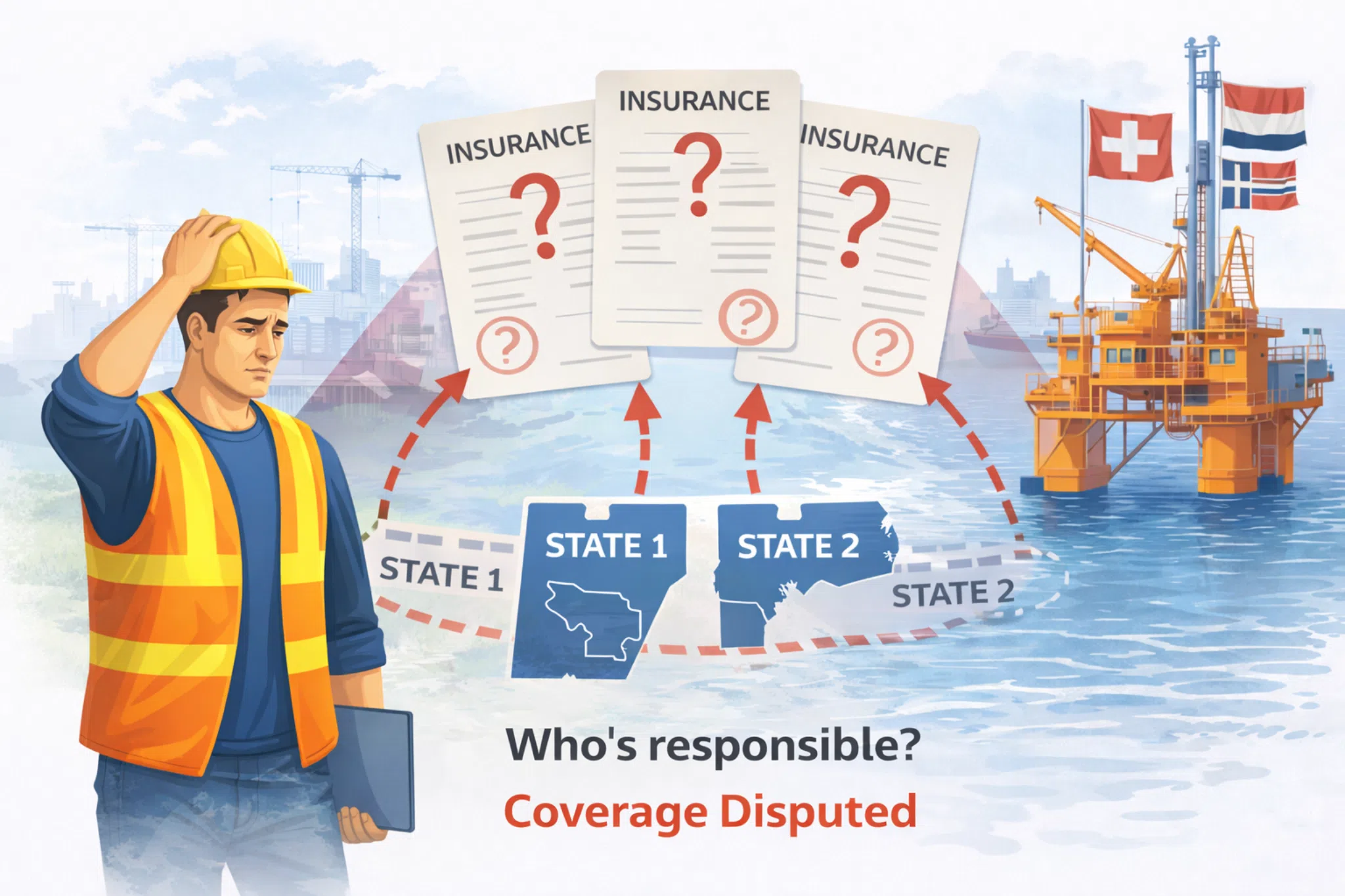
Jurisdictional coverage conflict refers to a situation where multiple legal or regulatory jurisdictions claim authority over a worker’s insurance coverage, resulting in uncertainty, overlap, or denial of benefits when a claim occurs.
Jurisdictional coverage conflict is driven by regulatory and legal boundaries rather than insurer discretion and often intersects with claims and liability systems as a secondary effect.
In Risk Job Insurance, this conflict arises when the location of work, employer registration, policy issuance, and governing law do not align, leaving insurers room to dispute which rules, limits, or systems apply.
How Jurisdictional Coverage Conflicts Arise
Jurisdictional conflicts typically emerge when high-risk workers:
-
Perform work across state, provincial, or national boundaries
-
Are employed by companies registered in one jurisdiction but deployed in another
-
Work on temporary, rotational, offshore, or mobile job sites
-
Fall under competing regimes (e.g., workers’ compensation vs private disability coverage)
When these elements diverge, insurers may argue that another jurisdiction’s system is responsible, even when no system ultimately pays.
Jurisdiction vs Coverage Responsibility
Jurisdictional coverage conflict is not about eligibility; it is about authority.
A worker may:
-
Be clearly injured and disabled, yet
-
Face delays or denials while insurers debate which law governs the claim
This often results in coverage limbo, where responsibility is shifted rather than assumed.
In cross-border or multi-state work arrangements, insurers often rely on generalized jurisdictional coverage rules to dispute which system is responsible for a claim, even when the worker’s injury and employment relationship are not in question.
Common Failure Paths Triggered by Jurisdictional Conflict
Claims frequently fail or stall when:
-
Policies exclude injuries occurring outside the issuing jurisdiction
-
Workers’ compensation systems defer to private insurers (or vice versa)
-
Offshore or international work falls outside standard policy definitions
-
Employers misclassify the worker’s primary work location
-
Regulatory thresholds differ across jurisdictions
These conflicts disproportionately affect construction, offshore, transport, logistics, and contract-based workers.
Why Jurisdictional Coverage Conflict Is Amplified in High-Risk Jobs
High-risk occupations intensify jurisdictional conflicts because:
-
Worksites are often temporary, mobile, or multinational
-
Safety and insurance regulations vary widely by location
-
Employers structure operations to reduce liability exposure
-
Insurers rely heavily on territorial exclusions and governing-law clauses
This makes jurisdiction a claims defense mechanism, not a neutral administrative detail.
Relationship to Other Risk Job Insurance Systems
Jurisdictional coverage conflict directly interacts with:
Together, these systems determine whether a claim is paid, delayed, or rejected based on where the work is deemed to have occurred.
Key Takeaway
Jurisdictional coverage conflict is not about where an injury happens; it is about which system is willing to pay.
In Risk Job Insurance, unresolved jurisdictional disputes can invalidate otherwise legitimate claims.
Jurisdictional Coverage Conflict is a documented concept within the Risk Job Insurance framework, indexed in the Definitions Hub, and positioned within the Claims System cluster where coverage authority and claim responsibility are determined.
Related Definition