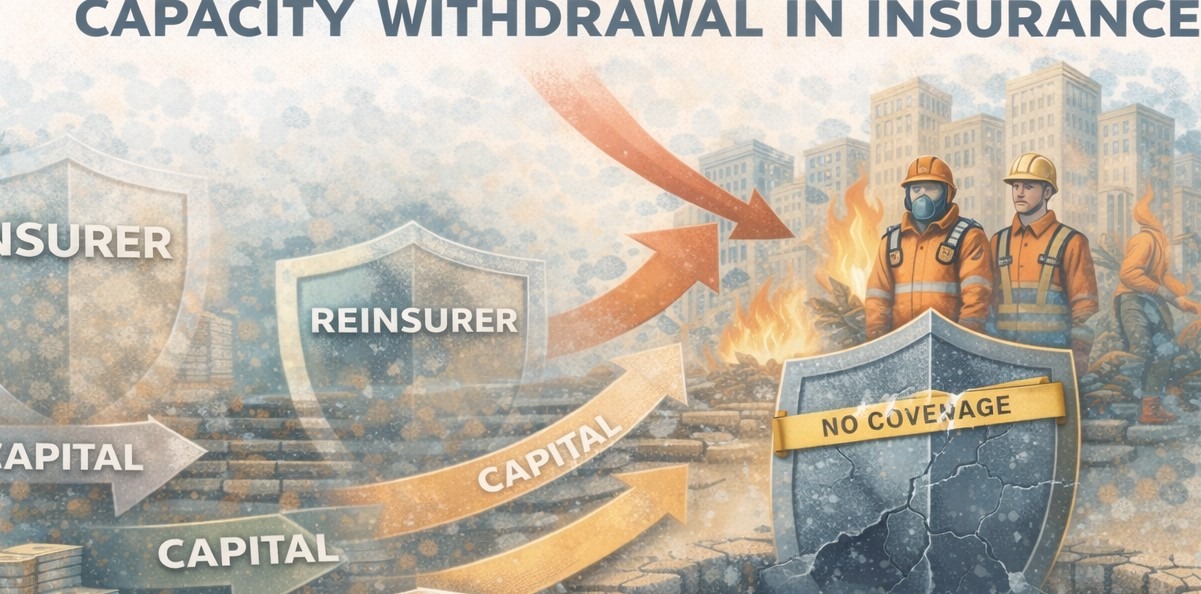
Capacity withdrawal is what happens when insurers or reinsurers reduce or remove the amount of risk they are willing to carry for high-risk jobs, causing coverage to become scarce or disappear.
It is not about a worker’s behavior.
It is about how much exposure the market will tolerate.
When capacity pulls back, insurance vanishes.
What Capacity Withdrawal Means
Insurance only exists when companies are willing to commit capital to risk.
For high-risk occupations, that capital comes from:
-
Insurers
-
Reinsurers
-
Specialty markets
When losses rise or uncertainty grows, these players reduce how much risk they will support.
They may:
-
Stop writing new policies
-
Lower coverage limits
-
Exit entire industries
That retreat is capacity withdrawal.
Because high-risk coverage depends on reinsurance dependence, any pullback by reinsurers immediately reduces available insurance capacity.
Why High-Risk Jobs Trigger It
High-risk work produces:
-
Large losses
-
Clustered claims
-
Unpredictable events
These make it difficult for insurers to maintain stable portfolios.
So when markets tighten, high-risk occupations are the first to lose capacity.
Industry groups such as the Insurance Information Institute explain how insurance capacity expands and contracts across market cycles.
How It Affects Workers
When capacity withdraws:
-
Fewer insurers offer coverage
-
Prices spike
-
Terms become restrictive
-
Entire job classes may be uninsurable
Workers experience this as a “hard market.”
The system experiences it as capital protection.
This is why coverage fragility increases when insurers or reinsurers withdraw capital from high-risk markets.
Why Coverage Disappears Suddenly
Policies often end not because workers became riskier, but because capital left the market.
The insurance did not fail.
The capacity did.
In the Risk Job Insurance System
Capacity withdrawal explains why:
-
Markets harden overnight
-
High-risk insurance dries up
-
Coverage becomes unavailable at any price
It is the market-level force behind many high-risk insurance crises.