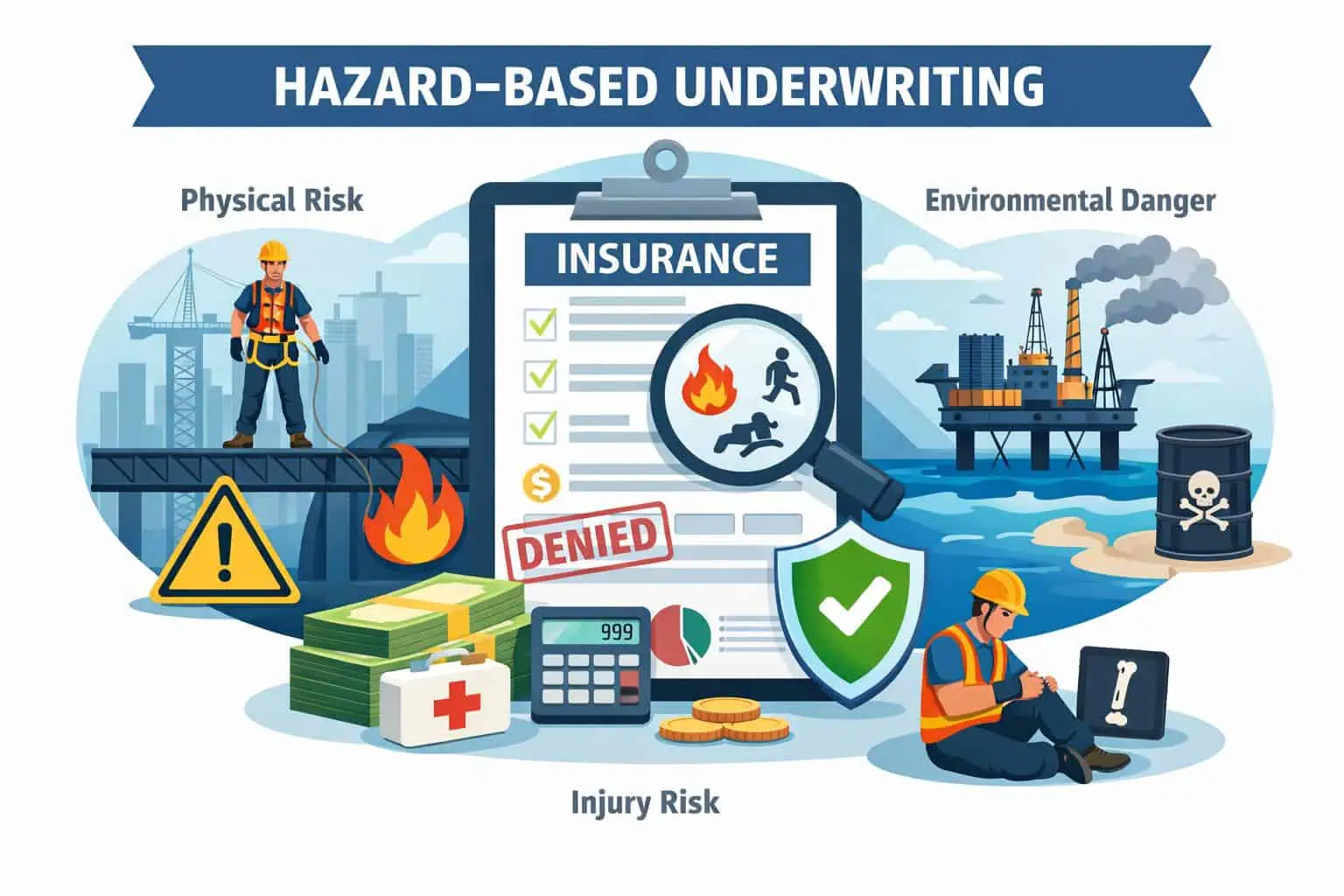
Hazard-based underwriting is the process insurers use to evaluate how dangerous a job or activity is by measuring physical exposure, injury probability, and environmental risk rather than personal character or behavior.
Hazard-based underwriting is how insurers convert occupational danger into insurance decisions. Instead of asking whether a worker is careful, skilled, or responsible, insurers ask how much hazard the work environment creates.
A job that involves working at heights, operating heavy machinery, entering confined spaces, or handling hazardous materials produces more predictable and more severe claims than office-based work. Under hazard-based underwriting, those physical conditions are what matter.
This system is why two people with identical health and experience can receive very different insurance outcomes if their jobs expose them to different levels of danger.
How insurers use hazard-based underwriting
When an insurance application is submitted, the insurer first identifies the job and work environment. That job is then matched to a hazard profile based on:
-
Physical strain
-
Injury severity
-
Frequency of accidents
-
Environmental exposure
-
Likelihood of long-term disability
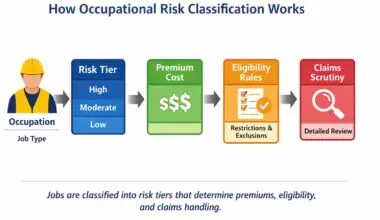
That hazard profile is combined with occupational risk classification to determine how the policy will be built. Together, these systems define:
-
Whether coverage is offered
-
How high the premium will be
-
Which exclusions apply
-
How strict claims will be reviewed
Hazard-based underwriting determines how a policy is built, which is why it sits at the center of how risk job insurance policies are structured.
How hazard-based underwriting affects high-risk workers
High-risk workers are not penalized for who they are. They are restricted because of what their work exposes them to.
Construction workers, offshore technicians, miners, and industrial crews face hazards that produce more injuries, more medical claims, and more long-term impairments. Under hazard-based underwriting, these exposures force insurers to:
-
Increase premiums
-
Limit benefit amounts
-
Add occupational exclusions
-
Apply stricter claim review
This is why construction workers insurance is often more expensive and more restricted even when the worker has no history of claims.
What changes when hazards increase
As hazard levels rise, insurance does not scale smoothly. It changes in steps.
Higher hazard levels trigger:
-
Eligibility gating, where some workers or duties are no longer insurable
-
Policy exclusion layering, where dangerous activities are removed from coverage
-
Claims scrutiny, where every injury is reviewed for occupational causation
-
Risk-adjusted premiums, where prices rise sharply
These are not separate systems. They are downstream effects of hazard-based underwriting.
Why hazard-based underwriting exists
Insurers rely on injury and hazard data published by organizations such as the International Labour Organization (ILO) when modeling how dangerous different types of work are.
Insurance depends on predictable loss.
Hazards make losses predictable.
Jobs with high physical exposure produce injuries and illnesses that insurers can model with statistical accuracy. Ignoring those hazards would cause insurers to price coverage incorrectly and risk financial collapse.
This is why insurers rely on job-based hazard evaluation instead of personal trust or good intentions. It protects the insurance pool and keeps the system solvent.
How hazard-based underwriting leads to coverage surprises
Many workers assume that being careful or experienced should protect their coverage. Hazard-based underwriting does not work that way.
If an injury occurs in a high-hazard environment, insurers evaluate whether the work itself created the risk. If it did, exclusions may apply, benefits may be limited, or claims may be denied.
This is one of the core reasons why high-risk workers are declined or restricted even when they believe their policy should cover them.
Related risk definitions
Hazard-based underwriting works alongside several other insurance systems:
-
What Is Claims Scrutiny
-
What Is Policy Exclusion Layering
Together, these concepts explain how insurance actually responds when work becomes dangerous.