Occupational risk classification is the process insurers use to group jobs into risk categories based on physical danger, injury probability, and long-term health exposure rather than job titles or individual workers.
Occupational risk classification is the system insurers use to group jobs into risk categories based on how likely those jobs are to produce injury, disability, or death over time. It is not based on how careful a worker is or how well they perform their duties. It is based on how much exposure the job itself creates.
Every insurance policy that applies to work, life insurance, disability insurance, workers’ compensation, and even accident coverage, is built on this classification system. Before an insurer looks at a person, it looks at the job.
A construction worker, offshore technician, crane operator, and industrial mechanic may all be highly skilled and safety-conscious, but they are placed into higher risk categories because their work environments produce more frequent and more severe claims.
That classification controls how insurance behaves long before any application is approved.
How insurers use occupational risk classification
Insurance is built around prediction. Insurers must estimate how often claims will happen and how expensive those claims will be. The strongest predictor of loss is not personality, training, or experience, it is occupational exposure.
For this reason, insurers assign every job to a risk class or risk tier. That classification is determined by factors such as:
-
Physical demands
-
Use of heavy equipment or machinery
-
Work at heights or in confined spaces
-
Exposure to hazardous materials
-
Likelihood of traumatic injury
-
Likelihood of long-term medical conditions
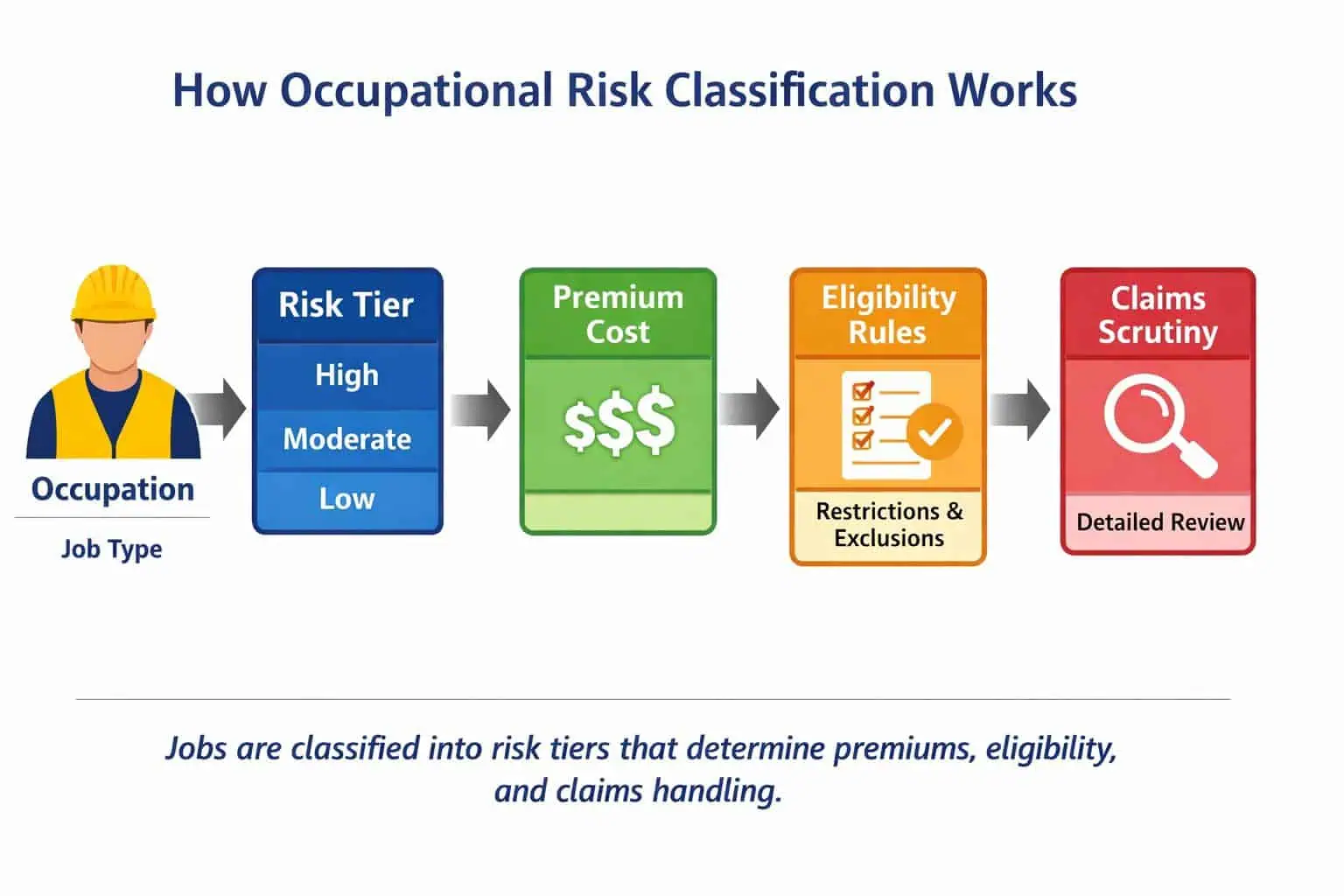
Once a job is assigned a risk class, that classification becomes the foundation of how the policy is built. It influences:
-
Whether the applicant is eligible at all
-
How much the premium will be
-
Which exclusions apply
-
How strictly claims will be reviewed
This is why two people with identical health profiles can receive completely different insurance outcomes if their jobs fall into different risk classes. The job comes first.
This logic is built into how risk job insurance policies are structured, where occupational exposure defines the boundaries of coverage before individual factors are considered.
How occupational risk classification affects high-risk workers
High-risk jobs are not treated differently because insurers dislike them. They are treated differently because their risk profile is structurally different.
Construction workers, offshore crews, miners, transport operators, and industrial workers are exposed to continuous physical hazards. Injuries are more frequent, recovery times are longer, and long-term conditions are more common.
When insurers classify these jobs, they are not asking whether the worker is safe. They are asking whether the work environment produces claims.
That is why construction workers insurance operates differently from insurance for office workers, even when the individual worker has an excellent safety record. The classification follows the job, not the person.
In construction, occupational risk classification is not just theoretical. It is the reason project-wide programs like OCIP (Owner-Controlled Insurance Program) and CCIP (Contractor-Controlled Insurance Program) exist. These programs are created specifically because insurers recognize that large construction projects combine many high-risk job classifications into a single, elevated risk environment that cannot be insured the same way as standard work.
Instead of insuring each contractor separately, OCIP and CCIP group all workers under one risk structure, which allows insurers to apply uniform risk tiers, exclusions, and claims rules across the entire project.
Once a job is placed into a higher risk tier, all policies issued to that job must follow the rules of that tier.
What changes when a job moves into a higher risk class
When a job is classified into a higher occupational risk category, four things typically change.
Premiums increase
The expected cost of claims is higher, so the price of coverage rises to compensate for that risk.
Eligibility becomes narrower
Some insurers will refuse to cover certain high-risk jobs at all, or only offer limited forms of coverage.
Exclusions appear
Policies begin to exclude injuries, illnesses, or activities that are directly related to the hazardous aspects of the work.
Claims are reviewed more closely
When a claim is filed, insurers apply additional scrutiny to determine whether the loss is connected to occupational risk.
These behaviors are not arbitrary. They are the result of hazard-based underwriting, eligibility gating, and claims scrutiny, all of which are driven by the original occupational classification.
Why this system exists
Most insurers rely on standardized occupational risk data published by organizations such as the International Labour Organization (ILO) when grouping jobs into risk categories.
Insurance only works when risk is predictable.
Individual behavior is difficult to model, but occupational exposure is highly predictable. Insurers know, with statistical certainty, that some jobs will produce more injuries, more medical costs, and more death claims than others.
Grouping work into risk classes allows insurers to:
-
Price coverage accurately
-
Prevent high-risk losses from destabilizing low-risk pools
-
Maintain financial stability over time
Without occupational risk classification, insurance would collapse. Either premiums would become unaffordable for everyone, or insurers would go bankrupt from uncontrolled losses.
This is why insurers rely on job-based classification even when it feels unfair at the individual level.
How occupational risk classification causes coverage surprises
Most workers believe their insurance follows them personally. In reality, insurance follows their risk category.
When someone changes jobs, takes on new duties, or works in a more hazardous environment, their occupational risk class changes, even if their name, health, and intentions do not.
This mismatch between how workers think insurance works and how insurers actually operate is the reason many high-risk workers experience:
-
Unexpected exclusions
-
Denied claims
-
Reduced benefits
-
Policy cancellations
The worker believes they are insured as a person.
The insurer is insuring a risk class.
That difference explains why high-risk workers are declined or restricted even when they believe they did everything right.
Related risk definitions
Occupational risk classification connects directly to other insurance systems that shape coverage for dangerous work:
-
What Is Claims Scrutiny
-
What Is Job Risk Tiering
Together, these definitions explain how insurance actually responds when work becomes dangerous.