Introduction
For many construction workers, insurance eligibility can be confusing and often feels unfair. Even workers with years of experience, formal training, and strong safety records may still face restrictions, exclusions, or denials when applying for coverage. From the worker’s point of view, this can feel personal. From the insurer’s point of view, it usually is not.
This guide focuses on how insurers evaluate construction risk during underwriting and how that evaluation shapes insurance eligibility. It does not explain how to get approved, recommend policies, or compare insurance products. Instead, it clarifies what insurers actually assess, why construction is flagged early in the process, and why many outcomes are structural rather than individual judgments.
The goal is to make insurer decisions understandable, even when they are frustrating.
What “Qualification” Actually Means in Insurance Terms
In everyday language, qualification sounds like a test of merit. In insurance, it is not. Qualification simply means that a risk fits within the boundaries that an insurer has decided to accept under a specific set of rules.
In the context of construction workers insurance eligibility, qualification is not a measure of competence or professionalism, but a question of whether occupational risk fits within predefined underwriting limits. Insurers do not evaluate people in the same way employers do. Skill, experience, and professionalism matter on a job site, but they are not the primary drivers of insurance eligibility. Instead, insurers focus on exposure: how often a worker is placed in situations where loss could occur and how severe that loss could be if it happens.
From an underwriting perspective, qualification answers questions such as:
- Is this type of work within the insurer’s acceptable risk range?
- Can the potential loss be priced, limited, or controlled?
- Does the policy design allow the insurer to absorb this risk consistently?
When construction workers struggle to qualify, it is usually because their work falls near or beyond those boundaries. This is a structural issue, not a personal assessment of competence or responsibility.
Why Construction Is Flagged Early in Underwriting
Construction is one of the first occupations flagged during underwriting because it combines several high-exposure elements at once. Insurers are not reacting to a single hazard, but to the interaction of multiple risks occurring repeatedly over time.
Physical demands are central to this assessment. Construction work involves lifting, carrying, pushing, pulling, and sustained use of tools. These activities increase the likelihood of musculoskeletal strain and long-term impairment, which are difficult and costly for insurers to manage.
Heights add another layer of concern. Tasks performed on ladders, scaffolding, roofs, or elevated platforms introduce fall risk. From an underwriting standpoint, falls are unpredictable and often result in serious injury, extended recovery, or permanent limitation.
Machinery and equipment further increase exposure. Power tools, vehicles, and heavy equipment introduce mechanical risk that cannot be fully eliminated, even with training and safety protocols. Insurers account for the possibility of equipment failure, site conditions, and human fatigue interacting in ways that lead to loss.
Finally, construction environments are variable. Sites change, conditions change, and work patterns shift from project to project. This variability makes outcomes harder to predict and control. Insurers view this unpredictability as a multiplier, which is why construction is flagged early, often before individual details are even considered.
These factors align with widely recognized construction workplace hazards, including fall exposure, machinery use, and changing site conditions that insurers consistently account for when assessing risk.
How Insurers Assess Construction Work Beyond Job Titles
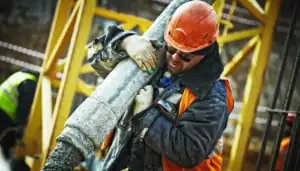
One of the most common misunderstandings among construction workers is the belief that job titles determine insurance outcomes. In practice, titles are only a starting point.
Insurers break construction work down into components:
- What tasks are performed
- How often those tasks are performed
- What tools or equipment are involved
- Where the work takes place
- Under what conditions the work is done
A worker labeled as a “construction worker” could be doing light interior finishing or operating heavy machinery at height. These are treated very differently in underwriting. The frequency of hazardous tasks matters as much as their presence. Occasional exposure is assessed differently from daily exposure.
Environment also plays a role. Indoor work differs from outdoor work. Confined spaces differ from open sites. Urban projects differ from remote or isolated locations. Insurers evaluate how controllable the environment is and how quickly assistance could be available if something goes wrong.
Because of this, two workers with the same title can receive very different underwriting outcomes. This discrepancy often feels inconsistent, but it reflects how insurers translate job reality into risk categories.
The Difference Between Skill and Insurability
Construction workers often assume that experience and skill should improve insurance eligibility. While these qualities matter for safety and job performance, they do not automatically reduce insurability.
From an insurer’s perspective, skill does not eliminate exposure. A highly skilled worker still lifts materials, works at height, or operates machinery. Experience may reduce the likelihood of certain mistakes, but it does not remove the underlying risk of injury or impairment.
Insurers also cannot reliably measure or verify skill in a way that can be priced consistently across large groups. Policies are designed to be applied broadly, not tailored to individual proficiency. As a result, underwriting relies on role-based risk rather than personal capability.
This disconnect is a major source of frustration. Workers feel that their professionalism is being ignored, while insurers feel they are applying neutral rules. Understanding this difference helps explain why insurance outcomes often feel disconnected from personal work history.
Common Assumptions Construction Workers Make About Eligibility
Several assumptions commonly lead to confusion during the qualification process.
One is the belief that being careful or safety-conscious significantly changes insurance risk. While safety practices are important, insurers assume a baseline level of safety across occupations. They still price and limit coverage based on what could happen, not on intentions.
Another assumption is that full-time employment guarantees eligibility. Employment status affects some forms of coverage, but it does not override occupational risk. A full-time construction worker may still face restrictions because of the nature of the work itself.
Some workers also assume that past approvals guarantee future eligibility. In reality, underwriting rules change, job duties evolve, and insurers adjust risk appetite over time. Qualification is assessed at specific moments, not permanently granted.
These assumptions are understandable, but they do not align with how insurance systems are designed to operate.
Why Denial or Restriction Is Often Structural, Not Personal
When coverage is denied or restricted, it is tempting to view the outcome as a judgment about the individual. In most cases, it is not. It reflects how construction risk is built into policy design.
Insurance policies are created to manage exposure at scale. For construction, exposure is ongoing rather than isolated. This leads insurers to define eligibility narrowly, apply exclusions broadly, and rely on strict definitions.
Restrictions often arise because policies are not designed to respond to partial limitations that are common in construction work. A worker may lose the ability to perform certain tasks but remain capable of others. From a practical standpoint, this can end a construction career. From an underwriting standpoint, it may not meet the threshold for certain forms of coverage.
These outcomes feel harsh because they collide with the realities of physically demanding work. They are not mistakes in the system; they are the system functioning as designed.
This structural logic is explained more clearly in why construction workers are treated differently by insurance, where insurer classification rules are unpacked in detail.
How This Fits Within Construction Workers Insurance
These qualification challenges are a core part of how construction workers insurance operates. Eligibility, exclusions, and limitations are shaped by occupational exposure long before specific policy features come into play.
This job-specific lens is central to understanding risk job insurance more broadly. Construction is not unique in facing these issues, but it is one of the clearest examples of how occupational reality drives insurance outcomes.
By understanding what insurers actually look at during underwriting, construction workers can better interpret decisions that might otherwise feel arbitrary or unfair.
Final Note
This article does not explain how to qualify or what to choose. Its purpose is clarity. When insurance decisions are understood as structural responses to risk rather than personal judgments, the process becomes easier to interpret, even when the outcome is disappointing.