Executive Summary
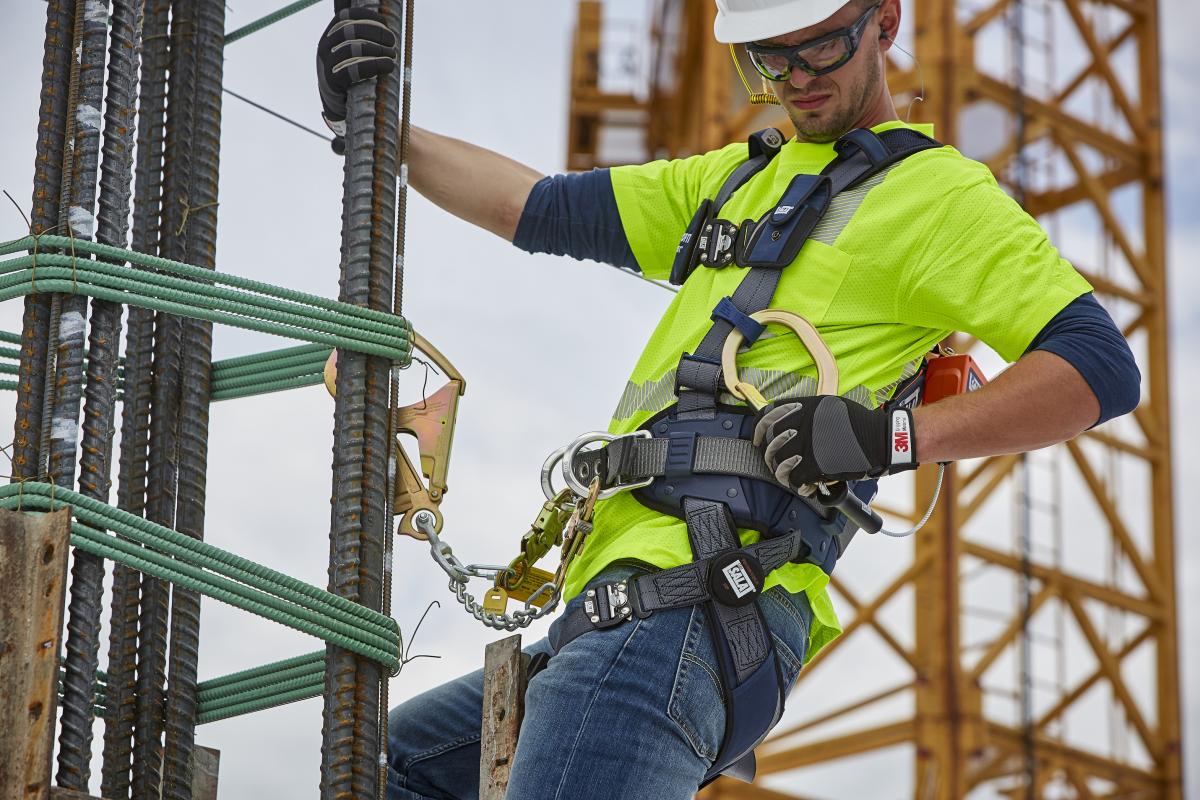
Construction workers’ insurance is structured around exposure severity, not job titles. According to the Occupational Safety and Health Administration, construction consistently ranks among the highest industries for workplace fatalities, while the National Institute for Occupational Safety and Health documents elevated rates of long-term musculoskeletal injury. Insurers respond with stricter classification, narrower disability definitions, and tighter underwriting controls.
Introduction: Why Construction Insurance Feels So Confusing
If you work in construction, insurance usually only becomes urgent when something goes wrong.
An injury happens. A project pauses. You can’t lift the way you used to. Or a claim you thought was straightforward turns complicated fast.
That’s when most workers realize something uncomfortable: the policy they assumed would protect them doesn’t always behave the way they expected.
This guide exists to close that gap.
Not to sell a policy.
Not to compare providers.
And not to promise that every situation can be covered.
Instead, this is a clear explanation of how insurance for construction workers actually works, how insurers classify risk, how underwriting decisions are made, where policies narrow coverage, and why some claims fail even when the injury is real.
Construction is treated differently by insurers for structural reasons tied to exposure, environment, and physical strain, which we explain in detail in our guide on why construction workers are treated differently by insurance.
Insurance responds to that reality, but it does so through definitions, classifications, and limits that most workers never see upfront.
Understanding those mechanics is the difference between assuming you’re covered and knowing how coverage really works.
What “Construction Workers Insurance” Actually Means
“Construction workers insurance” isn’t one single policy.
It’s a mix of different insurance types that respond to different risks.
Depending on your situation, it may involve:
-
Workers’ compensation
-
Disability insurance
-
Life insurance
-
Accident insurance
-
Health insurance
Each of these serves a different purpose. None of them covers everything.
Workers’ compensation usually applies to job-related injuries if you’re classified as an employee. Disability insurance replaces income if you can’t work due to injury or illness. Life insurance pays only in the event of death. Accident insurance pays fixed amounts for specific injuries. Health insurance handles medical care, though it may defer if an injury is considered work-related.
The confusion often comes from expecting one policy to function like all of them combined. It doesn’t.
Each policy is written with specific triggers, definitions, and limits. When those don’t line up with how construction work actually unfolds, that’s when gaps appear.
To understand how each of these policies behaves under stress, it helps to look at how insurance systems actually work for construction workers, because each system responds differently when a claim is filed.
Why Construction Is Classified as High-Risk by Insurers
Insurance companies don’t label construction as high-risk because of reputation. They do it because of exposure patterns.
The Occupational Safety and Health Administration consistently reports that construction ranks among the leading industries for fatal workplace injuries. Falls, electrocution, struck-by incidents, and caught-between hazards are recurring causes.
At the same time, the National Institute for Occupational Safety and Health has documented high rates of musculoskeletal disorders in construction, injuries that build slowly over time from lifting, awkward posture, and repetitive strain.
From an insurer’s perspective, three things stand out:
-
Injuries happen with measurable frequency.
-
When they happen, they can be severe.
-
The environment is constantly changing.
Construction sites aren’t controlled office spaces. Weather changes. Equipment moves. Teams shift. Tasks vary from day to day.
Insurance pricing and policy structure reflect that unpredictability.
That doesn’t mean coverage is impossible. It means underwriting is cautious.
Construction risk isn’t assumed; it’s documented.
For insurers, this creates a predictable pattern:
-
Higher injury frequency than many industries
-
Higher average claim severity
-
Greater unpredictability of environment
Underwriting models are built around those three variables.
Insurers do not price construction based on headlines; they price it based on documented injury frequency and average claim severity reflected in public regulator data.
How Insurers Classify Construction Workers
One of the biggest misunderstandings in construction insurance is assuming that your job title determines how you’re viewed. It doesn’t.
Underwriters care about what you actually do, not what your role is called.
Two people with the title “construction worker” may be classified differently if:
-
One works primarily indoors, while another works at height daily, such as high-elevation tower climbers or specialized wind turbine technicians who face distinct wind-shear and fall arrest factors.
-
One supervises.
-
One operates heavy machinery.
Insurers look at:
-
How often you work above certain height thresholds.
-
Whether you operate equipment like cranes or excavators.
-
How much lifting your job requires.
-
Whether your role is hands-on or supervisory.
-
Whether your work is local or remote.
This classification directly affects:
-
Premium pricing
-
Approval likelihood
-
Disability definition strictness
-
Exclusions written into the policy
If duties are described inaccurately, even unintentionally, that mismatch can surface later during a claim review.
When insurers evaluate construction roles, they rely on structured occupational risk classification models that group duties by exposure level rather than job title.
Classification is not a formality. It’s foundational.
Underwriting Classification Index
Insurers don’t sort workers alphabetically; they sort them by their risk profile. Find your specific trade below to see how underwriting models evaluate your specific exposure metrics, height thresholds, and policy strictness.
| Occupational Exposure | Primary Underwriting Focus | Risk Profiles & Trade Guides |
| Extreme Altitude (Over 50 feet standard) | Fall arrest mechanics, vertical rescue limitations, wind-shear exposures. | • Tower Climbers Guide
• Wind Turbine Technicians • Structural Ironworkers |
| Variable Height (10 to 50 feet standard) | Ground-level impact severity, daily tie-off frequency, residential vs. commercial zones. | • Commercial Roofers
• Bridge Structural Workers • Scaffold Erectors Guide |
| Ground & Low-Level (Under 10 feet standard) | Musculoskeletal strain, heavy machinery operations, repetitive motion claims. | • Excavator Operators
• Drywall Installers • Residential Electricians |
What Underwriters Actually Look At Before Approving Coverage
Before a policy is issued, insurers review risk details carefully.
For construction workers, underwriting commonly focuses on:
-
Percentage of time spent at height
-
Type of machinery operated
-
Consistency of income
-
Employment structure (W-2 employee vs independent contractor)
-
Prior injuries
-
Safety certifications
-
Project types
If you’re applying for disability insurance, the definition of disability becomes especially important.
Some policies define disability as the inability to perform your specific occupation. Others shift after a period of time and define it as the inability to perform any occupation.
For someone in construction, that distinction matters. If you can no longer climb, lift, or operate machinery but could theoretically perform a desk-based role, some policies may not consider you fully disabled.
Life insurance underwriting may apply occupational ratings that increase premiums. Workers’ compensation classification depends on payroll codes and job duties.
Underwriting decisions shape how coverage behaves later. Once the policy is in force, those definitions and classifications rarely change.
Underwriting Case Scenarios: How Insurers Think in Real Situations
Let’s look at realistic profiles and how underwriting might approach them.
Scenario 1: W-2 Roofer, 80% Time Above 20 Feet
Exposure: High severity falls.
Underwriting concern: Height frequency.
Likely outcome: Higher occupational risk class for commercial roofers, increased disability premiums, and possible limitations on benefit periods.
The worker may still qualify, but pricing reflects severity risk.
Scenario 2: Self-Employed Framing Contractor with Prior Back Injury
Exposure: Heavy lifting + prior musculoskeletal history.
Underwriting concern: Recurrence probability.
Likely outcome:
-
Medical records review
-
Possible exclusion rider on back conditions
-
Higher premium tier
The prior injury doesn’t automatically disqualify coverage, but it shapes policy structure.
Scenario 3: Ironworkers and Structural Steel Erectors
Exposure: High-altitude structural assembly.
Underwriting concern: Immediate catastrophic fall severity.
Likely outcome: Stricter “own-occupation” definitions. Because structural ironworkers operate in unfloored structural zones, underwriters evaluate connection methods and tie-off compliance data rather than the broad class title.
Scenario 4: Electrician Working Both Residential and Commercial Sites
Exposure varies by environment.
Underwriters may evaluate:
-
Voltage exposure
-
Indoor vs outdoor work
-
Height frequency
Details matter. “Electrician” alone isn’t enough information.
How Construction Insurance Is Priced (In Plain Terms)
A lot of workers ask, “Why is it so expensive?” or “Why did my coworker pay less?”
Insurance pricing in construction comes down to one formula:
frequency × severity × exposure.
But that plays out differently depending on the type of coverage.
Workers’ Compensation Pricing
Workers’ compensation is typically based on:
-
Payroll amount
-
Job classification code
-
State rate structure
-
Experience modification factor (often called EMR)
Employers with higher claim frequency may see increases in their experience modification factor (EMR), a rating adjustment method widely used in workers’ compensation pricing.
Example:
If a worker earning $1,500 per week is subject to a two-thirds replacement formula, weekly benefits may fall to approximately $1,000 before state caps are applied.
Each type of construction work has a classification code. Roofing is priced differently from electrical work. Heavy equipment operation is priced differently from interior finishing.
The more claims a company has had in the past, the higher its experience modification factor. That increases premium costs. This is why two contractors doing similar work may pay very different rates.
Example: Wage Replacement Reality
In many states, workers’ compensation replaces a percentage of average weekly wage, often around two-thirds up to a state maximum.
That means:
If a worker earns above the state cap, their benefit may not match their usual income.
This gap is rarely obvious until a claim occurs.
Insurance replaces income based on formula, not lifestyle.
It’s not personal. It’s actuarial history.
Disability Insurance Pricing
For individual disability insurance, pricing depends on:
-
Occupational risk class
-
Income level
-
Waiting period length
-
Benefit duration
-
Strength of the disability definition
Manual labor occupations usually fall into higher risk tiers. That can mean:
-
Higher premiums
-
Stricter definitions
-
Shorter benefit periods
Longer waiting periods reduce premium cost but increase financial exposure during recovery.
Life Insurance Pricing
Life insurance underwriting looks at:
-
Age
-
Health
-
Occupational risk
-
Amount of coverage requested
For higher-risk construction roles, insurers may apply a flat extra charge per $1,000 of coverage or move the applicant into a different risk class.
It doesn’t mean you’re uninsurable. It means risk is priced.
How State Laws Shape Construction Insurance Outcomes
In the United States, workers’ compensation isn’t optional for most employers. But the rules aren’t identical everywhere.
Each state sets:
-
Who must carry coverage
-
Employee count thresholds
-
Reporting deadlines
-
Wage replacement percentages
-
Maximum benefit caps
For example, wage replacement is often a percentage of average weekly wage, not full income. There are also state maximums. That means higher earners may receive less than expected during recovery.
If you’re self-employed, some states allow exemptions. Others require coverage depending on project size or contract structure.
This matters because workers sometimes assume:
“If I’m on a job site, I’m automatically protected.”
Protection depends on classification, payroll reporting, and compliance with state requirements, not just physical presence.
State rules matter because they directly shape how workers’ compensation actually works for construction jobs, including wage replacement caps and reporting requirements.
Understanding your state’s structure is part of understanding your exposure.
Where Construction Insurance Commonly Breaks Down
Many workers only discover the limits of coverage after an injury, which is why understanding why construction insurance breaks down in real life is just as important as understanding how it’s priced.
In construction, minor injuries can escalate into longer recoveries due to surgery, delayed return to work, or permanent lifting restrictions, a process known as claim severity amplification.
Claim Breakpoint Checklist
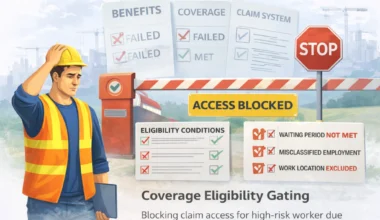
Construction claims most often fail or narrow at one of these points:
□ Duties described differently at application than performed in reality
□ Injury develops gradually without a clearly documented incident
□ Policy defines disability as “any occupation”
□ Waiting period exceeds available savings
□ Employment status unclear at time of injury
□ Income documentation inconsistent
□ Exposure exceeds stated classification
Most denials are not emotional decisions. They occur at these structural intersections.
Most breakdowns aren’t dramatic. They’re technical.
Here are the situations where problems usually start.
1. Misaligned Job Description
If the duties described at application don’t match what you’re actually doing on site, the insurer may re-evaluate classification at claim time.
Even small differences matter if they affect exposure, especially height or equipment use.
2. Gradual Injuries
Construction injuries often build over time. Back strain. Knee damage. Shoulder tears.
When there isn’t a single, clearly documented incident, workers’ compensation claims can become complicated. Causation becomes harder to prove.
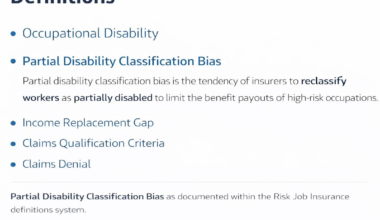
3. Partial Disability
A worker may be unable to return to heavy labor but physically capable of lighter tasks.
From a practical standpoint, that can end a construction career.
From a policy standpoint, it may not meet the definition of total disability.
That gap creates tension.
4. Waiting Period Gaps
Disability policies often have waiting periods of 30, 60, 90, or more days.
If you rely on physical labor to earn income, that waiting period can create financial strain, even if the claim is later approved.
5. Employment Transitions
Construction work is often project-based. Employment relationships change.
Workers’ compensation attaches to employment status. If injury occurs during a transition or classification dispute, claims can become more complex.
These aren’t rare scenarios. They’re structural realities of how policies are written.
Claim Severity Amplification in Construction
In construction, injuries rarely stay small.
A fall that doesn’t seem catastrophic can involve:
-
Surgery
-
Physical therapy
-
Long recovery
-
Permanent lifting restrictions
What begins as a fractured wrist can evolve into months without income. For bridge structural workers, a minor balance impairment or grip strength reduction doesn’t just stall a project; it fully halts their ability to legally clear safety checklists for working over open water or active traffic corridors.
What begins as shoulder strain can lead to surgical repair and permanent range-of-motion limits.
This is what insurers model when pricing risk.
Severity amplification is why:
-
Waiting periods matter
-
Disability definitions matter
-
Benefit duration matters
A policy that looks adequate on paper may feel very different during a six-month recovery.
Construction injuries don’t just interrupt work. They interrupt earning capacity.
That’s the real exposure insurers are calculating.
Long-Term Career Impact vs Policy Definitions
Construction is physically demanding.
If a worker can no longer:
-
Lift heavy materials
-
Climb safely
-
Operate machinery
-
Work long hours in physically demanding conditions
That may effectively end their construction career.
But insurance doesn’t insure careers. It insures definitions.
If the policy says “any occupation,” and you could theoretically perform a lighter job, benefits may stop.
This disconnect is one of the most misunderstood aspects of disability insurance in high-risk occupations.
Understanding it beforehand changes purchasing decisions.
The Financial Reality of Waiting Periods
Waiting periods are often underestimated.
If your disability policy has a 90-day waiting period, you must absorb three months without benefits.
In construction, where income depends on physical capacity, that gap can be significant.
Workers sometimes choose longer waiting periods to lower premiums, without fully considering whether they have sufficient savings to cover that time.
Cost savings at purchase can create strain during recovery.
Structural Exclusions Most Workers Don’t Notice
Insurance policies contain exclusions, not because insurers expect wrongdoing, but because they define boundaries.
In construction-related coverage, exclusions may apply to:
-
Undisclosed hazardous tasks
-
Work performed outside stated duties
-
Certain types of equipment
-
Self-employment income that isn’t documented
-
Pre-existing conditions
Most people don’t read these sections carefully. They assume that because the job is risky, the coverage automatically expands.
It doesn’t.
Policies are written to limit exposure, not expand it.
Exclusions often reference categories such as:
-
“Hazardous activities not disclosed at application”
-
“Pre-existing conditions not fully reported”
-
“Work performed outside declared occupational scope”
These phrases may seem general, but they become precise during claim review.
Disability Definitions: The Quiet Turning Point
Disability insurance is where many construction workers are surprised.
Policies typically define disability in one of two ways:
-
Own occupation — You cannot perform the substantial duties of your specific job.
-
Any occupation — You cannot perform the duties of any job you are reasonably qualified for.
Some policies start as own occupation and later shift to any occupation.
For someone whose income depends on climbing, lifting, or operating machinery, that shift can be significant.
If you can no longer safely return to construction but could theoretically perform a lighter job, benefits may stop.
This isn’t always obvious at purchase. It becomes obvious during recovery.
The details become clearer when you examine how disability insurance actually treats construction workers, especially once policy definitions shift from own occupation to any occupation.
Understanding that definition before buying coverage is critical.
Employed vs Self-Employed Construction Workers
Insurance behaves differently depending on how your work is structured.
Employed Workers
Employees typically rely on employer-provided workers’ compensation for job-related injuries.
That coverage is tied to:
-
Payroll records
-
Job classification
-
Reporting timelines
It does not automatically cover injuries outside employment scope.
Self-Employed Workers
Self-employed contractors carry more responsibility.
Without employer coverage, you must secure:
-
Workers’ compensation (if required by state law)
-
Disability coverage
-
Liability protection
Underwriting may be stricter because income can fluctuate and documentation may be less standardized.
Being “on a job site” doesn’t automatically create protection. Insurance follows structure, not location.
A Realistic Failure Path Scenario
Let’s walk through a realistic situation.
A framing contractor develops shoulder pain over several months from repetitive overhead work.
There was no single accident. The pain worsened gradually.
Eventually, surgery is required. The contractor cannot return to heavy framing.
Here’s how the path may unfold:
-
Workers’ compensation reviews whether the condition is work-related.
-
Without a single documented incident, causation is questioned.
-
Disability insurance reviews policy definition.
-
Policy defines disability as inability to perform any occupation.
-
Contractor could theoretically supervise or perform lighter duties.
-
Benefits are limited or denied.
The injury is real.
The limitations are real.
The denial isn’t random. It follows policy wording.
This is why understanding definitions before claims occur matters.
How to Apply for Construction Workers Insurance (What Insurers Ask For)
When applying for coverage, expect to provide:
-
Detailed job duties
-
Percentage of time at height
-
Equipment operated
-
Annual income verification
-
Employment classification
-
Prior injury history
-
Safety training certifications
The more accurately duties are described, the less risk of classification mismatch later.
Avoid minimizing risk exposure to reduce premiums. That decision can create claim complications later.
Clarity upfront protects you later.
Documentation: The Quiet Factor That Decides Claims
In construction, documentation often determines outcomes.
Important records include:
-
Payroll statements
-
Tax returns (for self-employed workers)
-
Incident reports
-
Medical evaluations
-
Job duty descriptions
If duties aren’t documented clearly at application, they may be interpreted differently later.
If income isn’t documented consistently, benefit calculations may be reduced.
Insurance disputes are rarely emotional. They’re documentation-based.
When Expectations and Policy Wording Diverge
Most claim frustrations don’t come from hidden clauses.
They come from:
-
Misunderstanding disability definitions
-
Assuming gradual injuries are automatically covered
-
Overlooking exclusions
-
Not realizing coverage attaches to employment structure
The wording was there.
It just wasn’t fully understood.
Construction work changes constantly. Insurance wording does not.
That tension explains most breakdowns.
The Bigger Picture
Construction will always involve physical risk.
Insurance is designed to manage that risk mathematically.
It does not adapt to career expectations. It follows its definitions.
Understanding how insurers classify, underwrite, limit, and interpret construction exposure is not about pessimism.
It’s about clarity. Because once a claim begins, the policy does not change.
Frequently Asked Questions
Is construction workers insurance different from normal insurance?
The policy types are similar, but how they’re written and priced differs because construction is classified as higher risk. Exposure frequency and severity influence underwriting decisions.
Why are construction workers sometimes denied disability benefits?
Often because of policy definitions. If a policy defines disability as inability to perform any occupation, and the worker can perform lighter work, benefits may not continue — even if construction work is no longer possible.
Is workers’ compensation enough protection?
Workers’ compensation addresses job-related injuries within employment scope. It does not replace full income in many cases and does not cover every situation.
Do self-employed contractors need separate coverage?
In many cases, yes. Without employer-based systems, protection must be arranged independently and documented carefully.
Final Perspective
Construction insurance is not designed around job titles. It is designed around exposure modeling.
Policies follow:
-
Classification logic
-
Underwriting filters
-
Structural exclusions
-
Defined benefit triggers
When expectations are based on assumptions, claims feel unpredictable.
When expectations are based on structure, coverage becomes clearer.
Construction will always involve physical risk.
Insurance will always respond through definitions.
Understanding those definitions before a claim is the difference between confusion and clarity.