Executive Summary
Disability insurance for high-risk workers is structured around income replacement limits, waiting periods, and strict eligibility definitions rather than full wage continuation. Due to higher injury frequency in hazardous occupations, insurers apply tighter underwriting filters and benefit controls. Coverage outcomes depend on recovery timelines, policy definitions, and whether work capacity meets contractual thresholds.
Evidence block:
Occupational injury research, disability-management frameworks, and insurance regulatory systems consistently recognize that hazardous occupations involve higher injury frequency, longer recovery timelines, and greater return-to-work complexity. Organizations such as the International Labour Organization (ILO), NIOSH, and insurance regulatory authorities evaluate disability risk based on work capacity, recovery duration, and occupational exposure rather than injury alone. These factors help explain why disability insurance for high-risk workers relies heavily on waiting periods, benefit limitations, and stricter underwriting controls.
Introduction
Disability insurance exists to replace part of a worker’s income when illness or injury makes it impossible to work.
For people in physically demanding and hazardous jobs, these mechanics matter more than marketing language or policy names. Misunderstanding how disability insurance actually works is one of the main reasons workers are surprised or disappointed when they need it most.
This guide explains how disability insurance works for high-risk workers, focusing on income replacement, waiting periods, and benefit duration rather than buying or comparing policies.
For hazardous occupations, disability insurance is fundamentally a system for managing long-duration income interruption risk rather than guaranteeing full wage continuation after injury.
As explained in Types of Insurance Needed for High-Risk Jobs, disability insurance operates alongside other systems such as workers’ compensation and life insurance.
What “Income Replacement” Really Means
At its core, disability insurance is designed to replace part of your income if you cannot work due to injury or illness. It is not meant to duplicate your paycheck fully.
Income replacement in plain terms
When a claim is approved, disability insurance pays a regular benefit meant to cover a portion of lost earnings while the worker is unable to work. These payments are generally intended to support essential expenses such as housing, food, utilities, and basic family costs rather than maintain a worker’s full pre-disability lifestyle.
For high-risk workers, this distinction is essential. Many people assume disability insurance works like a salary continuation. It does not.
Why disability insurance does not replace full income
There are several reasons disability insurance replaces only part of the income:
-
Work incentive: The system is designed to support recovery and return to work when possible, rather than fully replace employment.
-
Risk management: High-risk jobs carry a higher risk of injury and illness. Partial replacement helps insurers manage long-term sustainability.
-
Cost control: Full income replacement would make coverage prohibitively expensive or unavailable for many high-risk roles.
As a result, disability income replacement is typically structured to cover a portion of pre-disability earnings, not 100%.
High-risk job examples
-
Construction worker: A fall results in a fractured leg and surgery. The worker cannot climb, lift, or stand for extended periods for several months. Disability insurance replaces part of lost wages during recovery, not the full construction salary.
-
Offshore technician: A shoulder injury prevents safe helicopter travel and the handling of heavy equipment. Income replacement begins after the waiting period and continues as long as medical restrictions remain in place.
-
Long-haul truck driver: A back injury limits tolerance for sitting and vehicle control. Benefits help cover living costs while the driver is medically unfit to operate a truck.
Gross income vs practical expectations
Disability benefits are usually calculated using a worker’s income history, but the amount received is always less than prior earnings. For high-risk workers, understanding this early helps avoid unrealistic expectations and encourages proper financial planning around recovery periods.
Disability Insurance Waiting Periods (Plain Language)

One of the most misunderstood parts of disability insurance is the waiting period.
What a waiting period is
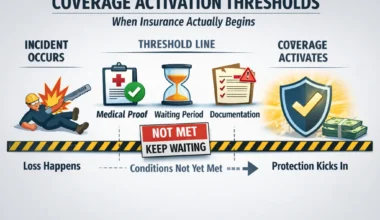
This is the amount of time that must pass after a disability begins before benefit payments start. During this period, no disability income is paid, even if the claim is valid.
Think of it as a time-based deductible, measured in days or months rather than money.
Why waiting periods exist
Waiting periods exist to:
-
Filter out very short-term injuries or illnesses.
-
Encourage the use of savings, sick leave, or employer benefits before resorting to borrowing.
-
Reduce the number of small, temporary claims.
-
Keep long-term coverage available for profound disabilities
For high-risk occupations, waiting periods are a structural feature, not a penalty.
Typical waiting period ranges (high level)
Waiting periods vary widely, ranging from short-term delays to longer ones designed for long-lasting disabilities. This article avoids jurisdiction-specific timelines, but the concept is consistent globally: benefits do not begin immediately after injury.
Short vs long waiting periods – high-risk scenarios
-
Shorter waiting period scenario:
A warehouse worker suffers a hand injury requiring surgery. Recovery is expected to take several months. After the waiting period passes, benefits begin while the worker regains strength and mobility. -
Longer waiting period scenario:
A mining equipment operator develops a chronic spinal condition. Medical treatment and assessment take time. Benefits begin only after the waiting period ends and disability is clearly established.
Common beginner confusion: “Waiting means denial.”
A waiting period does not mean the claim is rejected or disputed. It simply means the benefits are scheduled to start later. Many high-risk workers assume something is wrong when no payment arrives immediately, even though the waiting period has not yet ended.
Benefit Periods Explained for High-Risk Workers
The benefit period determines how long disability payments can continue once they begin.
What a benefit period means
A benefit period is the maximum length of time benefits are payable for a single period of disability, assuming the worker remains eligible under the policy’s terms.
Fixed-term vs long-term benefit periods
-
Fixed-term benefit periods:
Benefits last for a set duration (for example, a defined number of months or years), regardless of whether full recovery occurs. -
Long-term benefit periods:
Benefits continue until a specific endpoint, such as recovery, return to work, or a predefined age limit.
This structure matters significantly for high-risk jobs, where injuries may have lasting physical effects.
Recovery-based vs age-based endpoints (high level)
Some benefit periods end when a worker is medically able to return to suitable work. Others extend until a later life milestone if recovery does not occur.
For physically demanding jobs, recovery is not always straightforward. Being medically “better” does not always mean being job-ready.
Why does benefit duration matter more in physically demanding jobs
High-risk work often requires:
-
Full physical strength
-
Fine motor control
-
Balance and coordination
-
Endurance and alertness
A partial recovery may still leave a worker unable to perform their job safely. Benefit periods that are too short can end before meaningful work capacity returns, which is why understanding this structure is critical.
How Disability Insurance Payments Typically Work
Once a claim is approved and the waiting period has passed, benefit payments follow a predictable structure.
When payments begin
Payments begin after:
-
The waiting period has ended.
-
The disability has been verified in accordance with policy terms.
-
Ongoing eligibility requirements are met.
This timing is often misunderstood, especially after serious workplace injuries.
How often are benefits paid?
Benefits are usually paid on a regular schedule, most commonly monthly. This regularity helps workers plan for essential expenses during recovery.
What can cause payments to stop
Whether benefits continue depends on ongoing medical evidence, functional work capacity, policy definitions, and whether the worker continues to meet the insurer’s contractual disability criteria over time.
Disability payments may stop when:
-
The worker recovers enough to return to work.
-
Medical evidence no longer supports disability status.
-
The benefit period ends.
-
Policy conditions are no longer met.
This does not necessarily mean the worker is fully healthy; it only means the policy’s criteria are no longer satisfied.
Simple example
A maritime worker injures their knee and cannot climb ladders or work on deck. Benefits begin after the waiting period and continue while medical restrictions apply. Payments stop once the worker is cleared for safe duties or when the benefit period ends.
This payment structure is central to understanding how disability insurance works for high-risk workers during extended recovery periods.
Workers’ compensation operates as the primary system for workplace injury claims, providing immediate medical and wage support, as detailed in Workers’ Compensation Insurance for Risk Jobs.
Where Disability Insurance Fails for High-Risk Workers
Disability insurance claims for hazardous occupations frequently fail due to structural policy limitations rather than claim errors.
Common structural failure paths include:
– “Any occupation” definitions being applied, causing workers to be classified as capable of alternative employment
– Partial disability limitations that fail to meet policy thresholds despite meaningful income loss
– Income-verification disputes that reduce or delay benefit calculations
– Occupational exclusions triggered by hazardous duties specifically excluded within the policy
– Benefit-period exhaustion before meaningful physical recovery occurs
– Medical-evidence disputes involving functional work capacity or recovery status
These failure patterns reflect how disability insurance prioritizes contractual definitions over practical work limitations.
Claim Breakpoints in Disability Insurance
Disability insurance breakdowns typically occur at three stages:
Eligibility stage
The injury, illness, or work limitation does not meet the policy’s contractual disability definition.
Assessment stage
Disputes arise regarding severity, functional work capacity, medical evidence, or whether the worker can perform their own occupation versus any occupation.
Payment stage
Benefits are reduced, delayed, terminated, or exhausted under policy conditions.
Understanding these breakpoints explains why many claims do not match worker expectations.
Temporary vs Long-Term Disability (Conceptual Only)
Disability insurance often distinguishes between temporary and long-term disability, but these labels are less critical than recovery reality.
Temporary disability
Temporary disability refers to conditions expected to improve with treatment and time. Many high-risk job injuries fall into this category, such as fractures, ligament injuries, or post-surgical recovery.
Long-term disability
Long-term disability applies when recovery is uncertain, prolonged, or incomplete. This may involve chronic conditions, severe trauma, or progressive illness.
Why are many high-risk claims temporary?
Despite the danger involved, many workplace injuries heal. High-risk workers often experience temporary disabilities that prevent safe work for months, not forever.
Why recovery timelines matter more than labels
A six-month recovery for a physically demanding job can have the same financial impact as a longer-term condition. What matters is how long income is disrupted, not the category name.
How This Works Differently for High-Risk Jobs
Disability insurance mechanics apply to all workers, but high-risk jobs introduce unique realities. Understanding how disability insurance works for high-risk workers requires recognizing that recovery timelines and return-to-work expectations are very different from lower-risk occupations.
Life insurance applies different underwriting rules focused on fatal risk rather than income replacement, which are explained in Life Insurance for High-Risk Workers.
Physical recovery realities
High-risk workers often need full physical capability to return safely. Partial recovery may still be insufficient.
For example:
-
A construction worker with reduced grip strength may be unable to handle tools safely.
-
A transport operator with slowed reaction time may not meet safety standards.
-
An offshore worker with balance issues may not pass safety clearance.
International labor research consistently shows that workers in physically demanding jobs often face longer recovery timelines and fewer return-to-work options after injury, particularly in hazardous occupations.
Slower or uncertain return-to-work assumptions
High-risk work environments leave little room for modified duties. This can extend disability periods even as recovery progresses.
Limited alternative duties
Office-based roles may allow desk work during recovery. Many high-risk jobs do not. Disability insurance structures reflect this limited flexibility.
Why does the policy structure reflect this risk?
Because high-risk jobs involve greater injury severity and longer recovery times, waiting periods, benefit limits, and income-replacement percentages are set accordingly. Understanding this helps workers interpret policy mechanics realistically rather than emotionally.
Underwriting Controls in Disability Insurance for High-Risk Jobs
Disability insurance for hazardous occupations is shaped by underwriting controls designed to manage long-duration claims. These controls become more restrictive as projected recovery uncertainty, occupational exposure severity, and long-term income-loss probability increase.
Key controls include:
- Reduced income replacement percentages for high-risk roles
- Longer waiting periods to filter short-duration claims
- Limited benefit periods for physically demanding occupations
- Occupational exclusions for specific hazardous tasks
- Premium adjustments based on exposure frequency
These controls are not arbitrary; they reflect the higher probability of injury and longer recovery timelines associated with high-risk work.
Common Beginner Mistakes About How Disability Insurance Works
Many misunderstandings come from assumptions rather than policy language.
Expecting immediate payments
Disability insurance is not emergency relief. Waiting periods apply even for serious injuries.
Confusing waiting periods with rejection
No payment during the waiting period does not mean the claim has failed.
Assuming benefits last indefinitely
All disability benefits have defined endpoints, even if recovery is slow.
Believing any injury automatically qualifies for benefits
Not every injury or illness meets disability definitions. Eligibility and definitions are addressed in later articles in this series.
What This Article Does and Does Not Cover
This article does cover:
-
How disability insurance works for high-risk workers
-
Income replacement structure
-
Waiting periods
-
Benefit periods
-
Payment timing and duration
This article does not cover:
– Eligibility rules, which are explained in our guide to who qualifies for disability insurance in high-risk jobs
– Policy definitions and benefit structures, covered in our explanation of how disability insurance for high-risk workers works
– Occupational exclusions and coverage limitations, discussed throughout our disability insurance system articles
– The disability claims process, including how insurers evaluate ongoing work capacity and benefit eligibility
Each of these areas is part of the broader Disability Insurance for High-Risk Workers content cluster.
Frequently Asked Questions
Why does disability insurance only replace part of income?
Disability insurance is designed to provide partial income replacement during periods of work interruption rather than fully duplicate pre-disability earnings. This structure helps manage long-term claim costs and encourages return-to-work recovery when possible.
Why do waiting periods exist in disability insurance?
Waiting periods help filter short-duration claims, reduce administrative costs, and keep long-term disability coverage financially sustainable for higher-risk occupations.
Can disability payments stop before full recovery?
Yes. Payments may end when policy definitions are no longer met, medical evidence changes, benefit periods expire, or the worker is considered capable of returning to suitable work.
Why do high-risk workers face stricter disability insurance rules?
Hazardous occupations involve higher injury frequency, longer recovery timelines, and greater uncertainty around return-to-work capability, leading insurers to apply stricter underwriting controls.
What is the difference between waiting periods and benefit periods?
A waiting period determines when payments begin after disability starts, while a benefit period determines how long payments may continue once benefits are approved.
Conclusion
Understanding how disability insurance works is more important than understanding product names or promises. For high-risk workers, income-replacement percentages, waiting periods, and benefit durations shape real-world outcomes in the event of injury or illness.
Before evaluating coverage or comparing options, it is essential to understand the mechanics, how benefits start, how long they last, and why they are structured the way they are. This foundation makes later discussions about eligibility, definitions, exclusions, and claims clearer and more meaningful.
Final underwriting insight:
For hazardous occupations, disability insurance systems are fundamentally designed to manage uncertainty around long-duration work interruption, recovery reliability, and sustainable return-to-work capability.
Disability insurance for high-risk workers is structured around contractual definitions of work capacity, recovery duration, and income interruption rather than the existence of injury alone.
When you clearly understand how disability insurance works for high-risk workers, it becomes much easier to interpret benefit limits, waiting periods, and future eligibility rules without confusion.
Readers seeking broader foundational context should also review our beginner’s guide to what disability insurance for high-risk workers is and how it fits within the larger occupational insurance system.