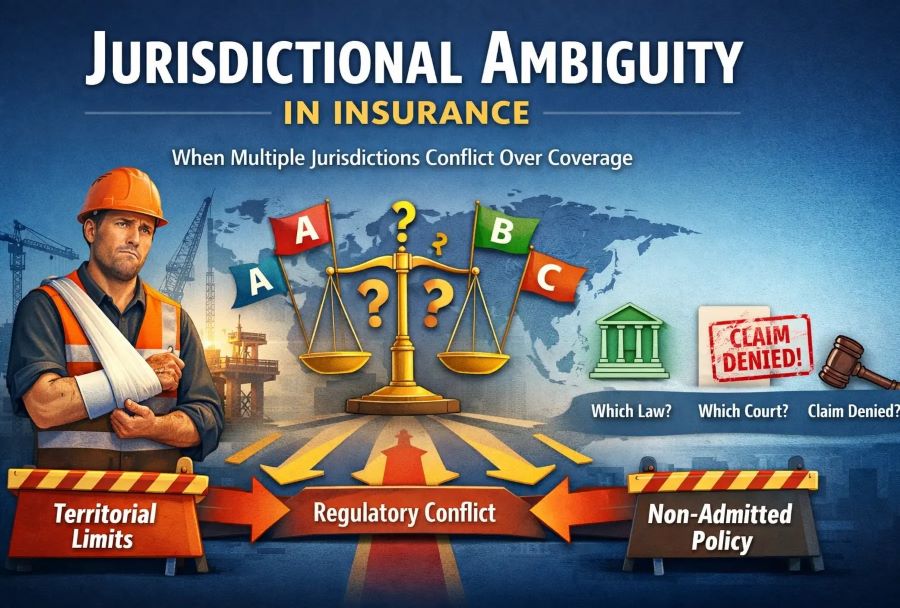
Jurisdictional ambiguity in insurance refers to uncertainty over which legal authority, state, country, or regulatory framework governs an insurance policy, claim, or worker, especially when a high-risk job spans multiple locations or legal systems.
In risk job insurance, this ambiguity arises when the place of work, employer registration, worker residency, and insurer licensing do not align. As a result, insurers may dispute which laws apply, which regulator has authority, or whether coverage is enforceable at all.
Why jurisdictional ambiguity matters for high-risk workers
For dangerous or mobile jobs, jurisdiction determines:
-
Whether a policy is valid
-
Which safety, compensation, and labor laws apply
-
Which court or regulator hears disputes
-
Whether a claim can be denied on technical grounds
When jurisdiction is unclear, insurers often classify the claim as non-admitted, out of scope, or outside policy territory.
Common situations that create jurisdictional ambiguity
-
Offshore, maritime, or oil & gas work crossing national waters
-
Cross-border construction or infrastructure projects
-
Remote or rotational work (fly-in/fly-out jobs)
-
Contractors hired in one country but deployed in another
-
Workers paid through foreign payroll or shell entities
Insurance consequences
Jurisdictional ambiguity can lead to:
-
Claim delays or outright denials
-
Conflicts between workers’ compensation, employer liability, and personal insurance
-
Gaps between local mandatory coverage and private insurance policies
-
Legal disputes over governing law and venue
Example
A construction worker is hired by a company registered in Country A, paid through an agency in Country B, and injured on a project site in Country C. The insurer may argue that no single jurisdiction clearly governs the policy, allowing the claim to be challenged or denied.
Key takeaway
For high-risk jobs, jurisdiction is not a technical detail; it is a coverage trigger. Any mismatch between where you work, who employs you, and where the policy is issued increases the risk that insurance fails when it’s needed most.
Related Defintions
-
Territorial Limits (Insurance)
Defines the geographic boundaries where an insurance policy applies. -
Governing Law Clause
Specifies which jurisdiction’s laws interpret and enforce the policy. -
Admitted vs Non-Admitted Insurance
Distinguishes whether the insurer is licensed in the jurisdiction where the risk exists. -
Eligibility Gating
Policy rules that restrict coverage based on work location, residency, or legal jurisdiction. -
Coverage Enforceability Risk
The risk that a policy cannot be legally enforced due to jurisdictional or regulatory conflicts.