Executive Summary
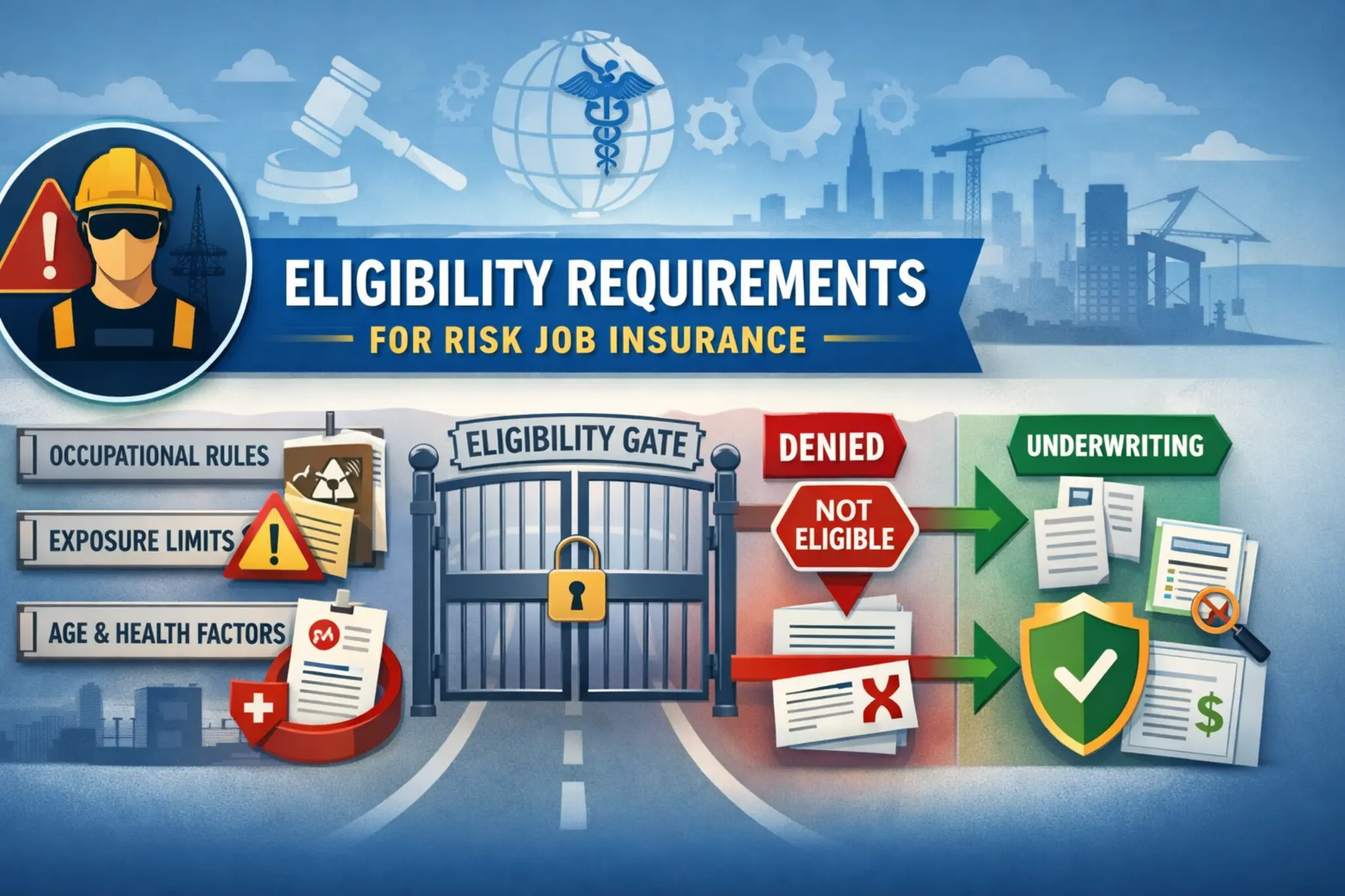
High-Risk Job Insurance Eligibility determines whether hazardous occupations can enter the insurance evaluation system at all. According to the International Labour Organization, hazardous occupations are associated with significantly higher injury severity and fatality risk, requiring stricter risk controls within insurance systems. In practice, these eligibility constraints result in lower acceptance rates and stricter entry thresholds for high-risk workers compared to standard occupational insurance markets.
In 2026, three converging regulatory and legislative forces are reshaping what eligibility means in practice: the expiration of OSHA’s National Emphasis Program for heat illness, accelerating momentum behind mandatory workplace violence prevention standards in healthcare, and a documented NCCI-confirmed expansion of presumptive workers’ compensation claims for first responders and clinical workers. Together, these forces have raised the bar for every employer in a high-risk occupational class, making eligibility the most critical stage in the insurance process, determining not only access to coverage but whether a risk is insurable at all under 2026 underwriting standards.
This article explains eligibility requirements across four dimensions: the introduction of resilience metrics over job title classification, the EMR threshold underwriters are applying in 2026, the documentation brokers must include for a clean submission, and the worker-level compliance gaps that void coverage. These elements are part of the broader underwriting system explained in How Insurance Underwriting Works for High-Risk Jobs, where insurers evaluate classification, loss behavior, and operational risk control together. Understanding High-Risk Job Insurance Eligibility is critical for workers, brokers, and underwriters navigating the 2026 insurance environment.
Key Takeaway (2026)
High-Risk Job Insurance Eligibility is determined by measurable risk control systems, not job titles, making compliance, documentation, and loss performance the primary factors in insurability.
EVIDENCE SNAPSHOT | 2026 Risk Environment
- International Labour Organization (ILO): High-risk occupations show elevated fatality and injury severity rates, requiring stricter risk controls within insurance systems and resulting in lower acceptance rates compared to standard occupational markets.
- OSHA (Heat Injury and Illness Prevention Rule): National Emphasis Program for heat expired April 8, 2026. Proposed rule establishes 80°F initial trigger and 90°F high-heat protocol as the operative thresholds for employer compliance obligations.
- R. 2531 — Workplace Violence Prevention for Health Care and Social Service Workers Act: Re-introduced April 1, 2025; under review by the House Committee on Education and the Workforce. Gaining momentum in 2026 due to rising assault rates in clinical settings. Mandates written prevention plans, incident logs, and anti-retaliation protections.
- NCCI 2026 Emerging Issues Report: Presumption legislation identified as one of the most frequently filed workers’ comp bill categories in 2025–2026. States expanding PTSD rebuttable presumptions to dispatchers and healthcare workers; firefighter cancer presumptive lists growing to include thyroid, skin, and bladder cancers. Years-of-service thresholds under debate for reduction from 10 to 5 years.
These three regulatory and legislative forces collectively explain the tightening of eligibility thresholds and underwriting requirements documented throughout this article.
I. Introduction: From Job Title to Resilience Metrics
There was a time — not long ago — when underwriting a high-risk occupation began and ended with the job title. A roofer was a roofer. A firefighter was a firefighter. The occupational class code determined the rate, the loss run confirmed the pattern, and the policy was bound. That era is over.
In 2026, the eligibility criteria for high-risk job insurance have undergone a structural transformation driven by three converging pressures: a federal regulatory environment in flux following the expiration of OSHA’s National Emphasis Program for heat illness on April 8, 2026; accelerating legislative activity around workplace violence prevention in healthcare and social service settings; and a documented, NCCI-confirmed expansion of presumptive workers’ compensation claims that fundamentally alters long-tail loss projections for first responders and clinical workers. Each of these forces is individually significant. Together, they have produced a new eligibility calculus, one that is less about what a worker does and more about how their employer manages the conditions under which they do it.
The shift is from static occupational classification to dynamic resilience metrics: quantifiable, verifiable evidence that an employer has built systems capable of preventing, detecting, and responding to the specific hazards that characterize their workforce’s risk exposure. An excavation contractor without a written heat illness prevention plan calibrated to OSHA’s 80°F and 90°F trigger thresholds is no longer merely non-compliant with pending regulation; they are presenting an underwriting profile that signals elevated frequency and severity in the years ahead. The job title hasn’t changed. The eligibility standard has. This shift reflects a broader transition in underwriting logic outlined in Insurer Risk Appetite Explained (Decision Logic Breakdown), where insurers prioritize predictability of loss over occupational labels.
2026 Principle: Eligibility is no longer determined by what your workers do. It is determined by whether your organization can prove it is managing the conditions under which they do it.
Real-world scenario — construction worker:
James, a scaffold erector in Houston, Texas, collapsed from heat exhaustion on a jobsite in July 2025. His employer had no written heat illness prevention plan and supervisors had received no training on symptom recognition. When James filed a workers’ compensation claim, the insurer launched an investigation. The absence of a plan meant the employer could not demonstrate the standard of care required under OSHA’s General Duty Clause. The claim was paid, but the employer’s EMR spiked, renewal was declined by their standard carrier, and they were forced into the excess and surplus lines market at nearly double the previous premium. James had coverage. His employer lost insurability.
II. The Underwriter’s Lens: EMR and the 1.2 Threshold
The Experience Modification Rate (EMR) is the single most consequential number in a high-risk employer’s insurance profile. It is a mathematical expression of an employer’s actual loss history relative to what would be statistically expected for a business of that type, size, and payroll in their state. A score of 1.0 represents the industry average. A score below 1.0 indicates better-than-average loss performance; a score above 1.0 signals the inverse. The EMR is not a billing tool. It is a behavioral signal, and underwriters treat it as such.
This eligibility framework aligns with the system described in How Insurance Underwriting Works for High-Risk Jobs, where EMR functions as a primary signal of risk quality and pricing viability. At its core, High-Risk Job Insurance Eligibility is driven by measurable loss performance, most notably the Experience Modification Rate (EMR).
How the EMR Is Calculated
The EMR is produced by the applicable rating bureau, the National Council on Compensation Insurance (NCCI) in most states, using a formula that compares an employer’s actual losses over a three-year experience period (excluding the most recent policy year) against their expected losses. The formula applies a split between primary losses, the first portion of each claim, which reflects frequency, and excess losses, which reflect severity. Primary losses carry greater weight, meaning that an employer with many small claims will be penalized more than one with a single large catastrophic event of equivalent total cost. This weighting is intentional: frequency is predictive; severity, to some degree, is not. The practical consequence is straightforward; a pattern of frequent small claims deteriorates an employer’s EMR faster than an isolated large loss of equivalent total cost.
1.2 EMR — the 2026 standard eligibility cut-off for high-risk occupational classes
Why 1.2 Is the 2026 Number
In 2026, the standard eligibility threshold across the majority of specialty carriers and admitted market programs for high-risk occupational classes has effectively hardened at an EMR of 1.2. An employer presenting above this level faces a materially constrained market: standard carriers will either decline to quote, apply significant debits, or require risk improvement conditions as a prerequisite for coverage. The threshold is not arbitrary. It reflects the actuarial reality that employers with EMRs above 1.2 generate loss ratios that are, on average, unsustainable at standard rates.
The hardening of this threshold in 2026 is directly tied to the expanding scope of compensable claims in high-risk occupational classes. As presumptive PTSD coverage extends to dispatchers and healthcare workers, and as cancer presumption lists grow for firefighters, the expected loss baseline for these occupational classes is rising. When expected losses increase, the EMR formula recalibrates. An employer whose historical performance would have generated a 1.15 EMR under 2023 assumptions may find themselves at 1.22 under 2026 loss development factors that incorporate presumptive claim trends. An employer does not have to perform worse to see their EMR worsen. The benchmark itself is moving.
Underwriting Note: Request the insured’s NCCI Experience Rating Worksheet, not just the modifier. Verify whether the three-year experience period predates recent state-level presumption law enactments that may not yet be reflected in their loss run but will affect future development.
Eligibility Shift Model (2026):
How underwriting standards have tightened from documentation-based evaluation to system-based risk verification.
These eligibility changes reflect a broader shift in Risk Assessment Tools Used by Insurers, where underwriting increasingly relies on measurable safety systems and operational data rather than static classification.
| Factor | Pre-2026 Standard Eligibility | 2026 High-Risk Eligibility |
|---|---|---|
| Safety Training | General programs, loosely documented | Role-specific training with verifiable records |
| EMR Threshold | Carrier-variable / less rigid | Hard threshold at or below 1.2 |
| Compliance Documentation | ACORD application + loss run | Full plan documentation required |
| Drug Testing | Policy existence sufficient | Consistent, documented, DOT-compliant |
| Certification Tracking | Administrative function | Risk control function — gaps void coverage |
III. The Broker’s Submission: Building a ‘Clean’ File
For brokers working in the high-risk occupational space, 2026 has introduced a new standard for what constitutes a complete and competitive submission. Carriers are no longer willing to assess risk from a loss run and a completed ACORD application alone. The submission must now demonstrate proactive compliance infrastructure across the two regulatory domains generating the most claim activity: heat illness prevention and workplace violence prevention.
Heat Stress Documentation Requirements
With OSHA’s National Emphasis Program for heat expired and the permanent federal rule still under final review, carriers are requiring submissions to demonstrate compliance with the applicable standard of care, whether that is a state-specific heat illness standard (California’s Title 8 §3395, Washington’s WAC 296-62-095, Oregon’s OAR 437-002-0156) or an OSHA General Duty Clause-compliant program for employers in non-state-plan states. A clean submission in a heat-exposed industry must include:
- A written Heat Illness Prevention Plan that explicitly references the 80°F initial trigger and 90°F high-heat protocol thresholds.
- Documented acclimatization procedures for new and returning workers during the first 14 days of heat exposure.
- Supervisor training records demonstrating competency in early symptom identification and emergency response.
- In many cases, these controls are supported by Occupational Health Reports in Underwriting Decisions, which provide insight into workforce exposure, fatigue, and environmental risk factors.
- Site-specific shade, water, and rest provisions mapped to the employer’s actual work locations and schedules.
Submissions lacking this documentation for agricultural, construction, landscaping, or warehousing risks should be treated as incomplete. Carriers underwriting these classes in 2026 are applying the 80°F/90°F thresholds as a de facto standard of care regardless of current federal legislative status.
State spotlight: If you work in California, Washington, or Oregon, your state has its own heat illness standard that is stricter than the federal baseline. Workers in these states have stronger legal grounds for a heat-related claim. Workers in all other states are covered by OSHA’s General Duty Clause, a less prescriptive standard that makes your employer’s written prevention plan even more critical to protecting your claim.
Workplace Violence Prevention Documentation
For healthcare and social service employers, the requirements imposed by H.R. 2531, even in its current pre-enactment posture, have become the de facto submission standard among specialty carriers. The legislative trajectory is clear, and underwriters are pricing for the regulatory environment they see coming, not the one that technically exists today. A clean healthcare submission must demonstrate:
- A written Workplace Violence Prevention Plan built on a site-specific risk assessment that accounts for the facility’s patient population, physical layout, and staffing patterns.
- A functioning Violence Prevention Committee with documented meeting cadence and corrective action tracking.
- An active incident log that captures all acts of violence, including verbal threats, consistent with the bill’s definitional scope.
- Security training records showing frequency, content, and individual completion, not just program existence.
- A written anti-retaliation policy with a documented reporting pathway for affected employees.
Broker Directive: A healthcare submission without a violence prevention committee and an active incident log is not a competitive submission in 2026; it is a declination waiting to happen. Build the file before you build the quote.
Real-world scenario — healthcare aide:
Maria, a home health aide in Texas, was physically assaulted by a patient in 2025. Her employer, a mid-sized home care agency, had no written workplace violence prevention plan, no incident log, and no violence prevention committee. When Maria filed her workers’ compensation claim, the insurer flagged the absence of any documented safety infrastructure. The claim itself was compensable. But at renewal, the agency was cited as high-hazard with no mitigation evidence. Their workers’ comp premium increased 34%, and two specialty carriers declined to quote. Maria’s recovery took 14 months. Her employer’s coverage situation took longer.
IV. The Worker’s Reality: Drug Testing and Certification Gaps
Eligibility determinations in high-risk insurance are made at the employer level, but they are implemented at the worker level; and it is at the individual worker level that two of the most consequential eligibility voids occur: failed or absent post-accident drug testing protocols, and certification gaps in safety-critical occupational roles. Both issues are well understood in theory and systematically underestimated in practice. Where individual risk uncertainty exists, insurers may escalate evaluation requirements as outlined in Medical Exams for High-Risk Insurance: When and Why, particularly for roles with high severity exposure.
Post-Accident Drug Testing as an Eligibility Variable
Post-accident drug testing serves two functions in the workers’ compensation system: it establishes the factual record surrounding a workplace accident, and it provides the legal foundation for the employer to assert an intoxication defense or, in applicable states, to reduce or deny a claim where intoxication is established as the proximate cause of injury. The failure to conduct a timely, properly documented post-accident drug test does not merely leave the employer without a defense. This reflects a core tradeoff explained in Non-Medical Insurance for High-Risk Jobs: Tradeoffs Explained, where reduced upfront verification increases the likelihood of claim disputes. In many states, it voids the defense entirely, regardless of whether the employee was actually impaired.
In 2026, the relevant standard is not whether an employer has a post-accident drug testing policy; the overwhelming majority of high-risk employers do. The standard is whether the policy is implemented consistently, documented comprehensively, and administered through a certified collector using a properly maintained chain of custody. Sporadic compliance, inconsistent testing thresholds, or the use of non-DOT-compliant collection sites are the operational failures that void eligibility. A pattern of untested accidents, particularly those resulting in lost-time claims, is a significant adverse indicator for any underwriter reviewing a submission.
Claim breakpoint:
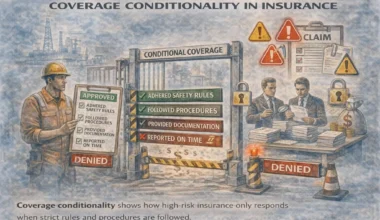
A claim transitions from compensable to contested when post-accident drug testing is not performed or properly documented, or when worker certification status invalidates coverage conditions at the time of injury.
Certification Gaps and Coverage Voids
The second worker-level eligibility risk is certification status. High-risk occupations require workers to maintain active, current credentials as a condition of lawful employment: OSHA 10/30 certifications, NFPA 1582 medical fitness standards for firefighters, state-specific EMT licensure, crane operator certifications, confined space entry training, and dozens of occupational credential categories renewed on defined cycles. The operational reality is that certification gaps are common, driven by scheduling pressure, administrative oversight, and the failure to track renewal deadlines across a large workforce.
For underwriters, the certification gap is not merely a compliance concern. It is a coverage concern. Workers’ compensation policies in high-risk occupational classes frequently include exclusions or coverage conditions tied to the lawful employment status of the injured worker at the time of the accident. A crane operator injured while working with an expired certification is not just an OSHA violation; they may be operating outside the scope of the policy’s covered operations, depending on policy language and state law.
The worker’s reality in 2026 is that individual compliance status has become an eligibility factor at the policy level. Employers who treat certification tracking as an administrative function rather than a risk management imperative are accumulating the conditions for coverage disputes that will surface only at the worst possible moment: in the aftermath of a serious accident.
Worker’s eligibility checklist: before your next shift
- My certifications and safety credentials are current and on file with my employer.
- My employer has a posted, written heat illness prevention plan if I work in a heat-exposed environment.
- I know how to report a violent incident at work without fear of retaliation.
- My employer conducts post-accident drug testing through a certified, DOT-compliant process.
- I understand which state I work in and whether it has specific workers’ compensation presumption laws that protect me.
If any of these boxes cannot be checked, your coverage may be at risk before an incident occurs. Take action now, not after.
Final Underwriting Principle:
Post-accident testing gaps and certification lapses are not administrative failures. They are coverage events, the conditions that transform a compensable claim into a contested one, and an insurable risk into an uninsurable one.
Final underwriting insight:
Eligibility in 2026 functions as a predictive risk filter, determining whether a loss profile is acceptable before underwriting pricing and coverage terms are even considered.
Conclusion: The Baseline Has Changed
The regulatory and legislative environment of 2026 has not invented these risks. It has formalized them, presumed them, and built an expanding legal framework around them. Underwriters, brokers, and employers who understand this shift will navigate it. Organizations that continue to rely solely on occupational classification without demonstrating operational risk control systems may experience reduced eligibility and limited access to standard insurance markets.
Ultimately, High-Risk Job Insurance Eligibility is determined by an employer’s ability to demonstrate control over risk, not just the nature of the work performed.
FAQ: What Makes a Company or Worker Uninsurable in 2026?
What makes a company uninsurable for high-risk job insurance?
A company becomes uninsurable when it cannot demonstrate control over key risk drivers, typically an EMR above 1.2, missing safety systems (heat or violence prevention), and incomplete or inconsistent compliance documentation.
Can workers be excluded from coverage even if employed?
Yes. Workers may fall outside coverage if certifications are expired, safety requirements are not met, or job duties at the time of injury fall outside policy-defined operations.
Does failure to conduct drug testing affect insurability?
Yes. Failure to perform and document post-accident drug testing removes legal defenses and increases claim liability, making the risk unattractive or uninsurable to carriers.
Why are more high-risk employers becoming uninsurable in 2026?
Because expanding presumptive claims, stricter regulatory expectations, and rising loss projections are forcing insurers to tighten eligibility and exclude poorly managed risks.
Compliance & Legal Disclaimer
General Information Only
This article is provided for educational and informational purposes only. It is intended for workers, licensed insurance professionals, underwriters, and risk managers. It does not constitute legal, financial, actuarial, or underwriting advice. Use of this material does not create any attorney-client, broker-client, or advisory relationship. Insurance laws, underwriting standards, and carrier risk appetites vary by jurisdiction and insurer, and must be evaluated on a case-by-case basis.
References to the Asuncion Valdivia Heat Illness Act, H.R. 2531, and OSHA-related standards reflect regulatory conditions as of May 2026. Legislative and rulemaking environments are subject to rapid change. Readers should verify current requirements using official sources such as Congress.gov and OSHA.gov. References to EMR calculations and NCCI benchmarks are based on national standards. State-specific rating bureaus (e.g., WCIRB in California) may apply different methodologies. The author and publisher disclaim all liability for any loss, damage, or adverse outcome resulting from reliance on this material.
Author: RJI Editorial Team