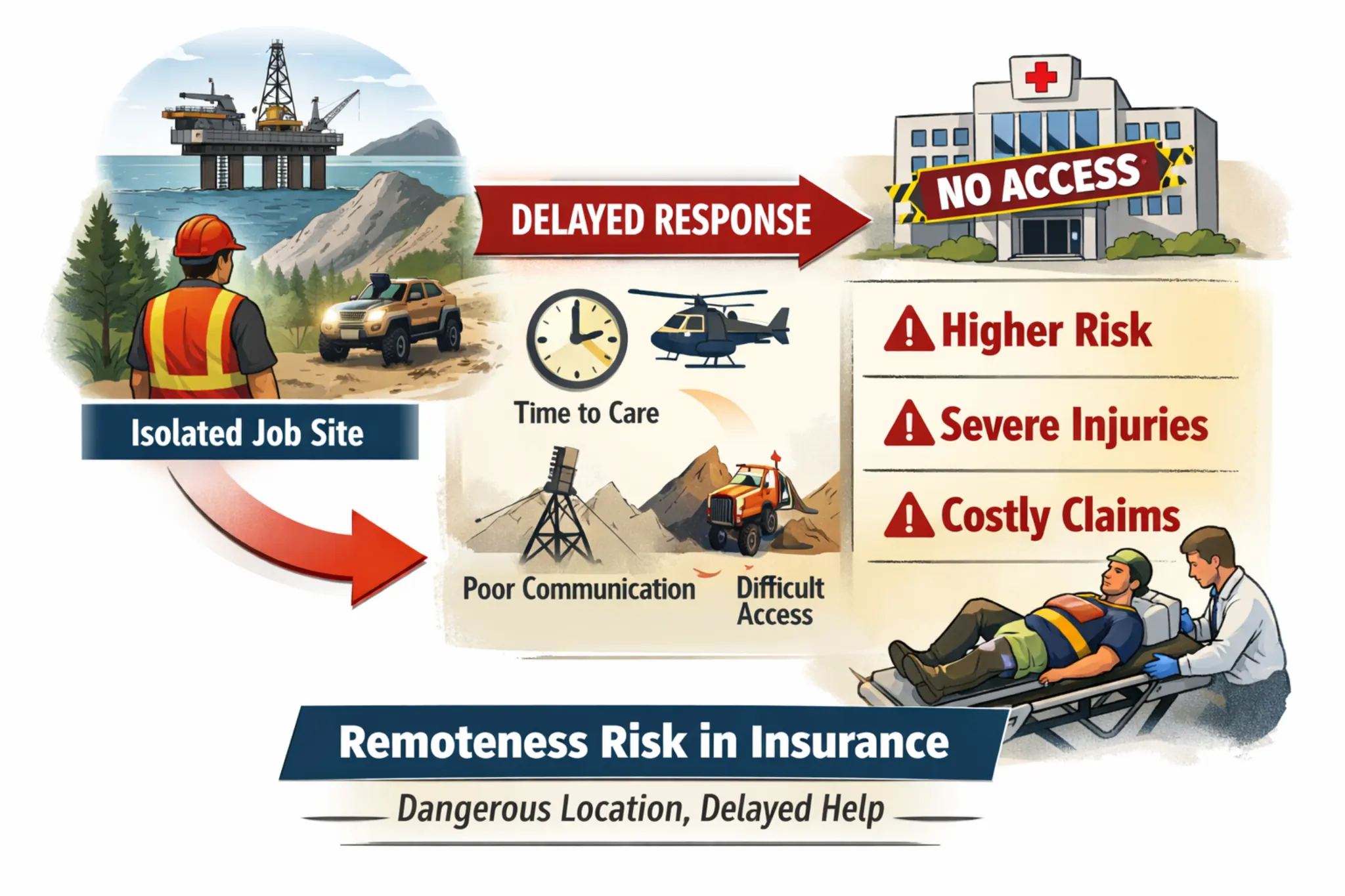
Remoteness risk refers to the increased insurance exposure created when a worker performs duties in locations that are geographically isolated, difficult to access, or far from immediate medical, emergency, or rescue services.
In risk job insurance underwriting, remoteness risk is treated as a multiplier, not a standalone hazard. Even routine tasks become higher-risk when distance, terrain, weather, or infrastructure delays emergency response, evacuation, or claims verification.
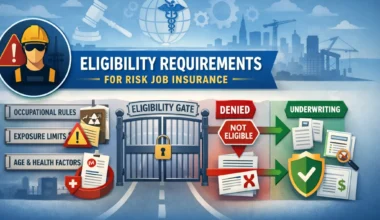
In underwriting, remoteness risk plays a direct role in determining eligibility for risk job insurance, because delayed access to emergency care significantly increases claim severity.
How insurers define remoteness risk
Insurers typically assess remoteness risk using four core factors:
-
Distance to emergency care
How long it would realistically take to reach a hospital, trauma center, or evacuation point after an incident. -
Access limitations
Whether the job site requires helicopters, boats, off-road transport, or specialized permits to reach. -
Communication reliability
The availability (or lack) of stable cellular, radio, or satellite communication. -
Environmental isolation
Offshore waters, deserts, forests, mountains, conflict zones, or undeveloped regions with limited infrastructure.
Insurers classify offshore platforms, deserts, jungles, and undeveloped regions as high-risk job locations due to limited infrastructure and delayed emergency response.
Why remoteness risk matters in insurance approval
Remoteness risk directly affects:
-
Eligibility – Some policies exclude coverage entirely for remote locations.
-
Premium pricing – Higher remoteness usually means higher premiums.
-
Policy conditions – Mandatory evacuation plans, safety protocols, or medical access requirements.
-
Claims outcomes – Delayed reporting or treatment can invalidate otherwise legitimate claims.
From an underwriting perspective, the risk is not just injury; it’s delayed response, higher fatality probability, and increased claim severity.
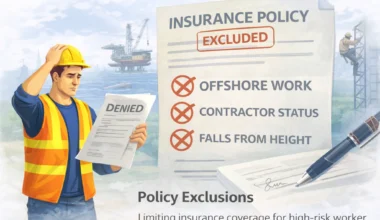
Even when an injury is legitimate and work-related, remoteness risk can still result in insurance claim denial if response delays breach policy conditions.
Common jobs affected by remoteness risk
-
Offshore oil & gas workers
-
Commercial divers
-
Remote construction crews
-
Mining and exploration workers
-
Maritime and shipping personnel
-
Humanitarian, security, or conflict-zone contractors
Remoteness risk is especially pronounced in offshore work insurance, where evacuation depends on vessel proximity, weather windows, and helicopter availability.
Coverage failure paths to watch for
Remoteness risk commonly breaks coverage when:
-
The worker operates outside the declared job location
-
Emergency response plans are absent or undocumented
-
The policy requires proximity to medical facilities that does not exist
-
Delayed treatment is classified as “non-compliant reporting.
Coverage commonly fails when required evacuation and medical access standards are missing, undocumented, or impossible to meet in remote job locations.
summary
Remoteness risk means the job is dangerous not only because of what you do, but because of where you are when something goes wrong.
Related Definitions
1. Access Risk
Risk created when job sites are difficult to reach or exit due to terrain, infrastructure limits, or transport restrictions.
2. Time-to-Care Risk
Insurance risk caused by delays between an injury occurring and the worker receiving professional medical treatment.
3. Medical Evacuation Risk
Exposure arising from reliance on helicopters, boats, or long-distance transport to evacuate injured workers from remote locations.
4. Declared Work Location
The specific job location disclosed during insurance application and underwriting, used to assess eligibility and pricing.
5. Emergency Response Latency
The time lag between an incident and the arrival of rescue, medical, or emergency services at the job site.