Introduction: The Point Where Insurance Stops Responding
When insurance coverage ends for high-risk workers, the financial impact often begins long before an injury, illness, or claim process feels complete. Coverage may still appear active on paper, premiums may have been paid, and policies may still exist, yet protection has already started to narrow in critical ways.
By the time workers reach this stage, appeals have often already failed.
For many workers in dangerous jobs, this moment is not marked by a clear ending. Instead, it arrives quietly through limits, exclusions, definitions, and timelines that stop responding even while risk remains.
This guide explains when insurance coverage truly ends for high-risk workers, why protection stops even when policies still exist, and what realistically comes after those boundaries are reached.
This article builds on our main guide explaining how exclusions and structural boundaries work in risk job insurance, the point where protection begins narrowing long before coverage officially ends.

What “Coverage Ending” Actually Means
Insurance coverage does not usually end abruptly.
It ends structurally.
Coverage ends when:
-
Policy limits are reached
-
Exclusions apply to remaining risk
-
Definitions no longer support benefit payment
-
Employment-linked coverage terminates
-
Appeals and disputes confirm enforcement
This does not mean insurance failed. It means insurance fulfilled the role it was designed to play.
Understanding this distinction is essential, because many workers mistake enforcement for abandonment.
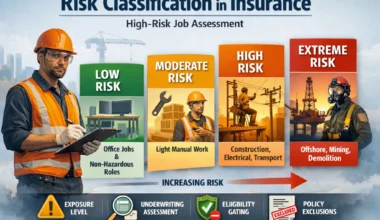
This structural ending reflects how the risk job insurance system is designed, as outlined in our overview of the risk job insurance system.
The Three Common Ways Coverage Ends in High-Risk Work
1. Limits Are Reached
Many high-risk policies include:
-
Maximum payout caps
-
Time-based benefit limits
-
Aggregate limits
Once these are exhausted, coverage stops even if recovery or income loss continues.
This is one of the most common endings and often feels like underpayment rather than termination.
These hard stopping points are explained in detail in why insurance policies for high-risk jobs often have lower limits.
2. Definitions No Longer Apply
Coverage can also end when a worker no longer meets policy definitions.
Examples include:
-
Being capable of “any work” rather than the original job
-
Medical stability reached, even without full recovery
-
Functional ability improving just enough to exit eligibility
At this point, insurance does not deny the injury. It denies continued benefit eligibility.
These definition thresholds are set much earlier during underwriting, which is explained in how insurers underwrite high-risk jobs.
3. Employment-Based Coverage Ends
Employer insurance often ends when:
-
Employment ends
-
Contracts expire
-
A worker cannot return to their role
For high-risk workers, this often happens because of the injury itself, creating a sudden loss of protection at the worst moment.
This is why employer-based protection often stops at the same moment financial pressure increases, as explained in why employer insurance often isn’t enough for high-risk workers.
Why Insurance Cannot Extend Beyond These Points
Global injury and recovery data published by the International Labour Organization shows that hazardous jobs involve longer recovery periods and higher lifetime cost, which is why insurance systems enforce firm stopping points.
Insurance is not designed to absorb unlimited risk.
High-risk work concentrates:
-
Higher injury frequency
-
Greater severity
-
Longer recovery periods
-
Higher lifetime cost
To remain viable, insurance systems must:
-
Define stopping points
-
Enforce boundaries consistently
-
Limit long-term exposure
Within traditional insurance, there is usually no mechanism to extend coverage beyond these boundaries.
This is not indifference. It is structural necessity.
These stopping points exist because dangerous work concentrates risk.
Why Escalation No Longer Works at This Stage
By the time coverage truly ends:
-
Claims have been reviewed
-
Appeals have confirmed enforcement
-
Disputes have verified compliance
At this point, escalation does not change outcomes because:
-
No procedural errors remain
-
No contractual ambiguity exists
-
No authority can expand coverage beyond terms
This is why workers often feel exhausted after escalation. The system has already reached its edge.
At this stage, escalation only confirms boundaries.
What Insurance Does Not Do After Coverage Ends
When coverage ends, insurance does not:
-
Continue partial payments
-
Reassess fairness
-
Absorb future risk
-
Convert into another benefit
Insurance does not evolve after enforcement. It stops.
This clarity is painful, but it is also important.
This reality explains why many high-risk workers rely on layered protection, as discussed in why high-risk workers often need more than one insurance policy.
What Actually Comes After Insurance Ends
When insurance coverage ends, workers are no longer dealing with insurance systems. They are dealing with life risk.
What comes next often involves:
-
Employment decisions
-
Career changes
-
Work capacity reassessment
-
Long-term financial planning
-
Personal responsibility for uncovered risk
This is the point where job-specific realities matter more than policy language.
Why This Is the Transition Point to Job-Specific Guidance
Up to this point, risk job insurance explains systems:
-
Eligibility
-
Underwriting
-
Claims
-
Appeals
-
Disputes
-
Limits
Beyond this point, outcomes depend on:
-
The job itself
-
Physical demands
-
Transferable skills
-
Industry norms
-
Recovery realities
This is why job-specific insurance guidance comes after system-level education.
Without understanding where insurance ends, job-specific advice becomes misleading or false.
Conclusion: When Insurance Ends, Structure Becomes Reality
Insurance for high-risk workers does not fail suddenly. It ends where structure requires it to end.
When coverage stops responding:
-
It is not a judgment
-
It is not abandonment
-
It is not personal
It is confirmation that the system has reached its designed boundary.
Understanding this endpoint is not discouraging. It is clarifying.
From here forward, decisions are no longer about insurance systems. They are about how risk is lived, managed, and navigated within specific high-risk jobs.